I agree with Joy Pullman: “I shouldn’t have to give a flying fig about whom Donald Trump picks for this position.”
But we care, and the figs are flying, because there’s so much power unconstitutionally wielded by the executive branch over local education.
Although Trump did say in a campaign interview that he wanted to eliminate the Department of Education, it does not look as though that’s going to happen, sadly. The next best thing is to name a local-control oriented, constitution-loving Education Secretary.
A similar public letter from Parents Against Common Core asked Trump to consider, along with Dr. Bill Evers, Dr. Larry Arnn, Dr. Sandra Stotsky, Dr. Peg Luksik, or Dr. William Jeynes.
Frighteningly though, this week Trump interviewed Michelle Rhee, one of the top ten scariest education reformers in the nation, for the job; the scandal-pocked former Commissioner of Education in D.C. and author of a creepy ed reform book, “Radical” is no friend to children, to opt-out liberty, or to the free market. Of “letting them choose wherever they want to go,” she said, “I don’t believe in that model at all.” So, Goodbye freedom, under Rhee.
There should be no chance that she’s chosen. (Even though she’s suddenly, cutely, dressing in red, white and blue to meet the president elect, do not be fooled!)
I hope Trump’s receiving a storm of anti-Rhee letters this week from parents and educators at his public input website. He’s probably going to make his announcement this week. Please, please speak up.
Here are 6 reasons that a vote for Trump will help preserve freedoms for our children– including freedom from Common Core– contrasted with 6 reasons that a vote for Hillary (or a third party who can’t beat her) will dramatically reduce the future freedoms of our children.
Reason #1:Religious Liberty and Freedom of Conscience
Hillary’s aiming to remove religious liberty and freedom of conscience from schools and from society. She has called for this:
“All the laws we’ve passed don’t count for much if they’re not enforced… laws have to be backed up with resources and political will. And deep-seated cultural codes, religious beliefs and structural biases have to be changed.” (see video minute 8-9)
“‘I would like them to pray for guidance and to pray for our country because we need prayer now almost more than we’ve ever needed it before.”
How might presidential stands for or against religious liberty trickle down into school curricula, and into laws concerning churches and homes?
Reason # 2: Trump’s opposed to Common Core.
His campaign video about education explains that America must “end Common Core,” which he calls “a disaster” because “education has to be local“. At rallies like this one in Wilmington, North Carolina, he’s said: “We’ve got to get rid of Common Core.”
On a Fox News interview, when asked if he would cut departments, Trump said, “I may cut the Department of Education“.
In the March presidential debate, Trump said, “Education through Washington, D.C., I don’t want that. I want local education. I want the parents and I want all of the teachers, and I want everybody to get together around a school and to make education great.” This contrasts greatly with Hillary, who mocked local control.
She called Common Core nothing more than a “political failure.” She said, “…this was a political failure because they negotiated something and they had no real agreed-upon program for explaining it and selling it to people so that they left an opening for those who were always in the education debate, who don’t think anybody should be told anything about what to study, even if it’s the multiplication tables. You know, that that should all be left to local control. And then you get into more complicated areas, as we all know, that that’s just totally off limits.”
Reason # 3:Trump’s got Evers.
Trump’s opposition to the Common Core machine aren’t just words. Check out who Trump chose for an education advisor: Williamson “Bill” Evers.
I had the honor of helping to transport Evers to a Stop Common Core speaking engagement in Salt Lake City a few years ago. I remember the leather satchel he carried, which overflowed with books– all titles about federalism and states’ rights.
Reason #4: Trump’s free from the NEA and AFT (abortion-promoting) national teachers unions, which fully endorse Hillary.
Both the National Education Association (NEA) and the American Federation of Teachers (AFT) back Hillary Clinton, and both financially uphold Planned Parenthood and other controversial groups and initiatives.
Even so, when Hillary presented her keynote speech at the recent National Education Association (NEA) conference, she was booed –why?
She spoke of cooperation between public charter schools and public schools. She’s not talking about sporting events or dances, folks. She wants all schools to be controlled by her public-private partner-shipping elite agenda.
Democratic-leaning NEA takes an anti-charter stand, but Hillary is aiming to play both sides with her private-public school initiatives. She knows that the Common Core machine is comprised of two machines, both of whom she needs: the corporate machine, comprised of Pearson, Microsoft/Gates, etc. (these make money starting charters and selling ed tech aligned to common standards) and the government machine (this gains control by using common data mining systems and common tests and teacher evaluations). This is what Hillary is speaking of when she speaks of her educational technology agenda, built on public-private partnerships).
Trump doesn’t need Gates’, Pearson’s, the NEA’s, or the AFT’s funds, and he’s not bound to their political standards. Hillary, though, is bound; Bill Gates, her Foundation’s top $25 Million+ donor, remember, is also the leading promoter of Common Core Education and Data Mining. He was almost her vice presidential pick. Hillary’s not about to get rid of Gates’ precious baby, the Common Core.
Reason #5: Trump’s not about Hillary’s 1998 Marc Tucker successful conspiracy against local control.
The infamous Tucker-Hillary letter, a detailed plot outlining how Hillary and Tucker planned to turn America into a socialistic machine using national school standards and “large scale data management systems” (school-work data) is part of the Congressional Record from 1998. You can read the PDF files of each page of Marc Tucker’s “Dear Hillary” letter in the 1998 Congressional Record through these links:1234567.
Hillary and Tucker are still working hard to implement their plot, nearly twenty years later. Tucker‘s at NCEE, where his reports still spout sickening ideas such as: “the United States will have to largely abandon the beloved emblem of American education: local control“. Meanwhile, Hillary’s whole “Initiative on Technology and Innovation” is a detailed, updated extension of their 1998 conspiracy letter against local control.
Will Americans be smart enough to decipher her witchery of wordplay to see her plan for what it really is?
Whose vision keeps children safe? How will voting third-party bless children?
If you want your home –or local school– to have defenders– gun-owning teachers and principals— and if you believe as our founders did, that self-defense and gun ownership are vital American values, vote for Trump.
If you want to be disarmed and at the mercy of an unaccountable government, and if you are comfortable with the murder of babies, then vote for a third party candidate, or Hillary. It is the same.
A final note:
Many of my constitution-loving friends are voting for Castle (or McMullin) and tell me that Trump is only slightly, if at all, better than Hillary, and say that voting for either Trump or Hillary is condoning evil and will thus draw the displeasure of God.
I beg to differ.
God holds us accountable for the world we allow to come upon our children by our votes– far more so, I imagine, than He weighs our dream vote or “statement” vote which we might cast for a candidate who will never be elected to stand against our actual enemy.
Is just “what’s in our hearts” what matters here– or is what matters the real vote, a vote for actual power, that affects actual lives, and actual deaths?
Trump’s commitment to the American dream’s basic foundation: religious liberty, self-defense/gun rights, educational liberty, the right to life, and freedom from governmental micromanagement, are unarguably, eternally significant differences between these, the only two candidates who are within hope of winning this presidential election.
Will not the consequences of voting for Hillary (or third party)– thus enabling the loss of the basic American rights outlined above– draw greater grief and displeasure from God?
My friends and neighbors are receiving mailers this week that look like this.
When my husband saw this, he said, “So what? What’s so bad about Education First?”
Glad he asked.
Here’s the short version: Education First = Common Core.
If you love Common Core and federal-corporate takeover of local control, vote for Herbert, Haynie and Hemmert. That’s what they and their funders, Education First, stand for, and will be pressured to vote for. Past legislative sessions have shown this to be the case, in the very own words of the co-chairs of Education First.
If you love local control of education, with local children (not monied lobbyists) being put first, vote for Johnson, Greene, Voeks and Philpot.
These are in my area; ask any Utah candidates if they’ve accepted money from Education First.
If they have, they are either ignorant and thus incompetent to see through the maze of deceptions they’ll encounter as legislators, or they really believe in the idealogy of the Common Core.
Please vote for candidates Jonathan Johnson (Governor), Brian Greene (UT Rep), Casey Voeks (UT County Commissioner) and Morgan Philpot (State Senate) –each of whom refused Education First money– instead of candidates Herbert, Haynie and Hemmert (who are all paid campaign babies of Education First).
Here’s the longer explanation:
In 2012, Education First sent out a letter to every legislator in the state of Utah. A legislator showed me his letter, and I posted much of it.
The letter told legislators that Education First had, and would continue, to “champion Common Core implementation” with “consensus support for Utah’s utilization of Common Core“.
It also explained that Education First had partnered with Governor Herbert’s “Prosperity 2020” movement –which is modeled after Obama’s 2020 movement– to put business-governmental financial partnerships first– but they call this, instead, putting “education first”.
The Education First letter said, “Prosperity and Education First comprise the largest business-led education movement in state history.”
There’s a big problem with Education First “leading” and promoting workforce alignment to K-12, especially in “partnership” with the government.
If Susie Q. wants to be an entrepreneur or a ballerina, Big Business has no business pushing her into truck driving or computer coding –even if, during Susie Q’s high school years, the business sector says it needs more truck drivers or coders.
That’s central planning, and it’s un-American.
Big business, in partnership with big government, wants to make pathways for children based on “robust assessment”. Ugh! Can you say China?
Why should free, American children be pressured and funneled into career paths determined by central planners (governmental-business forecasts)? Since when is the American Dream to be determined by others, and not by individual Americans? That’s the “citizens are grains of rice and the collective consumes the rice bowl” mentality.
What can we expect from Herbert, Haynie, Hemmert, and others who have taken large sums of money from the Education First lobby?
Let’s look at the evidence.
The co-chairs of Education First co-wrote a Salt Lake Tribune opinion editorial this March, praising the legislature for funding many of the bills for which Education First had lobbied, including bills for: workforce development (which is China-styled central planning) early childhood education (which competes with free enterprise/private preschools), personalized learning (which is a euphemism for digital everything; impersonal, privacy-killing “learning”) and community schools (which is Obama’s socialistic vision that integrates healthcare with academics and socio-political movements “using government schools as a hub”). Is that what you want? Not me!
The Salt Lake Tribune reported in 2014 that Governor Herbert (whose baby is Prosperity 2020, the partner of Education First) had appointed Rich Kendall (the co-chair of Education First) to assess the pros and cons of the Common Core in 2014. So no one should have been surprised to find out that Kendall’s committee found the Common Core to be “sound, legal and rigorous”. Were Kendall’s and Herbert’s Common Core committee’s findings correct?
There is a big problem with Education First loving and promoting Common Core as if it were good for everyone, as if it weren’t suffocating innovation for localities and teachers, as if the Utah GOP wasn’t officially opposed to it. There’s also a big problem with Education First trying to lead education, marginalizing local citizens because their “leadership” means siphoning off most education dollars from teachers and students toward big ed tech sales companies, while setting up data mining programs approved by federal (unconstitutional) initiatives (not approved by moms and dads.)
Since Education First gives huge marketing dollars to newbie candidates like Dan Hemmert and Xanie Haynie and to incumbents like Gary Herbert, we naturally see their billboards EVERYWHERE, and far fewer billboards for the stalwart, unbought candidates: Morgan Philpot, Brian Greene, Casey Voeks and Jonathan Johnson.
Education First invests huge money in the candidates that they foresee being able to control when they are in the legislature, so that later, Education First can make more big money, all at our expense and at the expense of our children.
See through this, please.
I have personally spoken, face to face, with the Education First-funded candidates. They are nice people; this is NOT a personal attack. I would be happy to be their neighbors or co-workers or dog-walkers. But I am totally unwilling to let them put their hands on the levers of real power –when I can see that they either don’t understand, or lack a healthy fear, of what Education First lobbies and promotes.
“It’s not people outside the party that have thrown the conservative, grassroots base under the bus. It’s the people who have paid lip service to limited government while gorging on it. It wasn’t any outside candidate that is not a part of our movement… it was not outsiders, who are not familiar with our movement, who conspired with the establishment on Common Core. That was Republicans– who threw us under the bus. That was Republicans who are con men. And it was the heart and soul of conservative, grassroots activists, mostly everyday, ordinary moms, who shamed the Republican Party elites into backing away.
“And now what are they doing? The same thing that they always do when grassroots conservatives call them out: they smear the people who fought against them and who call them out. They sneer at them as hysterical. They sneer at them as just “fringe movements” on the Internet. And then they go and campaign on our side, knowing that they’ve stabbed us. My job is not to tell people what they want to hear, but what they need to hear.
“We just had Governor John Kasich, a nice guy, by all means, who last night, during the debate, pretended that he was on the side of local control. Ohio grassroots activists and moms know better. This is a man who smeared home schoolers and teachers for their opposition to Common Core. I am telling you the truth. I am asking you to do your homework. I am asking you to follow the money. I know it isn’t what you want to hear. But do you want to hear the same Republicans promise you, as they have been, since 1981, that they’re going to abolish the Federal Department of Education? It’s an empty talking point. And those empty talking points need to be punctured like helium balloons.”
“There are three reasons why Jeb Bush failed: his last name, his support for Amnesty, and his cheerleading and cashing in on Common Core.”
Thank you for speaking the truth, Michelle Malkin.
Former U.S. Department of Education Senior Policy Advisor Charlotte Iserbyt, patriot, whistleblower, and author of The Deliberate Dumbing Down of America, has written an open letter to Senator Mike Lee of Utah, which is posted with her permission below. She asks him to follow up on his speech about the mishandling of the ESEA bill, by working to postpone further votes until an investigation is made into the House and Senate’s failure to adhere to Congressional Procedural Laws in regards to this bill.
Please read and share this letter, especially with the most freedom-friendly members of the House of Representatives, whose twitter handles are here.
———————————————————————————
Dear Senator Lee,
You, Senator Lee, appear to be a friend of parents, teachers and plain grassroots Americans who have serious concerns related to the Reauthorization of the Elementary and Secondary Education Act (ESEA/NCLB).
A significant number of parents and teachers wonder if the most effective way to stop the Reauthorization of ESEA might be for you to request a delay in the House vote Wednesday, December 2, due not to the controversial nature of the bill, but to the circumvention of procedural requirements in passage of all legislation by the Congress.
Concerned parents, teachers and others who have been following the history of this legislation believe there have been important and disturbing irregularities in the normal procedure related to enactment of legislation.
What has transpired since Janary when HR5 was first being considered is itself interesting.
Our first concern was when, in February, Rep. John Kline postponed the House Education Committee vote on HR5 (Student Success Act) knowing he didn’t have enough Republican votes for passage. His excuse was that an urgent Homeland Security vote took precedence.
We know that Sen. Alexander wanted to move very fast with his version of the Reauthorization of ESEA. All of us kept wondering when he would get his Senate bill in shape for a Committee vote. It took Alexander from January to July to feel comfortable in moving ahead, only after Rep. Kline managed to get a five vote majority on HR5 (Student Success Act) in July. Those of us who watched the House vote on C-SPAN can attest to Kline’s HR5 initially losing by a substantial number of votes. Suddenly, after the Congressional clock stopped ticking, the necessary five votes for passage came in. Shouldn’t that be investigated?
We parents and teachers, and other groups opposed to this legislation, ask you to speak out (formally) regarding the Senate and House Education Committee’s not following the procedural rules required for passage of legislation.
You certainly recognized that what happened in the Conference Committee’s handling of the last stages of passage of this bill was illegal, and we thank you so much for making a public statement in that regard.
“So, from the surface it will still look like the conference process is happening, is unfolding in the manner in which it is supposed to, but beneath the surface we know that all of this has already been prearranged, precooked, predetermined by a select few Members of Congress working behind closed doors free from scrutiny, and we know this vote was scheduled on extremely short notice so it would be difficult, if not impossible, for the rest of us to influence the substance of the conference report through motions to instruct.”
Could you, Senator Lee, request a postponement of any further votes by the House or Senate until an investigation is made into the House and Senate’s strict adherence to Congressional Procedural Laws in regard to the Reauthorization of ESEA?
Such a postponement would allow for not only Congress to have more time and input into the legislation, but for grassroots Americans (not the usual lobbyists who attend all hearings) to have more time to express our opposition to what we consider legislation which will end forever many of the freedoms enshrined in the United States Constitution.
Thank you very much for whatever consideration you can give to this Open Letter.
Protecting our children from increasing oppressions and loss of freedoms will require not allowing federal S.1177 to pass.
The name of S.1177, which now sits in the Senate on Capitol Hill, is also: “The Every Child Achieves Act of 2015,” “No Child Left Behind – rewritten,” “Elementary and Secondary Education Act,” and is virtually the same as House Bill HR5, “The Student Success Act” which passed the House yesterday.
I decided to skim the near-800 page bill using American Principles Project’s 21 items as my guide. The hide and seek that readers must wield with the real purposes and powers of this bill is ridiculous. Clearly, the authors of S.1177 aim to obscure its true purposes, which I now see only serve the Obama-UN agenda for education.
The media’s calling S.1177 “a bipartisan compromise” but that’s far from true. It’s all part of the Common Core bipartisan profiteering scheme that aligns federal tests and standards, but elbows out parents and voters. Many in Congress are fooled, but don’t you be fooled by the word “bipartisan” –nor by the bill’s misleading talking points.
The power struggle is no longer between the Republicans and the Democrats. Bipartisan means almost nothing. The fight is between voting families– We the People, whether Democratic, Republican or other– versus the clique of profiteering businessmen and politicians. Those who profit in money or with the power that increased data mining provides, each profit from the standardization and nationalization of testing, data standards, education standards, accountability measures, and aligned curriculum.
Killing this bill ought to be easy because nobody likes No Child Left Behind, that ugly federal law, and this is its big brother. Ask any teacher, any principal, any politician in any party. NCLB blessed no child and was a bureaucratic quagmire. Why did its reauthorization successfully pass the Senate committee– unanimously— in April after being stopped in its tracks in March? And why is S.1177 onstage again? The answer is simple: because the states have become addicted to federal money and many are selling souls to get it.
Passing S.1177 based on money-fear is pure stupidity. More school funding comes from local sources, by FAR, than from federal funds, and ugly strings are attached to the federal money– strings that take away freedom, privacy rights, a say over our own schools. If we’d be courageous and fiscally responsible, and fire most of the outrageous salary-consumers at state offices of education and the entire federal Dept of Ed, we’d have abundant cash for legitimate school needs. Plenty. We should be retaining local dollars, rather than sending them to D.C. to be redistributed back to some of us, conditionally. It’s common sense.
So here is my little list.
Six Things That I Find Evil, Hidden in S.1177
1. The bill aims to kill parental rights in the parental opt-out movement.
Taking away a parent’s authority over his or her own child is a crime that the Fed Ed is willing to try to get away with. This bill says that states must not only give federally aligned common core tests (they use the code term “college and career ready” which is Common Core) but must collect data from 95 percent of the students. That aims to kill our huge, growing parents’ opt out movement. The bill says, “Measures the annual progress of not less than 95 percent of all students, and students in each of the categories of students”. (1111)
2. The bill’s master-servant relationship between Fed Ed and State Ed is unconstitutional.
I don’t like the master-servant relationship between the Fed Ed agencies and the State agencies. It’s clearly, clearly unconstitutional. States are supposed to be in charge of their own educational systems. But in this bill, read: “The state shall submit,” and “The Secretary [Fed Ed] shall have power to disapprove a state plan” (Sec. 1111) “If a State makes significant changes to its plan at any time… such information shall be submitted to the Secretary”. That just gives the Fed Ed Secretary power to disapprove a state’s decision to drop Common Core. (Sec. 1111)
Cementing Common Core is not what the authors of S.1177 said were the goals of the bill, yet there it is. Putting parents last, and making states do the dirty work for the false authorities at the Department of Education, is a deceptive way of getting people to think that there’s less federal involvement, a misleading attempt to get conservative people to pass this bill.
3. The bill will suppress student expression of religious and political values.
I don’t like the bill’s repeated use of the concept and term “school climate” –for example, in conditional “formula grants”. These give the federal government power to model citizenship, to influence what is a federally appropriate world-view, and to pressure schools to suppress student expression of religious values, using each state as enforcer. (Sec. 4103-4104). The bill says that money will be conditionally given and that data gathered by the school will determine whether a student holds appropriate beliefs in the “school climate”. This will allow absolute federal indoctrination in local schools. If family values don’t match Fed Ed values, there will be federally-directed school-based re-education.
Here’s the very wordy sentence that unsuccessfully aims to hides its true aim, asking for collection of “school-level data on indicators or measures of school quality, climate and safety, and discipline, including those described in section 1111(d)(1)(C)(v); and risk factors in the community, school, family, or peer-individual domains that are known, through prospective, longitudinal research efforts, to be predictive of drug use, violent behavior, harassment, disciplinary issues, and having an effect on the physical and mental health and well-being of youth in the school and community.”
The bill says: “may include, among other programs and activities— drug and violence prevention activities and programs, including professional development and training for school and specialized instructional support personnel and interested community members in prevention, education, early identification, and intervention mentoring, and, where appropriate, rehabilitation referral, as related to drug and violence prevention… extended learning opportunities, including before and after school programs and activities, programs during summer recess periods, and expanded learning time… school-based mental health services, including early identification of mental-health symptoms… and appropriate referrals to direct individual or group counseling services” (4105)
4. The bill sees government, not families, at the center of the universe– for younger and younger people, for more and more of the time.
I don’t like the way federal schools are creeping into the community life via this bill. It allots money to fulfill Sec. Duncan’s “21st –century community learning centers” (Sec. 4201) I don’t like that this bill consumes more family time, giving so much time to government schools. The “community creep” of Fed Ed schools expands in multiple ways if S.1177 passes. The Fed Ed Secretary will pay “programs that support extended learning opportunities, including before and after school programs and activities, programs during summer recess periods, and expanded learning time; in accordance with subsections (c) and (d), school-based mental health services, including early identification of mental-health symptoms” — which means more government surveillance of belief and behavior, via more time spent with Fed Ed, and less time spent with Mom and Dad, Grandma and Grandpa.
The bill’s long, long, long, long sentences hide a lot, probably on purpose. So I’ve cut phrases to highlight what I see under the wordiness. Let me know what you think. Am I reading this wrong?
“The local educational agency or consortium… shall take into account… school-level data on… family… predictive of … mental health and well-being of youth in the school and community.” (See 4104)
I don’t like that the bill puts it hands on preschoolers. It bullies preschools, too, by mandating federal preschool standards to be enforced by states, as it encourages states to take over toddler time from moms and dads. I don’t like the time-away-from-family aim nor the data mining aim (without consent of parents, of course). Preschool babies are to be psychologically profiled by the state. The bill does not state this plainly. You have to connect the dots: the word “preschool” shows up 43 times in the bill. Statewide preschool standards align with federal standards, creating nationalization of measurement of citizen babies; federal standards are heavily socio-emotional; it all results in the compilation of psychological data on very young children. We already had the Dept. of Ed and its partners co-creating Common Educational Data Standards (CEDS) the better to align everyone with, without voter input, and these folks wave banners with their motto (fourth principle) : “Continued Commitment to Disaggregation“ of students’ personal data. Your specific, individual child is wanted in their clutches. That’s what disaggregation means: not in a clump; individual.
I happen to have a toddler, who will never attend government preschool. Since my toddler has been watching VeggieTales for too long I’m going to quit right here and right now and take off to the park. I will be speed dialing senators with one hand while pushing the swing with the other, and hope you do the same.
To read the whole, near-800 page monster bill, CLICK HERE, and insist that your senators and school boards read the bill. They are paid by our tax dollars to read bills and to speak intelligently about them. Pressure is on. No one can afford to trust talking points; verify claims in the bill’s language.
Look at more actual language found in S.1177 “THE EVERY CHILD ACHIEVES ACT” (duplicated on my other post here.)
Pretending to protect states and parents from federal overreach using redundant, nonhelpful (and contradictory) language:
First the bill raises our hopes; the talking points sound good; maybe this won’t be a federal sledgehammer to parents and states. The bill’s sections 5001-5010 (a large chunk of the very large bill) even go under the title “Empowering Parents and Expanding Opportunity Through Innovation”. Sounds nice. But deep inside, the bill almost conceals ugly and unconstitutional words like this:
“State plan disapproval: The Secretary shall have the authority to disapprove a State plan” –1004
“If the Secretary determines that a State plan does not meet the requirements of this subsection or subsection (b) or (c), the Secretary shall, prior to declining to approve the State plan immediately notify the State of such determination… offer the State an opportunity to revise” –1111
“A State educational agency may use not more than 5 percent of the amount made available to the State… for the following activities…”
“Closing student achievement gaps, and preparing more students to be college and career ready” -2501(4) (Making everyone common does tend to close the achievement gaps, by slowing those who would otherwise soar ahead of the mediocre and the slow.)
Cementing the unconstitutional Fed-Master/State-Servant relationship:
“State plan disapproval: The Secretary shall have the authority to disapprove a State plan” –1004
“For any State desiring to receive a grant under this part, the State educational agency shall submit to the Secretary a plan…” – 1111
Retaining federal testing and standards mandates:
“Same standards: … standards required by subparagraph (A) shall be the same standards that the State applies to all public schools and public school students” –1111 (Do you want to give the feds the authority to dictate uniformity to us? What if a state wants to be innovative and diverse and various? That won’t be allowed by this federal law.)
“Alignment: Each State shall demonstrate that the challenging State academic standards are aligned with entrance requirements, without the need for academic remediation, for the system of public higher education in the State; relevant State career and technical education standards; and relevant State early learning guidelines” –1111
“Measures the annual progress of not less than 95 percent of all students, and students in each of the categories of students” -1204
“Measure the annual progress of not less than 95 percent of all students and students in each of the categories of students” – 1205
Adding to the list of programs States must consult, and aligning with workforce socialism program:
“(aa) student readiness to enter postsecondary education or the workforce” -1111 (repeated many times)
“an application … shall include the following: A description of… assets, identified by the State… which shall include— an analysis of science, technology, engineering, and mathematics education quality and outcomes in the State… labor market information regarding the industry and business workforce needs within the State….” –2504
Dictating types of testing– including using nonacademic, interpretive, and diagnostic student reports:
“produce individual student interpretive, descriptive, and diagnostic reports… include information regarding achievement on academic assessments aligned with challenging State academic achievement standards… in uniform format” –1111(b) (2) (B) (vi) (xiii)
“(vi) involve multiple up-to-date measures of student academic achievement, including measures that assess higher-order thinking skills and understanding, which may include measures of student academic growth and may be partially delivered in the form of portfolios, projects, or extended performance tasks” – 1111 (b) (2) (B) (vi)
Assessments must “be administered through a single summative assessment; or be administered through multiple statewide assessments during the course of the year if the State can demonstrate that the results of these multiple assessments, taken in their totality, provide a summative score” – 1111 (b) (2) (B) (viii)
“(xiii) be developed, to the extent practicable, using the principles of universal design for learning.” – 1111 (b) (2) (B) (xiii)
Forcing out the parental opt-out movement; also, booting family out and putting government in to the center of the universe:
Crushing opt outs, each state test must “Measures the annual progress of not less than 95 percent of all students, and students in each of the categories of students” -1204
Same: “Measure the annual progress of not less than 95 percent of all students and students in each of the categories of students” – 1205
Schools to be far, far more than places to learn numeracy and literacy: “21st Century Learning Centers… an array of additional services, programs, and activities, such as youth development activities, service learning, nutrition and health education, drug and violence prevention programs, counseling programs, art, music, physical fitness and wellness programs, technology education programs, financial literacy programs, math, science, career and technical programs, internship or apprenticeship programs, and other ties to an in-demand industry sector” – 4201
“address family instability, school climate, trauma, safety, and nonacademic learning.” -7304
Two of my favorite ed reform analysts, Diane Ravitch and Emmett McGroarty come from opposite sides of the political aisle, yet each has called on America to sit up, take notice, and take action against the Common Core movement.
Is Congress too busy, or too conflicted, to pay attention?
Diane Ravitch has long been calling for a Congressional investigation into “Bill Gates’ swift and silent takeover of American education.” She rightly called Gates’ unelected, leviathan influence an unauthorized coup worthy of Congressional investigation and wrote, “the idea that the richest man in America can purchase and — working closely with the U.S. Department of Education — impose new and untested academic standards on the nation’s public schools is a national scandal.”
Ravitch’s congressional investigation needs to happen fast, though, because– once again, we and our children are under the gun.
Emmett McGroarty, pointed out this week, at Townhall.com that the “No Child Left Behind” horror is being refried and re-offered to American school children as a worse, sweatier mess of Gates-inspired, CEDS and Datapalooza -aligned Common Core cement, now being called “The Every Child Achieves Act” (ECAA).
Think of the new ECAA bill as the 2.0 –but not from No Child Left Behind only; also from an earlier version of itself just two months ago. Remember that this “Every Child Achieves Act” bill went down in flames — thanks to actual grassroots moms and dads and teachers screaming NO earlier this year. But it’s risen from the ashes, more sly this time, like a recurring nightmare.
McGroarty writes that the ECAA targets the [parental freedom to say no to high stakes testing] Opt-Out movement. He and co-author Lisa Hudson explain:
“It [ECAA] keeps the testing requirements. A state must still have an “accountability system” that includes as a “substantial” factor student performance on standardized tests. It does try to lessen the teach-to-the-test pressures by allowing the state to determine “the weight” of the tests… But this will not alleviate such pressures. It’s like saying, ‘We’re going to beat you with a wooden bat, not a metal one.’ … each state must demonstrate that it will measure ‘annual progress of not less than 95 percent of all students’ …Now is the time for all the senators and representatives who support local control of education and all those who support federalism to stand up and get rid of the federal dictates on how often and in what subjects our children are tested.”
So, if Congress is debating passage of ECAA, and if many in Congress are pushing the bill, will Congress simultaneously investigate Common Core, and its own governmental and business allies?
Keep in mind Diane Ravitch’s call for congressional investigation of Gates and his federal allies:
“The close involvement of Arne Duncan raises questions about whether the law was broken” knowing that Gates, “one very rich man bought the enthusiastic support of interest groups on the left and right to campaign for the Common Core…”
Ravitch’s call needs to be echoed and re-echoed throughout our nation. She asks:
“Who knew that American education was for sale? Who knew that federalism could so easily be dismissed as a relic of history? Who knew that Gates and Duncan, working as partners, could dismantle and destroy state and local control of education?
“The revelation that education policy was shaped by one unelected man, underwriting dozens of groups. and allied with the Secretary of Education, whose staff was laced with Gates’ allies, is ample reason for Congressional hearings.
“…I could not support the Common Core standards because they were developed and imposed without regard to democratic process. The writers of the standards included no early childhood educators, no educators of children with disabilities, no experienced classroom teachers; indeed, the largest contingent of the drafting committee were representatives of the testing industry.
“No attempt was made to have pilot testing of the standards in real classrooms with real teachers and students. The standards do not permit any means to challenge, correct, or revise them.
…The high-handed manner in which these standards were written and imposed in record time makes them unacceptable. These standards not only undermine state and local control of education, but the manner in which they were written and adopted was authoritarian. No one knows how they will work, yet dozens of groups have been paid millions of dollars by the Gates Foundation to claim that they are absolutely vital for our economic future, based on no evidence whatever…. Local boards are best equipped to handle local problems. States set state policy, in keeping with the concept that states are “laboratories of democracy,” where new ideas can evolve and prove themselves… Do we need to compare the academic performance of students in different states? We already have the means to do so with the federally funded National Assessment of Educational Progress (NAEP)… Will national standards improve test scores? There is no reason to believe so. Brookings scholar Tom Loveless predicted two years ago that the Common Core standards would make little or no difference. The biggest test-score gaps, he wrote, are within the same state, not between states… the most reliable predictors of test scores are family income and family education.
“… at a time when many schools have fiscal problems and are laying off teachers, nurses, and counselors, and eliminating arts programs, the nation’s schools will be forced to spend billions of dollars on Common Core materials, testing, hardware, and software.
“Microsoft, Pearson, and other entrepreneurs will reap the rewards of this new marketplace. Our nation’s children will not.
“Who decided to monetize the public schools? Who determined that the federal government should promote privatization and neglect public education? … Who decided that schools should invest in Common Core instead of smaller classes and school nurses?
“These are questions that should be asked at Congressional hearings.”
Please, please share these thoughts with your Congressional representatives. Stop the current Every Child Achieves Act. Don’t let Congressmen tell you that they can’t get involved because education is a states’ issue. It is! But because it is a constitutionally designated states’ issue, Congress must get involved and get the feds and the privateers out of our schools.
Before I post Dr. Sandra Stotsky’s most recent testimony, I will tell you why I am a devoted fan of Dr. Stotsky and why I’m a tomato-thrower at the Common Core version of English Language Arts.
Despite its charming claims, Common Core deforms –not reforms– the English classroom.
It also closes what used to be a wide door to the treasure trove of the classics– now the trove is shut, to only a crack. By their senior year in virtually every high school across this land, American students are only allowed to have 30% of their readings be imaginative or classical readings; 70% is “informational text” under Common Core. It’s frankly stupid. But why?
Why the change in focus?
Here’s a clue. Common Core standards were drawn up primarily by a businessman, David Coleman, at Achieve Incorporated. This workforce and business-eye’s-view explains why Common Core standards focus on language as business, not as heritage. It may explain why Common Core’s centerpiece is imagination-less, with a focus on teaching impersonal, non-narrative, (aka boring) writing skills. It may explain why tests aligned to Coleman’s standards invite students to write only from narrow selections of pre-cut opinion samples.
Of course, getting a job is one facet of education; but the Common Core’s dogged focus on that alone, on making individuals into state-inventoried human capital whose purpose is to get skills and get to work, comes at high cost. One of the costs is literature.
Common Core’s ravishing of proper English education, and its focus on utilitarian, workforce-centric skills above actual literary knowledge, has been amply expressed in white papers, scholarly articles, interviews, books and more, by top literature professors across the United States. (Please study these professors’ wise words. I won’t take the space now.) Dr. Stotsky’s friend, Dr. Anthony Esolen, nutshelled it this way:
“It is rotten because its whole approach to education is wrong; it is based upon a wrong understanding of the human person. That is why it has no real place for the humanities, reducing them to occasions for scrambling up “skills,” rather than for opportunities to grow wise, to learn how to behold and cherish what is beautiful, and to build up the intellectual / moral virtues…”
Cheer as Dr. Stotsky stands in the ring, gloves off, representing me, you, and countless teachers and professors, whose dedicated scholarship and love are sunshine and water to sprouting, thriving student minds! Know that Dr. Stotsky is not someone that America can easily ignore or dismiss: she served on the original validation committee for Common Core ELA standards– and after studying them, she refused to sign them off as being adequate or valid standards; for years thereafter, she has spoken and published on this subject, fighting for the free exercise of academic thought, access to good and proper English education, and meaningful, reasonable school tests.
As a lifelong author of and professor of curricular standards, as editor of a premier research journal on English teaching, as one who truly understands why legitimate English education is a treasure worth defending, she can right the toppled applecart –if enough people hear what she’s saying.
Please share.
————————————————————————————————————–
Why Massachusetts Should Abandon the PARCC tests and
the 2011 Coleman et al English Language Arts Standards
on which the MCAS Tests are Based
Sandra Stotsky
June 10, 2015
Acknowledgments: I want to thank Chairman Paul Sagan of the Board of Elementary and Secondary Education for his invitation to testify at the public hearing at Bridgewater State University on whether the Board should abandon the MCAS tests and adopt the PARCC tests.
Overview of my Testimony: I first describe my qualifications, as well as the lack of relevant qualifications in Common Core’s standards writers and in most of the members of Common Core’s Validation Committee, on which I served in 2009-2010. I then detail some of the many problems in the 2011 Massachusetts English language arts (ELA) standards, written by David Coleman, Susan Pimentel, James Patterson, and Susan Wheltle (so the document indicates), in the tests based on Common Core’s standards (PARCC), and in the two external reports—one issued in February 2015, the other yet to be completed—comparing the PARCC tests with MCAS tests. I offer several recommendations for parents who want civically sound and academically rigorous standards and tests written and reviewed by English teachers and who want a form of accountability that doesn’t penalize their children’s teachers for results of tests based on either the Coleman et al standards or Common Core’s standards.
I. My Qualifications: I am professor emerita at the University of Arkansas, where I held the 21st Century Chair in Teacher Quality until retiring in 2012. I was Senior Associate Commissioner in the Massachusetts Department of Elementary and Secondary Education (DESE) from 1999-2003, in charge of developing or revising the state’s K-12 standards, teacher licensure tests, and teacher and administrator licensure regulations. I served on the Massachusetts Board of Elementary and Secondary Education (BESE) from 2006-2010, on the National Mathematics Advisory Panel from 2006-2008, and on the Common Core Validation Committee from 2009-2010. I was one of the five members of the Validation Committee who did not sign off on the standards as being rigorous, internationally competitive, or research-based.
I was also editor of the premier research journal, Research in the Teaching of English, published by the National Council of Teachers of English, from 1991 to 1997. I have published extensively in professional journals and written several books. In recent years, I have testified before many state legislative committees and boards on the flaws in Common Core’s standards.
II. Lack of Relevant Qualifications in Common Core’s Standards Writers
The absence of relevant professional credentials in the two standards-writing teams helps to explain the flaws in Common Core’s standards. The two “lead” writers for the ELA standards, David Coleman and Susan Pimentel, have never taught reading or English in K-12 or at the college level. Neither has a doctorate in English or reading. Neither has ever published serious work on K-12 curriculum and instruction. Neither has a reputation for literary scholarship or research in education. At the time they were appointed, they were virtually unknown to English and reading educators and the public at large. They now earn large fees for Student Achievement Partners (their business) consulting to school systems trying to implement their ELA standards.
The three lead standards writers in mathematics were as unknown to K-12 educators as were the lead ELA standards writers. None of the three mathematics standards writers (Phil Daro, William McCallum, and Jason Zimba) had ever developed K-12 mathematics standards that had been used—or used effectively. The only member of this three-person standards-writing team with K-12 teaching experience had majored in English as an undergraduate (although Phil Daro had taught mathematics at the middle school level for two years).
Who recommended these people as standards writers and why, we still do not know. No one in the media commented on their lack of credentials for the task they had been assigned. Indeed, no one in the media showed the slightest interest in their qualifications for standards writing.
III. Lack of Academic Qualifications in Most Members of the Validation Committee
The federal government did not fund an independent group of experts to evaluate the rigor of the standards, even though it expected the states to adopt them. Instead, the private organizations in charge of the project created their own Validation Committee (VC) in 2009. The VC contained almost no academic experts in any area; most were education professors or associated with testing companies, from here and abroad. There was only one mathematician on the VC—R. James Milgram—although there were many people with graduate degrees in mathematics education or with appointments in an education school, and/or who worked chiefly in teacher education. I was the only nationally recognized expert on English language arts standards by virtue of my work in Massachusetts and for Achieve, Inc.’s American Diploma Project.
Professor Milgram and I did not sign off on the standards because they were not internationally competitive, rigorous, or research-based. Despite our repeated requests, we did not get the names of high-achieving countries whose standards could be compared with Common Core’s standards. (We received no “cross-walks.”) Nor did the standards writers themselves offer any research evidence or rationale to defend their omission of the high school mathematics standards needed for STEM careers, their emphasis on writing not reading, their experimental approach to teaching Euclidean geometry, their deferral of the completion of Algebra I to grade 9 or 10, or their claim that informational reading instruction in the English class leads to college readiness. They also did not offer evidence that Common Core’s standards meet entrance requirements for most colleges and universities in this country or elsewhere.
IV. Flaws in the 2011 Massachusetts ELA Standards (the document lists David Coleman, Susan Pimentel, James Patterson, and Susan Wheltle as the four lead writers)
A. Most Coleman et al standards are content-free skills, not “content” standards. They do not address specific literary knowledge, specific literary history, or specific reading levels, i.e., they omit significant literary/historical content. E.g., there is no standard on the history of the English language, on British authors or texts, or on authors or texts from the ancient or classical world.
Examples of Coleman et al literature standards in grades 11/12:
Cite strong and thorough textual evidence to support analysis of what the text says explicitly as well as inferences drawn from the text, including determining where the text leaves matters uncertain.
Determine two or more themes or central ideas of a text and analyze their development over the course of the text, including how they interact and build on one another to produce a complex account; provide an objective summary of the text.
Examples of authentic ELA literature standards
*In California’s pre-2010 standards for 11/12:
3.7 Analyze recognized works of world literature from a variety of authors:
a. Contrast the major literary forms, techniques, and characteristics of the major
literary periods (e.g., Homeric Greece, medieval, romantic, neoclassic, modern).
b. Relate literary works and authors to the major themes and issues of their eras.
*In Massaschusetts’ pre-2010 standards for grades 9/10:
16.11: Analyze the characters, structure, and themes of classical Greek drama and
epic poetry.
B. The 2011 Coleman et al standards expect English teachers to spend at least half of their reading instructional time at every grade level on informational texts. They contain 10 reading standards for informational texts and 9 for literary texts at every grade level, reducing literary study in the English class to about 50%. Pre-2011 Massachusetts English classes spent about 20% of reading instructional time on nonfiction (which included informational material). No research studies support increasing the study of nonfiction in English classes to improve college readiness.
C. The 2011 Coleman et al standards reduce opportunities for students to develop analytical thinking. Analytical thinking is developed when teachers teach students how to read between the lines of complex works. As noted in a 2006 ACT report titled Reading Between the Lines: “complexity is laden with literary features.” According to ACT, it involves “literary devices,” “tone,” “ambiguity,” “elaborate” structure, “intricate language,” and unclear intentions. Thus, reducing complex literary study in the English class in order to increase informational reading, in effect, retards college readiness.
D. The 2011 Coleman et al standards discourage “critical” thinking. Critical thinking is based on independent thinking. Independent thinking comes from a range of observations, experiences, and undirected reading. The Coleman et al document contains no standards for writing a research paper like those spelled out in the pre-2011 Massachusetts ELA standards.
V. Why the MBAE and Fordham Studies Cannot Tell Us Much
As noted by the Commissioner of Education in his announcement of the five public hearings on MCAS vs. PARCC, the Board would review studies conducted by “outside organizations.”
The first outside study, commissioned by the Massachusetts Business Alliance for Education (MBAE), was released in February 2015. It recommended abandoning MCAS, yet it did not indicate that current MCAS tests are based on the Coleman et al standards, while the PARCC tests are based on Common Core’s. Do the contents of the test items differ? We don’t know. Nor do we know what test items were examined in this study. Nor does the study give us a single clue to the contents of the test items in either set of tests at any grade level.
A second outside study is being undertaken by the Thomas B. Fordham Institute. The MBAE study had earlier indicated that “the Thomas B. Fordham Institute and the Human Resources Research Organization will conduct a full-scale evaluation of how well aligned PARCC, MCAS, and other national assessments are to the Common Core State Standards and the extent to which they meet the criteria for high-quality assessments established by the Council of Chief State School Officers.” It is not clear why CCSSO is qualified to establish criteria for high-quality assessments. All we know at present is that the Fordham Institute decided to use a portion of the Bill and Melinda Gates Foundation funds it regularly receives to compare MCAS and PARCC test items and to let BESE know what it would recommend as an organization dedicated to the Common Core project. Its report will be issued in time for BESE’s official vote to adopt PARCC in fall, 2015.
Nevertheless, we face the same problems in learning anything from the Fordham report that we face with the MBAE report. The test items for both the 2015 MCAS ELA tests and the 2015 PARCC ELA tests are test-secure and can’t be discussed in a public report. I have twice asked directors of both assessments for permission to examine under secure conditions all their ELA test items for 2015 but have not been given permission to do so. I have also asked DESE for a copy of all proposals or requests to DESE for permission to examine non-released MCAS test items, but DESE has not sent me a copy of this public information.
The public CAN examine “sample” and “practice” test items that PARCC has made available online (which I have done). The public CAN examine all released test items for all MCAS tests from 1998 to 2007 (which I have done—see Appendix A for URLs to these test items). And parents and teachers CAN testify about what students say about the test items they have responded to on their computers or in their test booklets. But researchers cannot present either an evaluation of the grade appropriateness of PARCC test items or a comparison of the contents of MCAS and PARCC test items, two of the sub-topics that testifiers were asked to address at the Bridgewater hearing, because they are not allowed to say anything about the actual contents of the test items if indeed they examined them.
Until all the test items used by PARCC and MCAS in ELA in 2015 are available to BESE and all parents, legislators, and other citizens for inspection under secure conditions, BESE has no legitimate information on which to base an official decision. In fact, the entire process leading to a decision on which set of tests to use appears to be a sham, beginning with the fact that the Commissioner of Education chairs the Governing Board of PARCC, yet is to make the final recommendation to BESE, and ending with the fact that all local superintendents were told in 2014 that the decision had already been made (according to a letter from Superintendent William Lupini to the Brookline School Committee in June 2014, in Appendix B). The public, including the media, have been abused by a fake process. Only a post hoc, pro forma vote for PARCC remains to be taken.
Yet there are significant differences between PARCC and MCAS for ELA tests that can be brought to public attention. These differences have their source in the criteria established by English teachers in Massachusetts in 1997, as explained above, and in other sources.
VI. Problems with PARCC in 2014-15, based on the examples/test items given
* The overall reading level of PARCC sample test items in most grades seems to be lower than the overall reading level of test items in MCAS ELA tests based on the pre-Coleman et al standards—sometimes by more than one reading grade level. E.g., an excerpt from The Red Badge of Courage is an example in the 2015 grades 10 and 11 PARCC. But an excerpt from this novel was assessed in a pre-2011 grade 8 MCAS. E.g., an excerpt from Joseph Conrad’s Heart of Darkness is an example in the 2015 grade 11 PARCC but appears in a 2010 grade 10 MCAS.
* PARCC doesn’t tell us who determines the cut (pass/fail) score, where it will be, and who changes it, and when. Cut scores on MCAS tests are set by Massachusetts citizens.
* PARCC test specifications do not indicate from what authors or kinds of text the literary passages are to be drawn, and how they are to be balanced. English teachers in Massachusetts have had higher expectations for MCAS than do test-developers at PARCC, it seems.
* PARCC 2015 grade 11 test samples are not aligned with Common Core’s standards; there are no passages from founding political documents.
* PARCC offers too many tests at each grade and across grades.
* PARCC requires extensive keyboarding skills and too much time for test preparation.
* PARCC plans to provide only a few released test items for teachers to use, it seems.
* The change to a grade 11 PARCC for fulfilling the requirement for a high school diploma hurts low-achieving students, who often need two years for remediation and retests before graduation.
* The PARCC tests are very long (see the chart in Superintendent Lupini’s June 2014 letter to the Brookline School Committee), even though they have been recently shortened.
* The writing prompts in PARCC in 2015 do not elicit “deeper thinking” because students are not given a provocative question about a reading assignment and encouraged to make and justify their own interpretation of an author’s ideas based on a range of sources, some self-chosen. They are almost always given the sources to use, beginning in grade 3: e.g., “Write an essay comparing and contrasting the key details presented in the two articles about how endangered animals can be helped. Use specific details and examples from both articles to support your ideas.”
* The two-part multiple-choice format in PARCC (and in SBAC) often requires students to engage in a textual scavenger hunt for the specific words, phrases, or sentences that led to their own thinking when answering the previous question. This two-part multiple-choice format is especially taxing and problematic in the early grades. E.g., in grade 3: “Part B: Which sentence from the story supports the answer to Part A?” “Which detail supports the answer to Part A?” “Which detail from X shows another example of the answer to Part A?” “Which detail from paragraph 14 best supports the answer to Part A?” “What phrase from paragraph 14 helps the reader to understand the meaning of thriving?” “Which section in X introduces how the scientists made wolves feel comfortable in the park?” In sum, the questions are poorly worded, confusing, tedious, unfriendly to children, and cumbersome.
VII. Criteria for MCAS ELA Selections Developed in 1997 by the State’s English Teachers
About 60% of the selections should be literary.
At least half of the literary selections should come from authors in a list of suggested authors or works reflecting our common literary and cultural heritage
About half of the literary selections could come from authors in a second list of suggested contemporary authors from the United States, as well as past and present authors from other countries and cultures.
These criteria were enforced in two ways for MCAS ELA tests: by the Guiding Principle on literary study in the introduction to the ELA standards and by the use of texts by authors in the two lists. The Guiding Principle itself (“An effective English language arts curriculum draws on literature from many genres, time periods, and cultures, featuring works that reflect our common literary heritage.”) indicated that a “comprehensive literature curriculum contains works from both [lists].” The two lists of recommended authors served as guides to choosing MCAS passages at all grades. MCAS ELA tests from 1998 on were dominated by literary selections because of these criteria, the Guiding Principle on literary study, and the two lists.
BESE voted to add the Guiding Principles and the two lists in the 2001 Massachusetts ELA curriculum framework to the Common Core standards adopted in 2011. But DESE altered the wording of the Guiding Principle on literary study to read “An effective English language arts and literacy curriculum draws on literature in order to develop students’ understanding of their literary heritage” so that it no longer expected the school curriculum or literary passages on MCAS to feature works reflecting “our common literary heritage.”
VIII. Recommendations for Massachusetts:
Fewer grades tested (just 4, 8, and 10), as in the 1993 MERA and 1994 authorization of ESEA
Paper and pencil tests; no computer-based tests
All or most test items released every year, as MERA requires
Retention of grade 10 competency determination for a high school diploma, required in MERA, for the benefit of low-achieving students
Tests requiring less time for preparing for and teaching to the tests
Test passages and questions chosen and reviewed by Massachusetts English teachers
A Massachusetts-determined cut score
Appendix A. URLs for locating all MCAS ELA test items from 1998 to 2007, plus some URLs for later items
Appendix B: Letter from Superintendent William Lupini to the Brookline School Committee in June 2014
THE PUBLIC SCHOOLS OF BROOKLINE
333 WASHINGTON STREET BROOKLINE, MASSACHUSETTS 02445
TEL: 617-730-2401
FAX: 617-730-2601
Office of the Superintendent of Schools
William H. Lupini, Ed.D.
June 3, 2014
To: Members of the Brookline School Committee
From: William H. Lupini, Ed. D. Superintendent of Schools
Re: State Assessment for 2015
On May 22, 2014, I recommended that the Public Schools of Brookline administer the PARCC Assessment for grades 3-9 and 11 for the 2014-2015 school year. This recommendation was based on the following considerations:
• Our experience with the recent PARCC field test allowed our team to gain a deep understanding of all that is required to administer this assessment to support students’ success. Our learning was detailed in my presentation to the School Committee at our last meeting.
• The Department of Elementary and Secondary Education (DESE) will “hold harmless” the accountability status of Districts choosing to administer PARCC in 2015. Specifically, a school’s level will either stay the same or improve but cannot decline due to PARCC test results.
• MCAS will be phased out in favor of either PARCC or another new “next generation” assessment after the 2015 test administration.
• Administering PARCC in 2015 will allow all students tested the opportunity to get comfortable with the new expectations and testing environment, and will give us the opportunity to fine-tune its administration, which may reduce the risk of disruption in future years.
• The high school did not participate in the 2014 pilot. Administering PARCC in grades 9 and 11 in 2015 offers BHS a year to pilot the new assessment. Also, a score of 4 or 5 on the PARCC Assessment would allow an 11th grader to skip remedial courses at Massachusetts state colleges. MCAS will still be administered to all 10th grade students through the class of 2018 for competency determinations.
• In addition to being “held harmless,” DESE has mitigated other risks for districts that choose to administer PARCC in 2015, including:
-Pencil and paper tests will be an option for a number of years in order to allow districts to adequately prepare their technology to meet the needs of the online test; and,
-Student Growth Percentiles (SGP) will be calculated continuously; therefore, there will be no interruption in utilizing SGP in the educator evaluation system.
The purpose of this Memorandum is to provide you with additional information about PARCC testing, our revised recommendation for your consideration during the June 5th Public Hearing and your June 19th vote, and the reasoning for these revisions to our thinking. Additional Information One of the main areas of discussion during our May 22nd presentation involved the number of PARCC testing sessions at each grade level.
Following is a chart detailing the grade-by-grade and subject area testing sessions for both PARCC and MCAS (grades 3-8):
Grade Level PARCC & Science MCAS Difference
3rd 9 5 +4
(5 ELA; 4 Math) (3 ELA; 2 Math)
4th 9 7 +2
(5 ELA; 4 Math) (5 ELA; 2 Math)
5th 11 7 +4
(5 ELA; 4 Math) (3 ELA; 2 Math)
(2 MCAS Science) (2 MCAS Science)
6th 9 5 +4
(5 ELA; 4 Math) (3 ELA; 2 Math)
7th 9 7 +2
(5 ELA; 4 Math) (5 ELA; 2 Math)
8th 11 7 +4
(5 ELA; 4 Math) (3 ELA; 2 Math)
(2 MCAS Science) (2 MCAS Science)
These differences are somewhat governed by the addition of end-of- year (EOY) testing in PARCC, along with the inclusion of a writing composition component for grades beyond the fourth and seventh grade currently tested in MCAS.
The amount of time to be spent in testing is a much more complicated analysis. Students are permitted 50% additional time beyond what is recommended in PARCC, while MCAS is an untimed assessment. Below is a comparison of the “expected” times for both grade 3-8 scenarios described above:
These numbers are somewhat misleading in that the PARCC timing is probably much closer to actual for most students, given the “timed” nature of the assessment. Furthermore, given that factor, it would be possible to schedule multiple testing sessions in one day with PARCC, while this is not possible in our current MCAS assessment configuration.
The high school analysis is even more difficult, given the following factors:
• As noted earlier, current MCAS assessment occurs only in 9th grade with a Science test, 10th grade with the English Language Arts and Mathematics exams, and again beyond 10th grade for those students who did not initially meet the competency determination standards.
• The PARCC assessment system is designed to provide 11th grade students who score of 4 or 5 on the PARCC Assessment to skip remedial courses at Massachusetts state colleges.
• MCAS will still be administered to all 10th grade students through the class of 2018 for competency determinations.
• PARCC high school math assessments are based on courses aligned to the Common Core State Standards, not grade levels.
Assessments are available for Algebra I, Geometry, Mathematics I, Mathematics II, Algebra II and Mathematics III.
Given these factors, it is more difficult to provide a comparison of numbers of testing sessions and total time devoted to assessment for PARCC v. MCAS. However, it is very safe to conclude that students would experience a greater volume of testing under the PARCC plan than is currently the case.
Revised Recommendation
After considering input from the Headmaster and her administrative team, as well as issues raised by School Committee members at our May 22nd meeting, we are now recommending that the Public Schools of Brookline participate in the PARCC operational test for grades 3-8 only during the 2014- 2015 school year.
High School testing would be limited to those MCAS tests required for the competency determination in 9th and 10th grades.
Reasoning
We do not come to any of these recommendations lightly. This new assessment will consume more valuable teaching time than the current program. The timed nature of the assessment for students who do not have an IEP is not in the best interest of any of our students and represents a significant change in beliefs for the Commonwealth. The PARCC assessment is still in development and, as such, will continue to represent a learning opportunity for all of us, even while students are receiving scores for their performance on the exams. Finally, we are not at present prepared to move to an on-line testing environment as a school system, meaning that some of our students will participate in a paper and pencil assessment and, therefore, we will have students being tested on somewhat different competencies and skills across our schools.
However, much of our rationale for this recommendation is, in our view, compelling and remains the same as discussed in May. We cannot recommend staying with MCAS for another year if this assessment is to be phased out in favor of either PARCC or another new “next generation” assessment. We believe that students should be given the opportunity to experience “next generation” expectations and testing environments, and that we need the chance to work with the administration of these assessments. Finally, we need to take advantage of having school accountability status held “harmless” while we work to support student, teacher and school success within this new testing situation.
While this same logic exists with respect to high school testing, we simply do not believe that it outweighs the issues for our students. As was discussed on May 22nd, eleventh grade students would be taking a PARCC assessment after most of them had already met the competency determination in their sophomore year, without the benefit of knowing up front that this was to be the case. Ninth grade students would be participating in a “next generation” pilot program, only to revert to MCAS as a competency determination exam. Therefore, we do not believe that the benefits of PARCC testing outweigh these concerns for our high school students in 2014-2015.
I am looking forward to continuing our discussion of this recommendation with you at our meeting on Thursday, June 5, 2014.
Are you afraid of freedom? Are you so afraid of the possibility that, with freedom to choose, some people choose to fail, that you would remove all freedom, even the freedom to soar?
A few weeks ago, at the Utah County Republican Convention, I met a man at our Stop Common Core booth. He was a sweet faced, caring man. He liked the common core agenda of national standards and tests because, he said, he could not stand to see anyone suffer and fail because he’d seen the worst of the worst in Mississippi. The fact that Massachusetts had dropped its high academic standards to come down to Common Core’s level didn’t bother him, he said, because lowest-performing states like Mississippi had upped their standards to the Common Core level. He didn’t want to see anybody fail; so he’d rather see everyone mediocre.
This one sided “philanthropy” struck me as misguided, but it is the trendy philosophy of social justice, the philosophy of Arne Duncan-style redistribution. It is theft– easily justified because it’s done on a large, impersonal, governmental scale.
Where do you stand?
Would you– alone– steal from one, in order to benefit another? Then why do you let government do it? What gives “us” the right to redistribute anything at all– money, education standards, teachers, data? Would you make this a habit: Alone– you walk outside, knock on the door, and then forcibly take money or items from your next door neighbor to then hand to another neighbor? It’s cruel. That is, on a smaller scale, what our society is doing on a large scale with its increasingly socialistic answers to almost every aspect of life, with the justification that this theft is a kindness, a social justice. This type of enforced equality is an impossible absurdity (Read Harrison Bergeron) but people believe it will work. It’s why we are in this ed reform mess.
The freedom to fail and the freedom to soar are two ends of the same stick. So much freedom has been sacrificed at the fake altar of “no soul left behind”. Ironically, as these equality enforcements come, people still fail. This fake philanthropy (aka “social justice”) takes away the possibility for those who might soar, to ever soar. In the 1950s, they used to call this equalizing “communism”. But today, if you use describe the education reforms taking place in America as socialistic/communistic, you get labeled a believer in Unicorns. (Thanks, Representative Kraig Powell.)
Truth is truth whether people believe it or not.
Long after I’d left the man that day at the booth, I found this perfect answer to his confused philanthropy. Thank you, C.S. Lewis.
——————
“God created things which had free will. That means creatures which can go wrong or right. Some people think they can imagine a creature which was free but had no possibility of going wrong, but I can’t.
If a thing is free to be good it’s also free to be bad. And free will is what has made evil possible. Why, then, did God give them free will? Because free will, though it makes evil possible, is also the only thing that makes possible any love or goodness or joy worth having.
A world of automata -of creatures that worked like machines- would hardly be worth creating. The happiness which God designs for His higher creatures is the happiness of being freely, voluntarily united to Him and to each other in an ecstasy of love and delight compared with which the most rapturous love between a man and a woman on this earth is mere milk and water. And for that they’ve got to be free.
Of course God knew what would happen if they used their freedom the wrong way: apparently, He thought it worth the risk.
(…) If God thinks this state of war in the universe a price worth paying for free will -that is, for making a real world in which creatures can do real good or harm and something of real importance can happen, instead of a toy world which only moves when He pulls the strings- then we may take it it is worth paying.”
Ever since that dark day three years ago when I received a written response from the State Office of Education saying that the answer to my question was “No,” –NO to the question of whether a student could attend school to simply learn (as opposed to being tracked at school, as “human capital” by the state and federal SLDS and P-20w data mining systems, without parental consent or knowledge) –ever since that day, I’ve been on a quest to reclaim our basic constitutional freedom of privacy, the right to NOT be inventoried like merchandise of the state.
A lot of other people agree that privacy and freedom matter. But not all. The big money in big data is so big; data is the Gold Rush of our age, not to mention to big control issue “datapalooza movement” of our age, making it difficult to overpower the big data lobbyists and their giant piles of fat money that work very effectively against moms and dads and non-monied lobbyists and activists like you and me.
Twice, for example, a Utah state legislator has tried to run a privacy protection bill for Utah kids. Two years in a row it hasn’t even gotten close to getting off the ground in the Utah legislature. Seems that money and power talk more persuasively than children’s or family’s rights, even in Utah.
But today many organizations nationwide are joining to support and to push forward Louisiana Senator David Vitter’s congressional bill that returns control of education records to parents on the federal level. It’s big news. See Breitbart, The Hill, Truth in American Education.
The bill implements new, more robust guidelines, in order to protect student privacy, for schools and educational agencies to release education records to third parties, even in cases of recordkeeping.
These entities will be required to gain prior consent from students or parents and implement measures to ensure records remain private. Further, educational agencies, schools, and third parties will be held liable for violations of the law through monetary fines.
Extending Privacy Protections to Home School Students
FERPA does not currently apply to students who do not attend a traditional education institution, such as students who are homeschooled, despite some states requiring homeschoolers to file information with their school district.
This bill extends FERPA’s protections to ensure records of homeschooled students are treated equally.
Limits Appending Data and Collection of Additional Information
The bill prohibits educational agencies, schools, and the Secretary of Education from including personally identifiable information obtained from Federal or State agencies through data matches in student data.
Please contact your state legislators, board members and congressional representatives in support of this bill.
Board@schools.utah.gov is the email for all the members of the state school board. Find congressional legislators and state legislators here: http://www.utah.gov/government/contactgov.html
P.S. I often get asked why this matters. Last week, for example, at the Salt Lake County Republican Organizing convention, people came up to the booth where I was answering questions and asked, “What information is being collected about my child?” My response? Rather than to point them to the National Data Collection Model data points that are being requested, I simply say this truth: there are NO proper privacy protections in place; federal FERPA law was destroyed by the Dept. of Education, and we have no idea what information is being collected locally; we do know there is a database that we aren’t allowed to opt out of; we do know that there are no prohibitions on the schools/state/federal government/corporations collecting as much as they can get away with.
We know that the National Data Collection Model invites and encourages schools and states to collect over 400 data points. And we know that no laws currently prevent schools/states from doing so. It is only good intentions and individual/district policy that is preventing an Orwellian data collection reality today.
We need to establish proper, real protections. We need strong laws that establish that students and families, not the state/corporate/federal education forces, own the data and control the data. We need opt out laws from participation in the database systems too. We need to talk about this issue often and openly. And the ball is in the parents’ court. The boards aren’t fighting for data privacy. The lobbyists are actively fighting against data privacy. And no legislator will fight for your child until you demand that he does.
Ask your legislator to support Senator Vitters’ bill, and to write state laws that enforce these protections too.
1.THE TESTS HAVE NEVER BEEN VALIDATED. It is out of the norm for tests to be given to children that never have been validated in a formal, scientific, peer-reviewed way. Professor Tienken of Seton Hall University calls this “dataless decision making“. What does it mean to a mom or dad to hear that no validity report has ever been issued for the SAGE/Common Core tests? It means that the test is as likely to harm as to help any child.
We would not give our children unpiloted, experimental medicine; why would we give them unpiloted, experimental education? –And, did you know that Florida bought/rented the SAGE test from Utah, and now Florida points to Utah students as its guinea pigs? Where was Utah’s parental consent? Is it okay that the youngest, most helpless citizens are compulsory research subjects without the knowledge or consent of their parents?
2. THE STANDARDS (upon which the test is based) HAVE NEVER BEEN VALIDATED. Building a test on the sandy foundation of unvalidated standards –hoping but not having actual evidence on which to base that hope– that the standards are unquestionably legitimate, means that not only the test but the teaching that leads up to it, is experimental, not time-tested. The SAGE evaluates teachers and even grades schools (and will close them) based on test scores from this flawed-upon-flawed (not to mention unrepresentative/unconstitutional) system. Dr. Tienken reminds us that that making policy decisions in this baseless way is “educational malpractice.”
4. THE TESTS ARE SECRETIVE. Parents and teachers may not see test questions, not even years after the test is over. Last year’s leaked screen shots of the test, taken by a student with her cell phone to show her mother, revealed an unpleasing agenda that asked students to question the value of reading (versus playing video games). The student who took the photos was told that she was a cheater, was threatened with expulsion; and the teacher who didn’t notice (or stop) the cell phone photography was threatened with job loss. Members of Utah’s 15-parent SAGE review committee have expressed grave concerns about the quality and content of SAGE, citing “grammar, typos, content, wrong answers, glitches, etc.,” but were never shown whether corrections were made to SAGE, prior to its hasty rollout.
5. TEST ITEM CREATION IS QUESTIONABLE. SAGE questions were written by two groups: a few hand picked Utah educators, and the psychometricians at the testing company, American Institutes for Research (AIR) which is not an academic organization but a behavioral research group. We don’t know why psychometricians were entrusted to write math and English questions. And we don’t know what the percentages are– how many SAGE questions come from educators, and how many from AIR’s psychometricians?
6.THE TEST DISREGARDS ETHICS CODES FOR BEHAVIORAL RESEARCH TESTING. As Dr. Gary Thompson has pointed out, behavioral tests are normally governed by strict codes of ethics and test-giving psychologists lose their licenses to practice if they veer from the codes of ethics.
The Utah State Office of Education claims tests do not collect psychological information, but it seems unreasonable to believe the claim.
Consider:
“Behavioral Indicators” is a phrase that’s been in Utah laws concerning student testing for years. It’s old news. Happily, last month, Sen. Aaron Osmond wrote a bill to remove that language. (Thank you, Senator Osmond.) Time will tell if the new law is respected or enforced.
“Psychometric census” of Utah students was part of the agreement Utah made with the federal government when it applied for and received a grant to build a longitudinal database to federal specifications, (including federal and international interoperability specifications.) Utah promised in that grant contract to use its Student Strengths Inventory to collect noncognitive data.
The test company, AIR, is a behavioral research company that creates behavioral assessments as its primary mission and focus.
U.S. Dept of Education reports such as “Promoting Grit, Tenacity and Perserverance” promote collection of students’ psychological and belief-based data via tests, encouraging schools to use biometric data collection devices. I have not seen any of these devices being used in Utah schools, but neither have I seen any evidence that the legislature or our State School Board stand opposed to the Dept. of Education’s report or the advice it gives.
The NCES, a federal agency, has a National Data Collection Model which it invites states to follow. Since Utah has no proper legal privacy protections in place, there is nothing stopping us from accepting the invitation to comply with the Model’s suggestions, which include hundreds of data points including intimate and even belief-based points: religious affiliation, nickname, voting status, bus stop times, birthdate, nonschool activities, etc.
7. UTAH’S NEW SCHOOL TURNAROUND LAW WILL SHUT DOWN SCHOOLS OR TAKE THEM OVER –USING SAGE AS JUSTIFICATION. The bell curve of school-grading uses SAGE as its school-measuring stick; when a certain number of schools (regardless of quality) are inevitably labeled “failing” because of their position on that bell curve, they will be turned over to the state, turned into a charter school, or closed. These events will alter lives, because of Utah’s belief in and reliance on the illegitimate SAGE test scores.
8.SAGE TESTS ARE GIVEN ALL YEAR LONG. These are not just end-of-year tests anymore. SAGE tests are summative, formative, interim, and practice (assignment based) tests. The summative (ending) test is given so early in the year that content has not been taught yet. But it gets tested anyway, and teachers/students/schools get negatively judged, anyway.
9. OPTING OUT IS ONE WAY TO PROTEST DATA MINING AND TO MINIMIZE IT. The State Longitudinal Database System (SLDS) collects daily data on every school child without ever asking for parental consent. SLDS collects much more than test-gathered data. The government of Utah will not allow an SLDS opt out. And since SLDS does not have an opt out provision (while SAGE does) it makes sense to minimize the amount of data mining that’s being done on your child by not taking these tests.
10.OPTING OUT OF SAGE FIGHTS EDUCATION WITHOUT REPRESENTATION. The lack of transparency, of fairness, of any shared amendment process or true representation under Common Core and its testing system defies “consent of the governed,” a principle we learned in the Declaration of Independence. “It is the right [and responsibility] of the people to alter or abolish” governments [or educational programs] destructive of life, liberty or the pursuit of happiness –or those that govern without the knowledge of, or consent of, the governed.
I believe that parents now have the right and responsibility to abolish SAGE testing, by refusing to participate.
If you haven’t yet realized that the Utah State Office of Education acts as an unaccountable bully to both the State School Board and to parents/teachers/legislators, please watch this; it is yet more reason to not allow your child to take the SAGE/AIR test, which is a science test as well as English and math:
Beware of Stealth Assessment as SAGE replacement
Please beware, however: The testing opt out movement has grown so huge (outside Utah) that some Utah legislators have decided to hop on the anti-testing bandwagon with an eye toward replacing SAGE with something from which public school parents can never, ever opt out (unless they home school or use private school). That’s called embedded testing, or stealth assessment.
Opt out of SAGE this year; fight Stealth Assessment next year.
———————————————————————————————
National News Update on Test Opt-Out Movement
provided by Fairtest.org
We’ve pulled together this special edition of our usually-weekly newsclips because of three huge stories that broke in the past several days.
– In New York, more than 173,000 students opted out of the first wave of state testing, at least tripling last year’s boycott level.
– In five states (Colorado, Minnesota, Montana, Nevada and North Dakota) computerized Common Core testing systems collapsed in a replay of the widespread technical problems which plagued Florida exams earlier this spring.
Both major developments further undermine the credibility of judgements about students, teachers and schools made on the basis of standardized exam results.
— And, in Washington DC, the U.S. Senate education committee responded to grassroots pressure for assessment reform by endorsing an overhaul of “No Child Left Behind,” which eliminates most federal sanctions for test scores. The bill does not go far enough to reversing test misuse and overuse, but it is a step in the right direction
Remember that these updates are posted online at: http://fairtest.org/news/other for your reference and for use in Facebook posts, Tweets, weblinks, etc.
This week in Florida, senators are speaking up against the Common Core testing and “accountability” systems.
In the video below, Florida’s Senator Lee’s states:
“I’m done with the testing program in the state of Florida; I’m done with the “accountability” system. Whoever those people are out there from whatever foundation they may be from, whatever testing groups they may be supporting: I’m over you. You’ve lost my confidence… You’re so married to this system, you don’t have a shred of common sense left…. As this has progressed, it has become a behemoth… We are now complicit in this problem… I hear the people supporting this system telling me that it’s so important to them that we maintain the bureaucracy that we hold this system up as so sacrosanct and so inflexible…
I just want to send a message… go find somebody else to talk to ’cause I’m done with you.
And I hope the folks over at the Dept. of Education understand that it takes a good long while to get me fed up, but I’m there. “
Senator Alan Hayes also stood up and spoke against the ed reform machine that’s hurting children. Senator Hayes’ admission here is that he realizes that he has been part of the problem, and now he regrets the mess that’s been made. He said that the intentions of ed reforms were honorable but the results are not good.
The Salt Lake Tribune reported that tonight, Utah lawmakers passed a bill that “will assign rewards and consequences to Utah schools based on the state’s controversial school grading system. Schools who improve their grades will get funding and salary bonuses, while struggling schools will have the option of getting mentoring from school turnaround experts.”
Am I the only one reading this as: Utah adopted Obama’s School Turnaround model?
There is in fact an Obama-led, federal school turnaround model. There’s the federal “Office of School Turnaround” where states are assigned program officers. There’s a blue team and a green team.
In the chart where Utah’s listed for turnaround (see below) the Utah program officer is not yet named. It says, “To Be Determined.” The feds hadn’t assigned us a program officer before today.
They surely will now.
There’s also a federal Center on School Turnaround (CST) that’s so much more than an office in D.C. It’s a whole ” federal network of 22 Comprehensive Centers” that boasts ” 15 Regional Comprehensive Centers… and 7 national Content Centers.” The federal CST condescends to report that states are allowed to play a role in their own school turnaround. But not the leading role; that’s for the feds and the Comprehensive Centers. In a report titled “The State Role in School Turnaround” we learn that some of CST’s goals are to change states’ laws and to micromanage turnaround efforts. In their words:
“The Center on School Turnaround’s four objectives:
Create a Pro-Turnaround Statutory and Regulatory Environment
Administer and Manage Turnaround Efforts Effectively”
The passage of SB 235 is just one example of this ongoing series of terrible mistakes that cement our actions in line with the federal will.
The new Utah law calls for “turnaround experts” to improve low labeled schools using one driving method: tests. Schools will be labeled by student performance on Common Core/SAGE tests as low- or high-performing. Then some will be assigned a “turnaround expert” to raise Common Core test scores.
That famous turnaround group, the Center for American Progress, brazenly “disagrees that school improvement should be left entirely to states” and the Center has written that: “the United States will have to largely abandon the beloved emblem of American education: local control… new authority will have to come at the expense of local control… local control is the source of many of the nation’s problems related to education.”
I am not screaming out loud because I’m saving my screams until this next paragraph:
This week, the Tribune reported that longtime Utah State School Board member Leslie Castle “expressed frustration with the political rhetoric that pits states’ rights against the federal government. She… urged her colleagues to refrain from statements critical of federal overreach.
‘I am not going to be voting in favor of anything that plays to this nonsense that somehow our relationship with the federal government is crazy and something we’re trying to get out of,’ she said.” -Read the rest here.
In the Utah turnaround law, the phrase “credible track record” is used to establish the person who will “fix” Utah’s low-labeled schools. “Credible track record” is an odd choice of words because in the post-2010 altered education world of Common Core, there has been no track record required of education reformers. There were exactly zero validity studies and no empirical evidence to accompany the Common Core standards and tests. If you didn’t know that validity and piloting were missing, read what academics and scientists have been shouting from the rooftops about the nonvalid, utterly empty track record of Common Core tests and standards: Dr. Christopher Tienken‘s and Dr. Sandra Stotsky’s and Dr. Gary Thompson‘s and Dr. Yong Zhao’s writings are good places to start.
Utah’s new law on school turnaround says that the experts who will turn around low-labeled schools must be: “experts identified by the board under Section 53A-1-1206“. They must “have a credible track record of improving student academic achievement…as measured by statewide assessments;(b) have experience designing, implementing, and evaluating data-driven instructional systems… have experience coaching public school administrators and teachers on designingdata-driven school improvement plans…”
Original source documents arm honest people who want to know the truth about Common Core to take back the reins of control.
This is important because proponents are increasing false advertisements about Common Core. They’re also hiding the Common Core Inititative under different names, such as “Utah Core” or “Indiana Core“. Unfortunately, well intentioned people whom we trust to tell us the truth often simply don’t know the whole story. It is up to us to find out for ourselves.
Please go go directly to source documents to fact-check claims being made by proponents of Common Core.
(This slightly updated syllabus was shared in a previous post.It is republished today because Alisa, Renee and I are speaking in Vernal tonight and we want to point our Vernal friends to solid information. If anyone wants to come to the meeting tonight, you are welcome. There is, of course, no charge and the event begins at 7:00.)
Link to tonight’s Vernal, Utah, meeting: 204 E 100 N, Vernal, UT 84078 (435) 789-0091
A Source-Focused Analysis of the Common Core Initiative
The General Educational Provisions Act – This law prohibits the federal government from directing or supervising education: “No provision of any applicable program shall be construed to authorize any department, agency, officer, or employee of the United States to exercise any direction, supervision, or control over the curriculum, program of instruction, administration, or personnel of any educational institution, school, or school system…” The Dept. of Education, by forming multipleofficial partnerships with corporate America, has gotten away with breaking this law.
U.S. Constitution – Amendment 10 – “The powers not delegated to the United States by the Constitution, nor prohibited by it to the states, are reserved to the states respectively, or to the people.” The disregard by the Dept. of Education for the authority and diversity of individual states’ educational pathways must be stopped.
The No Child Left Behind Waiver– This shows the 15% cap the federal government put on top of the copyrighted, unamendable (by states) common standards. So states are allowed to add frosting and sprinkles to state standards, but they have no say in what goes into the cake itself.
The lawsuit against the Department of Education– The Electronic Privacy Information Center has sued the DOE for destroying the previously data-privacy protective federal FERPA. The lawsuit explains that parental consent is a best practice, not a mandate, prior to data sharing; it shows that terms were redefined, that personally identifiable information, including biometrics, can be shared, and that agencies have legal access to private data of students.
The copyright on Common Core held by CCSSO/NGA – The fact that there are “terms of use” and a copyright shows that we have no real control over the standards which are written behind closed doors in D.C. Notice that no one outside CCSSO/NGA may claim to have helped write the standards.
The report entitled “For Each And Every Child” from the Equity and Excellence Commission – This report was commissioned by Obama. It reveals that forced redistribution of wealth is a main reason for the national education system.
The Cooperative Agreement between the Dept. of Education and the testing consortia – Even though Utah escaped the SBAC and is not bound by the Cooperative Agreement directly, Utah’s current testing group, A.I.R., is partnered with SBAC. This document shows clearly the mandates for synchronizing tests and sharing student data to mesh testing companies with federal aims and agents. Its only claim to binding authority is money.
The speeches of Secretary Arne Duncan on education – He states that Common Standards were Obama’s idea and that the federal government is moving to play a larger role in education. Also, the speeches of President Obama on education – Obama’s top 4 education goals: control data, common standards, teachers, and to take over low-performing schools.
The speeches of the CEA of Pearson Ed, Sir Michael Barber – Barber wants every school on the globe to have the exact same academic standards and to underpin every standard with environmental propaganda. He also pushes for global data and stresses the term “sustainable reform” which he calls “irreversible reform”.
The speeches and actions of the main funder of Common Core, Bill Gates – He’s funded Common Core almost completely on his own; he’s partnered with Pearson; he says “we won’t know it works until all the tests and curriculum aligns with the standards” and he’s writing curriculum for his “uniform customer base” –all children and all schools.
The speeches of David Coleman, a noneducator, the architect of the Common Core ELA standards and now promoted to College Board President -He mocks narrative writing, he’s diminished the percentage of classic literature that’s allowable in the standards. He’s not been elected, he’s never taught school, yet he’s almost singlehandedly altered the quality and liberty of classrooms. As he’s now the College Board President, he’s aligning the SAT to his version of standards.
The Dept. of Ed report: Promoting Grit, Tenacity and Perserverance– behavioral indicators are sought by the federal government. They may include monitoring children using cameras, posture chairs, and bracelets. (see graphic, mid-report.)
Federal data collection websites such as the EdFacts Exchange, the Common Education Data Standards, the National Data Collection Model, and the Data Quality Campaign, sites because three of these four ask us to give personally identifiable information on students, from our state database. -The first link shows what we already give to the federal government; the others show what the federal government is requesting that we share, which includes intimate, personally identifiable information. See Common Core creators’ data management branch, EIMAC of CCSSO, with its stated mission to disaggregate student data. The EIMAC/CCSSO link also shows the official partnership of the federal government with corporate Common Core.
The Official Common Core Standards – English and Math standards. Here you will see Common Core calling itself a “living work” meaning that what Common Core is today, will not remain. There is no amendment process for states to have a voice in altering the commonly held standards because they’re under private copyright. See a recommended reading list in Appendix B that includes “The Bluest Eye,” a pornographic novel.
See academic testimonies of the official Common Core validation committee members who refused to sign off on the legitimacy of the standards; other professors have also testified that Common Core hurts legitimate college readiness. See in contrast the motive of Common Core promoters such as Marc Tucker of the Center for American Progress who report that “the United States will have to largely abandon the beloved emblem of American education: local control. …[N]ew authority will have to come at the expense of local control.”
Common Educational Data Standards – The same private groups (NGA/CCSSO) that created Common Core have also created Common Educational Data Standards, so that student data mining and citizen tracking is interoperable and easy. Coupled with the breakdown of family privacy law (federal FERPA, altered by the Dept. of Education) we see that children’s data lacks proper protections, and that students are being used as compulsory, unpaid research objects.
Follow the money trails – Study what advocacy and development of common standards Bill Gates has paid for; see how his unelected philanthropy affects education and its governance, and see how his partnerships with Pearson, with the United Nations and others monopolize the U.S. and global education markets, excluding voters as public-private partnerships make decisions, instead of voters or elected representatives such as school boards or legislators making decisions.
How will President Obama’s multiple initiatives increase federal control over American technology and data mining –and how will these initiatives affect children?
There are several new initiatives to consider.
I. NET NEUTRALITY
Yesterday the Federal Communications Commission (FCC) passed the Obama-approved definition of “Internet Neutrality.” Proponents made it sound as if “neutrality” meant openness and freedom for individuals, but the ruling increases federal power over the internet.
The notion that fairness and neutrality should be government-defined and government-enforced makes me roll my eyes. The term “net neutrality” sounds just like Harrison Bergeron, with the FCC playing the part of the Handicapper General to enforce equality by handicapping achievers and punishing success.
So now that the federal government has increased power to define and enforce its one definition of neutrality, how will this advance the goals of Obama’s ConnectED initiative? Will “neutrality” aim, like ConnectEd aims, to strap tax dollars and children’s destinies in education to Bill Gates’ philosophies and coffers? I ask this in light of Microsoft’s alignment with the FCC’s ruling, Microsoft’s celebrated discounting of common core-aligned ed tech products and Microsoft’s promotion of ConnectED. Add to that question this fact: Microsoft’s owner, Gates, funded the Role of Federal Policy report, which found (surprise, surprise) that the power of federal groups, to “research” children/education without restraint, should be increased using ESRA reauthorization. More on that below.
How does all of this work with the SETRA bill’s student data collection goals?
II. CONNECT-ED
First, a quick ConnectEd review: Obama is bringing the now-neutralized internet to all schools while behaving very non-neutrally himself: he’s officially favoring and partnering with Microsoft/Bill Gates/Common Core so the uniform customer base (children) will only receive the One Correctly Aligned Education Product (and likely will thank Gates for what they see as kindness, deep discounts). Microsoft’s website explains: “Partnering with the White House’s ConnectED Initiative, we’re helping provide technology for education, at a fraction of the cost.” Pearson, Inc. is doing the same thing here and here and here to lay those near-irreversible foundations for the future.
What Microsoft, Pearson and ConnectEd are doing could be compared to offering free or discounted train tracks to your city. They’re fancy tracks, but customized to fit one sort of train only. By accepting the offer, you are automatically limited to using only the kinds of trains made to run on your new tracks.
States and schools ought to be saying “no, thanks” to Gates and Pearson if we want to have the freedom to later use education and ed technology that might be Common Core-free.
(As an important aside: one of the stated aims of Obama’s ConnectEd is to catch up to South Korea where “all schools are connected to the internet… all teachers are trained in digital learning, and printed textbooks will be phased out by 2016.” I’ll never join the chorus of “Let die traditional, print books”. But ConnectED has. )
The Internet has been, until now, unregulated by the federal government. It’s been free. The controllistas think of free as “unfair,” however.
“The main excuse for implementing the new invasions is the statists’ favorite complaint: Internet service providers ‘discriminate’ …[F]acilitators seeking to benefit from less competition, such as Facebook, Google, and Netflix, ought to be beige in color, have identical horsepower, the same number of doors, and get the same gas mileage no matter how far or fast they may be driven” (from Bob Adelman, New American Magazine).
In the FCC’s ruling, Bob Adelmann pointed out, there’s been dramatic change without transparent vetting. Adelmann wrote, three days ago: “On Thursday consumers will finally be able to see and read the FCC’s (Federal Communications Commission) planned new rules to regulate the Internet. Deliberately hidden from public view, the 332-page document … [was] demanded by President Obama… he told FCC … to adopt the “strongest possible rules” in regulating the Internet.”
WHY?
Why was Obama bent on getting the “strongest possible rules” to control the Internet– and why did he confuse people by calling this move one toward openness and freedom? I don’t know why.
The “why” is not so important.
What matters most now is that Americans recognize that he is, in fact, aiming for ever increasing control at the expense of our freedoms, and that he’s partnered with private corporations who share his aims. History teaches that many people seek to control other people; whether for kindly intentioned or malicious intentioned reasons, they always have and always will. That’s why our Constitution is so sacred. It protects individuals from others’ controlling tendencies by decentralizing power.
Government-imposed equality, or “neutrality,” is a theme Obama has promoted in many ways prior to yesterday’s “Net Neutrality” punch.
Match that to the speeches of Bill Gates about building the uniform customer base of students using Common Core.
In each of the Obama-promoted, standardizing measures, no one may soar. No one is allowed to meander into creative or superior or innovative paths because of that devoted mindset: no failure– not allowing anyone freedom, if that includes the freedom for some to fail. This commonizing of the masses under the banner of “fair and equal” once upon a time used to be called communism, but that’s not a politically correct term anymore. You can’t even call it socialism. Instead, the p.c. terms are “social justice” or “playing fair.” I call it theft. Legalized plunder.
And it’s never actually fair: There is nothing fair about elites centralizing power to take freedom from individuals. Also, for those who decide that they are above the law there are exceptions; the ruling elite still get to choose.
When I say, “elites centralize power to take freedom from individuals,” I don’t mean metaphorically or theoretically. It’s real. It’s no theory. The micromanagement of schools, children, teachers to minimize parental “interference” and parental “opportunity” is a large and extremely well oiled machine.
On its federal hand, there’s the Obama Administration’s “National Education Technology Plan“. On its private, corporate hand, there’s the Bill-Gates-led “Evolving Role of Federal Policy in Education Research,” explained out a report written by Aspen Institute and funded by the Gates Foundation. It says, “there is a broad consensus that federal investment in education research, development, and dissemination is vital” and “the pending reauthorization of ESRA creates new opportunities to better harness the tremendous research capacity we have in America to turn broad consensus into broad benefit,” and even: “the Obama Administration has proposed to create a new unit of ED, called ARPA-ED, that would be analogous to the high-profile Defense Advanced Research Projects Agency (DARPA) in the Department of Defense. ”
We need to study the “pending reauthorization of ESRA” that hopes to “harness” students’ data. The SETRA bill now on-deck, bill S227, is the data collection bill that American Principles Project warned America about in a press release. SETRA is a direct answer to what the both the Evolving Role of Federal Policy in Education Research and the National Education Technology Plan had requested: more power to the federal government over student data.
The history of educational data collection by federal/private forces is very boring. I only bring this up because we need to see them for what they are: public-private-partnerships, with unclear dividing lines between federal and private controls. That means that we can’t easily un-elect them or influence the power that they wield. It’s data collection without representation. That’s not only unconstitutional; it’s also very creepy.
The boring but important history of these public-private-partnerships is detailed in the Evolving Role of Federal Policy in Education Research report, as well as on websites from the REL/WestED groups. WestED, a now-nonprofit, explains: “The roots of WestEd go back to 1966, when Congress funded regional laboratories across the country to find practical ways to improve the education of our nation’s children. Charged with “bridging the gap between research and practice,” a number of the original Regional Educational Laboratories grew beyond their initial charge and developed into successful organizations. Two in particular—the Southwest Regional Educational Laboratory (SWRL) and the Far West Laboratory for Educational Research and Development (FWL)—evolved beyond their laboratory roots, eventually merging in 1995 to form WestEd.”
Why it matters? Ask yourself this: How does a parent protect his/her child from data leaks, privacy breaches and unwanted government intrusion or “guidance” when the data collection machines are not run by elected representatives, and they are paid to run well by the unstoppable force of taxes?
How does a parent protect his/her child when federal FERPA (Family Ed Rights and Privacy Act) has been altered so that it’s no longer protective of parental rights and student privacy?
How does a parent protect his/her child when the new SETRA bill allows power to go to regional commissioners, rather than residing in local schools, districts, or even states? Regions take precedence over states under SETRA.
But the public does not know this because proponents of SETRA reveal what they want to reveal in their “pro-SETRA” talking points.
Proponents fail to reveal the details of the bill that alarm opponents of SETRA. I’ll share a few.
Psychological Profiling
For example, page 28, section 132 reveals that data to be collected on students may: “include research on social and emotional learning“. Social and emotional learning means psychological testing! This is promoting the same creepy biometric data mining methods that the Dept. of Education was pushing two years ago in its “Promoting Grit, Tenacity and Perserverance” report of 2013 (see report pdf page 44).
This SETRA bill’s language empowers the government to create a profile on your child, psychologically (emotional learning) and politically (social learning).
I do not support allowing the government to keep psychological/political dossiers on children.
Reliance on a wet-noodle FERPA for privacy protection
Likewise, in Utah, there’s no protection for student data. The state longitudinal database system (SLDS) gathers data about each child from the moment he/she registers for kindergarten or preschool without parental consent.
Utah’s legislature and school board continues to allow the SLDS to run wild, unaccountable to parents or to anyone. Students’ data in Utah is unprotected by law. If the board or an administrator tells you differently, ask them to show you the law that provides protection in Utah. Then send it to me.
In fact, the Utah Data Alliance promotes the sharing of data between agencies such as schools, higher ed, workforce services, and other agencies. If the board or an administrator tells you differently, ask them to show you the law that provides protection in Utah. Then please send it to me.
Parental Rights Dismissed
Soon, if federal SETRA passes, student data will be even more unprotected. Zero parental rights over student academic data (thanks to shredded federal FERPA protections and wrongheaded Utah policies) will be joined by zero parental rights over student psychological data (thanks to power-hungry SETRA).
In section 208 (see page 107) the SETRA bill reauthorizes the federal government “to align statewide, longitudinal data systems [SLDS] from early education through postsecondary education (including pre-service preparation programs), and the workforce, consistent with privacy protections under section 183;’’
“Privacy protections under section 183,” as we discussed above, equals no privacy at all. Why? There used to be confidentiality standards, such as those seen in the 2002 data privacy code. But all of that changed. Now, confidentiality and parental consent have been reduced to “best practice” status, and parental consent prior to sharing data is not required by federal FERPA.
REGIONAL EDUCATION LABS MAY SUPERCEDE STATE AGENCIES IN POWER
Under SETRA section 174, “REGIONAL EDUCATIONAL LABORATORIES FOR RESEARCH, DEVELOPMENT, DISSEMINATION, AND EVALUATION” the power of the regional educational laboratories is expanded. This whole section is worth reading, but it’s hard to read because of the many interruptions where the bill alters definitions and phrases from the original ESRA bill. Try it.
I have to say that in this section, the repeated use of the term “laboratories,” in the context of “regional educational laboratories” gives me the creeps. Am I the only one? Our children as guinea pigs in laboratories of educational and now psychological experimentation –organized by region and not by state? No, thank you.
When Regions Rule, States Lose Constitutional Strength
Another important thought: how can states’ rights over education ever be defended and protected when education is being restructured to function in regional, not by states, divisions? Is this why the regional laboratories of educational research are growing to become more powerful than state boards?)
On page 57 of the pdf the R.E.L. Commissioner is given a lot of power. “Each eligible applicant desiring a contract grant, contract, or cooperative agreement under this section shall submit an application at such time, in such manner, and containing such information as the Evaluation and Regional Assistance Commissioner may reasonably require.” The Commissioner can deny funds, or give funds, to people who “shall seek input from State educational agencies and local educational agencies in the region that the award will serve”. Hmm. I see. People may seek input from state agencies, but the regional laboratory commissioner is The Man.
The Regions aim for that power.
I’m not finished with my SETRA analysis. I’m just sick of it right now.
Last Friday, my children and I were on an educational field trip to see Governor Herbert address the state school board in Salt Lake City. We were learning how to use civic rights to free speech and expression. I had hoped to influence the establishment to not renew the federal waiver (NCLB/ESEA) and hoped to influence them to consider withdrawing from Common Core and all its data-and-teacher-control-tentacles. We also wanted to spread the good news: that Mia Love’s H.R. 524, if it passed, might help enforce states’ constitutional rights to control education locally.
There we stood holding signs outside the door of the state school board meeting, my children and I: “Vote No on NCLB Waiver” and “We Support Mia Love’s H.R. 524“ (the anti-common core bill).
We couldn’t go inside the meeting because 1) one of my children is very young and noisy, and 2) there was no room.
We had even been discouraged by USOE officials and by the governor’s bodyguard (!) from standing in that hall outside the board meeting; they said the handful of us posed a fire hazard.
Yet we were standing there when Governor Herbert made his exit alongside Tami Pyfer. The Governor read our signs and he said, “I support Mia Love’s H.R. 524.”
I immediately felt the same sick way I’d felt when President Obama came out with his student data review saying he was concerned about privacy, after his administration had done everything in its power to destroy student privacy: from decreasing privacy rights in federal FERPA, to paying each state to build matching, interoperable SLDS databases, to hosting “Datapalooza” and pushing inter-agency “data-mashing.”
Obama (and Herbert) get away with blatant hypocrisy because most of us are, sadly, low-information voters. People don’t know. And they don’t know who to trust.
I prefer it when everyone gives each other plates of warm cookies instead of headaches. I don’t like thinking of –or labeling– my country’s president or my state’s governor as hypocrites.
The governor has only asked Utah to comment about the standards, not the governance of them, and he never asked for comments about the data mining nor testing nor lack of parental and teacher freedom. Although months agoGovernor Herbert said, “we will not cede that responsibility [of local education] to anyone else,” we know that Utah had already given that responsibility away years ago (control of tests, data sharing and of standards-amending). That power left when Utah adopted standards from private groups NGA/CCSSO who created and copyrighted Common Core, groups in which Governor Herbert holds top leadership positions. Governor Herbert’s words about standing up to federal encroachment are either feigned or very, very fractional.
We all heard the Governor quoting the Old Testament prophet Isaiah in his speech to the board that day, “Come now, and let us reason together.” (Isaiah 1:18) But there is no “reasoning together” happening! Where is the real discussion, the real debate? I see a top-down dispensing of “politically correct” marketing lines about Common Core, a one-sided “conversation”. Under the public radar– in emails and blogs and social media, discussion percolates, sans Governor.
We don’t see our Governor (nor Common Core financier Bill Gates nor Common Core architect David Coleman nor Common Core test grant-giver Arne Duncan) ever participating in debates on this subject. These top promoters/creators of Common Core are actively hiding, as is clear from Kathleen Jasper’s Conversation ED and countless others. They don’t want to thoroughly, honestly, honorably reason. They don’t have a leg to stand on. Common Core, when you scratch beneath the surface, is utterly indefensible and unconstitutional.
The Utah public is only allowed ten minutes (divided by five citizens, with two minutes each) per month at state school board meetings. Per month! Some reasoning together! Meanwhile, the state school board is appointed via a very biased, committee-to-the-governor selection process. And yet taxpayers fund this charade, these one sided flyers, mailers and the USOE website itself, all debate-free, marketing the Common Core product without intellectual discussion of any kind.
It’s maddening to those of us who are paying close attention.
Know these facts (and fact check me, so you really actually know it for yourself.)
3. Speaking about standards-tweaking is a charade.
In Friday’s meeting, no mention was made of the fact that if Utah adds the permitted 15%, the addition will never be seen on the nationally aligned test questions. So what’s motivating the teachers to teach the addition? And it won’t be in the shared textbooks anyway.
In Friday’s meeting, no mention was made of any rebuttals to the Attorney General’s blanket statement (that Common Core in no way harms Utah autonomy over education). It was just: “Tell us which particular standard did Utahns find troubling?”
The narrow, controlled “conversation” about Common Core in our state is light years away from the spirit of the scripture that the governor quoted, “Come and let us reason together.”
I was invited to speak on the Rod Arquette show today about the results of a poll published by Utah Policy. I’ve decided to write here what I won’t have time to fully say there.
The poll’s questions narrowed the larger Common Core Agenda to a tiny fraction (just the academic standards, string free) so that it reaped the kinds of positive responses that it sought.
For example, it said: “Utah is currently participating in a coordinated effort with other states to set similar education standards in math and language. These standards outline what a student should know and be able to do at the end of each grade in K through 12 education.” This half-truth left out volumes that would have altered the poll-taker’s responses if the poll taker would have been more fully informed.
Focusing on the actual standards themselves is as foolish as focusing on rearranging the deck chairs on the Titanic. Good or bad, the standards, like deck chairs, will soon be in an uncontrollable, different place.
If Utah Policy would have been fully honest, disclosing the fact that the standards are not coordinated by Utah and other states but by private, unelected organizations in D.C. (NGA and CCSSO) which have copyrighted the standards, answers would have been different.
If Utah Policy would have been fully honest, disclosing the fact that the standards-creators, (NGA/CCSSO) are official partners with the federal government in creating Common Educational Data Standards (CEDS) that are aligned to Common Core Academic Standards, so that CEDS can be used to track students in state (SLDS), federal (EdFacts) and corporate data banks, thanks to the recent federal alteration of FERPA, answers would have been different.
If Utah Policy would have been fully honest, disclosing the fact that the Utah Chamber of Commerce and the Governor’s Prosperity 2020 Initiative is promoting Common Core for financial gain and that special interests make millions from Utah’s education tax dollars, due to schools now being essentially forced to purchase the standardized books, test infrastructures, and technologies, answers would have been different.
If Utah Policy would have been fully honest, disclosing the fact that Common Core standards lack empirical evidence (meaning that they are unpiloted, unproven, and that they turn our children into unconsenting, unpaid guinea pigs for marketers, researchers and for the creators of Common Core) –answers would have been different.
If Utah policy would have been fully honest, disclosing the fact that Common Core may raise some specific standards spottily in some grades and in some states, but it lowers them elsewhere, dumbing down some and rigor-izing others, but making everyone common, as if one size could fit all — answers would have been different.
The poll’s article said: “Utah’s Education IS NOT controlled by the federal government, Herbert has said time and time again.” True, Herbert has said that. So has the Utah Attorney General. Yet it is false. Fact check for yourself. Truth is truth whether we believe it or not.
In fact, in Secretary of Education Arne Duncan’s 2010 “Vision” speech, he said:
“Traditionally the federal government has had a limited role in education policy… the Obama Administration has sought to fundamentally shift the federal role so that the Dept. is doing much more… creating a strong cradle-to-career continuum… In March 2009 Obama called on the nation’s governors and state school chiefs to develop standards and assessments.”
Both the Republican and the Democratic parties in various states –and even the Chicago Teacher’s Union — have written resolutions condemning Common Core. Not just because of the fuzzy math. Not just because of the lessening of classic literature. It’s all about Constitutional rights.
If you like socialist-styled, distant, top-down, big government, big-corporate control of tests, teachers and standards, Common Core may be your thing. But if you believe in local control, in free and independent academic thought, and if you want parental aims met –as opposed to big-government-big-corporate aims, then Common Core is not for you.
Tomorrow morning, the Utah State School Board will vote on whether or not to renew the federal No Child Left Behind ESEA Flexibility Waiver.
Governor Herbert will address the board in person prior to this vote, at the USOE offices at 250 E 500 S in Salt Lake City.
It’s an open meeting. Many of us will be there, and you are wanted and needed there. If you can’t come, please write to the board. Here’s the board’s email address. Board@schools.utah.gov
Here’s my letter.
——————–
Dear Board,
Please vote no on the ESEA/NCLB renewal of waiver tomorrow.
No Child Left Behind was bad; but the waiver from it (meaning that we consent to continue with Common Core) is far worse, because of the suffocating strings attached. A million tiny strings took Gulliver down.
I am referring to:
1- The CCSSO-created CEDS data collection aligned to the Common Core standards.
2- Teacher handcuffing via teacher grading related to Common Core testing.
3- No amendment process for the Common Core (copyrighted) standards. (We could alter our previous Utah Core; we can’t alter ELA or Math under Common Core’s copyright.)
Bottom line: we owe no accountability to the federal government Constitutionally and it returns very little money, percentage wise, of our education budget –of which Utah wastes much on bloated administrative salaries and on the common core tech ed sales cartel, not giving much to truly benefit children or teachers.
We have constitutional rights and we are shredding them, voluntarily, by tying our school system down under Common Core and Common Data.
Your physical presence speaks volumes even if you do not say a word at this board meeting and rally.
At the last ESEA flexibility board meeting, there were many people wearing green Stop Common Core T-shirts (or other green shirts) –filling the seats, lining the walls inside the meeting and lining the halls outside the meeting. We need to do it again, this time in the presence of our Common Core-defending Governor.
Come downtown this Friday morning, February 6th, 2015, when the meeting begins at 8:00 (or whenever you can get there.)
Governor Herbert will speaking from 8:30-9:30. At 9:30 the board will discuss renewing or not renewing the ESEA waiver.
(Public comment will take place for ten minutes at 8:15. If you contact the board secretary, Lorraine, ahead of time, you can be one of the five people per month who get two minutes allotted to speak during public comment.)
While some attend and speak up at the meeting inside, others will be standing with posters outside the building.
If you will be outside, please bring posters. What to write on your poster? Here are a few ideas:
ESEA Renewal Means Zero Leverage
Our Children Are Not Your Guinea Pigs
No More Education Without True Representation
We Support H.R. 524 – Mia Love’s Stop Common Core Bill
Stop Feeding Our Tax Dollars to the Common Core Cartel
Restore Freedom to Utah Teachers and Students
Support Mia Love’s HR 524 – Restore Liberty in Education
Thank You Mia Love
SCHEDULE – Utah State School Board Meeting February 6, 2015
Opening Business 8:00 – 8:15 AM
Public Participation/Comment 8:15 – 8:25 AM (sign up ahead of time)
Consent Calendar 8:25 – 8:30 AM
Discussion with Governor Herbert 8:30 – 9:30 AM (Note: Governor announced last week that he and the Utah Attorney General would meet with the Board this week)
Action Item/ ESEA Flexibility Renewal 9:30 – 10:15 AM
This Friday, Utah’s State Board will determine if Utah will submit a request to the Dept. of Education requesting a three-year renewal for the ESEA Flexibility Waiver and the continuation of the UCAS Accountability System. (Note: This is the End Game. 3-years of a new Waiver will buy the US Dept. of Education time to close the clamps on parental sovereignty, close down or severely alter private and district schools using Title 1 money, and dismantle school districts using charter “Choice” attached to Title 1 money.)
This State Board meeting is not even truly about education. Academics are a fraction of what this vote will affect. It’s really about the gradual abolishing of our representative form of government and what that means for our children long term. Even the term “ESEA Flexibility” reveals the ongoing federal practice of rationing out parcels of flexibility according to the whims of the federal Department of Education– this doesn’t look like our constitutional inheritance of sovereignty and freedom at all.
Come downtown Friday morning. Bring a neighbor. Bring your children. Make it a field trip. Wear green. Stand shoulder to shoulder with other parents, teachers, and grandparents who realize that we have to make our influence felt for the freedom and dignity of our precious children. This is real. Please stand with us.
Utah’s Mia Love this week announced that she’s co-writing a bill with South Carolina’s Joe Wilson that will do what Lamar Alexander’s bill pretended it would do: restore freedom to education.
Love said: “I’ve been working on a bill with Joe Wilson. Here’s a little information about it:
H.R. 524 – Local Control of Education Act Introduced in the House on January 26, 2015
Mia Love, cosponsor
Summary: This legislation will restore local control of education by prohibiting the federal government from mandating that states adopt a specific curriculum or set of academic standards, such as Common Core. It will also prohibit the federal government from using grants or waivers to mandate or incentivize states into adopting Common Core, thus ensuring that local control is left to the states. For states that already adopted Common Core, it would ensure that any previous requirements for waivers would be void and the Secretary of Education would be prohibited from requiring states to agree to any new conditions in order to keep their existing waiver.
This legislation helps to counteract the unprecedented federal overreach of the last several years into instructional content, academic standards, and assessments.”
Thank you, Mia Love.
Let’s support the Love/Wilson bill!
(If anyone has not yet written or called our D.C. representatives asking them to vote no on Lamar Alexander’s bill entitled “Every Child College and Career Ready Act of 2015,” please do so immediately. Public comment on that Common Core-supporting bill ends tonight. That email is: FixingNCLB@help.senate.gov ).
Dr. Evers’ article is published here with permission from the author. It was also published at Education Week this month.
THE COMMON CORE STANDARDS’ UNDEMOCRATIC PUSH
by Dr. Williamson M. Evers
“They forgot that the desire for a voice, the desire for political action, can become particularly intense when people are faced with the prospect of nowhere to exit to. They forgot that hemming in parents and teachers would create a demand for alternatives and escape routes. Alternatives to the national common-core-aligned tests have arisen.”
One of the most influential books in social science in the last 50 years is economist Albert O. Hirschman’s Exit, Voice, and Loyalty.
In this pivotal 1970 book, Hirschman discusses how individuals react when services they rely on deteriorate. The basic responses available to us are “exit” and “voice,” Hirschman points out, where exit means turning to a different provider or leaving the area, and voice means political participation.
We tend to think of these responses as stark alternatives. Hirschman, as a social scientist, wanted us to consider the interplay between them.
Exit usually has lower costs than voice for the individual. With exit, you can avoid the long slog of politics and simply turn to someone else or move somewhere else.
But there is a limiting case: Exit can have high costs when individuals are loyal to institutions—thus the third component in Hirschman’s trio of exit, voice, and loyalty.
In the 1830s, when Alexis de Tocqueville visited the United States, he found Americans intensely loyal to their local schools. Americans saw schools as extensions of their families and neighborhoods. They viewed public schools as akin to voluntarily supported charities and as part of what social scientists today call civil society.
Tocqueville described township school committees that were deeply rooted in their local communities. State control of local public education took the form of an annual report sent by the township committee to the state capital. There was no national control.
Today, Americans retain much of the sentiment about local schools they had in Tocqueville’s day. But, increasingly, parents and taxpayers view the public schools as an unresponsive bureaucracy carrying out edicts from distant capitals. Today, we are dealing with a deteriorating situation in a declining institution, namely widespread ineffective instruction in the public schools.
The Common Core State Standards have come to the fore precisely at a time when civically active individuals care much more than they usually do about exit, voice, and loyalty. But the common core has denied voice and tried to block exit.
The common core’s designers have taken the existing bureaucracy and increased its centralization and uniformity. By creating the common-core content standards behind closed doors, the authors increased the alienation of the public from schools as institutions worthy of loyalty. The general public had no voice in creating or adopting the common core.
The other approach in times of a deteriorating public service is offering better exit options. But the common core’s proponents have created an almost inescapable national cartel.
There has long been a monopoly problem in public education, which was why economist Milton Friedman called for opportunity scholarships (also known as vouchers) to create a powerful exit option. But even in the absence of opportunity scholarships and charter schools, we had some exit options in the past because of competitive federalism, meaning horizontal competition among jurisdictions.
Economist Caroline Hoxby studied metropolitan areas with many school districts (like Boston) and metropolitan areas contained within one large district (like Miami or Los Angeles). She found that student performance is better in areas with competing multiple districts, where parents at the same income level can move to another locality, in search of a better education.
We have also seen competitive federalism work in education at the interstate level. Back in the 1950s, education in Mississippi and North Carolina performed at the same low level. North Carolina tried a number of educational experiments and moved ahead of Mississippi. Likewise, Massachusetts moved up over the years from mediocre to stellar.
The common core’s promoters are endeavoring to suppress competitive federalism. The common core’s rules and its curriculum guidance are the governing rules of a cartel. The common core’s promoters and their federal facilitators wanted a cartel that would override competitive federalism and shut down the curriculum alternatives that federalism would allow.
The new common-core-aligned tests, whose development was supported with federal funds, function to police the cartel. All long-lasting cartels must have a mechanism for policing and punishing those seen as shirkers and chiselers, or, in other words, those who want to escape the cartel’s strictures or who want increased flexibility so they can succeed.
The new leadership of the College Board by David Coleman, one of the common core’s chief architects, is being used to corral Catholic schools, other private schools, and home-schooling parents into the cartel. The proponents of the common core have now established a clearinghouse for authorized teaching materials to try to close off any remaining possible avenue of escaping the cartel.
What was the rationale for the common core? The name given to the Obama administration’s signature school reform effort, the Race to the Top program, promotes the idea that the federal government needs to step in and lead a race. Central to this rhetoric is the idea that state performance standards were already on a downward slide and that, without nationalization, standards would inexorably continue on a “race to the bottom.”
I would disagree. While providers of public education certainly face the temptation to do what might look like taking the easy way out by letting academic standards decline, there is also countervailing pressure in the direction of higher standards.
If state policymakers and education officials let content standards slip, low standards will damage a state’s reputation for having a trained workforce. Such a drop in standards will even damage the policymakers’ own reputations.
In 2007, the Thomas B. Fordham Institute looked empirically at state performance standards over time in a study called “The Proficiency Illusion.” The study showed that, while states had a variety of performance standards (as would be expected in a federal system), the supposed “race to the bottom” was not happening. The proponents of the common core are wrong in their claims that state performance standards were inevitably on a downward slide.
The common core, in fact, provided relief from competitive pressure from other states. Sonny Perdue, the governor of Georgia at the time that the common core was created (the initiative was launched in 2009, and the standards were released in 2010), did not like it when the low-performing students of his state were compared with students in other states with standards different from Georgia’s. He became the lead governor in bringing the National Governors Association into the national standards effort. Nationalizing standards and tests eliminated them as differentiated school reform instruments that could be used by states in competition over educational attainment among the states.
The common core undermines citizens’ exit option and competitive federalism. It was designed to do so. It likewise evades and negates the voice option. But the makers of this malign utopia have forgotten a few things.
They forgot that the desire for a voice, the desire for political action, can become particularly intense when people are faced with the prospect of nowhere to exit to. They forgot that hemming in parents and teachers would create a demand for alternatives and escape routes. Alternatives to the national common-core-aligned tests have arisen. States are dropping these national tests. States are also struggling to escape the common-core cartel itself. Parents are opting out of common-core testing.
By trying to block exit and voice, the designers and proponents of the Common Core State Standards have caused blowback: A large parent-, teacher-, and community-based movement has arisen to oppose the common core and its national tests.
Williamson M. Evers is a research fellow at Stanford University’s Hoover Institution. He was an assistant U.S. secretary of education for planning, evaluation, and policy development from 2007 to 2009, during the George W. Bush administration.
Not by using Common Core-based standards and tests, for sure, or anything that looks like them. As anyone can see, the English language arts and mathematics standards dumped by the Governor Patrick-appointed Board of Elementary and Secondary Education in July 2010 are nothing like Common Core’s standards. Unlike Common Core’s standards, which are not designed to prepare American high school students for authentic college coursework, the Commonwealth’s previous standards accelerated the academic achievement of minority groups in the state and did prepare our grade 10 students for authentic college coursework. Yet, Massachusetts parents, legislators, and teachers have been regularly told for five years that standards cleverly labeled “college and career ready” are better than those they replaced because the old ones didn’t prepare our students for authentic college coursework, just for a high school diploma. The facts tell otherwise.
We know that achievement on the grade 10 MCAS was related to authentic college readiness from a report relating our high school students’ performance on their grade 10 MCAS to the type of public college they enrolled in after graduation in 2005 and the extent of remedial coursework they needed.* Almost all the students at the Advanced level and about 80% of the students at the Proficient level who had enrolled in four-year public colleges and universities in the Bay State in 2005 needed no remediation in mathematics or reading. They were college-ready as well as high-school diploma-ready, whether or not they took a mathematics course in their senior year of high school (which the report doesn’t tell us). That is exactly the way the system should work.
On the other hand, about half of the 2005 high school graduating students who had enrolled in a Massachusetts community college in 2005 and had earlier been placed at the Needs Improvement level on a grade 10 MCAS test needed remediation in mathematics, reading, or both. (Again, we don’t know if they had taken a mathematics course in their senior year of high school.) Sounds completely rational.
Yet, the Patrick-appointed Board of Elementary and Secondary Education decided in July 2010 that students enrolling in a state college after graduation from high school should not be required to take any college course without college credit if they passed a grade 11 test deeming them “college ready.” In other words, no placement test or enrollment in a non-credit-bearing developmental course in reading or mathematics. Instead, students needing improvement must be given credit for the courses they take, whether or not they are academically ready for them.
Clearly, their readiness depends on the academic quality and rigor of this grade 11 “college readiness” test, about to be given in Massachusetts high schools in 2015. Yet, we know from many mathematicians (e.g., R. James Milgram of Stanford, Marina Ratner of Berkeley, Jason Zimba of Bennington) that Common Core’s mathematics standards do not prepare students for STEM careers—the jobs of the 21st century. And it is obvious to anyone who compares the reading passages used over the years on the grade 10 MCAS with the sample reading passages for the grade 11 Common Core-based reading test that the overall reading level of the passages on the latter test is not higher than the overall reading level of the passages on the grade 10 MCAS test.
So who are the chief victims of this gross public deception? Minority students, especially African-American students.** They are the students for whom Common Core’s standards and tests were created in order to label them college-ready when they aren’t. In the 2005 report, they were featured as having lower “persistence” rates than most other demographic groups, as having a lower Grade Point Average than Asian/Pacific Islanders (2.5 to 2.8), and as earning a lower number of credits on average during their first year of college than Asian/Pacific Islanders (22.7 to 27.1), even though more than 80% of all students in the 2005 school-to-college cohort remained enrolled for a second year of college in 2006.
Instead of finding commendations for their persistence and their college-going rates, readers are left to infer that they are so hopeless that the only solution to the “gaps” in demographic performance between African-American students and Asian/Pacific Islanders is to reduce the academic demands of the high school curriculum for all students. Why not restore the standards that actually turned out to help make all Massachusetts students better prepared for high school and for college? Why do Massachusetts legislators and the Board of Elementary and Secondary Education want to believe what they have been told by organizations funded by the Bill and Melinda Gates Foundation, when these organizations seem to be the only ones who have benefitted from states that have committed to the use of Common Core’s standards.
*Massachusetts Board of Higher Education and Massachusetts Board of Education. Massachusetts School-to-College Report: High School Class of 2005. February 2008. http://www.mass.edu/reports
Phillip Hamburger, law professor at Columbia Law School, gave a moving speech at Hillsdale College about the Constitution, also published in Imprimis this year. It laid out more clearly than I’d seen it before, exactly how the U.S. has strayed from our Constitution, and how it’s endangering us. His speech was titled, “The History and Danger of Administrative Law”.
Professor Hamburger made no allusion to education reforms, yet he wonderfully, as a bonus, happened to explain the foundational problem of the Common Core Initiative: that the governance system of Common Core is unrepresentative, unconstitutional and dangerous. Here’s how.
Hamburger explained that administrative law revives something that the Constitution barred: prerogative, or absolute power. He wrote: “Administrative law is commonly defended as a new sort of power, a product of the 19th and the 20th centuries that developed to deal with the problems of modern society in all its complexity… What I will suggest, in contrast, is that administrative power is actually very old.”
Old is right. Throughout history, countless generations suffered because others have wielded power over their lives. The whole purpose of the suffering and sacrifices of American pilgrims and pioneers was to escape unbalanced, top-down, often cruel, power. The success and freedom of the USA stemmed from the Constitution’s restraining of human power over other humans, and its strict limitation of its own government, and its checking and spreading of power, in order to avoid the cycle of oppression that the founders fled. The Constitution gives no lawmaking power to anyone but Congress.
Hamburger said, “Put simply, administrative acts are binding or constraining edicts that come, not through law, but through other mechanisms or pathways…In a way we can think of administrative law as a form of off-road driving… For those in the driver’s seat, this can be quite exhilarating. For the rest of us, it’s a little unnerving.”
Reading this, I thought about Secretary of Education Arne Duncan, who drove off-road when he made regulations and policy changes to what Congress had long ago created in the privacy-protecting federal FERPA laws, so that he could meet his education data mining goals, which included (as outlined in his cooperative agreements* with state testing consortia) the sharing of “student-level data” –subject to law. Duncan had to alter that law. He shredded the previously protective FERPA when he made those regulatory changes. The Electronic Privacy Information Center sued him for it. But Duncan got away with it. Case dismissed.
I also thought of Duncan’s waving of money in front of cash-strapped states, tempting/coercing states into adopting Common standards and assessments and database systems in exchange for money. Off-road again. No basis in Constitutionality, just in cash.
I also thought about the little unauthorized onto-the-road drive taken by a little private club with a misleading name, the National Governors’ Association (NGA) which acts as if it were a legitimate voice for the people, as if it were Congress. NGA created, promoted and copyrighted these national standards, (the Common Core) as well as partnering with CCSSO in making national data collection standards (CEDS). The CCSSO and NGA hold no representational authority over education. It’s a giant bluff, and would almost be laughable, but it’s not funny, because it damages America.
I also thought about the blurring of lines of authority and power that happen with the creation of public-private-partnerships. When NGA and its sister-club, the superintendents’ club, CCSSO, partnered with the federal government and with Bill Gates to create education policy, Common Core bypassed Congress in two ways: by federal overreach plus corporate overreach –into what ought to be the states’ voters’ decision making arena.
Here’s a screenshot, evidence that the federal government has partnered with the private club that copyrighted Common Core and created Common Data Standards:
Remember our Constitution. It says that ALL legislative powers shall be vested in a Congress. Congress is supposed to make the laws. The Department of Education isn’t Congress. Neither is the National Governors’ Association, and neither is Bill Gates. Their assumption of unauthorized power over education policy, rather than having voters, via their Congressional representatives, to determine how education goes, is a clear corruption.
So what about corruption? Who cares?
Here’s why we must care. Hamburger writes that administrative law is “essentially a reemergence of the absolute power practiced by pre-modern kings. Rather than a modern necessity, it is a latterday version of a recurring threat—a threat inherent in human nature and in the temptations of power.”
He reminds us: “Early Americans were very familiar with absolute power. They feared this extra-legal, supra-legal, and consolidated power because they knew from English history that such power could evade the law and override all legal rights… Americans established the Constitution to be the source of all government power and to bar any absolute power. Nonetheless, absolute power has come back to life.”
He goes on: “ over the past 120 years, Americans have reestablished the very sort of power that the Constitution most centrally forbade. Administrative law… binds Americans not through law but through other mechanisms—not through statutes but through regulations—and not through the decisions of courts but through otheradjudications. It… requires judges to put aside their independent judgment and defer to administrative power as if it were above the law—which our judges do far more systematically than even the worst of 17th century English judges. And it is consolidated in that it combines the three powers of government—legislative, executive, and judicial—in administrative agencies.”
He concludes: “In sum, the conventional understanding of administrative law is utterly mistaken. It is wrong on the history and oblivious to the danger. That danger is absolutism: extra-legal, supra-legal, and consolidated power. And the danger matters because administrative power revives this absolutism. The Constitution carefully barred this threat, but constitutional doctrine has since legitimized this dangerous sort of power. It therefore is necessary to go back to basics… We should demand rule through law and rule under law. Even more fundamentally, we need to reclaim the vocabulary of law: Rather than speak of administrative law, we should speak of administrative power—indeed, of absolute power...”
*Today, I noticed that the Cooperative Agreement between the Department of Education and Smarter Balanced Assessment Consortia link says “webpage not available.” But I had typed it into another post, not in full but at length, if you are interested, here.
Once again, we are indebted to Colorado Principal Bob Schaeffer who has collected this list of national news articles about pushback concerning high-stakes tests in the U.S.
Before I post the list of news articles, I want to share a concern recently raised by Utah Dr. Gary Thompson: that perhaps the heated, national testing pushback could result in public acceptance of another nascent trend called stealth assessments. What do you think? Stealth Assessments are tests that are so deeply embedded into the curriculum and into video-game-based assignments that students do not suffer from test anxiety, not knowing they are being tested; but parents cannot easily opt children out of the tests; and in fact, teachers may be unaware that any testing/data mining is going on during stealth assessment. The tests blur the lines between assessment and curriculum. Is that to be the solution to all the test trouble? Which is worse? View Dr. Thompson’s full lecture on SAGE testing (Utah’s Common Core testing) here. See minute 35 for information on stealth assessments.
Joy Pullman’s new must-read article at The Federalist is: “Seven Things Politicians Will Say to Make You Think They Oppose Common Core”.
Linked, documented and easy to read, this article delivers a long-needed direct punch to the gut of the hypocritical politicians (and school board candidates and others) who claim to be “for local control,” for parents’ rights, for teachers, for children—- some even claim to be against Common Core— but all the while, their left hand is undoing whatever their right hand does. Pullman’s article explains this hypocrisy so well. Her seven points are:
1. Scott Walker: Let’s Create Another Educrat Committee
2. Mike Pence: But We Can’t Lose Our NCLB Waiver
3. Mike Huckabee: It’s Not Common Core, It’s the Name
4. John Kasich: We Still Have Local Control
5. Jeb Bush: I Will Never Support a National Curriculum
6. Bobby Jindal: The Feds Ruined Common Core
7. Senators: I Can’t Do Anything Because It’s a State Issue
Pullman also exposes the still-little-known fact that Common Core is NOT just academic standards but also common data standards and databases.
She explains that the federal government is “sending states millions to create identical student databases that plug directly into Common Core K-12 testing pipelines so everyone’s personal information can be collected in a government dossier. Are these senators saying they have no power to stop things they or their predecessors (mostly) authorized? Are they saying they can’t sign onto bills that prevent federal involvement with Common Core, testing, or curriculum? That once an executive decides to run all over Congress and the laws, no one can stop him? If so, time to get someone else into their offices who thinks Congress is more than a bunch of bobble heads. At the very least, they could be honest like Louisiana Sen. David Vitter, who recently went from supporting Common Core to opposing it, and to prove his conversion has introduced a bill that would prohibit the federal government from mandating or incentivizing curriculum mandates, tests, or curriculum. It seems to be a strong bill, but here’s the problem: The U.S. Department of Education is already ignoring three laws that prohibit its Common Core-pushing. Adding another doesn’t seem likely to change its behavior. That means what really needs to happen is cutting USDOE off at the knees by slashing its budget and responsibilities.
Here’s a video that I hadn’t seen before, made last spring as Alaska legislators listened to expert testimony about Common Core. It’s long, but truly worth the time. My plan was to listen while I folded laundry but I kept throwing down the laundry to run over and replay a section, cheering for the vital testimonies being presented.
One of the jumping-and-cheering parts was Professor Anthony Esolen –on the ham-handed writing of the Common Core English standards– which starts at minute 19:00 and goes to about 27:00.
He vividly expressed how during this era of trash-literature, when it is more important than ever to bring students to great books, the Common Core fails us; it doesn’t even introduce students to their great literary heritage except in little fragments and shards; it fails to coherently teach grammar; it tragically kills any chance at kindling a deep love of reading, suffocating under information-text mandates the needed wide exposure to imaginative and classic literature.
It’s understated to say that the meeting grew a bit tense. Those gathered did not seem to agree even on whether or not Alaska’s standards are the same as Common Core standards. Key attendees appeared unmoved by the logical, passionate expressions given by testifiers, their minds likely having been made up prior to the testimonies.
At this link, watch the discussion, introduced by Representative Lora Reinbold. Testifiers include: Terrence Moore of Hillsdale College; Anthony Eselon of Providence College; Sandra Stotsky (ret.) University of Arkansas; Ze’ev Wurman, former Department of Education Official (Bush Admin.), NEA Ron Fuhrer President; Marty Van Diest, parent; Troy Carlock and Joe Alward, teachers; and Mike Hanley, Commissioner of Education.
The Governor’s new budget plan is making news this week, with most of the tax surplus money planned for Utah “education.” That’s the governor’spipeline-based definition of education, not education as most of us would define it. His “education funding” funds the state’s SLDS data-mining aligned programs made palatable to citizens and legislators under the branding of “education.”)
It’s tragic and ironic that the Governor has often said that Utah can get out of Common Core anytime we want to. The Utah Attorney General validated that statement in his report, saying that Utah’s Common Core doesn’t cede control to the federal government. (See rebuttal to the report here.)
But how would Utah free herself now of Common Core?
We’ve decided to sign away, in ink made of the sweat and blood of taxpayers who earned the hundreds of millions— any real possibility of withdrawal from the Common Core.
How would Utah ever get out of Common Core after recreating our whole education system based on the experiment of Common Core and Common Data aligned technologies and tests? (Not only that– we are now leading others along: Utah now gains millions by selling our Common Core test questions to other states, making them dependent on us for their own Common Core assessments.)
How foolish are we, to keep investing and investing— in something that was built on a sandy, utterly experimental, and unconstitutional foundation from the start?
The Governor’s even planning to hike gas taxes to support his enthusiasm for the workforce-pipeline version of “education”. The Deseret News reported that “The governor’s spending plan… puts pressure on lawmakers to look at a gas tax increase by calling for $94.2 million in sales taxes earmarked for transportation to instead be used for education.”
The Utah Board of Education praised the governor this week: “The Board of Education is very pleased that the Governor recommends such a large investment in Utah’s public education and its children. Like the Governor, the Board of Education believes the best educational policy in Utah is made in Utah by Utahns.”
Sadly, these are lies. The funding decisions aren’t set up to bless children. The programs being funded just promote centralized–not local– control.
This is far from being policy being “made in Utah by Utahns.” This is voter-unvetted policy being duplicated precisely from policies laid out by Obama, Arne Duncan, Bill Gates/Microsoft/Pearson Inc, CCSSO, Choice Solutions, Utrex, and the rest of the partnered organizations and corporations that profit deeply from Utah’s taxpayers’ gullibility and the same-ifying of Common Core (CCSS) education and Common Data (CEDS) education data systems.
Remember that Common Core/Common Ed Data financier Bill Gates said: “We’ll only know that this effort has succeeded when the currriculum and tests are aligned to these standards …The Common Core …when the tests are aligned to the common standards, the curriculum will line up as well, and it will unleash a powerful market… For the first time, there will be a large, uniform base of customers“.
That “powerful market” and its “uniform base of customers” includes Utah’s clueless taxpayers and legislature. Gates’ customer base is being funded by Governor Herbert to benefit the Utah Chamber of Commerce and the D.C. based, Gates-funded, private organizations behind Common Core.
“$500 million for the state’s public and higher education systems, bringing total state education spending to approximately $4 billion. The Governor recommends over $340 million in support of public education…Major investments include $10.7 million for the Utah Education Network(UEN) to connect schools by providing statewide technology infrastructure. [This is the SLDS database.] An additional $56 million …provides funds for buildings or technology infrastructure to small school districts… The budget recommends $1.5 million for innovative approaches and collaboration for college and careercounseling and $2.4 million for the Utah Futures website.”
These budgetary decisions do not educate. They strengthen the tracking systems, the prediction systems, the control systems.
Do you see the tragic humor in these words from the governor’s budget?
“Unlike those who want to micromanage the public education system from the state level, the Governor believes that the state should establish general policy goals and expected outcomes and allow local control in the specific methods of attaining those goals.”
The opposite is happening.
Utah’s SLDS database, which was built to federal specs, using common data standards (CEDS) and an SIF national-interoperability framework, from which no Utah school district nor parent may opt any child out, does not allow any kind of “local control”. Neither does funding “Utah Futures,” which calls itself the one-stop career and college readiness* website and which fulfils the Governor’s socialistic workforce focus that puts citizens in a cradle-to-workforce “P-20” human capital pipeline, with central planning and far less personal freedom in education– just like China.
I wish our legislature were not afraid of offending those who accuse them of not funding “the needs of the children”–who give in and fund anything calling itself education. Funding for UEN, Utah Futures, SLDS technologies and Common Core testing infrastructures is not meeting children’s needs. Shame on those who say that it is.
Shame on this foolish waste of hundreds of millions of vital tax money on the shackles of Common Core.
*Career and college readiness, college-and-career-ready standards, and any other similar sounding word, means in the redefined langugage of the Department of Education, Common Core aligned.
The Daily Signal reported yesterday that Louisiana Senator David Vitter has filed a bill that would help ease the way for any state to opt out of Common Core.
Vitter’s new bill intends to enable states to more easily exit the national Common Core standards, which so many parents and educators now oppose, by voiding requirements attached to issued waivers from federal law. The Daily Signal reports: “States likely could retain their waivers from the law, called No Child Left Behind, even if they chose to pull out of Common Core.”
Breitbart News reported that Vitters explained why he changed his stance on Common Core: “After listening to literally thousands of parents, teachers, and others…I don’t believe that we can achieve that Louisiana control, buy-in, and success I’m committed to if we stay in Common Core…
“First, Common Core is controlled by national groups and interests outside Louisiana… many Louisianans legitimately fear that it will become a federal government takeover of education under President Obama and his far-left allies.
“Second, Common Core is causing deep frustration and worse in many classrooms and homes, and not because of greater rigor… “It’s preventing lots of involved parents and teachers — our most important education leaders — from being effective and helping kids learn.”
Vitter added that a third reason for his change of heart is his view that “an entrenched few in public education are trying very hard to manipulate the Common Core controversy to greatly weaken or reverse accountability measures.”
Senator Vitters proposed that his home state:
Exit the Common Core PARRC testing consortium immediately and adopt a rigorous interim test that is not aligned with Common Core.
Have the Governor, Legislature, and BESE convene a blue-ribbon panel of Louisiana parents, teachers, experts from higher education, and business leaders to develop an updated system of rigorous Louisiana standards and testing outside of Common Core/PARCC.
Require that this new system be developed, debated, and adopted in a fully inclusive, transparent, and democratic way.
Implement it in a careful, methodical manner, unlike the roll-out of Common Core.
This month in Wappingers Falls, New York, a panel presented concrete ideas for how to take back control of education from the federal government and from its corporate Common Core partners.
To these ideas, add the brilliant idea recently presented by Utah Dad Oak Norton. View that here.
Utah Dad Oak Norton runs a yearly freedom-in-education conference and website called “Agency Based Education (ABE).” At this year’s ABE conference in Provo, Utah, he presented an exciting, specific solution that could go a long way toward reclaiming local power over education.
He explained that if every high school in the state were to become its own district, rather than having 40 districts Utah would have 116. This would almost triple the number of elected, local school board members, allowing much more personal, accountable leadership to take place. It would mean that each board would be directly responsible to about 4,000 students rather than the current average of over 13,000 students.
Norton explained that empowering local parents by electing far, far greater numbers of them to local school boards, over smaller districts, echoes what the founders promoted, (which is exactly the opposite of what education reforms are doing today).
Jefferson said, “the way to have good and safe government, is not to trust it all to one, but to divide it among the many… What has destroyed liberty and the rights of man in every government which has ever existed under the sun? The generalizing and concentrating all cares and power into one body.”
This screen shot, from Norton’s presentation, shows the current Utah system versus what could be:
The principles and ideas presented in this video could dramatically empower local control if legislators, encouraged by their consituents, would take notice. Please watch and share this video.
A judge has issued a restraining order in Missouri that says that Missouri is “restrained from making any payments in the form of membership fees to the Smarter Balance Assessment Consortium… including but not limited to disbursements pursuant to “Invoice #1″ issued to the State.” The restraining order is, at least temporarily, halting [some aspects of] Common Core SBAC tests in the state.
According to the Missouri Education Watchdog, “the Solicitor General, in arguing for the state defendant, argued that if the fees were not paid, there would be no assessments available in Missouri schools this year at all. This contradicts what an SBAC spokesperson said on the phone to legal counsel for the plaintiff when she said that the membership fees are separate and distinct from the charge for using the assessments. It also seems to contradict provisions of federal regulations that require the assessments developed by the consortia to be generally available to non-member states… if other states were to withdraw their membership based on the same grounds, this would require a significant reorganization of the test supplier into a commercial venture as opposed to a testing consortia… it would weaken the federal government’s requirement that states use the consortia tests in order to comply with federal regulation or waivers, because then the federal government would be granting a monopoly to a particular private company.
This ruling is a sign that the court sees some merit in the case, that SBAC may be an illegal interstate compact and thus the state’s membership in it should be null and void.”
Update: Missouri Education Watchdog has asked to make the following clarification/correction. Here it is:
“The TRO does not stop the state from implementing the SBAC test. It simply stops the state from paying any money to SBAC in the form of membership payments. The state will continue with its plans to administer the SBAC test in spring 2015, but the recently passed HB1490prohibits the student scores from that test from being used in teacher evaluations or district accreditation determinations. They call it a “Pilot” test. The money we pay them would have to be classified as a purchase of SBAC…
We were stuck in an odd situation where the company that serviced our previous test (we called it MAP) stopped providing that test in 2014 so continuing with that for another year while we develop new standards was not even an option. The legislature went for the easier temporary fix of allowing the state to use SBAC for our NCLB accountability while the new standards are being developed. They didn’t have the guts of KY to simply say we won’t be providing test data for a year. “
Adding to the Breitbart report that many have already have seen is this report by Dr. Sandra Stotsky, who was present during this month’s Common Core promotional visit by Secretary of Education to California. The U.S. Secretary of Education ignored parent protesters but spoke about his programs for implementing Common Core, including his aim to lengthen the school day and to extend each school year to year-round school. Dr. Stotsky stands in the middle of San Diego protesters in this photo.
USDE Not Interested in Parents’ Perspective on Common Core
By Sandra Stotsky
While Professors R. James Milgram and Sandra Stotsky were on a 13-city speaking tour throughout California (joined by Ze’ev Wurman in Southern California) in November, a protest rally against Common Core by parents in San Diego took place. What exactly were they protesting? A speech by Secretary of Education Arne Duncan, invited by the Council for Chief State School Officers for prime time at its 2014 Annual Policy Forum at the U.S. Grant Hotel. The advanced description of his speech suggested that his talk was to center on ways to promote implementation of Common Core, such as by lengthening the school day and extending the school year to include summer as well as fall, winter, and spring. A few protesters wondered if parents would be given visiting rights.
While marching back and forth in front of the main door to the hotel, they asked the security guards to let Duncan, CCSSO officers, and the state superintendents in the audience know they were outside. No invitation to come in and listen to Duncan’s speech was forthcoming. The protesting parents outside the hotel were completely ignored by the CCSSO, Duncan, and the state superintendents listening to him, just as parents across the country have been ignored by them for five years. Not one public meeting with upset parents in any state by a US Department of Education official, a state board of education, a state commissioner or superintendent of education, a governor, a local board of education, or a local superintendent.
This is apparently the official federal policy toward the parents of the children in our public schools on whom the states have imposed the deeply flawed educational policies associated with Common Core: Keep them at a distance.
—————————————————–
Thank you, Dr. Stotsky.
This is a pattern. Recently, a federal agent from the Department of Education visited Salt Lake City. Although Utahns Against Common Core organized a protest during this event to call attention to the federal visit and to support Utah Sen. Orrin Hatch’s letter of rebuke of the Department of Education and its false assumption of authority, the Salt Lake City protest was, like the San Diego protest, completely ignored by the visiting federal agent. (“Keep them at a distance.”)
Heritage Foundation hosted a panel this month to inform and update the public about Common Core. The introduction by Lindsey Burke of Heritage Foundation includes her story of New Jersey homeschoolers who are being told by the state that they must conform to Common Core, even in home school. Burke also cites the rapid decline of teacher support for the Common Core, from 76% down to only 46% according to the latest poll. Enjoy.
Panelists:
Stanley Kurtz, Ph.D.
Senior Fellow, Ethics and Public Policy Center, and contributing editor, National Review Online
Ted Rebarber
CEO and Founder, AccountabilityWorks
Neal McCluskey, Ph.D.
Associate Director, Center for Educational Freedom, The Cato Institute
William Estrada
Director of Federal Relations, Home School Legal Defense Association
Williamson M. Evers Research fellow, The Hoover Institution, Stanford University
Have you seen the new regulations that just came out of the White House?
Americans who see these must run screaming to legislators for protection against the Department of Education.
The new regulations declare that Secretary Arne Duncan will amend ESEA to “phase out the authority of States to define modified academic achievement standards and develop alternate assessments based on those modified academic achievement standards in order to satisfy ESEA accountability requirements. These amendments will permit, as a transitional measure, States that meet certain criteria to continue to administer alternate assessments…for a limited period of time.”
“Phasing out the authority of the states” has been precisely the point for every last one of Duncan’s promoted education reforms, from Common Core to Common Data Standards to State Longitudinal Database Systems to P-20 programs to Common Core Assessments to teacher and school evaluations.
Utahns Against Common Core have been pointing out this phase-out of local authority for over two years. Others have been saying it for decades.
But fat cats (Salt Lake Chamber of Commerce, School Improvement Network, Prosperity 2020, Education First, Pearson Inc., Microsoft) –each of whom wants to sell fat educational products to the fat, “uniform customer base of Common Core” (as Gates put it) will not listen, and will mock and scorn critics because they want to get fatter and fatter on the taxpayer’s dime.
Why does such a supposedly conservative state allow the educational authority of the state to be “phased out” –because of businesses’ greed and lack of care for our children? Where are our children’s educational defenders when we need them? Where is the action behind all the flag-waving speeches that we’ve heard, now, Governor Herbert, Education Advisor Pyfer, Senator Stephenson, Representative Powell?
Why doesn’t our Governor, our legislature, our state school board, lift a finger to fight for our Constitutional right to educational self governance?
I cannot understand the apathy and the complacency and the tolerance– even at the legislative level– of all reforms aligned to the Common Core.
Is it not tragically crazy that we, as a state, willingly allow liberties –guaranteed under the supreme law of the land– to slip so easily out of our lives? We allow ourselves to be lied to by our leaders, who cradle these education reform lies in positive, appealing language, and only for one reason: cash flow. Not for our children, at all.
When will Utah, when will America, wake up to this devastation of liberty and education?
Not to speak is to speak. Not to act is to act. -Dietrich Bonhoeffer
According to Utah law, a 15-member parent committee must be assembled to review the test questions on the Common Core SAGE test prior to the test being administered statewide.
Members of the committee now report that, contrary to what was reported by the Utah State Office of Education and the media, there was no consensus of approval on SAGE by the parent committee. Several members want to set the record straight. Here is the first of what will be a series of parental testimonies that all was not well with SAGE tests. This comes from committee member Molly Foster, with her permission.
Email from Molly Foster (written to the other members of the 15-parent committee to review SAGE test questions)
… In the spring when I was made aware of the USOE putting words in my mouth I contacted JudyPark several times, through email and phone messages to no avail until I sent a more honest email to her one day, she immediately responded. I will enclose our emailed conversation.
…The results of the SAGE test across the state were not surprising for the 5 Supers I spoke to in southern Utah. JudyPark herself told them in training that the students would fail until they got all the curriculum aligned, this could take years, and quite frankly by then they will have another mandatory program they are shoving down each district’s throat, keeping everybody busy testing instead of teaching, and most importantly nurturing human relationships within their own schools and communities… Let’s not forget that the test scores are also tied to school grades, and teacher performance pay.
As a teacher, I believe formative and summative assessing is best done at district level. An antiquated idea, I know. While our law makers spend their time passing bills with the impression they are providing a little vehicles for educators in their state to produce “college and career ready” students, even “globally” ready for life I have to laugh (in order to not cry).
Last I checked, this is America! The rest of the world is trying to come here to work and live. Remember? We have the liberty and freedom to work and educate people as we so desire. Comparing test scores to kids in Scandinavia or Singapore does nothing. Their kids in the end have no choice of whether they will pursue arts, science, technology, this is decided for them before many have even hit puberty! I love that American kids get to choose. Some may really like science through high school but when they begin college they may find a new love for the arts and find a degree in that pursuit. In America you may even decide NOT to go to college (gasp!). Isn’t this the greatest country?!
The state is not going to get rid of a 38 million dollar exam anytime in the next few years. The parent committee is nothing but a political move they will continue to use to their advantage as long as ya’ll stay quiet and polite. Best case scenario for me would be to administer it only at the end of the year, just like the old state tests.
Cut any ties it has to teacher performance pay, and school grading. If they think this is silly you should tell JudyPark and the rest of the USOE staff and all the legislators to take it themselves three times a year, tell them they will be fired if they don’t score at an appropriate global level. Tell them not to get nervous when they sit down in front of a computer for 2-4 hours a day, for 5 days, 3 times yearly. They might have to start “working to the test” but in the end it will all be worth it, I am sure they will immediately understand why this multi million dollar test is the only way to make them college and career ready. They will see how easy it is to judge their workday hours on a CAT exam, they can grade each employee and determine pay scales on their scores.
You were all a great bunch of parents and I urge you to each speak. Share your personal opinions with the parents, teachers and administrators in your communities, that is why you are there! Be honest with the USOE. Best part…..you don’t have to all have the same opinion!
But you do have the obligation to the people you represent to be their voice. Teachers and administrators cannot safely voice personal opinion. I have a lot of family members and loved ones working in Utah that need more parents to make a stand for education. Lucky for them there are some real smart, delightful people on the committee that will do just that!
Enjoy another round of tests!
Best to each of you!
Molly Foster
The emails:
————————————————
Ms. Park,
I am very disturbed at what you said in a recent letter sent to districts across the state:
“There are also concerns that the test questions contain inappropriate content of a social or political nature. Every question on the SAGE assessment has been reviewed by the 15 member parent committee last fall. Every parent on the panel (including the parents that do not support the common core) agreed that there was nothing in the questions that was inappropriate.”
I am on your 15 member parent committee and you know we agreed there were questions that were inappropriate.
It is unfortunate that I have to tell people that the USOE is not a trustworthy entity. I did not intend my participation that week to be a blanket validation for your political purposes.
Thank you.
Molly Foster
————————————————
From Utah State Office of Education’s Dr. Judy Park to Molly Foster:
Molly, I am so sorry that you misunderstood my comments. I am regularly receiving concerns that the questions have inappropriate language and are pushing a social agenda. When we held the parent debrief panel the last day of the parent committee review, when asked if the test questions had inappropriate words or pushed a social agenda (I don’t remember exactly how it was worded), all 15 parents responded that the questions did not. There is no doubt that there were many questions that were flagged by the parent committee. I have freely shared the information you received from John Jesse that showed the number of items that were flagged by the parent committee and the resolution of those items. I am also in the process of preparing the items that were dropped from the test due to the input from the parent committee, for public release. I think it will be very helpful for any interested persons to see the actual items that have been eliminated. I have tried in all of my comments about the parent committee (written or verbal) to honor the great work of the committee and appropriately portray the views and opinions that were shared. I will try to be much more specific in the future to hopefully prevent misunderstanding.
Why Do Common Core’s Supporters Try to Discredit Critics of Common Core’s Mathematics Standards?
by Dr. Sandra Stotsky
Professor R. James Milgram, for over 40 years a full professor of mathematics at Stanford University, and I did a 13-city speaking tour on Common Core throughout California in November. At all of the meetings, Professor Milgram provided a two-page hand-out titled Missing or Delayed in Common Core’s Mathematics Standards—a short version of a 13-page critique he distributed at the time he refused to sign off on Common Core’s standards. Not one of the thousands of parents, school board members, and legislators at these meetings challenged him about anything on this hand-out. (The Modesto Bee estimated about 500 at the meeting in Modesto alone.)
Yet, when speaking without Professor Milgram after distributing (with his permission) his two-page list of missing or delayed mathematics standards in Common Core, along with my own list of flaws in Common Core’s English language arts standards, I have been accused by non-mathematicians of relying on an incompetent mathematician. Why are Common Core’s supporters so desperate to discredit those with orders of magnitude more mathematical knowledge than they have at any educational level? And to do so in such a cowardly fashion.
For example, I was warned by a very angry, self-identified local school board member and former K-12 mathematics teacher at a St. Louis, Missouri meeting in October that Professor Milgram is not “truthful.” I was told in a November e-mail sent to me by a mathematics educator at a Missouri university not to “trust Milgram’s opinions.” I was also told by an employee of the Massachusetts Business Alliance for Education at a Marshfield, Massachusetts meeting in October that, in contrast to Professor Milgram’s comments, a mathematics professor at Boston College thought highly of Common Core’s standards, and that for every analysis I did, there was another one that found that Common Core’s standards strengthened, not weakened, the high school curriculum.” She also accused me of saying that “the old Massachusetts standards were so good that they couldn’t be improved.” In response to a follow-up e-mail query from the organizer of the meeting asking for written evidence of her claims, she replied: “Professor Friedberg has not done a paper on the topic but he and other Massachusetts professors of mathematics strongly endorse Common Core’s standards and believe our previous standards were not sufficiently rigorous, didn’t stress mastery or understanding, included too many topics, and were not sufficiently focused. I’m sure Sandra Stotsky is already familiar with Bill Schmidt’s peer-reviewed study that found the standards comparable to the highest achieving nations.”
Yes, indeed, I am aware of William Schmidt’s study. I am also aware of its fatal methodological deficiencies. As Ze’ev Wurman noted in his review of Schmidt’s study:
“Advocates of Common Core’s mathematics standards claim they are rigorous, reflect college-readiness, and are comparable with those of high achieving countries. The two members of the Common Core Validation Committee with college-level mathematics content knowledge [R. James Milgram and Dylan William] refused to sign off on them, finding them significantly lower than those of high-achieving countries….
Schmidt and Houang’s 2012 study—the only study that claimed the standards met international expectations—lacks reliable coding of the standards, and uses a variety of visual and statistical strategies to create the illusion that the profile of topics in Common Core’s mathematics standards is, indeed, comparable to the curriculum profile of six high-achieving countries. In fact, their own data suggest that Common Core’s mathematics standards are not at all like those of international high achievers, and that—at least from a statistical point of view—they do not carry any promise of improving American educational achievement.”
Wurman went on to conclude:
“Not only do Common Core’s standards remain unvalidated, but there are now many doubts that they could ever be validated as research-based, rigorous, and internationally competitive. Indeed, there is growing concern that they are far below the level of standards in high-achieving countries. Yet, these standards were officially adopted by over 46 states, national tests are being piloted based on them, textbooks and other curriculum materials have been aligned down to them, and all our seemingly independent indices of academic achievement or potential for college-level work have been or are in the process of being aligned down to them. What should be done?”
It is easy to understand why Common Core’s proponents would be unhappy with criticisms of Common Core’s mathematics standards. Especially when other mathematicians publicly corroborate the thrust of Professor Milgram’s criticisms (for example, the op-ed in The Wall Street Journal by Marina Ratner at the University of California/Berkeley).
But they should be ashamed of making spurious charges to people who do not understand high school mathematics any better than they do. And they should learn to speak directly to mathematicians themselves to try to understand the criticisms.
7) Marina Ratner. Making Math Education Even Worse. Wall Street Journal, August 5, 2014. http://online.wsj.com/articles/marina-ratner-making-math-education-even-worse-1407283282
————————————————————————————————————————————
Thank you, Dr. Stotsky!
Dr. Sandra Stotsky (English Professor) and Dr. James Milgram (Math Professor) served on the official Common Core Validation Committee and after reviewing the standards, each refused to sign off that the Common Core was academically legitimate.
Watch these video presentations where Dr. Stotsky and Dr. Milgram explain at forums across the nation why these standards do not live up to their college-and-career-ready billing.
With gratitude to Joy Pullman, whose long version of “Top Ten Things Parents Hate About Common Core” article, with photos and videos, is posted at The Federalist, I’m sharing this extremely condensed two-pager, which can be printed out as a one-pager, front to back, on neon colored paper.
This is the year national Common Core tests kick in. It’s also the first year most people heard of Common Core, four years after bureaucrats signed our kids onto this complete overhaul of U.S. education. Why do 62 percent of parents think it’s a bad idea?
The Senseless, Infuriating Math
Common Core deforms elementary math. Even simple addition takes inordinate amounts of time.
The Lies
Common Core’s lies and half-truths include talking points essential to selling state leaders on the project, such as that Common Core is: “internationally benchmarked,” (“well, we sorta looked at what other nations do but that didn’t change anything we did”); “evidence based” (“we know there isn’t research to undergird any standards, so we just polled some people and that’s our evidence“); “college- and career-ready” (“we meant community-college ready“); “rigorous” (as long as rigorous indicates “rigid”); and “high-performing nations nationalize education” (so do low-performing nations).
Obliterating Parent Rights
Parents are frustrated. When they go to their school boards they get disgusted looks or thumb-twiddling or worse. A New Hampshire dad was actually arrested for going over his two-minute comment limit in a local school board meeting that was packed with parents complaining about graphic-sex-filled literature assignments.
The workforce-prep mentality of Common Core focuses on the materialistic benefits of education, and is not concerned with passing down knowledge, heritage, and morals. The workforce talk certainly tickles the ears of Common Core’s corporate supporters, but why do corporations get to dictate what kids learn?
Data Collection and Populace Management
Common Core enables the theft of kids’ and teachers’ data, furthering businesses’ bottom lines and governments’ populace-control fantasies, at the expense of private property and self-determination.
Common Core tests are the key instrument of data collection.
Common Core architect David Coleman admitted special interests packaged data mining into Common Core.
Common Core classifies enormous amounts of data, like as an enormous filing system.
States that use federally funded Common tests have given control of collected data to private organizations which have promised the government access to kids’ data.
Common Core and data vacuuming are philosophically aligned—they both justify themselves as solutions to problems. The goal is to use data to “seamlessly integrate” education and economy. In other words, we learned nothing from the USSR.
Distancing Parents and Children
A recent study found that the Common Core model of education results in parents being less engaged in their kids’ education and expressing more negative attitudes about schools and government.
Making Little Kids Cry
It’s one thing to teach a child to endure life’s suffering for a higher purpose. It’s another thing to inflict suffering on children because you’ve got a society to remake. Psychologists and teachers say Common Core inflicts poorly designed, experimental instruction and testing on children.
The Arrogance
Imagine you’re a mom or dad whose child is sobbing at the table trying to add two-digit numbers. Then you hear your elected representatives talking about Common Core. And it’s not to offer relief. It’s to ridicule opposition to Common Core. Florida Senate President Don Gaetz said of Common Core: “They’re not some federal conspiracy.” Wisconsin state Sen. John Lehman (D-Racine) told an audience state hearings on the topic were “crazy”. Delaware Gov. Jack Markell (D) called opponents a “distract[ing]” “fringe movement.” Well-paid “experts” say parents don’t get what’s going on because this is above parents’ ability to understand.
The Collectivism
Common Core supporters admit that several states had better curriculum requirements than Common Core. Then they say it’s still better for those states to have lowered their expectations to Common Core’s level, because that way the US has more curricular unity.
Tech companies are uber-excited about Common Core because it facilitates a nationwide, uniform market for products. But the diversity of the unregulated private market far, far outstrips the diversity of the Common Core market. That variety is one of substance, not just branding. In other words, it’s true diversity, not fake diversity. Which would you rather have: fake freedom in education, where others choose your end goal, but “let” you decide some things; or real freedom, where you pick goals and how to achieve them, and you’re the one responsible for the results? Whoops, that’s a trick question. The overlords have already picked fake freedom for us. It’s Common Core or the door, baby.
Joy Pullmann is managing editor of The Federalist and an education research fellow at The Heartland Institute.
Twenty-two of the United States are represented in this list of national news articles about frustrated teachers, parents, professors and psychologists pushing back against Common Core tests.
Utah’s Dr. Gary Thompson: SAGE Common Core tests break basic codes of test ethics https://whatiscommoncore.wordpress.com/2014/11/18/dr-gary-thompson-sagecommon-core-tests-break-basic-codes-of-test-ethics/
I sat in the Early Life Child Psychology and Education center this week, watching Dr. Gary Thompson’s presentation about Common Core testing, thinking that Dr. Thompson is the fearless kid in the tale, “The Emperor’s New Clothes.”
Dr. Thompson stands armed with honesty, science and evidence, pointing out that the Emperor of SAGE/Common Core tests is stark raving naked. All around Salt Lake City, meanwhile, people play along with the wealthy emperor, pretending that nothing’s wrong with what the whole world seems to have been paid to agree are such smashing, new –dare we call them rigorous— clothes.
What does Dr. Thompson see as he analyzes the Common Core SAGE test in its birthday suit?
He points out foremost that there is such a thing as a code of ethics for the psychological testing of children.
“Wait, wait–” says the State Office of Education– “We’re not doing psychological testing on your kids.” But this does not placate Utahns who fact check for themselves. SAGE/Common Core tests –in addition to being tests of academic subjects– are psychological tests. We know this because:
1) Utah law demands it. HB15, passed in 2012, required Utah’s public and charter schools to administer computer adaptive tests aligned with Common Core. It specified “the use of behavior indicators in assessing student performance.” Behavior indicators are not math, science or language arts data points. They are psychological data points.
2) The SAGE tests are created by Utah’s test contractor, American Institutes for Research (AIR) which is primarily “one of the world’s largest behavioral and social science research organizations.” Its stated mission is “to conduct and apply the best behavioral and social science research and evaluation.”
3) The federal Department of Education –which shouldn’t, but does, call shots for the Utah State Office of Education– openly encourages psychological profiling of students via tests, calling it “data-driven decision making,” “a data quality campaign” and other positive-sounding terms. See any of its initiatives, reports and recommendations which do depend on/openly promote psychological profiling of children by testing.
Here’s how Dr. Thompson says that SAGE violates the code of ethics for psychological testing:
Standard 9.03 from the Ethical Principles of Psychologists states that “psychologists obtain informed consent for assessments. SAGE does not do this. The ethics for informed consent include telling the client (in SAGE’s case, the student and parents) what the nature, purpose and anticipated course of services will be; using clear language; allowing the client (student and parents) to ask questions; telling them about involvement of any third parties who may have access to the information gathered via the test; disclosing whether experimentation will be used; informing the client whether the test administrator is a trainee or fully qualified to administer psychological testing; obtaining consent in advance of recording or observing; potential risks; potential limitations; and more.
Each of these codes of conduct were broken by the USOE in implementing SAGE tests on Utah schools.
Standard 9.02 states that “Psychologists use assessment instruments whose validity and reliability have been established…when such validity or reliability has not been established, psychologists describe the strengths and limitations of test results and interpretation.”
There have been no independent validity and reliability studies done on SAGE tests, whatsoever, as Dr. Thompson pointed out. Another enormous principal of all scientific forms of testing– broken.
While it is clear that SAGE tests are psychological in nature, and that the tests do not adhere to the code of ethical conduct for psychological testing, there’s even more at stake.
Dr. Thompson pointed out that the future is very close to already here: Game-based assessment, also known as Stealth Assessments, are secret tests embedded in video games for schools that are further eclipsing parental rights and knowledge about what data is being collected while children are at school. Even teachers would not know what exactly is being collected or analyzed when stealth assessments are used in classroom settings.
In a scholarly journal entitled “District Administration” Dr. Thompson read, and shared, that now, in an attempt to lessen student stress, Gates-funded groups are telling us that video games are the education of the future. “District Administration” journal writes that because “complex thinking skills can’t be measured by traditional standardized tests, educators are turning to stealth assessments hidden in video games.” The article continues, “stealth assessments are seamless, so the distinction between learning and assessment is completely blurred. Kids are playing, they are learning, and they are being assessed all at the same time.” Further: “testing companies are working on ways to integrate formative assessments into daily instruction.” Children will be tested all of the time. How does a person opt out of that?
Dr. Thompson’s presentation also touched on many other issues of great importance. He spoke about the vulnerable populations that are forced to take Common Core SAGE tests (unless parents opt them out). These include children with any of a host of learning disabilities, children with depression and anxiety, children with autism and Asberger’s, children with historically poor test taking scores due to cultural bias in testing including African-American and Latino children, children with Post Traumatic Stress Disorder, children from high-stress poverty homes, children with psychotic disorders, ADHD, and dual exceptional (gifted and learning disordered) to name a few.
He shared from academic journals many ethical considerations associated with Common Core’s pushing of the very young into “rigorous” and age-inappropriate standards. He shared research he’s collected, too, about the use of children’s data for marketing purposes, (quoting from the academic journal article, “Children as Consumers.” This is relevant and troubling because the SAGE test creator, AIR, has open partnerships (and data sharing policies) with numerous corporations that have no restraint on accessing SAGE-collected student information.
Thompson further discussed harm to the brain of a child using Common Core testing practices on every type of child, and using Common Core styled math on every type of learner. He spoke of the brain’s disorganization response to Common Core-styled math pedagogy and to high-stakes tests like SAGE.
This brain-analyzing portion of the presentation must be explained in detail in a separate post. Briefly: the neurological (brain-affecting) Common Core issues raised by Dr. Thompson’s research are extremely important in light of the fact that both Bill Gates (Common Core funder) and our federal government are highly focused on studying and applying research about the neurology of children, right now. The federally approved Fattah Neuroscience Initiative, also known as the White House Neuroscience Initiative, was granted federal funds to invest in brain research and drug development, and not just to prevent Alzheimer’s. Its stated aims: “optimizing interactions between the environment and the brain across the lifespan,” “applying the brain’s information processing capabilities” and “enhancing communication among federal agencies”. Congressman Fattah wrote that he is “a major proponent of brain mapping… understand…the role of individual neurons in controlling our thoughts, movements…”. –Recall that Secretary Duncan mocked the idea that the federal government was involved in this, when it was accused of collecting student data using Common Educational Data Standards. He said, “Let’s not even get into the really wacky stuff: mind control, robots, and biometric brain mapping.” Yet that is exactly what the federal Fattah Neuroscience Initiative aims to do. Congressman Fattah has made it clear that brain mapping is the aim of the White House Neuroscience Initiative. Now, let’s use our brains. Who is the only huge, captive group of guinea pigs they have under their control upon whom they can do brain mapping research (call it education) for hours and hours every single day?
Dr. Thompson’s full presentation:
You’ll want to see the whole presentation and discuss it with your local and state representatives on the school boards in detail. Each of the issues touched on in Dr. Thompson’s presentation deserves a chapter or a book written on it.
It is the enforcer of Utah’s Common Core and the primary vehicle for massive student data collection right now. We need to get rid of it, or opt individual children –by the thousands and thousands– out of it, so that its data collectors cannot do what they aim to do, and so that Common Core experimental standards cannot take deep root in our schools, cannot dictate teacher salaries, cannot narrowly define and narrowly present what is “education” to our children.
Somebody will look out for students’ mental health, privacy, and happiness, even in this age of politically motivated high-stakes SAGE testing –and soon, in this age of stealth testing. Somebodywill look out for the parents’ rights to know about and to guide psychological treatment or analysis of children. Someonewill pound on the door of the USOE, the governor, and the legislators’ offices, demanding the end of SAGE tests in Utah schools, demanding answers to the questions that Dr. Thompson and other child psychologists, such as Joan Landes and Dr. Megan Koschnick (video below) have raised.
That someone is that person in your bathroom mirror or it’s nobody, because everybody’s so busy.
Legislators are busy. Teachers are busy. Board members are busy. Reporters are busy. Common Core technological implementers and teacher development conference producers are busy. Everyone is so busy being busy that the busy-ness that matters most of all— our children and our liberty-– have lost precious ground.
Dr. Sandra Stotsky, emeritus professor and member of the original Common Core validation committee
Dr. Christopher Tienken, professor at Seton Hall University
Dr. Duke Pesta of Freedom Project Education
Dr. Tom Borelli, a molecular biologist
Deneen Borelli of FreedomWorks
Dr. Vern Williams of MathReasoning
The symposium was filmed and is posted here in three segments.
One of the event organizers, Janice Lenox, wrote an op-ed in the Cape May County Herald that succinctly explains why this symposium was so needed.
After a tremendous amount of grassroots labor, the Assembly bill against Common Core was read and voted on. Lenox wrote:
“We were there for the vote and absolutely ecstatic when the vote 72-2 in our favor was called. Now, on to the Senate… the Senate president passed over the bill without posting for a vote. We were told that the governor had a meeting with the Senate president and the Teachers Union president and cut a deal. “Regulation, not Legislation” –that’s what the governor wanted. He issued an executive order… He was to assemble a Study Commission to examine the PARCC testing and alleviate the teachers’ assessments for a year… and look at the Common Core… That was July 19 of this year… As of this date, Nov. 1, no Commission of any kind has been named and no information has been forthcoming… We urge Senator Steven Sweeney to do the people’s business and post Senate bill S2154 to the floor for a vote and let the peoples’ voices be heard…. Let teachers teach and parents parent.”
If the good people of New Jersey will simply watch, learn, and share these vital messages from the symposium speakers, and then firmly let Senator Sweeney and their other elected representatives exactly how important this is, maybe this mountain will move move.
Connecticut Against Common Core hosted Seton Hall University professor Dr. Christopher Tienken last month. Start at minute 4:22 for Dr. Tienken’s speech.
Dr. Tienken talks about intended and unintended consequences of any treatment –including educational “treatment,” to children. He explains how important it is to have evidence for the need and the effectiveness of Common Core, which he refers to as “the latest round of standardization.” He defines himself not as others do, as “anti-Common Core” but more “pro-evidence”. He assesses education reforms through the lens of evidence, sourcing all of his statements and writings against Common Core, which you may read at his website and in the many academic journals in which he has been published.
He challenges the assumptions that underlie advocacy for Common Core.
For example: What if the results of the international test are not meaningful? –We might not be lagging at all in international competitiveness. None of the international tests can tell you the quality of a national education system nor can they predict the economic future. That’s not just an opinion; that’s his job, he says –reading 400 page technical manuals on international testing. Only about 6,000 kids in a country take these tests, and they may not be at all representative of the rest of the kids in that country. In China and Singapore, for example, most students aren’t in high school when the tests are administered. Only the wealthiest kids take these tests, not second language learners and others. These tests, he says, are sensitive to factors outside of school. PISA and TIMMS tests, for example, measure skills akin to the 19th century. Innovation, creativity and entrepreneurship, skills that drive economies today, are not even measured.
Why do Americans think that one narrow test (not evidence based) will be the ultimate predictor of student and national economic achievement?
Dr. Tienken later breaks out the charts to show how well the United States is actually doing, showing the misguidedness of Common Core’s foundational claims.
“…The US ranks 1st in the world in Nobel Prizes in the sciences and medicine. 60% of all Nobel Laureates come from US public schools. The US ranks 1st in the world in the number of utility patents and the number of scientific papers produced.
The US ranks 2nd in the world on the Global Creativity Index, 3rd on the Global Entrepreneurship and Development Index, and 5th on the Global Innovation Index.
We rank in the top 10 in the industrialized world for the percentage of high school graduates and the percentage of our population with BA degrees.
We produce the highest percentage of engineers who are qualified to work in multi-national corporations, we produce the greatest number of engineering doctorates, over 90% of which go to US born students, and the list of the accomplishments goes on.
In short, the arguments that all these standardizing reforms are both necessary and will increase competitiveness and secure a vibrant macro-economic future rest on pillars of sand.” –Dr. Christopher Tienken, Seton Hall University
That quote, from a speech and article Dr. Christopher Tienken posted recently, explains that negative myths about the terrible quality of American education abound, in part, so that corporations can make money and power grabbers can grab power. We must not believe or act on the negative myths.
Boards of education are the last defense against this corporatism, social Darwinism and neoliberalism that is combining to take control over American education, says Tienken. He encourages boards to push back. (Why don’t locals do their own fact checking, and then echo Dr. Tienken, rather than Coleman, Barber or the USOE?) Here are some facts you can share from Dr. Tienken as you explain why you are opting out and pushing back:
“To proclaim that one test and one set of curriculum standards, the Common Core, can provide meaningful data about whether a child is college and career ready, that is, ready to attend one of the over 4,400 colleges and universities in the US or pursue one of the tens of thousands of careers that exist or those that don’t but will by the time this year’s preschool class, the class or 2029 or 2030 graduates high school, is educationally bankrupt. No test, not the ACT nor SAT, or any other test can tell you that. In fact, high school GPA is a better predictor of first year college success and college completion than either the SAT or ACT. Maybe that is why there are now almost 1,000 colleges and universities that don’t require either test or make it optional.”
Moreover, he writes: “You cannot standardize creativity, innovation, and entrepreneurship. What is being cut from schools now, because of this misguided adherence to standardization, are the subjects and experiences that children will really need to acquire the skills necessary to compete in a global economy in 2030.”
I have no personal ill will against the Common Core pushers; I’d bake them cookies if they were my neighbors and help carpool their kids. But the fact is, nice people or not, that they are all wrong for allowing Common Core and Common Data Standards to harm our students’ academics, privacy, creativity and autonomy. The list of wrong thinkers is long.
Governor Herbert is wrong. His Prosperity 2020 and State Longitudinal Database System is wrong. His friends in the Chamber of Commerce are wrong. His education advisor is wrong. His State Office of Education is wrong. His NGA Governors’ private club is wrong. Utah companies such as Education First and the School Improvment Network are wrong. SAGE/AIR testing and its prime pusher, Asst. Supt. Judy Park, are wrong. Local school boards, principals, charter school boards and anyone who parrots what others say, are wrong. No matter how many people get on board with Common Core, it’s still wrong.
Dr. Tienken (and countless others) have assessed this situation correctly.
Word of mouth is always better than big, fat glossy marketing campaigns. Help the truth to surface. Please read Tienken’s article and pass it on to your local boards, state board, principals, legislators, local chambers of commerce, and the Governor’s office.
This music video, written by Ohio’s “Anti Common Core Club,” rewritten to the tune of Pink Floyd’s Brick in the Wall, is sure to be a hit nationwide. Thanks, Ohio.
One of the reasons that our family moved from Wasatch County to Utah County last month was to be closer to the school in Alpine (Utah County) that my son is attending this year. The 50-mile (times two) daily commute was worth it.
Filled with uniformed students and happy-looking staff, Mountainville Academy’s a cheerful, academically-focused K-9 school that displays the Covey Seven Habits of Highly Effective People posters all over the school (and incorporates the 7 habits into classwork.) Parents each volunteer 40 or more hours of service to the school, and it shows.
We chose Mountainville Academy because it was one of the few remaining public schools that was using time-tested, excellent Saxon Math (2007 version; pre-Common Core), and it was a rare school where students were grouped by achievement level rather than by age, at least for math. This meant that a sixth grader would often be found in an eighth grade math class, or vice versa, placed not by government tests, but by a “results-remained-in-the-school” performance test.
Also, despite the government mandate that the school administer end-of-year Common Core SAGE/AIR tests, the school had been gracious with parents who chose to opt students out of those end of year tests.
This school year had been good, so far.
But last night, I received a school email that has resulted in our family’s decision that our son will not attend Mountainville next year. I was so sad. I truly felt sold out, as Alyson Williams described it, because this board could not claim ignorance. I had met with them, presented to them, emailed them, shown them links and documentation and countless reasons why this decision would harm the students and the school.
The email, from the school’s academic excellence committee, stated that despite the two presentations I made, and despite other parents also speaking out, the school will abandon “results-remain-in-the-school” performance testing, to adopt year-round, formative SAGE/Common Core testing.
This, the email said, was in the best interests of the children.
I was sickened by the email’s news, but also confused– how can anyone, having received the amount of information and documentation that I presented and emailed to the board and the committee about SAGE/AIR, still say with seriousness that this decision was “in the best interests of the children”?
I don’t get it.
But I’m going to post the email that I gave to the board, which the board had requested from me as a follow-up to my five or ten minute oral presentation. I’m also going to post the email I received last night.
So, is this an epic ruination of a great, formerly-parent-led school, or was this decision made truly “in the best interests of the children”? The school has been altered to its very center. The school-altering decision was made without taking a vote from parents, without even announcing in the weekly “Mountainville Minute” that the school will now be very, very different.
It will be administering Common Core testing throughout the year, and on purpose, voluntarily, rather than only administering the state-mandated end of year SAGE/AIR test. It will necessarily align its teachings more and more to the federal desires for what college-and-career readiness is, because placing students in different levels of learning will be structured all year long now upon common core testing and teaching.
I can’t see any way that this course of action can take place and still keep classic education, Saxon math for example, at the school for long. Because formative tests are utterly Common Core and David-Coleman-club aligned, to get the state version of “excellent” scores on these tests, teachers will be pressured to teach more Common Core and less classic Saxon. The formative tests will form student’s paths and teacher’s definitions of what education now means, and that’s giving up the reins of power, reins that had made this school so unique and wonderful.
Beyond the academic transformation is something probably even more serious: student data privacy. Privacy for Mountainville students is thrown out the window, because individuals and schools were the only defense we had against the federal-corporate partnership that is aiming to rape the nation of its student privacy.
The state government won’t protect us if Mountainville’s board won’t; the state’s SLDS (State Longitudinal Database System) tracks children without parental consent or knowledge and gives much of it to the federal EdFacts Data Exchange and to the corporate American Institutes for Research, which is then free to share that data with its countless affiliates, including Data Recognition Corporation and Smarter Balanced Advisory Consortium (SBAC) which happens to be under contract to share its student level data with the federal government. American Institutes for Research, the primary data collector of Utah’s SAGE tests, is a behavioral research organization focused on psychometric data collection and behavior.
All of this is known to Mountainville’s Board of Trustees, and with full knowledge, the Board has decided to still jump on the year-round SAGE testing bandwagon. Neither preserving a classical education nor student data privacy apparently matters too much to the Mountainville Board.
But it does to me.
My heart goes out to the students and their families who will remain at Mountainville, most likely oblivious to the fact that the school’s educational program and their student’s academic and behavioral data privacy just took a very sharp nose dive down.
Here are the emails.
——————————————–
On Oct 13, 2014, at 2:12 PM, Christel wrote:
Dear Mountainville Academy,
I’m following up from last week’s school board meeting with a summary of my concerns underlying my request that Mountainville Academy continue to use the in-house testing system that’s worked so well in past years, rather than switching over to the state’s SAGE/AIR formative testing system.
The reason my sixth grade son’s commuted 50 miles– from Heber to Alpine– and back, each day this school year (up until this week when our family moved from Heber to Pleasant Grove) is that Mountainville is very different in important, crucial ways, from other public schools. I love those differences and want them to remain in place.
The use of time-tested Saxon math rather than the kind of experimental Common Core math that’s being taught elsewhere was reason #1 for our choosing Mountainville.
Reason #2 was the in-house testing that places children where they need to be, rather than placing them in a common pace that does not serve individual needs as well; the fact that these in-house test results remained only at Mountainville, rather than being submitted to state or federal entities— as government-mandated school tests are– was a big deal to me.
If Mountainville switches to SAGE/AIR formative testing, I predict that many parents, like me, will very sadly decide to leave the school. Here’s why:
LOCAL CONTROL: American Institutes for Research (AIR), the company that writes Utah’s SAGE tests (along with some limited Utah educator input), represents a lack of local control and freedom to me. AIR is federally approved and is officially partnered with the federally funded and micromananged SBAC, Utah’s former Common Core test maker. AIR/SAGE partnership makes Utah indirectly partnered with the federal government via that SBAC partnership. AIR has a progressive, left-leaning agenda, a focus on psychometric rather than academic testing, and a set of values that do not match mine. I do not trust that the questions will be values-neutral nor that the questions will not push children toward pre-determined beliefs that go far beyond traditional academic facts or even critical thinking about traditional truth. I feel this way about AIR based on carefully studying AIR’s own website, mission statement, clients, staff, secretive questions, history; vague responses by the USOE and state leaders in response to parental concerns; the research of Alpine School Board members, and the actual contract between AIR and Utah.
PRIVACY: Privacy will go out the window. What is reported about students by Mountainville to the state, federal and corporate research entities will go from a tiny trickle to a fast-flowing river of data. Formerly, Mountainville performance tests remained at the school level. Now, the state of Utah would be tracking and collecting all in-house formative information on each child, without parental knowledge or consent. While parents can opt out of end of year SAGE tests, they cannot opt out of year -round formative tests while remaining at this school.
FEEDING THE SLDS: Because the legislature has not clearly defined, as far as I can tell, who owns individual student data in our state, the state is making what I feel is the wrong assumption –that it owns or is entitled to student data. Common sense says that the student and his/her family should own his/her data. Because it’s not clear in current law, our children are unprotected. This is evidenced by the existence of the state longitudinal database system (SLDS) which follows and tracks students without parental knowledge or consent, from the moment a parent registers a child for school (unless it’s private school) until the child is in the workforce. The SLDS system was created to federal specifications, with federal interoperability rules, using $9.6 million federal dollars to build Utah’s SLDS. Every other state also has a federally paid for SLDS. Much student data is shared from the SLDS to the federal EdFacts Data Exchange. Because we do not know exactly what data is shared from Utah to the federal government, we are wise to not feed Utah’s SLDS any more data that we are absolutely required to by state law; i.e., don’t drop our in-house testing and use the state’s SAGE/AIR system.
FEEDING THE NDCM DATA POINTS: There is a National Data Collection Model at the federal level which requests– it does not mandate, but it requests— over 400 data points about every student in our state. It is an invasion of student and family privacy, yet at the state level, Utah is increasingly conforming to the NDCM requests using its P-20 system promoted in Governor Herbert’s Prosperity 2020 program. I do not see any benefit or need to cooperate with these unethical requests.
DON’T PASS THE BUCK ON PROTECTING CHILDREN: In my experience I have found that most Utah legislators, state school board members and even our governor’s staff do not know nor work to understand these things.. They have not taken the time to understand recent education reform changes, or they see them as a positive thing.
We cannot depend on others to protect our children. We need to be the first line of defense as parents, teachers and local school board members. I ask you to retain Mountainville’s in-house tests, keep the strengths of Mountainville, and reject the opportunity to use Utah’s SAGE/AIR year-round testing system.
Thank you.
Christel Swasey
Mountainville Academy Parent
(also a Utah credentialed teacher)
————————————————————————–
Date: Mon, Nov 10, 2014 at 2:05 PM
Subject: Re: Request to continue with in-house testing rather than
formative SAGE testing
Christel,
I just wanted to let you know the status of our SAGE testing decisions.
At Mountainville Academy, we make every decision based on what is best for our students. After listening to all sides with concerns about SAGE testing, we as an academic excellence committee has decided to go ahead with the interim SAGE testing. We feel that it will help students learn and prepare for SAGE testing in the spring. As you know, spring SAGE testing is mandatory and schools are not allowed to opt out of testing.
After reviewing the results from SAGE testing of spring 2014, we recognize the many challenges that come with a new test, but are excited by the tools created to help our students achieve greater understanding of various topics.
Please feel free to contact me with any questions you may have. I completely understand your concerns and we will continue to monitor the testing and SAGE program. Thanks for coming to our board and committee meeting.
Thanks Again!
Board of Trustees
Mountainville Academy
—————————————————————————
(For those with concerns, look into schools that are not yet taking the path of Common Core year-round testing. In Utah County there’s the (fully aware of the Common Core problem) Maesar Prep (a public chartered jr. and high school), American Heritage (private K-12), Timpanogos (public elementary charter) or one of the many home school co-op academies nearby.)
It is not for corporations or federal entities to delegate an education “role” to the state or to schools or parents, like a play director hands out a role or a prop to an actor. Similarly, it’s not a school’s or any agency’s right to delegate parents as partners in their child’s education. Teaching children is not a governmental dictatorship, nor is is a community collective.
Parents and families are the authority, followed by teachers, followed by districts, followed by states. Unless a parent specifically requests involvement, it’s never a federal or corporate or a “collective” right to rule over the parent-led student’s education. The state is lower on the totem pole than the local district and the schools and families. The federal government and corporations are not even allowed on the totem pole. Neither is the United Nations despite what it has planned for local schools.
We hold the American, Constitutional right to control our own lives, and not to be bullied by outside forces, but the stream of control over education is trying to flow the wrong way: outside in.
Case in point: here is a new homework assignment for those in Common Core 101 (aka researching the unconstitutional ways in which federal ed reform is destroying representative government and parental control): Read and analyze this 268-page document for constitutional viability: “The State Role in School Turnaround“.
No, wait a minute. Don’t bother to read the whole 268 pages. Just read the title– and nothing else– and realize that it’s completely unconstitutional.
Think about it. The “state role”? Under this Republic and its Constitution, the people are in charge– under laws they have created via elected representation. The states individually are in charge –and not the federal government agencies (nor its agents or branches, like WestEd, which wrote this document.)
America, we are losing the local representative form of government, losing power to control what happens in our schools, because of central planning taking place by “councils” and “stakeholders” and “partnerships” and chambers of commerce that lack authority in schools and individuals’ lives. Money, not actual legality, is the source of the assumed authority.
The above “State Role” document happens to be new in 2014, but there are countless other, equally unauthorized, equally arrogant documents written to support mandates created by grant-givers (Bill Gates or federal Dept of Ed) who lack the authority to control our state educational system, but who are nonetheless beginning to rule over us.
Don’t buy into the posture of authority or the glossy, legitimate-seeming pdf’s and conferences. Groups like WestEd, AIR, CCSSO, NGA, Microsoft, Pearson, Achieve Inc., SBAC, PARCC, ACT, The College Board, The Center on School Turnaround, The National Center on Education and the Economy– are nongovernmental. We didn’t elect them and we can’t boot them out.
An Idaho grandmother, Yvonne Hyer, recently wrote a letter to legislators. She didn’t just confront her own representatives about Common Core and student data mining; she signed, stamped, and mailed her letter to one hundred and five members of the Idaho legislature.
On this eve of her ninetieth birthday, Yvonne Hyer told Idaho legislators that she remembers what she was doing when America’s Pearl Harbor was bombed, on a day when the current Idaho legislators weren’t even born.
Her letter warns, “We had all better remember. If we don’t learn from the past, we are bound to repeat the same horrible mistakes.”
(I have added some historical photos to illustrate Yvonne Hyer’s points.)
Yvonne’s letter explained that is was a mistake to give in –during a climate of dissatisfaction, unemployment and economic insecurity– to the comforting lies of collectivist power-grabbers, focused on transforming schools.
Actual illustrated children’s textbook from 1941 Germany (notice Hitler’s agenda embedded in curriculum)
The mistakes seem to be repeating themselves, wrote Yvonne Hyer: American leaders have begun to walk the school-transforming path sketched out by current elected officials and their corporate allies. This reminded Yvonne Hyer of how many listened to the then-heroic young leader of the 1940s, Adolph Hitler, and how nobody stopped him from taking over the schools.
“He gained control over the minds of the German children who became known as Hitler’s Youth. This he did in the school room…” she wrote.
Her letter further explains that one reason the German government mandated what went on in the classroom was to indoctrinate students with “politically correct” idealogy. But there was a second reason.
It was student (and family) data mining which took place in large part the German educational system:
“They were taught that it was their duty to report anyone who spoke against the government or its leaders, even their own parents….There was a lot of spying, to keep them in line… If Hitler had had access to Common Core’s data mining in that day, it would have been a snap to get what he wanted…”
“…Please don’t think I’ll believe you or anyone else who tells me that this data mining is strictly for educational purposes. As I told you in the beginning of this letter, I was not born yesterday…. Please do all you can to get us out of Common Core….the data mining of our children, by way of the State Longitudinal Database System, and the complete disregard for the child’s privacy (and their family’s privacy) are uppermost in my mind and heart“.
Yvonne is correct.
But will her legislators ponder the wisdom of this woman’s observations –and take action?
Are they aware that no student or family is permitted to opt out of the state longitudinal database system, which does collect massive amounts of student and family information without parental consent– and that this database system has been built in exactly the same, federally-prescribed, interoperable way, in every single one of the fifty states?
Do they realize that she’s completely correct– that Common Core is no different from the power grabbing that’s taken place throughout history, where always, the would-be elites have sought and gained access to and control over the school room?
Do they take a moment to think about the fact that the reason so many were successfully deceived and used as pawns in the widespread power-taking agendas of the past (not limited to Hitler’s Reich; including countless historical examples, past and present, around the world–) the reason for that success was that the official marketing lines sound so very, very appealing?
Will these legislators take a moment to fact check Yvonne’s claims and to fact check the claims about Common Core that gush forth, with exactly the same phrasing, from Boards of Education, federal grant application documents, official federal speeches, corporate educational sales speeches, poised-for-riches Chambers of Commerce and crony moneymakers’ speeches? Why doesn’t any legislature or state school board use its research team to fact-check and motivation-check?
This wise woman’s call for the legislators to wake up and stop the takeover of our schools and our students’ data privacy could not be more important.
Here’s the letter:
———————————————————————————————————————————-
Dear Senator ________________,
In just four months, I will be 90 years old. Why is that important and why do I mention it to you? It’s important because I remember World War II.
Most of you serving in the legislature at this time had not even been born then. I remember what I was doing on Dec. 7th 1941, the day the Japanese bombed Pearl Harbor! Most of us living then, still remember, just as all of us living now remember what we were doing on Sept. 11th 2001, the morning the Twin Towers were attacked. We had all better remember! If we don’t learn from the past, we are bound to repeat the same horrible experiences. I see many things going on in our country today, not identical, but reminiscent of an earlier time in a different part of the world.
After World War I, much of Europe was in shambles. Millions of men had died in the trenches and open battle fields. As those who survived returned home, they found the additional human cost was staggering. The length of the war, four long years, brought all kinds of problems, starvation not the least among them, along with unemployment, industry having almost shut down, with so many men at the front. In this climate of dissatisfaction, a group calling themselves the “Workers’ Party” was formed.
A young corporal was sent by his superiors to a meeting of the group to investigate. Dressed as a civilian, he blended in and heard a speaker convincingly describe how to get rid of capitalism. He was given a pamphlet called “My Political Awakening” which resonated with his own feelings. In challenging a statement made by own of the workers, he learned that he had a voice and passion that could sway his listeners. He joined the Worker’s party and advanced in its ranks, learned how to work a crowd and thus he entered into politics and in time became one of the most infamous world figures. He used whatever means and schemes, regardless of morality or legality, to achieve his objectives.
Adolph Hitler! What a hey-day he would have had with Common Core’s data mining! He gained control over the minds of German children who became known as “Hitler’s Youth”. This he did in the school room.
They were taught that the Third Reich was supreme and that its leaders had unquestioned authority; this was drilled into them from the earliest grades up. They were taught that it was their duty to report anyone they heard talking against the government or its leaders, even their own parents, and they did; it was so ingrained in them. There was a lot of spying then to find information on people, to keep them in line. If Hitler had had access to Common Core’s data mining in that day, it would have been a snap to get the information he wanted.
I know this sounds paranoid because this would never happen in America, but lots of things have happened in our country that we would never have dreamed of.
Of what possible use is all that data that is being gathered through Common Core tests or assessments, and to whom is it important? Ask yourself that question, and while doing so, let the fact cross your mind, that some of the items of information from your child or grandchild’s “data back pack” might just end up biting you. Please don’t think I’ll believe you or anyone else who tells me that this data mining is strictly for educational purposes. As I told you in the beginning of this letter, I was not born yesterday.
Please do all you can to get us out of Common Core. There are many other things about this program that I am deeply concerned about, but the data mining of our children, by way of the State Longitudinal Database Systems and the complete disregard for the child’s privacy (and their family’s privacy) are uppermost in my mind and heart at this time.
We know that changing the name to Idaho Core didn’t change anything! We want out!
Those of you not on the Education Committee may not be aware that Common Core is a package deal. It’s either take all of it, or none. It is copyrighted by two private trade groups, “The National Governors Association” and “The Council of Chief State School Officers” the NGA and the CCSSO (check: http://www.corestandards.org/public-license ).
We can add a little of what we would like to the program, 15%, but none of that will be included in the assessments. So if an inquisitive student should choose to study some “outside material” on his own time, none of the knowledge he acquired, regardless of how much effort he put in, or the accuracy or the importance of what he learned, will be counted toward his grade, because it will not be on the prescribed assessment. When I went to school and even when my children went, students were encouraged to reach out and expand their minds, we even got extra credit. We were taught that that was the way people got ahead in the world.
If the teachers’ job and salary and the ranking of their school is dependent on how well his or her students perform on the assessment, who can blame them for “teaching to the test”? Many fine teachers in this awful predicament are disheartened. This was not why they chose a teaching career. Few of them dare to speak up against Common Core because they need to provide for their families.
Common Core is and will be more far reaching and intrusive in our lives than any of us can foresee at the present time. Loss of local control is frightening to me, not just in education, but particularly in education, because of the effect on the minds and hearts of our precious children, the future leaders of our Republic.
Can you please tell me, Senator, why an issue as important as almost completely changing our education system, did not come before the whole legislative body for discussion and debate– time and again? Is not your opinion on this subject, vital as it is to each of us, as important as that of those on the Education Committee? Were you not also elected to uphold Idaho conservative values? You were probably as much in the dark about this as the rest of us; the more people in the dark about it, the more likely it was to be passed, and I think that was planned.
As Common Core is actually being implemented in the classroom and as more people are becoming aware of what this program really is, you will see it becoming more of an issue.
“You can fool some of the people all of the time, and all of the people some of the time; but you can’t fool all of the people all of the time” -Abraham Lincoln
Since Common Core affects all Idahoans, I’m sending this letter to each of you legislators, with my earnest plea that you will consider the ramifications inherent in such power and control as this program gives “somebody”.
Christina Leventis, a mother from Nevada,has had it with Michael Petrilli of Fordham Foundation, for his unwavering support for Common Core.
Christina Leventis and her husband are in the photo.
Dear Mr. Petrilli:
It is near impossible to catch my breath between your compulsory admonishments on “embracing the core.” I continue to read them and I continue to reject them. Your reasoning is unsound and, frankly, I simply disagree with you. So, I have a question for you Mr. Petrilli.
What if I just don’t want my children to be taught under the Common Core State Standards or any aka there of, period?
I do not understand this game of tug-of-war over my children. In polite society, Mr. Petrilli, when a mother says “No, thank you” on behalf of her child, she means “No, thank you.” It is not code for “verbally abuse me until I lay my child at the altar of Thy-Will-of-Bill-Gates-Be-Done.”
My mind ponders at length the accomplishments of Bill Gates. He is an excellent example of the American dream. Bill Gates capitalized on American freedom to live as he pleased; to learn in a way that fit him; to create and build for himself and his family. The irony that Bill Gates is now using his amassed millions to usurp that same freedom from American families and to pigeon-hole the nation’s children into a standardized learning that suits him is grotesque and unjustifiable.
I had the privilege this past week to meet some of the national moms standing against this federal rush for our children. I looked long and hard at each of them because I was looking for something specific. What I found was a group of moms: funny, wise, sharp, thoughtful, sincere, caring, focused, genuine, and much more. I didn’t find what I was looking for though. I didn’t find any bullies.
The mothers in this fight are not the bullies – white, suburban or otherwise. What we are is the last line of defense, in some cases, the only line of defense for our children. I’m afraid our silence has been mistaken for complacency. Maybe we were quiet when we should have spoken. That’s on us. But we are speaking now. We tried polite. We tried firm. We tried loud. When we are not being ignored we are being labeled.
If the pushers could stop the diversion tactics for just five minutes they would be able to recognize the point of failure immediately. The “architects” did not start with the children in mind, whereas, mothers always begin with their children in mind. The writers begin with job placement – moms begin with giving life. The writers think assessment – moms think development. The writers think corporate boardroom – moms think sandbox. Life is an unfolding of an individual’s soul and spirit – it is not a race of the mindless clones to the factory time clock.
Here is my admonishment to you Mr. Petrilli – I love my children and Bill Gates will run out of money before I ever run out of love for my children.
The Office of Education’s official comment is: “With the new standards and with the new assessments they will see fewer students actually being proficient, but take that in context…”
Thus the USOE readily admitted that the new standards (Common Core) and the new assessments (SAGE/AIR) will make it appear that fewer students are actually being proficient. So it’s not reality. It’s an illusion created by the flawed new standards and testing system. It’s not that suddenly students are failing; it’s that the measuring stick has been switched midstream.
Everything’s different! How can we say that Utah students are “not college and career ready” when even the very phrase (and meaning) of the term “college and career readiness” has been hijacked by the federal government to mean only what the federal government says it means? And that means sameness. Nothing else.
America had locally controlled, traditional, time-tested education in the past. We have Common Core –standardized but experimental– education standards now. The test and its standards are a whole different beast from anything we had a few years ago. Children taught traditionally up until the past year or two or three (depending on the location of their school district) suddenly have been tested using a different measuring stick.
It’s almost as if we used to measure children’s height and now, instead, we’re measuring their weight. It’s almost like measuring with metric when you used to use pounds, ounces and inches. It’s almost like taking a test in Spanish when you were raised speaking English. We used to test traditional learning. Now we test Common Core-defined math, Common Core-defined English. It’s not the same thing.
How is it different? Well, the Internet is buzzing with examples of awful, awkward, unwieldy Common Core math problems that confuse and slow down math learning. But what about the writing portion of the Common Core SAGE/AIR tests?
A friend who served on a state committee and recently reviewed 500 textbooks, recently expressed his Common Core English writing test concerns this way:
“In a typical Common Core practice item, children as young as 6 and 7 are given two “opinion” passages to read, usually on a social issue of some kind. The passages are short. The children are directed to read the passages, form “their own” opinion, based on one of the passages (an inherently biased exercise, but that’s a separate issue), then ADVOCATE for their opinion in writing, using information from the opinion pieces as supporting evidence. Net, net: Read little to no actual information, then form your own opinion, supported another person’s opinion.
Consider the following:
· The word “opinion” or “argument” is mentioned 38 times in the 110 Common Core writing standards.
· Under Common Core, opinion-forming practice and testing is required for EVERY student in all thirteen grades, including Kindergarten.
· “Opinion writing” testing is a central feature of the SAGE/Common Core tests.
What do you get when you combine low-info opinion practice, with messages (from the “informational texts”) to organize, resist, influence, strike, stand up, sit in, and vote, vote, vote…and you do this regularly for thirteen years? Yep, an entire generation of highly-opinionated ‘Low-Information Voters.'”
The same idea was expressed by an Arizona teacher who wrote:
“My turning point came when in answer to questions I had about a student writing sample, my Common Core handler blurted out, “We don’t ever care what the kids’ opinions are. If they write what they think or put forth their opinion then they will fail the test.” I have always taught my students to think for themselves. They are to study multiple views on a given topic, then take their own position and support it with evidence. “That is the old way of writing,” my Common Core handler sighed. “We want students to repeat the opinions of the ‘experts’ that we expose them to on the test. This is the ‘new’ way of writing with the Common Core.” From http://www.sott.net/article/280622-Creating-a-generation-of-Authoritarian-Followers-Interview-with-5th-grade-teacher-reveals-ideology-behind-Common-Core-creators
The above observations are supported by additional evidence from the actual SAGE test. When a high school student last year chose to post screen shots she’d taken of a SAGE/AIR Common Core test question, we all saw that the students were being asked to opine about whether video games or books were a better way for students to learn. The question itself framed the purpose of education oddly. And the pieces that students were to read were slanted toward the opinion that video games were better.
The point is that SAGE/AIR Common Core tests are not just the flavor of the month, not just any variety of a test. They are heavily agenda-driven. They are manipulative of academic tradition, of student thought and student beliefs.
The news that students didn’t score “well” on them, should not lead us to conclude that “Utah students aren’t ready for college.” The news should lead us to conclude that “these experimental, secretive tests are a departure from traditional, time-tested education and must be immediately revoked.”
The whole false narrative being pushed by the USOE should be scrutinized by sane minds. For example, Judy Park of the USOE defended the tests and Common standards in the Fox 13 news article cited above. Park implied that conforming to a national standard and test had been a good idea because “Our students are seeking jobs all over the world.” Her argument, that Utah needed to become Common Core- aligned to help students be more competitive, truly lacks common sense. The whole world flocks to U.S.Universities, including Utah universities– not because we have conformed to others, but because traditionally, we have been above and beyond others. Shouldn’t America remain individualistic and free, especially in the realm of education?
Making the education standards of Utah conform to Mr. David “Noneducator” Coleman‘s Common Core was a huge mistake; jumping on the “alignment of common data standards” bandwagon was likewise a huge mistake. We are losing individuality, autonomy and local innovation because of Common Core and its testing and data collection practices.
Dropping Common Core like an ugly hot potato, the way that Oklahoma did this year, is going to be increasingly difficult, however, because the Utah Attorney General fanned the flames of Common Core promotion when he reported that there’s no reason to worry about Common Core.
In this week’s stories, all key public education stakeholder constituencies — parents, teachers, administrators, school board members, community activists, and the general public — add their voices to the ever louder call for assessment reform. Too many politicians, however, give little but lip service to the movement’s demands while continuing to double down on failed test-and-punish policies. The Atlanta and Philadelphia standardized exam cheating scandals are reminders of one kind of ugly fallout from this obsession
Utahns Against Common Core receives notes from parents and teachers on a regular basis. Here is a heartbreaking message from an anonymous teacher in Canyons District:
“We are currently gearing up for our new educator evaluation system called CTESS. Today I was reading through the evaluation and of the 12 standards 3 require you to show that you are supportive of and actively teaching the “Utah Core Standard”, otherwise known as “Common Core.” This is why teachers are afraid to speak out. I really am fearful for my job. There have been times when I have wanted to speak up, like recently when attending a district meeting and Common Core came up. The comment was made by a district official that those who were against Common Core were “kooks.” This is the environment teachers have to work in. If you disagree, you have no place to turn. I am ready to find another career and get out.”
Below is the full text of the resolution that Utah County Republicans voted to pass, in opposition to Common Core this week.
It will be interesting to see what Governor Herbert does with the mounting evidence that Utahns oppose Common Core. Despite publically taking a second look at the academics, he has not taken any steps to get a second look at state and federal data mining done in Utah, nor has he taken a second look at the actual governance structure of Common Core which seems far, far more important than the academic snapshot. The governor’s still moving full steam on with the Common Core-promoting Prosperity 2020 and SLDS systems in this state, and has not resigned from his Common Core-promoting role in the National Governors Association (that unelected, private trade group which created and copyrighted the Common Core.)
Governor, is it time to start listening more closely to voters?
Utah County Republican Resolution
WHEREAS, The Common Core State Standards Initiative (“Common Core”), adopted as part of the “Utah
Core,” is not a Utah state standards initiative, but rather a set of nationally-based standards and tests
developed through a collaboration between two NGO’s (non-governmental organizations) and
unelected boards and consortia from outside the state of Utah; and,
WHEREAS, Common Core binds us to an established copyright over standards, limiting our ability to
create or improve education standards that we deem best for our own children; and,
WHEREAS, the General Educational Provisions Act prohibits federal authority over curriculum and
testing, yet the U.S. Department of Education’s “Cooperative Agreements” confirm Common Core’s test-
building and data collection is federally managed; and,
WHEREAS, “student behavior indicators” – which include testing for mental health, social and cultural
(i.e. religious) habits and attitudes and family status – are now being used for Common Core tests and
assessments; and,
WHEREAS, Common Core promotes the storage and sharing of private student and family data without
consent; using a pre-school through post-graduate (P-20) tracking system and a federally-funded State
Longitudinal Database (SLDS), creating substantial opportunities for invasion of privacy; and,
WHEREAS, Common Core intrudes on the constitutional authority of the states over education by
pressuring states to adopt the standards with financial incentives tied to President Obama’s ‘Race to the Top’, and if not adopted, penalties include loss of funds and, just as Oklahoma experienced a loss of
their ESEA waiver; and
WHEREAS, the Republican National Committee and Utah State Republican Convention recently passed a
resolution opposing Common Core State Standards;
THEREFORE, BE IT RESOLVED, that we call on the Governor and the Utah State School Board to withdraw
from, and we ask the Utah State Legislature to discontinue funding programs in association with, the
Common Core State Standards Initiative/Utah’s Core and any other similar alliance, and;
THEREFORE, BE IT FURTHER RESOLVED, that a copy of this resolution shall be delivered to the Governor
and the State legislature requesting executive and legislative action.
Peter Greene, veteran teacher, keeps coming up with unforgettable metaphors that explain what is wrong with Common Core in non-political language that makes sense and is dang funny. His latest: detecting a bad boyfriend is like seeing through Common Core.
Clues:
“…The crying kids. When your boyfriend makes your kids miserable, that’s a sign that he’s toxic. When your educational reform problem sucks the joy of learning out of children, something is wrong.
The addictions. If bad boyfriend is an alcoholic, you can argue that he’s not the problem—it’s just the alcohol. But the truth is you can’t separate the two. The common core has a bad addiction to high-stakes testing, lesson micro-management, and invalid teacher evaluations. It’s technically true that CCSS and these other reform ideas are separate, but they come as a package.
The lies. If you catch bad boyfriend lying about his job, his age, and his family, all the charm in the world can’t keep you from wondering what else he has lied about. Common-core boosters claimed it was written by teachers, internationally benchmarked, and research based. Turns out none of thatis true…
The money. Money is not inherently evil. But when it turns out bad boyfriend has been taking money out of your purse, that doesn’t help the romance. Common-core-based reform keeps revealing new ways to suck money out of schools and deliver it to corporate interests.
The blaming. Bad boyfriend is sorry that he yells at you, but you shouldn’t have made it necessary. The common-core narrative asked teachers to see themselves as failures, regardless of what they could see with their own eyes…”
This three minute video features a beautiful Connecticut public school student making a speech at her local school board meeting.
Highlights:
“In my honors English class we are focusing more on social studies topics than on English topics. The texts we have received so far contain subliminal messaging of a leftist view of society. One quote…’American pride seems excessive.’ Is this the message you want to send to your students? Well, I for one would never be ashamed to be an American…”
“…These methods are being sold as rigorous and critical thinking skills…. They are a waste of time… Under the Common Core system we are taught in groups and are told we have to come to an answer we all agree on. We are being taught to think as a whole and not as a creative individual”
“I will never surrender my unique right as an American to disagree with the person sitting next to me or the people in my government…. this program is destroying our schools, our confidence, and our freedom.”
“I would also like you to know that there will be more like me soon –and we will not go away.”
Jenni White of Oklahoma’s Restore Oklahoma Public Education spoke last night in Midvale, Utah, to a clapping, cheering, energized crowd that included two legislators from the Utah House of Representatives, Kay Christofferson and LaVar Christiansen, both of whom stood and spoke after Jenni’s speech to voice their support.
Feisty, hilarious, sassy and smart, Jenni White’s presentation explained that she and her group have been working for many, many years (longer than the majority of us have in Utah) to stop Common Core. The bills that were written there never got heard, or only made it through one committee hearing, year after year. It took hard work and dogged persistence to work the miracle that Oklahoma finally saw this year. Her speech was filmed and will be posted soon. Here are highlights:
What Oklahoma moms did:
1. They didn’t just work with one or two legislators. They emailed all the legislators, every week, with short, vital pieces of information to help educate them about just what the Common Core Initiative has done to schools, to student privacy, to teacher autonomy, to the voice of parents, to the power of local control of education.
2. They showed up by the hundreds during the legislative session, wearing the green Stop Common Core t-shirts, and made it impossible during rallies for legislators to walk down the halls without swerving around green t-shirted parents and teachers and students. They would not be ignored or dismissed.
3. They sent legislative baseball cards, stop common core cookie bouquets, postcards, notes, legislator memos, tweets, emails.
4. They held a “Hear the Bills!” rally to persuade legislators to at least listen, to at least let this issue have a fair hearing.
5. They did photo ops with Governor Fallin, wearing the green t-shirts, even before she had decided to stand against Common Core.
6. They had meetings statewide, educating the public, asking the public to call their legislators and tell them they wanted Common Core to be repealed and replaced with better standards like Massachusetts had prior to the Common Core-ing of America.
7. They stuck together, not allowing infighting or small disagreements to break apart their coalition of parents, teachers and citizens who wanted Common Core to go away.
Since the Oklahoma miracle, some pro-Core advocates such as Fordham Institute’s Mike Petrelli, (a financial beneficiary of Bill Gates, of course) have tried to spin the Oklahoma miracle of repealing Common Core as a disaster, saying that Oklahoma teachers have no idea what to teach right now.
The indomitable Jenni White, rather than shrink under his arrogance and criticism, happily invited Petrelli to Oklahoma for an open debate and discussion on this subject.
Petrelli has accepted, according to his Twitter feed.
Today at 6:20 on KNRS on the Rod Arquette show, Oklahoma’s Jenni White will be interviewed about how Oklahoma successfully booted Common Core from the state. Listen free here.
Tomorrow at 2:00 on KTALK 630, she’ll be interviewed again.
And tomorrow night, at a free public event, she’ll speak telling the story of how a few Oklahoma parents influenced the governor and legislature to boot the entire Common Core out of Oklahoma, as well as explaining what we must do to stop the unauthorized data mining of students, and why parents should opt out of Common Core tests.
This Utah teacher is the dedicated, experienced and compassionate kind we all want for our children. She has a genuine passion for teaching and a sincere interest in the growth of each unique student. What makes her even more special is her willingness to voice concerns about current education reforms –in spite of the negative consequences she has already and will continue to face as a result. She is not willing to say things are perfect or working well when she can see they are not.
The specifics she shares in this video, about how her teaching has been affected and particularly about the professional development, offer insights I hadn’t heard before.
Agree or disagree, can any policy be so perfect to be above discussion or dissent?
Wouldn’t you love to hear the story –directly from an Oklahoma mom– of how a few Oklahoma parents influenced the governor and legislature to boot the entire Common Core out of Oklahoma?
Now you can! Clear your calendar: come hear the incredible Jenni White, from Restore Oklahoma Public Education, who will speak on Thursday, September 11th at 7679 South Main Street in Midvale, Utah at 7:00 PM.
The event is free and open to all.
Jenni White, mother and former teacher, has been involved infighting the Common Core Agenda in Oklahoma for years. Jenni has been featured on Glenn Beck, Fox News and multiple national media outlets. See you there!
“Two of the most significant events in the history of public education occurred over the last year. First, after two centuries of local control and variation, states adopted a national curriculum. Second, states changed the way they would evaluate and retain teachers, significantly altering teachers’ most revered right, tenure. Not all states adopted these changes of their own free will. The changes were the result of the United States Secretary of Education exercising unprecedented agency power in the midst of an educational crisis: the impending failure of almost all of the nation’s schools under the No Child Left Behind Act (NCLB). The Secretary invoked the power to impose new conditions on states in exchange for waiving their obligations under NCLB…. As a practical matter, he federalized education in just a few short months.”
Peter Greene divides the law journal article into four simple, easy-to-digest segments, and explains them. You will laugh as you learn.
For example, under “Part I: No Changing the Rules” Greene writes: “When the feds pass a law, they have to lay out all the rules that do and will apply to that law. You can’t pass a law, start folks working under it, and then years later announce, ‘Oh, yeah, and by the way, we’ve changed this law about making cheese sandwiches so that it also covers sloppy joes, and also, if you don’t go along with us on this, we get to take your car.”Also, you can’t suddenly say, ‘We’ve given my brother-in-law the power to judge your sloppy joes.’ Conditions for receiving federal fund must be “unambiguous” and non-coercive.”
Both the funny and easy-to-understand analysis of Duncan’s illegal waiver-waving, and the official law journal publication by Dr. Derek Black, as soon as it becomes available to the public, must be read and shared.
Let’s stop the Department of Education’s lawless disrespect for constitutional local control of education –and protect our children– by learning and then sharing these facts widely.
Utah’s Sen. Mike Lee is taking a powerful stand against Common Core. Lee has joined with FreedomWorks to try to eradicate the Common Core.
“The next generation of Americans doesn’t need to be force-fed big government propaganda in the classroom,” said Lee. “If they’re allowed to stay, Common Core standards will be the Obamacare of education.”
Sen. Lee stands with many on both the left and right sides of the political aisle against Common Core. It’s still uncertain whether Lee’s own Governor Herbert of Utah will ever take a clear and unmistakable stand against Common Core. (In other states we see many governors who do firmly oppose Common Core: Louisiana’s Gov. Jindahl, Texas Gov. Perry, Indiana Gov. Pence, South Carolina Gov. Haley, Oklahoma Gov. Fallin, Wisconsin Gov. Walker, Maine Gov. LePage, Indiana Gov. Pence, Alabama Gov. Bentley. This is interesting considering the fact that the National Governors’ Association is the group that co-founded and copyrighted the Common Core under the funding of Bill Gates.)
Read the Newmax report here. And read the email on which the Newsmax story is based, here:
It’s time to end Common Core.As a U.S. Senator, I’ve seen the federal government make a mess of everything it touches. And if they’re allowed to stay, Common Core standards will be the ObamaCare of education.Common Core is the DC takeover of our school system. It will dumb down standards and cheapen the education our children receive. But my friends at FreedomWorks are fighting back – their activists are working around-the-clock to take back their local schools.Just this year, Common Core was repealed in Oklahoma, South Carolina, and Missouri thanks to the hard work of grassroots activists.
I stand with FreedomWorks and grassroots Americans against Common Core. And I’ve seen their plan to make this Common Core’s last school year. But if they’re going to kick it off, they need to raise $250k in the next 7 days. I stand with them. And I need YOU to join me.
As a father of three, the last thing I want for my kids is a one-size-fits-all education system created in Washington. My kids deserve better. Your kids deserve better. They deserve the best education in the world. And the only way we can make that happen is to repeal Common Core across America.
There’s nothing more powerful in America than dedicated parents coming together to create a better future for their children. That’s why moms and dads are getting active, speaking out at their local school boards, and kicking Common Core out of the classroom. FreedomWorks is mobilizing this incredible energy and they plan to defeat the education takeover.
When it comes to education, the future of our country is on the line. The next generation of Americans doesn’t need to be force-fed big government propaganda in the classroom. They should be learning real American history, and why our sacred heritage makes this the greatest nation in the world.
Common Core does away with that. That’s why it must be stopped.
We are running out of time to make Common Core history. Activists need the tools to win this year. And you can play a big part in saving our children from another big government disaster.
Stanford mathematician and former Common Core validation committee member Dr. James Milgram spoke on Fox News recently, calling out math damages to student college preparation under the Common Core. Watch that five minute segment here.
Dr. Milgram said:
“I was very unhappy with them [the Common Core standards] from the beginning. At the end of the project… validation committee members were asked to sign a letter saying that these were great standards. I and four others out of about twenty five refused to sign.”
Here’s why:
“In mathematics, Common Core stops with Algebra 2. Now, Algebra 2 is absolutely minimal preparation even to go to college… One of the things they tout for Common Core is that it’s going to improve the STEM pipeline. That’s what everybody tells me. Well, the actual data is this. If you came to college with only an Algebra 2 background and you wanted to major in a STEM area, you have a 1 in 50 chance, a 2% chance, of ever obtaining a degree in STEM. In other areas, it’s the same. In any technical area it’s the same. This level of preparation is simply insufficient.” – Dr. James Milgram
Today, the Washington Post reported that in Lee County, Florida, the school board voted to opt the entire school district outof high stakes testing. The superintendent didn’t love it, but she has to abide by the vote of the board. Watch the cheering, standing ovation on this video after the board voted for the opt out.
Read this week’s powerful letter by Oregon State Representative Dennis Richardson.
Rep. Richardson’s Newsletter August 20, 2014
Common Core. The Answer to Oregon’s Failed Education System?
I flew helicopters for the Army in Vietnam. In flight school it was commonly known that one-third of us Warrant Officer Candidates would “wash-out” and not graduate. While a one-third wash-out rate may have been acceptable there, it is not acceptable for one-third of Oregon high school students to drop-out before graduation.
There are hard questions about Oregon’s education system that deserve to be answered. What will be the costs to individuals, families and society of having one-third of our students dropping out of high school? How are they going to perform in the competitive 21st century global job market? What is Governor John Kitzhaber and Oregon’s state education leaders doing to stop the race to the bottom, where Oregon currently has the second lowest graduation rate in the country, and the highest rate of chronic student absenteeism?
As families get their school supplies in order and make other preparations to help their students start the new school year on the right foot, many are questioning Oregon’s latest endeavor to fix our failed education system and wondering if it will pass the test. Today’s newsletter will address the misguided solution enacted by the Governor and state education leaders to the abysmal condition of Oregon’s public education system, by implementing the newest in a list of federally-promoted educational programs known as Common Core. To put this discussion into perspective, consider the following scenario: For years, the dilapidated Sellwood Bridge in SE Portland has been a source of concern. Out-of-date and unsafe, it needed to be completely rebuilt to remain functional, a project that is currently underway. Now imagine that because of the dilapidated condition of the Sellwood Bridge, every bridge in the state is to be torn down and rebuilt– all at the same time. Think of the cost, the disruption, the waste. Of course the idea would be ridiculous, but in a way it is exactly what is being foisted on the entire Oregon education system by mandating implementation of the Common Core, and the silence from the Legislature is deafening.
What is Common Core?
Starting this academic year, all Oregon public schools (as well as those in many other states) are scheduled to abandon previously established academic standards and implement a new and untried nationalized set of learning goals called Common Core. The performance of these standards will be measured by new standardized tests. At Common Core’s outset, when the federal government offered “stimulus” money to the state Governors that accepted Common Core, the standards and tests involved had not even been written. In other words, the Governor and state education leaders unilaterally committed all Oregon’s school districts to adopting a new statewide curriculum before it had even been developed, and Oregon was committed without Legislative consideration or approval.
Since then, Common Core’s standards and tests have been created by a group of people with very limited classroom experience, and in many cases NO classroom experience at all. Now, Common Core’s standards are being implemented without any legislative or public involvement, and still have not been fully tested. (The implementation of Common Core sounds to me like our national health plan, which was passed by Congress before any of our Congressional representatives had the opportunity to read it.) Currently many states are seeking to repeal or delay implementation of Common Core, and a great deal of legislation has been proposed across the nation to address this issue. The American Federation of Teachers union, called for a midcourse moratorium on the high-stakes consequences of Common Core. The Oregon teachers’ union (O.E.A.) has also called for a moratorium. Even Common Core’s biggest supporter, the Gates Foundation, has called for a two-year delay. Concern over prematurely implementing Common Core crosses political party lines. People who would normally be on opposite sides of the issues are banding together to speak out against Common Core.
Why is opposition to Common Core so widespread and impassioned?
Let’s ask the teachers, those who work in the ‘trenches,’ in Oregon’s classrooms, those who often spend more time with our children than anyone else. The best teachers will tell you that regardless of low pay or long hours, they are teachers because they are passionate about the subjects they teach, about learning, and about being able to make a difference in childrens’ lives. I can only imagine what it will do to the state of our classrooms if, when summer vacation ends, our teachers must throw out the lesson plans they adjust to meet their students’ needs and instead teach to Common Core’s new standardized tests—replacing curriculum with test preparation activities. The ‘heart’ and the passion that connects our best teachers to their students will be missing when they are relegated to class monitors, provided scripted materials written by bureaucrats and other non-educators. Certainly Oregon’s educational system needs to be overhauled, but Common Core is not ready to solve the systemic needs of Oregon’s failed educational system. Veteran teachers are reporting morale is at an all-time low and it’s attributed to the confusion and sterility of Common Core State Standard’s (CCSS) approach to learning and testing. This concerns me greatly, for if passion and creativity are forced out of teaching, we will lose our passionate and creative teachers.
To make matters worse, the future of our teachers are at risk. The new system will tie teacher evaluations to student success on Common Core tests without provisions made for those who teach our more “high-risk” learners, such as low-income students and those with learning disabilities. It seems an almost foregone conclusion that our at-risk learners will fail and the jobs of their teachers are jeopardized since pro-Common Core State Deputy School Superintendent Ron Saxton expects only 35% of Oregon students will pass the Common Core tests. The Oregon Department of Education has requested the U.S. Department of Education to temporarily let teachers off the hook for expected low test scores of Oregon students, but the schools and school districts will be ranked. Who then will teach our most challenged students, when teachers know their reputations or professional futures could be jeopardized if they work with at-risk students? Add the fact that teachers have been given little or no training on these new standards, and it becomes very evident that there are serious flaws with Common Core. Should we really be implementing something we are expecting students to fail? Who will flourish in this setting? Gifted students will be bored, students who already dislike school will be even more inclined to skip, and students with obstacles to learning will simply be unable to succeed. Teachers in schools that have already begun implementing Common Core tell me how struggling students are being pulled from electives in order to pass early implementation Common Core tests. These teachers are witnessing the marginalization of students whose strengths lie outside of the areas being tested. Many teachers are agonizing that Common Core’s mandate will do more harm than good, and will only compound Oregon’s problems with absenteeism and lack of on-time graduation. Is this really what we want for Oregon’s children? Of course not.
When it comes to enacting these new standards, we have more unanswered questions. How much will it cost to train teachers to implement Common Core? How much to purchase new learning materials and to acquire the technology necessary to administer and track the tests? And, who will pay? With schools already in dire financial straits, where will the money come from to implement yet another federal educational experiment on Oregon’s rising generation? Finally, it concerns me to see that many of the people behind these standards and the requirements of these tests are affiliated with multi-billion dollar companies with financial conflicts of interest.
These are companies that have near monopolies on the contracts to provide the tests and corresponding curriculum. There is a glaring conflict of interest in having mandatory materials designed by those who are positioned to profit from them. And even if profits to its originators didn’t taint this new system, even if good intentions were the sole impetus behind this top-down policy, national control of state education policies is still a bad idea.
Decisions about the education of our children should not be dictated by a select, distant few. Educational decisions are best made by those closest to the students—parents, teachers and local school boards—not far away state and federal bureaucrats and large, conflicted corporate representatives. Oregon’s education standards need local control with rational state oversight and evidence-based practices learned from Oregon’s most successful schools. Currently, Oregon’s on-time graduation rate is second worst in the nation and our student absentee rate higher than every other state. I believe in educational equality for all students and that every student deserves three things—a mentor, a reason to stay in school and an opportunity for a decent job after graduation. I believe action to fix Oregon’s failing schools system must be taken, but it should be based on what is working in Oregon’s most successful schools, not untried educational experiments fomented by national “educrats” and funded with federal largess.
Solutions for Oregon educational system’s tragic failure. Rather than fret over the dismal state of Oregon’s statewide educational system and rather than pathetic attempts by Governor Kitzhaber and his appointed education leaders to address it by implementing Common Core, let’s look to Oregon’s home-grown examples of success. Let’s look to the many stories of exemplary teaching and learning that are setting the standard for academic achievement in Oregon. At Riverdale High School in SW Portland, students in Mark Wechter’s physics class are ranked among the best national and international young bridge engineers today. At Summit High School in Bend, more than 40% of the students take AP classes prior to graduation. Students in the Portland School District have won more National Constitution Team championships than any other city in the nation. Singers in Sue Schriener’s vocal ensemble, “Souled Out” at Wilsonville High have competed nationally and are strong enough musicians to share the spotlight with professional ensembles. And there are many more stories like these. In fact, 77 Oregon public schools were exemplary according to the US News and World Report 2014 list of America’s best high schools.
The list of Oregon schools included four with gold medals (Beaverton’s International School ranked #26 out of more than 19,000 public schools nationwide), 22 with silver medals and 51 with bronze medals. With answers and examples of excellence right here in Oregon, why on earth should we diminish these rich learning environments by focusing on untried, one-size-fits-all nationalized experiments like Common Core? We shouldn’t. I believe it’s in the best interests of our students to stop implementing Common Core. It’s a remotely managed reform measure fraught with problems. Let’s look to model programs in Oregon’s own commendable schools for guidance on how to improve the performance of schools and students that are struggling. We should halt Common Core’s race to the middle and allow local schools who best understand their students to engage in creating Oregon’s educational solutions. We should focus on what it is that engages students and keeps them interested and in school, rather than on high stakes educational experiments written by “educrats” who don’t have an understanding of our children. Simply put, I strongly recommend we join the ranks of states that require “evidence-based” practices and have turned down Common Core.
Since our students are returning to class in less than a month, our Governor and state education leaders should immediately put a moratorium on Common Core. If they fail to take the initiative, our Legislative leaders should be unified in demanding an immediate moratorium on Common Core. We only have one chance to educate a child and all our children deserve better than what they’ll get from Common Core.
This article, found at Education Views, introduces John Saxon, whose math materials are used by one million home schooled students today. Saxon’s textbooks are found in Arizona’s BASIS schools, as well as in private schools and some public schools across the country.
Both this article and the book about John Saxon are written by Niki Hayes, who has given permission to repost the article here.
Seeking recognition for a hero in mathematics education may be a waste of time since so many Americans’ eyes glaze over at the mere mention of the word “math.” Too many claim they don’t like math, can’t do math, or don’t want even to think about math. (This phenomenon is found only in America. Interestingly, such attitudes are not heard in Third World countries that produce strong math students.)
So what’s the point in looking at an American math hero now? Maybe recognizing a math teacher-turned-millionaire-author-and-publisher who took a beating for 15 years from the powerful math education establishment will help refuel the parents and citizens—those special “Davids”—who are stepping up to fight the unified Goliaths of Common Core.
His enemies, who are among today’s Goliaths, will sneer upon hearing his name: John Saxon. They still refuse to accept the results of his “common sense genius” in teaching K-12 mathematics.
Saxon literally popped onto the national math education scene unexpectedly and uninvited in 1981 after self-publishing his first algebra textbook. Reformist authors, who quickly became his opponents, were claiming that making math more fun and “relevant” to girls and minorities was the answer to getting higher scores on international tests. He said his proven book was user-friendly and historically-based and was the answer for all students. They said his ideas worked only for white males and Asians because American girls and minorities couldn’t think analytically or with deductive reasoning. He called them racist and sexist. War was declared on Saxon with all the might of federal, state, and local resources of the math education leadership.
He had no idea that he, in turn, would ultimately choose to be a catalyst for the “math wars” that erupted among parents, school districts, and state textbook committees in the 1990s, and that the results of his promoting parent empowerment for a decade might help set up the battles by parents against Common Core.
Saxon was simply a retired U.S. Air Force officer who had begun teaching algebra to students in night classes at Oscar Rose Junior College in Oklahoma in 1970. Having taught engineering at the U.S. Air Force Academy, he discovered woeful deficiencies in his community college students’ basic math skills. Determining they were capable of learning but that they had not been taught those basic skills, he began creating specially-designed worksheets of problems for his students over the next five years, with step-by-step procedures and a use of creative repetition for continuous practice. By 1975, he had a manuscript that the junior college print shop mimeographed and collated for the students.
Then in 1980, after a year-long pilot study in 20 Oklahoma public schools with amazing results (monitored by the Oklahoma chapter of the American Federation of Teachers), Saxon was ready to publish his book in hardback for any school that taught a first year algebra course. He was rebuffed by six publishers in New York City because he wasn’t “a member of a math education committee.” One other publisher did suggest, however, that he publish the book himself. Borrowing $80,000, Saxon did just that. When he died in 1996, Saxon Publishers in Norman, Oklahoma, had sales of $27 million. When his company was sold in 2004, the reported selling price was $100 million.
For those 15 years as a teacher, author, and publisher, Saxon found himself on the defensive against not only government bureaucrats, but the National Council of Teachers of Mathematics (NCTM), a powerful special interest group with political ties to the U.S. Department of Education and the National Science Foundation (NSF). The followers of NCTM were receiving large federal grants to write reform math materials that promoted equity over excellence as the new American goal in mathematics. They did not want to share their bounty and prestige with an outsider who wasn’t even “trained” as a teacher. Worse, he disagreed with their equity ideology as the new function of math education.
They attacked his traditional content with no pictures as boring and “drill and kill.” He had refused to put color photos in his books, saying that such space and costs should be used for showing examples on how to work the problems rather than promoting social justice. He insisted on incremental development with one lesson per day, his unique creative repetition, and no separate chapters which he called “hunk learning”—i.e., students trying to consume a major concept and moving on to the next hunk even if they hadn’t digested the previous one. He required a test after every five lessons so reteaching, if needed, could be planned immediately. And, unbelievably, students were not allowed to use calculators for daily work or tests until the eighth grade. (That’s still true today with Saxon Math.)
Saxon scoffed when reformists insisted that historically-proven mathematics, which had been developed over 2,000 years by diverse cultures from around the world, was effective only with “white males” in America—and “Asians.” Then, he would explode with anger over what he called disastrous teaching materials and methods being purchased without proof of their results.
The biggest surprise to the leaders was when Saxon bought full-page advertisements in mathematics journals, magazines and major newspapers to respond to the charges laid against him and his work. As a World War II veteran, West Point graduate, Korean War combat pilot awarded the Distinguished Flying Cross, and a Vietnam veteran, Saxon was a fully trained and experienced warrior who was now fighting “a good war” for children in American mathematics education. Later described as the “George Patton of math education,” Saxon saw no purpose in losing any battle and was not averse to launching a frontal assault. He often got bloodied, but so did they.
As a man with three degrees in engineering, he also knew about the use of mathematics in the real world, including flying airplanes in life and death situations. He ridiculed the elitists’ feigned “real world” problems in textbooks. Saxon wasn’t about to back down from those he thought were promoting their ideology in textbooks and not proving their programs’ results before launching them into schools. “Results matter,” he kept saying, and he had reams of results to show that his textbooks were working.
He constantly called on parents to step forward and fight the new “fuzzy math” programs. Some parents finally did come out swinging in California and in 1994 led a major change in that state’s curriculum standards. That parental action is being repeated now across America regarding Common Core.
Some of his opponents literally cheered when he died. They still hate him today, 18 years after his death. Schools of education that train teachers dismiss his work even though many of his warnings about their programs have come true:
Use of calculators too early ruins students’ acquisition of basic skills, many of which must be learned by memorization, such as multiplication facts and mental math.
Not understanding the importance of algebra—true algebra—at the eighth grade level as the gateway subject for later entry into science, technology, engineering, and mathematics (STEM) would prevent many students from entering those fields and leave America short-handed for individuals who could help provide growth and development of the country.
Turning teacher-facilitated, rather than teacher-led, classrooms into discovery fun fests with lots of conversation, written explanations of problem-solving, and a focus on non-competitive, differentiated learning found math classrooms that included the weakest to the gifted student. “White males,” gifted children, and Asians were effectively ignored. Process, not the results, was to be enjoyed. Saxon warned this would cause both girls and boys of all races to be in remedial math classes in college, which would negate many of their career choices. Seventy to ninety percent of community college students are indeed enrolled in remedial math today. Up to forty percent must take it in four-year colleges. Common Core proponents claim they will change that statistic—with their weakened math program that even their leaders admit won’t prepare students for STEM careers.
John Saxon’s Story, a genius of common sense in math education, is the biography of a man who fought for his country in three wars and then, in an unexpected second career, for American children in mathematics education. He became, and still is, a real hero to millions of children:
A class of eighth graders in a Spokane, WA, Catholic school put his algebra book on the church’s altar at Thanksgiving in 1985 because of their appreciation for its impact on their learning. The Window Rock High School Navajo students in Fort Defiance, AZ, chose him as their graduation speaker over the state’s governor in 1992. His materials are used by one million home schooled students today and his textbooks are found in Arizona’s successful BASIS charter schools, as well as in private schools and smaller public schools across the country.
The biography is filled with facts and stories of his successes, as well as an honest portrayal of a colorful, eccentric man “cursed with clarity” who proved to be a born teacher as well as a born warrior. All proceeds from the biography go to West Point’s Department of Mathematical Sciences in honor of LTC (Ret.) John Harold Saxon, Jr. More can be learned about John Saxon and the book at http://saxonmathwarrior.com. (A free 16-page booklet can also be downloaded.)
Despite his shy nature, he’s one of the loudest, smartest, funniest and most fearless fighters in the quest to protect children and to expose the widespread education-establishment corruption called Common Core.
He actually fights. Actually cares. Is not in it for money.
He’s not one of the politicorporate bad guys who use the pretense of “doing what’s best for the children” as a facade for just the opposite– to gain power, prestige and money at children’s expense. (I’m talking about: Pearson Education/Bill Gates/Arne Duncan/A.I.R./Chambers of Commerce/Marc Tucker/ Obama/ CCSSO, etc. etc. –as well as those who sustain the bad guys’ club, promoting Common Core and student data mining and teacher redistribution– yes, yes, the education folk whom we’ve elected or appointed even here in Utah.)
Dr. Thompson is a Utah doctor of clinical psychology and a very vocal advocate for children’s protection –from data mining, from excessive high-stakes testing and from age-inappropriate educational standards.
He’s given me permission to post his notes here, which were directed to the Utah State School board and State Office of Education. Thanks, Dr. Thompson.
———————————————————–
From July 18, 2014:
In a public hearing yesterday Utah State Board members debated the issue of going back to the “old” (“No Child Left Behind”) or pushing forward with the developmentally inappropriate Common Core.
State Board Member Debra Roberts stated –in support of going forward with Common Core and renewing the NCLB waiver– “What counts to me is the immediate impact on individual students who are most vulnerable, and absolutely there would be an immediate impact on those kids.”
The adoption of Common Core for “the most vulnerable” of our kids flies in the face of science and parental common sense. I will leave all the political and money issues to the Board experts, but I will crucify on social and national media any and all Utah State Board members who are insane enough to cite the heart string pulling, manipulative “vulnerable kids” argument in support of Common Core.
That one-size-fits-all recent adoption of special education policies of the U.S. Department of Education is nothing short of developmental and cognitive child abuse.
Yes, Ms. Roberts, I said “Child Abuse“.
Use ANY other justification to support your wish to go forward with the waiver and stay on course with Common Core, but to use “vulnerable children” as any part of that justification is disingenuous, not supported by facts of science and child psychology.
Ms. Robert’s comments are nothing but a shameless manipulation of parents who voted for her to represent the best interests of their children, not the special interest groups of Utah’s teachers union or Bill Gate’s special interest testing groups.
Fellow Board Member Jeff Moss had the wisdom and courage to pull a last second, heroic motion out of his bag of procedural tricks to halt voting on this issue until more facts were gathered. One of these facts is the harm Common Core has on our States “most vulnerable children.”
Regardless of the consequences personally or professionally, I will not silence my voice while any Utah State Board Member uses the “vulnerable children” argument as justification to move forward with the NCLB waiver so that Common Core can continue to cause emotional, developmental, and cognitive harm to the children I dedicated my life to treating and serving…. and raising.
Ms. Roberts: Feel free to “spin” money issues. Spin the Standards debate. Spin anything you want in this debate Ms. Roberts. However, if you use “vulnerable children”…my therapist’s clients…or my own developmentally vulnerable children as part of your spin, I promise I will make you famous this summer.
-Dr. Gary Thompson-
Parent & Stay Home Dad
————————————————————–
Dr. Thompson also posted this letter, which is somehow hilarious even though it points out a tragic fact: that our educational leaders are promoting experimental, unvetted, non-peer-reviewed education standards –the Common Core standards– as if they were legitimate.
From July 24th:
Dear USOE:
Attached is something called “peer reviewed research”. When treating or testing children, especially those designated as “vulnerable populations,” we gear all our practices to be aligned with this type of research.
It’s best practice. It’s safe for the children. It’s the smart thing to do.
We do not base services provided to kids based on influences of special interest groups or Bill Gates. Nor do we give out propaganda-based information to parents, as such may pertain to children in vulnerable populations.
Peer reviewed research: Try it. You may like it!
exc.sagepub.com
-Dr. Gary Thompson
——————————————————————-
The next Utah State School Board meeting is on August 8th. It’s an open meeting. The public is wanted–and needed.
Many will be there, showing by our presence that it matters to us what the board does in this vote. We will wear matching stickers to petition the board NOT to renew the waiver from No Child Left Behind (ESEA). The board will vote on that day. The email for the board is board@schools.utah.gov and the phone number is 801-538-7517. You may have two minutes to speak at that meeting if you call well in advance.
After filling the Supreme Court of Oklahoma with so many people the Bailiff had to bring in folding chairs to accommodate everyone, the lawsuit brought by parents, teachers and members of our own Oklahoma state school board was heard yesterday morning. I took copious notes because the entire proceeding was fascinating to me, as I had never seen a case argued before the Supreme Court. I certainly encourage everyone to do so as well! One day I hope to get the notes transcribed to share, but the important thing here, is that in the end, Solicitor General Wyrick did a beautiful job defending the legislature and the people of Oklahoma and the case was decided in favor of the people by a ruling of 8-1.
Though I know of no one who was sure of the outcome, a question asked by Justice Edmondson probably provided a hint. There were many smiles and even a few muffled laughs, as Justice Edmondson asked Attorney McCampbel, a question similar to, “Didn’t the legislature direct the state school board to adopt Common Core in the first place?”
Thank you to all those who helped us hire our attorneys. With Amicus briefs filed on behalf of ROPE, Tulsa912Project, Professional Oklahoma Educators and Eagle Forum, I do believe it helped. Also, thank you so much to all of you who attended. There was great decorum in the room and I think it was important for the Justices to see that this issue was so important to so many parents and citizens. I hope our three successive wins this year (the passage of HB3399, electing a new superintendent and winning the court case against HB3399) are helping you to understand that citizens/parents can have an impact on OUR government. In fact, my greatest hope is that Oklahoma citizens will begin to realize that We The People can influence our government through our Representatives. Education, combined with a few emails, calls and an appearance once or twice at the Capitol can encourage our representatives in state government to support educational liberty in our state. I‘m attaching a number of articles at the bottom of this email in case you want to read more about the decision.
Thank you so much for your support, I will be releasing another email soon with more information on where we go from here. Please do not think the fight for educational liberty is over in Oklahoma. It is not. Too many laws, rules and identities have been forged to perpetuate the notion of education ‘reform’ and accountability. There is much, much more to do, so continue to stay aware and informed.
If you are interested in attending the Glenn Beck “We Will Not Conform” event which will play live on the big screen at the Provo, Utah Cinemark 16 on 1200 Towne Center Boulevard, today’s a lucky day. I’ve been given four special event passes by a Glenn Beck producer to give away and they need your name on them.
Just send an email to consecutiveintegers@yahoo.com with one reason that you would like two free tickets to this show. Give me your mailing address and I’ll send out the four tickets, two tickets per winner, today. If you don’t win the free tickets, you may buy tickets at FathomEvents.com
About the event:
This Tuesday, July 22nd, liberty goes up against the Common Core. A live, interactive event will take place at about 700 local movie theaters across the nation simultaneously. It will be filmed at the Glenn Beck studios in Dallas, Texas, where a handful of Utah friends will join others in Dallas as part of Glenn Beck’s participant panel.
Michelle Malkin, Glenn Beck, Jenni White, David Barton and many other Common Core fighters will interact with the nationwide audience, via social media, in a meeting of the minds to use “the brainpower, experience and passion of thousands of people from around the country…captured in a comprehensive, unified plan of action”.
You don’t want to miss this.
Another, non-interactive repeat showing of the evening will be rebroadcast in theaters on the evening of July 29th.
Renee Braddy, a Utah mother and a former elementary school teacher, has given permission to post this letter which she sent to the Utah Educator’s Association office.
As of this posting, she has still not heard back from the UEA.
Thank you, Renee.
—————————————————————————————————-
To Whom it Concerns:
I am writing to you first and foremost as a parent and second as a former public school teacher in Utah. I faithfully belonged to and supported the UEA the entire time I taught.. Today, I was sent an email from a friend. [Read it here.] The letter was from the UEA and it was a request for its members to voice their support for the Common Core because of concerns being voiced by a “small vocal minority”.
I would likely fit into that category. It seems this emailwas an attempt to label, marginalize, and thus dismiss those who have voiced concerns or opposition. I feel that my concerns, both as a parent and educator, are valid and are based on legal documents and lengthy research. I am writing in hopes of working together.
My experience has been that the large majority of citizens (including parents, teachers and administrators) are unaware of the big picture that comes with the adoption of the Common Core agenda. It is so much more than a set of standards. So, I would say that my experience has been that a large majority are silent on their like or dislike for Common Core. Silence is not acceptance; it is most likely ignorance.
I believe that as American citizens, we have a responsibility and a right to voice our opinions and to have questions answered and concerns addressed. Unfortunately, this opportunity never happened with Utah’s adoption of common core. Due process didn’t occur and the parents and teachers feel like a trust was violated.
I believe that Utah has some of the finest educators in the nation and my hope is to return educational decisions to the hands of parents, teachers and local administrators. I don’t think the shift began with Common Core, but it is the current reform and parents and teachers aren’t happy now. The issues need to be addressed, not dismissed.
Teachers have been told that “it will not bode well professionally to speak against Common Core.” They have told me that they have been sent a clear message that they should not talk about their concerns –and definitely not while at school. Local school board members are also being told to not speak out, and that they need to support the state board.
I am happy to meet and listen to your concerns and attempt to work together for a solution that is right for our state.
Please let me know when is most convenient.
Renee Braddy
———————————————————————————————————————————
While we wait patiently together to see if the UEA has the inclination to respond to Renee, I have a few thoughts. I happen to be waiting patiently, too, for a response to my letter to Governor Herbert (see below). But visiting or writing letters to any member of the education establishment results in either: a) silence or: b) a ridiculous pat on the head. Anyone who’s tried, knows.
This happens over and over and over– not only at the Utah state level, but also at the local school board level, and at the federal (unconstitutional) Department of Education level.
It does not stop us from writing, calling, and going to as many of their meetings as we can stomach.
I believe in the squeaky wheel theory, and I believe in Jesus’ parable about the woman and the unrighteous judge from Luke 18. If everyone who wanted Common Core to go away would call, write, and pray repeatedly, weekly, persistently, patiently, unceasingly–Common Core could not stand. No legs.
Why not? Because Common Corehasno legs –except expensive marketing networks and lies– to stand on. It has countless millions of dollars gambled on this takeover of American schools as a “uniform customer base” and more millions spent on marketing its unsupportable talking points.
And that is the simple, incredible truth. No legs.
It hasnoacademic pilot testing, no written amendment process for states to retain local control, no privacy protections for its tests’ data collection processes, no actual international benchmarking, no chance of improving “global competitiveness,” no heart, no wisdom, no love for classical education, no state-led history, no hope of developing a real love of learning; no common sense.
Remember the parable of Jesus fromLuke 18: There was in a city a judge, which feared not God, neither regarded man: And there was a widow in that city; and she came unto him, saying, Avenge me of mine adversary. And he would not for a while: but afterward he said within himself, Though I fear not God, nor regard man; Yetbecause this widow troubleth me, I will avenge her,lest by her continual coming she weary me.”
There are people at the State Office of Education and at the State School Board who likewise “fear not God, nor regard man” yet because we trouble them, they may choose to “avenge” our cause, since by our “continual coming” we weary them. And weary them we must because as a state, we are experiencing a huge Spiral of Silence.
Spiral of silence is the name of a well-studied communications theory by Dr. Elizabeth Noelle-Neumann, a phenomenon which happens when people fear separation or isolation (or job loss or even death) but perceiving or believing that they are in the minority, they keep their concerns to themselves.
Spiral of Silence theory arose as an explanation for why so many Germans remained silent while their Jewish neighbors were being persecuted in the 1940s. Parents, teachers and legislators who do not know enough about Common Core and the Common Data Standards, and who are told to “support” them, do not feel comfortable arguing that we should be free of them. The pressure is even more intense for state school board members and the UEA, which explains, in part, the repeated official stonewalling that we experience and the relatively low number of teachers and education officials who fight against the whole suffocating Common Core and Common Data Standards agenda.
But I will admit that I laughed out loud when I saw the “official” silencing response sent to me by a clerk from the governor’s office, in response to my letter last week to our governor. I would have received the same email had I sent the governor my favorite potato salad recipe.
Thank you for your email to the Office of the Governor regarding Education (Common Core). I have been asked to respond on behalf of the Governor.
Our office appreciates hearing from constituents and your comments and opinion regarding this issue have been noted.
Thank you for taking time to contact us regarding this matter.
Sincerely,
Tiffany Clason
Constituent Services
————————————————————————-
I wrote back.
————————————————————————-
Tiffany,
That was not a response to my letter. Pleasecontact your supervisor.. I feel that an honest and important letter deserves and honest and important response.
Thank you.
Christel
———————————————————–
Constituent services wrote back:
————————————————————
Christel,
Thank you for your follow up email. I regret that my response was not satisfactory. We receive hundreds of email, letters, and calls daily and aim to make sure every constituent gets confirmation that their correspondence was received and that their opinion is taken under consideration.
Common Core is a very important issue and the Governor is paying close attention to the feedback, opinions, and concerns he is receiving from constituents all over the state. Having said that, our office is appreciative of the initiative you took to thoughtfully email us with your experience related to Common Core and your concerns for the Common Education Data Standards.
Kind Regards,
Tiffany Clason
——————————————————————————
I wrote back.
——————————————————————————-
Tiffany,
While I appreciate the fact that you are responding, I still request a substantive response from someone at the Governors’ office. Noting that the Governor “is paying close attention” is not a response to the issues I raised but merely an acknowledgement that I wrote at all.
Please,forwardmy email, and the other emails you have been receiving, to those in office who are responsible to the people for these decisions. Perhaps the lieutenant governor has more time to answer specifics than the governor?
Constituents deserve real answers, not pats on the head and thank yous for simply writing at all.
Thank you.
Christel Swasey
———————————————————————————
I am patiently waiting to see if anyone at the Governor’s office or anyone who I copied the letter to at the office of education has the time to respond with substance.
Meanwhile, I sent a form of the same letter to the Daily Herald. My state school board representative, Dixie Allen, decided to respond. Dixie Allen’s response at the Daily Herald did not address my concerns although it was long. It said that she was one those responsible for bringing Common Core to Utah, and she defended that decision. I remain unanswered, by deafening silence by both the Governor’s office and my state school board representative, on these issues:
1) Why are parents denied the right to opt children out of the state longitudinal database system (SLDS) which tracks them almost for their entire lives without parental consent?
2) Why has there been no freedom of conscience, no open debate among educators when it comes to Common Core?
3) How can we maintain the reins of local control of education when we are attached like siamese twins to the will of the D.C. groups that control Common Core?
4) Why doesn’t Utah have her own standards, instead of copyrighted standards coming out of unelected D.C. groups?
5) Why has Utah agreed to Common Education Data Standards (CEDS) which align our private data with federal data standards?
6) Why doesn’t Utah look to the example of South Carolina’s and Oklahoma’s governors, who have decried the Common Education Agenda, and get Utah out of it, as those states have so wisely, so importantly, done?
———————————————————————————————
Please make some time and join me and other teachers and parents this Thursday in Salt Lake City as we simply show up to show that we are aware of what is going on in education today. We will attend the open state school board meeting. Some of us will speak at the 2 minute public comment segment. Most of us won’t say a word. Please, just show up. That day, they are to decide whether or not to renew the federal NCLB waiver which Utah received in part as a reward for agreeing to do Common Core instead of NCLB.
If you can’t be there, please DO SOMETHING ELSE. There is so much we can do. Here is the Utah State School Board’s address: board@schools.utah.gov. We can write or call the board, the newspapers and t.v. stations. We can politely and persistently pester our governor: 801-538-1000 or 800-705-2464 (Utah’s Governor Herbert’s number). We can politely and persistently pester the principals and state and local school board members, who are supposed to REPRESENT US,notArne Duncan, Bill Gates, or Sir Michael Barber of Pearson Ed. (If you want to get 2 minutes to testify about these things any month, at themonthly state school board meeting, contact secretary Lorraine at: Lorrain.Austin@schools.utah.gov)
ACTION ITEMS:
1. Attend the Utah State Board of Education meetings Thursday, July 17 from – 4:00 PM to 5:45 PM and Friday, August 8 (please save the date) at Utah State Office of Education, Board Room/Conference Rooms, 250 East 500 South, Salt Lake City, Utah. We plan to PACK THE HOUSE.
The state school board will consider “a decision on whether to apply for an extension to its waiver under the federal Elementary and Secondary Education Act (ESEA)” to be voted on at the August Board meeting (http://schoolboard.utah.gov/news/board-considers-not-applying-for-an-extension-on-utahs-esea-waiver). We hope that they DO NOT renew the waiver from No Child Left Behind. By not renewing the waiver, Utah can send a clear message that we are in charge of our education and would take us one step closer to cutting the many federal ties that are preventing true local control over education. We will not be the first state to make this vital stand. Read more here.
Our strong presence is vital to voice our support so that the board to vote in our favor. This is a critical vote. Please attend; bring your children; we need to fill the room. (This is their work meeting but with brief public input, so we need to be respectful. Signs are welcome to use in the hallways or outside.)
2. Call and write, before the July 17th meeting, to Governor Herbert, the State School Board, USOE representatives and send copies to your legislators, newspapers, and local school boards, asking them NOT to renew the ESEA waiver, to get us out of Common Core, and to return full control of education to Utah.
JULY 22nd we hope to see you as we pack all the available movie theaters throughout our state (and nationwide) for Glenn Beck’s event: “We Will Not Conform: A night to make Common Core history”. It’s in 700 movie theaters! Several Utah parents will be attending the event live in Texas as well. An updated theater list can be found here: http://www.fathomevents.com/event/we-will-not-conform-live/more-info/theater-locations
4. Parent Groups and Candidates Organized to Stop Common Core:
We have updated the local parent group listings for those organizing in their areas.
There is a large SLC group until smaller groups form from it. Here’s an announcement from them.
Salt Lake County Committees – To Organize, Plan, Educate, and Act! Salt Lake County Committees will meet each fourth Thursday, except when it is a Holiday – like July 24. In which case we will meet on the third Wednesday (to help other attend that might not be able to). So we will meet July 16th 7 PM, at 7679 South Main St. (700 West), Midvale, a nicer and more central location. All are needed at these education and organization meetings (but attendance is more vital at State Board meeting on the 17th). Come one, come all and join your efforts to making Utah Education the best. The building is Utah Addition Centers – but is unmarked so look for signs, to enter, on the front and rear doors. Parking is in the rear. Contact Wendell W. Ashby ashbyww@gmail.com, and Administrative Support – Michelle Rodgers shelbysemail@yahoo.com
Candidate Alert
If you live in –or know people who live in– Rich County, please contact Bryce Huefner (435-757-0967, behuefner@gmail.com) to help with his campaign.
The Utah Education Association sent out an email yesterday. I’m posting it at the bottom (scroll down.)
It’s sad evidence of the loss of open debate and the loss of freedom of conscience that the UEA pretends all educators agree with its pro-Common Core agenda.
I’m a Utah credentialed teacher and I sure don’t agree.
Please help counteract their mass email request by writing to Governor Herbert (and cc it to legislators, newspapers and school boards). If you want to share, feel free to post your letter here in the comments section as well.
Governor Herbert is surely tired of people like you and me by now. We’ve been speaking with him and writing to him for well over two years, pleading with him to free us from the Common Core agenda and to restore local control of education and of student data privacy.
Still, he needs to hear from us again. The UEA’s action bulletin is recruiting pro-Common Core emails to hang on to Common Core in Utah. The UEA asked readers to forward the email to those who care about public education. — Hey, that is you and me!
Please restore local control of education in our state by rejecting Common Core aligned testing and standards in Utah. We deserve to maintain the reins of control here, and this cannot happen when we are attached like Siamese twins to the will of the D.C. groups that control the tests, data collection network, and education standards: Achieve Inc., CCSSO, NGA and the federal Department of Education.
Utah needs her own, not-D.C.-copyright-protected, education standards so that we can ensure that we will always be teaching our students according to the values of the conscience of Utah parents and teachers, unencumbered by influences or pressures from the D.C. groups that control the Common Core agenda.
The Common Education Data Standards (CEDS) that align with the Common Core standards further control our citizenry by reducing the privacy of Utah students and families. This is an issue connected to the repeal of Common Core Standards that must not be ignored. Our federally paid for State Longitudinal Database System (SLDS) will continue to inform federal agencies about our local schools unless we put an end to CEDS involvement, or scrap the SLDS system completely. At the very least, parents in Utah ought to have the right to opt out of having a child tracked from preschool through workforce by the SLDS system.
Please, Governor, pay attention to these things. It is difficult to imagine any other issue being a more important use of your time. Utahns are watching what you will do, as we see governors in other states such as Oklahoma and South Carolina taking steps to restore liberty in education. Please follow their lead.
Here is a condensed version of the UEA email that was sent out yesterday statewide:
DEAR UEA MEMBER:…There is overwhelming consensus among educators that the Core Standards will ultimately be good for students and education, if implemented properly. There are significant challenges associated with implementing the Core, but the possibilities are immense.Utah has invested years of work and millions of dollars into creating its standards. There is concern that reversing course on Utah’s Core Standards now would mean starting the process all over again.• See more about the Utah Core Standards
What you can do:
Contact the Governor and your legislators NOW and share your opinion about the Utah Core Standards.
It is ironic that the UEA warns its members: “Do not use school computers or email addresses.” The UEA knows that it is wrong to use school resources and tax dollars to influence political decisions, yet its email does that very thing.
The burning education issue facing most states at the moment is which tests should they give their K-12 students next year to satisfy the conditions of their waivers from the United States Department of Education (USED) or the commitments they made in their Race to the Top (RttT) applications, whether or not they received an RttT grant or other funds from the USED or the Bill and Melinda Gates Foundation.
The two testing consortia funded by the USED – Partnership for Assessment of Readiness for College and Careers (PARCC) and the Smarter Balanced Assessment Consortium (SBAC) – for the purpose of developing common tests based on Common Core’s standards have experienced dwindling state commitments. SBAC is down to less than 20, and PARCC is down to possibly 9. Both consortia have been piloting test items across the states this past academic year to acquire the pool of items needed for computer-adaptive testing (by SBAC) and for gauging difficulty levels at all the grade levels participating in the assessments (K-11).
A new twist is the question of whether state boards, commissioners, and/or departments of education committed their states (i.e., the taxpayers) to particular testing companies and future technology costs without going through statute-mandated bidding procedures and cost-benefit analyses. New MexicoandLouisianaseem to be tied up in constitutional issues on contractual matters, whileArizonais trying to ensure it follows its own statutory bidding procedures.
What hasn’t been getting much attention from mainstream media, possibly because most reporters have no children in Common Core-based classrooms and don’t talk to parents of school-age children on a regular basis, are the problems students and teachers are encountering with the tests themselves and the similarities in the problems reported for PARCC and SBAC pilot tests.
The information on PARCC’s pilot tests comes from school administrators in the Bridgewater-Raynham Regional School District in Massachusetts, as reported on June 18 in Wickedlocal.com. Thearticlewas based chiefly on what took place at a school board meeting in June, during which the School Committee voted unanimously to stay with MCAS, the state test, for the next academic year. At the meeting, the school administrators explained why they wanted to stay with MCAS, based on the experiences teachers and students had with the PARCC pilot tests the school district gave in the spring of 2014.
“It’s like telling our teachers, ‘We’ll teach you how to drive.’ But then the test says you won’t be driving cars. You’ll be driving boats,”said Bridgewater-Raynham school SuperintendentJacqueline Forbes of the PARCC exam. “It’s not aligning with our curriculum or instruction.”
Based on pilot testing, school officials said PARCC did not match up with Bridgewater-Raynham’s teaching methods and also contained numerous technological flaws.
“The one word I’d use to sum up our experience is ‘frustration,’”saidBrian Lynch, an elementary school principal.“First, there were a lot of problems administering the test, which is taken on a computer – and the snags weren’t on the district’s end.”
“Second, the test requires students to be familiar with software programs the district does not teach,” Lynch continued. “The district uses a lot of technology, but students still take basic math tests on topics such as number lines and graphing using a paper and pencil.”
“Are we testing math or are we testing a child’s ability to drag and type?” asked Forbes. “We don’t teach typing in third grade. It’s not developmentally appropriate.”
According to high school Principal Angela Watson, the district piloted the PARCC Algebra I test to randomly selected ninth graders.
“Unfortunately, what we found is our written, taught and assessed curriculum doesn’t match up exactly with the PARCC exam. … It puts kids in unfamiliar territory,” Watsonsaid. “It would take time and resources to make the switch to a curriculum that matches up with PARCC.”
Forbes, however, said that effort might turn out to be misdirected because other districts have articulated similar concerns about the PARCC test.
Regarding SBAC’s pilot tests, a recent letter by Fairgrounds Middle School Principal John Nelson to Nashua Superintendent Mark Conrad provided a disturbing picture, wrote theNashua Telegraphin late January.
New Hampshire teachers had been asked by their local superintendent of schools to take an early version of SBAC in December 2013. According to the article, the teachers said the “new computerized test is confusing, doesn’t work well, and leads to frustration.”
In his letter to members of the Nashua Board of Education, Nelson said, “Teachers shared frustrations they had when they were taking the test and disappointment in test format and the difficulties they had trying to use their computer to take this test.”
His teachers agreed the test should not be used on Nashua students.
Nelson wrote:
The FMS staff collectively believe that the Smarter Balance Test is inappropriate for our students at this time and that the results from this test will not measure the academic achievement of our students; but will be a test of computer skills and students’ abilities to endure through a cumbersome task.
Despite the teachers’ plea and support from Nashua’s teacher union, Conrad, the state board, and Department of Education refused to back down, leaving Nashua’s students with a test their own teachers think is meaningless.
As in Nashua and Bridgewater-Raynham, local reporters all over the country are likely reporting what is happening in their local schools as they pilot Common Core-based tests. But Congress, state legislators, governors, and other policymakers at the state and national levels are not getting an accurate picture of what is happening to the curriculum in our public schools or to the children in them.
Sandra Stotsky, Ed.D. is Professor Emerita at the University of Arkansas. This article is posted with her permission and was first published at Breitbart.com
Oak Norton’s educational research story began when he asked his daughter’s third grade teacher why she hadn’t been learning the multiplication tables and was told, “We don’t do that anymore.” That day, he bought multiplication flashcards for his daughter, realizing that it was time to take education back into his own hands. This led to his many years of research on education reform, condensed in this one-hour presentation. Mr. Norton shares the concentrated top of his research iceberg, discussing the historical roots of compulsory (forced government) education and answering why there is such a defined socialist agenda for national education. That defined agenda includes teaching sex ed to five-year-old school children; officially tracking children from birth through the workforce; and central planning by the government of all education, including preschools.
The Domino effect is happening. States are getting free of Common Core.
First was Indiana. South Carolina and Oklahoma officially dropped out next. Now, here are two more immediately dropping dominoes, Louisiana and Mississippi:
Domino two: The Clarion-Ledger reports that Governor Bryant of Mississipi wants to be free of Common Core.
“I think Common Core is a failed program, and the United States is beginning to realize that,” Bryant said. “Governors all across America are realizing states can do it better.”
Note to Utahns: Utah children are being tested by AIR, not by Pearson. So why post this article?
It’s no secret that Utah, as well as the federal government, has heavily invested in Pearson/Microsoft‘s philosophy and product. Pearson leads out in all Common Core implementation and student-data gathering products nationwide, including here in Utah (except for the SAGE/AIR test itself).
Alan Singer’s article adds to the growing argument against Pearson, period. My hope is that both Pearson’s products and its “one-global-governance-system” philosophy will be vigorously rejected and that Pearson will not receive one more penny of the countless Utah tax dollars it has already claimed, both via curriculum sales and via its creepy database building for our state’s school system.
Why Pearson Tests Our Kids
by Alan Singer, Hofstra University
(Posted with permission from the author and also published here)
Pearson invited me to breakfast. Well not just me. I received an email inviting Long Island educators to a free “Breakfast Briefing” promoting “Pearson Personalized Learning” that would empower me to “Turn your traditional student learning into Student-Centered learning by delivering the right curriculum to the right student, at the right time.” I checked out Pearson’s personal learning products online and then decided that the free breakfast and the opportunity to annoy them was not worth the trip.
Pearson is promoting GradPoint, “an easy to use web based solution for grades 6-12” that “includes over 180 rigorous courses (Core, Electives, AP and Foreign Language & CTE).;” iLit, “a tablet-based reading intervention for students in grades 4-10” which promises “it has everything your class needs to gain two years of reading growth in a single year;” and aimsweb, “the leading assessment and RTI solution in school today-a complete web-based solution for universal screening, progress monitoring, and data management for Grades K-12.”
I thought calling their literacy program iLit was pretty funny, but otherwise I find their promotion scary. “Pearson Personalized Learning” is not about supporting schools; it is about replacing them. And it is about replacing them without any evidence that their products work or any concern for the impact of their products on schools and student learning.
Pearson executives Sir Michael Barber, Saad Rizvi and John Fallon call their global market strategy “The Incomplete Guide To Delivering Learning Outcomes.” Fallon, Pearson CEO, has been with the company for most of his professional career. He is behind the push for “efficacy,” the corporate buzzword, which in practical terms translates into the constant assessing of student performance who are using Pearson products. The testing strategy tied into common core in the United States is neither an accident nor an accessory. Testing is the core of common core.
I find Barber and Rizvi even more interesting than Fallon for understanding Pearson’s marketing strategies. Barber is Pearson’s chief education strategist and leads its three-pronged assault on education around the world through what Pearson calls efficacy, affordable learning, and the Pearson Knowledge and Research Centre. Efficacy is supposed to be about what works in education based on research done at the research centre, but everything is actually organized around the Pearson goal of “finding business models for affordable schools” that they will be selling, especially in “developing areas of the world.”
If you want to know how Pearson plans to operate, you have to look at McKinsey & Company, a global management consulting firm and advisor to some of the world’s leading businesses, governments, and institutions. Before joining Pearson, Michael Barber had a similar role at McKinsey where he was a partner. Saad Rizvi, who is Pearson’s Senior Vice President for Efficacy and head of its Catalyst for Education team, was a consultant at McKinsey. McKinsey & Company’s clients include 100 of the top 150 companies in the world. It has advised the Bank of England, the Roman Catholic Church in the United States, and the German government.
The main job of McKinsey is to help companies maintain profitability by closing subsidies, selling assets, shifting production, and laying off workers. McKinsey has had its share of mishaps. Former employees include Jeff Skilling, the disgraced chief executive of Enron and Rajat K. Gupta, who was convicted of insider trading. Other disasters include advising Time Warner on its ill-fated merger with AOL, advising General Motors on how to compete with Japanese automakers, and advising AT&T not to be concerned about cellphones. A top McKinsey partner dismissed these failures saying “We are advisers, and it is management’s job to take all the advice they receive and make their own decisions. Not to say that McKinsey told me to do this.”
I think a fair question to ask is, do we want the business model that led to the Eron scam and these other corporate disasters employed in operating American schools and McKinsey’s no-fault attitude toward advising local, state, and federal governments on educational policy?
Pearson’s Affordable Learning division currently focuses on emerging markets in Africa and India, but it is the model for Pearson business worldwide. It includes eAdvance (South Africa), which sponsors a blended learning chain called Spark Schools; Omega, a chain of thirty-eight private schools in Ghana; Bridge International Academies in Kenya; and Zaya, an educational technology and service company contracted to operate twenty-seven schools; Suiksha, a chain of pre-schools; Experifun, which markets science learning products; Avanti, after-school test prep; and Village Capital (Edupreneurs) promoting private education start-up companies, all based in India. The blurb for eAdvance’s Spark Schools give some sense of what Pearson is trying to do in Africa, India and worldwide – under price the market to disrupt existing educational institutions so Pearson companies can move in, take over, and gobble up profits.
“SPARK Schools has bold aspirations to disrupt the South African education system through introducing an innovative learning methodology to the African continent. In the SPARK Schools model, students split their time between digital content that adapts in difficulty to their learning and classroom interaction based on best practice pedagogy. Importantly, the blended model also allows eAdvance to deliver high quality education at an affordable price.” It will “build eight low-cost blended learning schools over the next three years, and more than 60 in the next ten.”
Pearson is also using mergers to expand its markets and influence. In December 2013, Pearson agreed to purchase Grupo Multi, an English-language training company in Brazil, to accelerate growth in Latin America.
Pearson uses the desperation of Third World countries to modernize to get its foot in the door and to act without regulation or oversight. Up until now, about sixty percentof Pearson’s sales were in the United States, however expansion stalled in this country because of lower freshman enrollments in U.S. colleges and a slowdown in textbook markets. Sales also suffered in Great Britain because of curriculum changes and the company spent about $200 million organizing its push into foreign digital markets.
As a result of these issues, Moody’s Investors Service, a ratings agency, lowered its evaluation of Pearson from stable to negative. “We are changing the outlook to negative as Pearson’s debt protection metrics for fiscal year 2013 are likely to weaken considerably,” says According to Gunjan Dixit, a Moody’s Assistant Vice President-Analyst, “This view reflects Pearson’s tough trading conditions, particularly in North America and the UK; the greater-than-originally-anticipated spending on restructuring; and certain start-up costs for new contracts in higher education and increased provisions for returns.” According to Moody’s, key challenges for Pearson in the future include (1) the fiscal health of U.S. states and international government funding bodies, in its schools and higher education businesses; (2) difficult market conditions in the U.S. education market; (3) the vulnerability of its Financial Times group; and (4) the accelerating transition of trade book publishing to electronic formats. Pearson stockholders were so disappointed in the company’s financial performance that in April 2014, shareholders protested against excessive executive bonuses.
In the United States, Pearson faces other problems that may be related to over expansion, the inability to deliver what was promised, and possible under the table agreements on contracts. In Florida, state officials blamed Pearson Education when at least a dozen Florida school districts were forced to suspend online testing this April because students had trouble signing in for the test. for the situation. Other problems included slowness when students tried to download test questions or submit answers and an inexplicable warning message that students should notify their teacher or proctor about a problem that did not exist. “State Education Commissioner Pam Stewart complained to Pearson that the “failure is inexcusable. Florida’s students and teachers work too hard on learning to be distracted by these needless and avoidable technological issues.”
Pearson blamed the test problems on a third-party hosting service provider. However, in recent years Pearson has had similar problems with computerized tests in Florida before as well as in other states. In 2011, Wyoming fined Pearson $5.1 million because of software problems and then switched back to paper tests. In April, Pearson was also forced to acknowledge and apologize for “intermittent disruptions to some of our online testing services.” This time they blamed a different sub-contractor.
In the meantime, the American Institutes for Research is challenging the awarding of a lucrative common core test development contract to Pearson. While the complaint is being brought in New Mexico, it has national ramification. The contract is for developing test-items, test delivery, reporting results, and analysis of student performance for states that are part of the Partnership for Assessment of Readiness for College and Careers, or PARCC, one of two main consortia designing tests linked to the common-core standards. The plaintiff claims the process for awarding the contract was designed to specifically benefit Pearson, which ended up being the only bidder, and was therefore illegal.
In New York State, parents and teachers are outraged because teachers and building administrators are forced to sign statements promising not to discuss or release questions about new Pearson “Common Core” aligned high-stakes tests. In the past, questions from past state high school “Regents” exams were posted on the State Education website. Now Pearson, which is paid $32 million by New York State to create the tests is demanding a payment of an additional $8 million to permit the state to post the questions.
In New Zealand, a group called Save Our Schools NZ is protesting the misuse of PISA (Programme of International Student Assessment) tests and rankings by national education departments. They charge “Pisa, with its three-year assessment cycle, has caused a shift of attention to short-term fixes designed to help a country quickly climb the rankings, despite research showing that enduring changes in education practice take decades, not a few years, to come to fruition.” Pearson holds the contract to prepare PISA assessments starting in 2015.
For all its claims about efficacy, Pearson is not a very efficient company. For all its claims about valuing education, the only thing Pearson appears to value is profit.
Alan Singer, Director, Secondary Education Social Studies
Department of Teaching, Literacy and Leadership
128 Hagedorn Hall / 119 Hofstra University / Hempstead, NY 11549
I love to watch my favorite thinkers from the left and the right wing agree that “college- and career- ready standards” or Common Core– aka ObamaCore –along with its CEDS data-grabbing plot in cahoots with the CCSSO — is utterly unacceptable and has got to go.
Today I read Stanley Kurtz (conservative writer) who praised Diane Ravitch (liberal writer) for her public call for Congressional hearingson Common Core.
Both are must-read articles.
They explain why in recent cases of states dropping Common Core, leading events appear to be bipartisan efforts. Nobody likes to be micromanaged. And the Constitution protects us all.
Look at a few highlights of the Stop Common Core fight:
Last year, in February, liberal educator/historian Diane Ravitch announced that she could not support Common Core. In April, eight Republican senators wrote an open letter decrying Common Core. The same month, the national GOP met to discuss (and then passed) the anti-Common Core resolution. In August, Dr. Joseph Rella, a superintendent of Comsewogue District in New York, led 1,500 parents in a rally against Common Core. In October, Democratic Massachusetts Senator Ed Markey penned an open letter to Secretary Arne Duncan, also attacking federal-corporate education “reforms” in student data collection. The next month, 132 Catholic scholars wrote a letter to U.S. Bishops, voicing their concerns about Common Core. Following several governors who wrote executive orders” against Common Core, a group of Florida parents launched a parental national executive order against Common Core and student data mining. And the teachers! Look at heroic progressive Democrat teacher Paul Horton alongside conservative Republican teacher David Cox — two examples of thousands from both political camps, equally opposed to Common Core.
“The misguided notion of social justice that stands behind the Common Core excuses in the minds of its advocates… silly little things like the consent of the governed… Congress is obligated to investigate.”
Ravitch wrote: “The story about Bill Gates’ swift and silent takeover of American education is startling. His role and the role of the U.S. Department of Education in drafting and imposing the Common Core standards on almost every state should be investigated by Congress.
“The idea that the richest man in America can purchase and–working closely with the U.S. Department of Education–impose new and untested academic standards on the nation’s public schools is a national scandal. A Congressional investigation is warranted.
“The close involvement of Arne Duncan raises questions about whether the law was broken.
“Thanks to the story in the Washington Post and to diligent bloggers, we now know that one very rich man bought the enthusiastic support of interest groups on the left and right to campaign for the Common Core.
“Who knew that American education was for sale?
“Who knew that federalism could so easily be dismissed as a relic of history? Who knew that Gates and Duncan, working as partners, could dismantle and destroy state and local control of education?”
——————
Ravitch and Kurtz make me proud to be an American. This is what freedom of speech, freedom of political choice and the national tradition of lively debate can do.
South Carolina’s Governor, Nikki Haley, who signed South Carolina’s H3893 bill, has spoken out in support of educational liberty and against Common Core for years. The effort has now paid off for South Carolinians, and other states are ready to move: North Carolina and Missouri may soon join Oklahoma and South Carolina in dropping Common Core, according to Caffeinated Thoughts, which also reported that the North Carolina House of Representatives passed a bill similar to South Carolina’s on a 78-39 vote. Missouri also passed a replacement bill, voting 131 to 12 in the House and 23 to 6 in the Senate.
(Although Indiana was the first state to drop Common Core, it appears the new Indiana standards are simply a rebranding; Oklahoma’s and South Carolina’s new laws have language designed to prevent the drop-retrieve-rebrand trick.)
This is wonderful news for South Carolina and Oklahoma.
These two excellent letters are written by two Utah dads, Oak Norton and Jared Carman.
If you would like to write to the state board, send an email to: board@schools.utah.gov -and if you would like to attend their meeting and speak during a two minute public comment allowance, email the board with your request.
If you would like to share your letter about Utah math and standards that you have sent to the board, please feel free to use the comments section below, so we can all read these letters. I’ll post mine there, too.
———————————————————————————————-
Dear State School Board members,
I have reviewed the presentation the USOE has prepared for the math committee members on Thursday night (http://schools.utah.gov/board/Meetings/Agenda/docs/Tab11.aspx). I have a conflict and cannot come to make a public comment so I am emailing you my comments.
I see you are also discussing the search for a new state superintendent. I have honestly appreciated Superintendent Menlove’s outreach, particularly these last few months. He truly made an effort to be a good listener to concerns and also helped resolve them, particularly as families around the state had difficulty opting their children out of SAGE tests. That said, I believe it is time to hire from outside the education circles of Utah. There are people within the power structure that must be fired. It is very difficult for friends to fire friends. Political games are played to ensure their jobs. Hiring from out of state would allow someone to come in and clean house and give the USOE the course correction they need. Someone experienced with a top notch education system elsewhere would be an ideal candidate.
It is obvious from the USOE presentation to you just how biased they are toward maintaining CCSS in Utah. During the last legislative session they succeeded in getting a $2 million fiscal note attached to Rep. Layton’s bill to replace Common Core, so I am happy to see they have dramatically lowered that figure for your presentation. Replacing standards is not nearly as expensive as they want to make it look. In fact, I know they were telling people that adopting Common Core was free, while doing anything else was expensive. Common Core was not free, it was quite expensive, but since Bill Gates funded its multi-million dollar creation and we only had to spend some millions of dollars in Utah to implement it, I guess we can play the game that it was free.
There happen to be free or extremely low cost solutions that are far superior to Common Core.
In math, we could adopt California, Indiana, or Massachusetts’ pre-Common Core math standards which Fordham identified as clearly superior to CCSS. The wonderful thing here is solid textbooks were completely aligned for CA due to its population size, and assessments would most likely be available with a 100% match to those standards.
In English, we have the Massachusetts revision to their excellent ELA standards, which never got implemented due to MA adopting CCSS. We also have another set of “English Success Standards” written by teachers which is free and could be adopted for free. We also have a standing offer from Dr. Sandra Stotsky, one of the MA authors, to come to Utah for the cost of lodging and incidentals, and work with Utah teachers to create our own top of the nation ELA standards.
I was heavily involved in getting Utah the 2007 standards. In 2009, before the 2007 standards had even been fully implemented in the state, the USOE signed onto an agreement to develop CC. This caused a number of districts to slow or stop their roll out of the 2007 standards because they knew something else was coming. By 2010, CCSS was released and adopted so many districts never even fully rolled out the 2007 standards because of the speed with which they were replaced. For the USOE to say that only 44% of students on the 2007 standards would achieve the 66% college goal of the governor is a wild falsehood and a scare tactic. They have no idea. For them to say CCSS will achieve this goal is also a wild stab in the dark since these standards are an experiment that just begun. Fordham actually said our 2007 standards were clearer and stronger than CCSS. Further, the 2007 standards would have been even stronger if the USOE had not wholesale rejected the recommendations of Dr. Wu, the external reviewer from Berkeley, for those standards. Their disgust at having to replace our D rated prior standards showed through the process and we wound up with A- rated standards instead of what would have probably been A rated standards. What we had was superior to Common Core and what we would have gotten would have put us in line with states like CA, IN, and MA.
Further, it is a bald faced lie that CCSS were internationally benchmarked. That has been completely disproven. They are not “world class” standards. The only professional mathematician on the Common Core validation committee, who also writes standards and reviews international standards, refused to sign off on CCSS precisely for this reason –that CCSS leaves us 2 years behind international competitors. CCSS is already damaging our children by pushing them too hard in early grades and too slow in upper, particularly due to the awful implementation of the integrated method by the USOE in order that they could push their constructivist agenda into schools with the awful MVP program. Our 2007 standards were supposed to have been internationally benchmarked against Singapore and Japan. Nicole Paulson at the USOE told the committee this would take place, but to my knowledge she never did it.
Utah must have a complete break from anything tied to the federal government. CCSS, regardless of who you think actually created it, has clearly been hijacked by the federal government in an effort to consolidate the powers of education and control the system. The best decision, I believe, is to grant control of standards to the LEAs and shatter the ability for the feds or even the state to affect truly local control. Lets set up the laboratories within the state. There are no parents in this state who are going to want less than a wonderful education experience for their children. We always talk about increasing parental involvement. This would maximize it from the standards perspective. If you’re not willing to do this, then I would strongly recommend adopting the excellent [pre-common core] standards of California for which there are textbooks and a large test bank that could be accessed.
The USOE slide of supporters contains a practical who’s who of constructivist, Investigations math loving people, as well as others who are financially benefiting from the USOE. Of course they are going to support them in CCSS!
I wish there was time and space to comment on many other slides in their presentation, but it’s obvious they are biased on their perspective, and it’s obvious that there is a strong growing concern about the direction they are taking Utah. Nothing impacts someone like having their child who once loved math now hate it. It only hits home when it affects you, as several legislators have now had happen to them.
Please get Utah off anything close to CCSS and its one-size-fits-all “solution.” LEA’s controlling their own standards can innovate and do things they otherwise couldn’t do.
Sincerely,
Oak Norton
——————————————————————————————————
Dr. Menlove,
I have read your June 6 memo to the USBE regarding Mathematics Standards. As a parent and citizen activist, I ask you to please restore control of standards and testing to local districts & charters (LEAs).
This will not be as costly or problematic as the table in the memo suggests. By engaging directly with parents, LEAs can adopt pre-common core standards from other states, and use time-tested, pre-common core textbooks.
‘Children are an heritage of the Lord,’ given to parents, not the state. By restoring LEA control of standards & testing, Utah would take an important step in support of this fundamental truth.
Restoring LEA control would not mean that the state does not have a role to play. In fact the state could help LEAs:
Build a culture of serving parents/guardians, who are the consumers of educational services on behalf of their children.
Create smaller districts that are more responsive to parents.
Work with parent/church groups to help mentor children with less than ideal home circumstances.
A smiling school board member, tired of me and unwilling to fight the Common Core monster, advised me to do what she does: focus on the positive parts of Common Core. Be an optimist, she said.
“The positive parts? –You mean the lies?” I thought, because I’ve not seen positive parts unless you count the positive–sounding parts.
There are lots of those– the Common Core advertisements, the school board’s website promotions and newspaper quotes.
Because the smiling board member knew many of these unsavory facts that she wished not to know, her advice reminded me of the part in Dr. Jekyll and Mr. Hyde when Dr. Jekyll tells Utterton not to worry about Mr. Hyde. How illogical, dangerous and self-defeating. But to some, it seems that being an optimist requires putting ourselves at the mercy of bullies and pretending to agree to things that are clearly not so.
This conversation exposed the wide gap between the pretty surface language versus the ugly facts under the belly of Common Core.
In response to that conversation, I’m promoting George Orwell’s brilliant 1946 “catalogue of swindles and perversions” entitled Politics and the English Language.
Orwell’s great at explaining how to cut through verbal jungles of lies. (Please read his whole essay here; I’m just borrowing highlights.)
My favorite image from the essay tops Orwell’s explanation of how manipulators make a bad situation sound grand by using language to cloud truth: as a cuttlefish clouds his intentions by squirting a lot of ink.
“When there is a gap between one’s real and one’s declared aims, one turns… to long words and exhausted idioms, like a cuttlefish squirting out ink” … “the great enemy of clear language is insincerity,” he wrote.
Orwell’s essay does more than reveal how political language deceived listeners in 1946; it also foretells 2014 ed reform lingo. It could have been titled “Interesting Ways That People Cook Up Lies to Appear Not Only True, But Delicious.”
They can’t risk alerting Americans to the real direction in which ed reforms have taken our liberties. Speaking plainly would reveal everything, so they use language to conceal and cloud the sources of the power grab, banking on the fact that most people accept wordiness as if it were smartness and lawfulness.
As a cuttlefish squirts out ink to mask the direction in which he’s really swimming, so do Duncan, Obama, Gates, Coleman, Barber, Tucker, writers of grants, reports and publications try to cloud our minds to lull us, as school boards, governors, parents and taxpayers, to nod and hand over our keys– because we can’t see where the cuttlefish is going and the ink’s kind of pretty.
This is how they do it.
1. BORROWED WORDS OR PRIVATE DEFINITIONS
Those who are either lazy or liars continually borrow phrases and metaphors “tacked together like the sections of a prefabricated hen-house,” as Orwell called it, rather than to actually work to think of an original phrase, metaphor or image.
Keeping that henhouse in mind, watch for the repetitive phrases tacked together in education reformers’ speeches. The repeated handful of vague, positive terms include:
These terms have defined, mostly private second meanings. For one example, “world class education” does not mean the best in the world, as we might think –instead, it means noncompetitive, as in: the same as all the world –which is supremely ironic given the fact that the phrase “international competitiveness” is another prefabricated ed reform hen house phrase.
Orwell said that people use words of this kind “in a consciously dishonest way. That is, the person who uses them has his own private definition, but allows his hearer to think he means something quite different.” The trendy, pre-fab terms are re-echoed by the federal government, the NGA, CCSSO, Achieve Inc., the Chamber of Commerce, and top university leaders. Some high up officials do not even know that there are private definitions, and they parrot what they’ve heard from people who they may not even recognize as being liars; real, actual, ongoing, habitual, caught-in-the-act liars.
The prime example, of course, of an overused, overborrowed term with a private definition is President Obama’s “call for success in college and careers” also known as “college and career ready standards.” It sounds unobjectionable. But it’s not just a nice, vague term to Obama. It’s narrowly defined on the federal website as standards “common to a significant number of states.” That’s no definition at all except common, the same. Excellence doesn’t come into it. And the phrase is repeated seven times just in one short white house press release. It’s that important and weighty. Now I can’t hear the term “college and career ready” without groaning and rolling my eyes. The ed reformers stole its innocent meaning.
Another pet deceit among ed reformers is to misuse the word “back” by equating any attempt anyone makes (to restore freedoms previously held) to moving backward, or making unintelligent decisions. Bill Gates said that controversy around Common Core “comes from people who want to stop the standards, which would send us back to what we had before.” He did not define “what we had before” as freedom. He left that intentionally vague. But ponder it: would restoring text and test diversity really be a step backward? Would restoring student privacy by getting rid of common data standards (CEDS) and the common databases (SLDS) be a step backward or forward for lovers of freedom? Is all change positive change?
Of course, some changes are good and some are bad. But top ed reformers, including education sales giant Pearson, relentlessly push the idea that deletion of traditional education is good. Pearson CEA Sir Michael Barber said, “governments need to rethink their regulatory regimes for an era when university systems are global rather than national… standing still is not an option.”
Do you buy the idea that governments should give up their national constitutions and local systems and that holding fast to time-tested traditions in education is stupidly “standing still”? Me neither. But this gives us insight into the private definition of “globally competent”.
2. VERBAL FALSE LIMBS
Overuse of the quantity words, especially of overused and educratically vogue words, is usually deliberate snowing. Ed reformers cover up the sharp truths so people don’t recognize what they’re doing, nor fight back. But George Orwell pointed out that adding extra, unneeded words is as obvious and cumbersome –if you pay attention– as adding an extra limb to the body. Watch for phrases lacking usefulness but still commanding space and posing as credibile.
Remember: the motive is to conceal, not to reveal, truth. Orwell said that these excess words “fall upon the facts like soft snow, blurring the outlines and covering up all the details… ”
Indeed they try. But there are red flags that they themselves created, phrases that can signal to us that lies are afoot. One especially irksome phrase is “informed by” –such a trendy, snooty false limb. Its academic tone may intimidate some readers, but the phrase is often used as a spout near missing evidence. For example, the Common Core official website states that “Common Core is informed by the highest, most effective standards from states across the United States and countries around the world.” Not true!
Promoters used to claim, often and loudly, that Common Core was internationally benchmarked, but after critics pointed out that not a single country had math and English standards that matched Common Core, promoters changed to the term “informed by” which is so vague that it’s harder to prove it’s a lie.
Still, it’s a lie: top state standards-holders prior to Common Core were Massachusetts, Indiana and California, and they dropped their high standards and came down to common core. Common Core didn’t reach up at all. There’s nothing “internationally informed” about them. Just ask validation committee member Dr. James Milgram, who said that the reason he didn’t sign off on the standards was that “they did not match up to international expectations. They were at least two years behind practices in high achieving countries by seventh grade”.
A very wordy example of verbal false limbs running amok is seen in a federal Common Core grant called the “Cooperative Agreement.” It connects the federal government and the Common Core tester, Smarter Balanced Assessment Consortium (SBAC). The lengthy agreement applies to PARCC, too. And since SBAC partnered with Utah’s and Florida’s current testing group, A.I.R., this document still matters to me despite Utah’s dropping out of SBAC. Buried in its snowbanks of wordiness is a micromanaging federal bully. States must:
“Actively participate in any meetings and telephone conferences with ED staff… Be responsive to requests from ED for information about the status of the project… providing such information in writing… Comply with… ED staff … make student-level data that results from the assessment system available on an ongoing basis… [R]espective Project Directors [this means the testing arms] will collaborate to coordinate appropriate tasks and timelines to foster synchronized development of assessment systems…The Program Officer for the RTTA grantees [this means the Feds] will work with the Project Directors for both RTTA grantees [this means the testing arms] to coordinate and facilitate coordination across consortia.”
In other words, conform. But that sharp message is buried behind pleasant phrases earlier in the document, such as “the purpose of this agreement is to support the consortium recipient.” Support? The way that a jail supports those jailed inside it? This brings us to the next tool: pretentious diction.
3. PRETENTIOUS DICTION
Orwell said that pretentious diction tries to “dignify sordid processes” and to “give an air of scientific impartiality to biased judgments.”
Example: Read the pretentious, one-sided judgments underlying the highly controversial Obama-Duncan “Preschool For All Initiative”. For those who don’t know, this move puts four year old toddlers in federal preschools –based on supposedly settled scientific research that concludes that this will benefit little ones.
Yet, highly respected researchers oppose what Obama-Duncan tout; they say that it is best to keep young children free of institutionalization (not to mention keeping them free of data tracking and high stakes testing). Still, President Obama speaks about the federal Preschool For All, using “research” that serves his idea that government should rear children from the cradle.
Watch how he does it. He imposes the intimate, tiny yet very pretentious term “we” on listeners, and implies that “we” can simultaneously –and fairly– serve the child, the business interests, and the educational-political interests:
“Research shows that one of the best investments we can make in a child’s life is high-quality early education.”
Notice that the president omits any mention of governmental mandate. Elsewhere, we learn that Preschool For Allis to be mandatory. In an April 29, 2014 speech, Duncan called for mandatory preschool, saying, “The third major priority in the 2015 request is to continue the President’s commitment to expanding educational opportunity for millions of children through a $75 billion mandatoryPreschool for All program…”
A clue to detecting the lies that are hidden behind pretentious diction is to search for links to research that supports the claims being made. Usually, there are no references, no links; listeners are expected to be trusting and dumb enough to assume what is being said is truthful. On those rare occasions that links to evidence are provided, find out if the cited think tank/university/publisher is financially partnered with the politicorporate cuttlefish of Common Core. Invariably, they are.
We are left to realize that in Common Core ed reform, money now has a stronger voice than voters, teachers, parents, students or taxpayers in determining what will be policy. And that money is deeply committed to making more of itself. Case in point:
Gates’ company, Microsoft, wrote: “At Microsoft, we are deeply committed to working with governments… [blah blah blah] … learning for all.”
“Deeply committed” sounds good. It sounds noble. But why is Gates’ company so deeply committed to “learning for all”? Because they’re making money while altering political and educational policy. Making money is a good thing; I’m all for capitalism. The problem is that nobody elected Microsoft or Pearson; they have no authority other than the dollars they use as bait. We can’t un-elect them now or ever, and we’ve swallowed their baited hooks right and left in countless “partnerships” with our governments.
Deeply committed.
4. MEANINGLESS WORDS
Orwell pointed out that much of what passes for writing is “strictly meaningless, in the sense that they not only do not point to any discoverable object, but are hardly even expected to do so by the reader.” Orwell despised “long passages almost completely lacking in meaning.” He would not enjoy the 26-transcript-paged speech by David Coleman, current president of the College Board, because it is a black hole that says nothing except for the part when Coleman admitted he’s unqualified for his office. That part would be funny if the education of children were some kind of laughing matter.
Here’s more meaninglessness: Bill Gates said: “common standards could transform U.S. education.” It’s meaningless because nobody would argue it; it’s like saying rain could make your hair wet. Common standards could and ARE transforming education. But is it a disasterous or a delightful transformation? He left out that part so nobody could argue with him or criticize his sound byte. Except that I am criticizing it for its desperate spineless meaninglessness.
Sometimes Gates speaks so vaguely that he covers both ends of opposing concepts. He said that Common Core would “enable American students to better compete globally.” He didn’t explain how (considering the fact that the standards are only preparing students for nonselective colleges). But since it’s an established, defined fact that “world-class education” now means “noncompetitive education,” Gates’ statement passes neither the logic nor the meaningfulness test.
Why does the second richest man in the world, who probably has dozens of speech writers and image makers, deliberately choose to speak and write meaninglessly, vaguely? Because Common Core is a power grab and the truth would upset people. He can’t say so.
Neither can Arne Duncan or President Obama. So the cuttlefish use words that mean “we control; you submit” but that don’t sound that way. Look at the beige terms they use such as:
turning around schools
fostering rigor
supporting states
flexibility for states
federal accountability
sustainable reform
education pipeline
stakeholder
These terms support the top-down edu-politicorporate control system that boils down to “we are the boss of you.”
Orwell warned readers against such ready-made phrases, not only because they often veil corrupt power moves, but also because “every such phrase anaesthetizes a portion of one’s brain.”
Not to mention that they smell like lies from miles away.
“Arne Duncan does not own our children; we do; and we are not ready to surrender their hearts and souls to the dumbing down and indoctrination of #FedLedEd. We believe that with the ever-growing backlash all across the country against Common Core that our COUNTER EVENT will draw more interest from grassroots moms, pops, grandparents, and citizens than Arne Duncan can generate. Even people attending the PTA convention across the street may come to our event to find out what is really happening in our nation’s schools,” organizers wrote.
Here are several important news/action items for those concerned about stopping the Common Core “reforms” and restoring freedom in education:
1. Michelle Malkin has joined American Principals Project and others on a letter-signing campaign aimed at governors, insisting that they break free of Common Core. Read and sign here.
2. The Utah State Office of Education is permitting people to give public comment on the new common library book standards.
I urge you to comment; the survey takes very, very little time. Also, send a personal letter to the USOE on this issue, to these addresses for the board: librarycomments@schools.utah.gov and Board@schools.utah.gov
Here is one of the library standards: 1.2.4. Maintain a critical stance by questioning the validity and accuracy of all information.
This simple little sentence begins with “maintain a critical stance” –implying having good critical thinking skills, but then it veers into idiocy by “questioning the validity and accuracy of ALL information.”
Are children to doubt the existence of any truth? Yes, according to the state school board’s library standards.
Classical (very pre-common core) education taught children to confidently and logically pursue truth. But “progressive” education teaches children that there is no truth, no morality, no known anything. Thus all information is of equal importance and any library book is of equal worth: reading the rantings of Joe the communist pedophile may be as worthy a way to spend class time as studying what Washington, Einstein and Shakespeare wrote. What a terrible “standard”!
Of course there is truth; and there are facts. Doesn’t our existence on earth depend on the truth that the earth is a certain, precise, indisputable distance from the sun? If it were not so, we’d freeze or burn! That library standard has got to go.
Utah Standards for Library Media are posted; comment please. (The USOE Web site is hosting the public comment –before Aug 17, 2014. Also widen your audience by posting your opinion of the library standards to librarycomments@schools.utah.gov and Board@schools.utah.gov as well as to your local newspapers and radio stations.)
4. Governor Herbert has approved government preschool in Utah, and President Obama is pushing for federal preschool for all, but is anyone questioning the wisdom of such a move? What are its impacts on the business of private preschools? What are its impacts on little ones who would stay home with their families if not for the big government push to put them in rigorous preschools? Jonas Himmelstrand’s my favorite opponent of this push. This Swede has spoken to countless groups in many countries about the disintegration of families, mental health and academic success when government daycare becomes the norm. He speaks from experience. Himmelstrand’s voice needs to be more widely heard. Please read more here and here.
5. If you haven’t already seen them, see these news links, published by Oak Norton at Utahns Against Common Core today:
Pioneer Institute Study Finds That New Technology, Relaxation of Protections Threaten Student PrivacyA must read press release: you can also download the full Pioneer Institute study.
Here’s a relevant clip: “These expansive data structures are intimately connected to the Common Core State Standards Initiative and national testing. Any information from the data initiatives mentioned above that is given to the two federally funded national assessment consortia aligned with the Common Core State Standards will be made available to the USED. The national standards will also create a unified “taxonomy” that facilitates creation of common instructional materials and data-collection technology. Because Common Core focuses not on academic knowledge but rather on “skills” that involve attitudes and dispositions, it paves the way for national assessments and digital platforms that measure such attributes.” http://pioneerinstitute.org/featured/study-new-technology-relaxation-of-protections-threaten-student-privacy/
Massachusetts Teachers Association Elects Anti-Common Core President We’ve already had the NY and Chicago teachers unions take anti-CC stances, but for a strong teachers association to join in is a great step. “The Massachusetts Teachers Association (MTA), a union that represents about 110,000 teachers in the Bay State, elected an anti-Common Core president on May 10 in a hotly contested and close election. Barbara Madeloni, a clinical psychologist turned teacher, beat a Brockton teacher by 681 to 584 votes. A proponent of local control, Madeloni opposes high stakes testing and nationalization of educational standards.” http://www.hslda.org/hs/state/ma/201405130.asp
Saber-Rattling on Common Core (Utah) This is why we want legislators who understand Common Core issues. “On Wednesday, education officials climbed Capitol Hill to inform lawmakers of the progress they’re making on implementing the Common Core education system into Utah’s K-12 schools. But the educators were met with an extremely hostile welcome, as Republican lawmakers expressed their animosity towards the Core changes, which have grown increasingly unpopular among conservatives nationwide.”
It is published here with permission, but without the name of the teacher.
Hi Donna,
I’ve been following your emails regarding Common Core, and the situation certainly is not pretty. Thanks a million for all you do. Many of my liberal friends are no longer liberals. They’re being screwed, and now they know it. We teachers had a meeting with the man who is basically in charge of all school programming, and it isn’t pretty. He’s leaving since they want him to reapply for a job; but he knows his job is being cut. He will be gone. More on that in a minute —
Hopefully Common Core can be neutered. I heard that 35 states have legislation to either restrict or eliminate Common Core. WOW!
Most of our math teachers are puzzled themselves by what they have seen in CC.
Our dept. chair (who is a vocal liberal and was a proponent of CC) came back from a district-wide meeting. He said the entire CC plan was so illogical that his hands were literally shaking after the meeting was over.
I personally don’t think we have seen the worst of CC as of yet, just a mild prelude. That’s why it needs to be eliminated and right now! Anyway, thanks ever so much for the emails and updates. I share them with my fellow teachers.
I learned today that LAUSD is eliminating the Special Ed. dept. altogether. I have no idea what they are doing, but it sounds crazy.
Our staff was asked to “apply” for a new school daily operations plan, whereby we could hire our own principal and have a say in the day-to-day operations. That has all backfired as of today, and one of the teachers said she would sue if she has the option. They have made it a living hell for teachers.
LAUSD is also getting rid of all Advanced Placement teachers. They have to reapply to get a job – now teachers will be called “Instructional Advisors” instead of teachers. Welcome to the real Common Core. Welcome Facilitators. We are no longer to be considered teachers.
People don’t understand the forethought into Common Core and what the feds want to implement. I’ll work at Home Depot or Wal Mart if it gets me out of here “yesterday.”
I am leaving California and moving to Texas. I would have left this year but because of health problems, I could not afford to leave my insurance. However, I am in the process of trying to get my Texas teaching certificate… At first, the Texas assessments were only given in Texas, but now they are available in San Diego. I’ll try and take them, but…we’ll see. I used to be a salesman, and I can do that again. I will do anything to get out of LAUSD.
Donna, please keep letting people, teachers, and parents know what is going on in the schools here. If parents really knew, they would be utterly shocked. This is where the education is heading. Complete control by the Feds. They are doing it to the teachers right now, yet the unsuspecting public is like the proverbial “frog in boiling water.” It’s over with here!
Anyway, just thought I’d let you know where Common Core is going. We in LAUSD are at the forefront. I’m going to try and document as many of the changes as possible so that I can send it to you. Maybe you can use it to alert the rest of America.
Take care, Donna, and thanks for helping me see some of the CC stuff; the whole picture is clearly coming into view now. I hope Texas is a better place for me to live and teach.
Nothing real supports the outrageous, increasing, ongoing federal overtake of schools. Federal bluffing and federal pretense to education authority continues because it is upheld by the stupored, undefending millions of us who aren’t aware of our right to control education locally –and who do not defend it.
Two federal overtake moves stand out in my mind today as heart-stoppingly wrong. These are things that we should firmly, loudly oppose.
The first is Secretary Arne Duncan’s mandatory preschool. In his “Statement for the Record” to Congress concerning the new education budget request, Duncan lay aside the former practice of calling federal preschool voluntary. In this recent (April 29, 2014) speech, Duncan called for mandatory preschool: “The third major priority in the 2015 request is to continue the President’s commitment to expanding educational opportunity for millions of children through a $75 billion mandatory Preschool for All program…” he said.
The other is the Department of Education’s principals’ re-education program, aka “Principal Ambassador Fellowship” (PAF). Do you like the idea of federally-approved-and-groomed, model “Fellowship” principals, teaching your local principal how to “engage with” federal policies? Me neither.
From the Department of Education’s site, learn why the PAF program exists: —“principals should have meaningful opportunities to both contribute to and understand the [federal] policies” —“to implement needed reforms, all stakeholders… must understand the intent of [federal] policy…” —“PAF’s will spend time gaining greater knowledge of the content of key federal programs and policies…” — “Principal Ambassador Fellows (PAF) are hired.. to facilitate cooperation between the Federal Government and the non-Federal entity…”
The Department of Education Secretary said, on the very same page where he announced the PAF program, that “The best ideas in education will never come from me or anyone else in Washington, D.C. They’re always going to come from a local level.” Yet principals are also told to understand and engage with federal policies. Such doublespeak. It is pretty unlikely that principals lack or need “greater knowledge” of the federal agenda. Given the increasing number of examples of defenders, notably schools like Maesar Prep in Utah, superintendents like Joseph Rella in New York, or the example of the state of Washington, which recently refused to tie teacher evaluation to Common Core student testing and got punished by Arne Duncan’s yanking of the state’s NCLB waiver– given these examples, it is more likely that principals are showing signs of resistance to the federal standardizations being shoved down their throats. Good for them.
Mercedes Schneider has written another detailed, rich article exposing the “unprecedented education profiteering” scandal that is Pearson Education’s partnership with the U.S. Department of Education.
Long ago, the horrific invading soldiers of Genghis Khan used children as shields. Seeing innocent children sandwiched between defenders and invaders, few defenders would continue a defense.
Washington State’s leaders had listened to teachers and parents; they then stood up to the unconstitutional federal demands and just said no. They would not comply with the damaging policy of tying teacher evaluation to student scores.
The federal response was a punch in the face: Duncan stripped Washington of its waiver from ESEA (aka No Child Left Behind).
Why is that a punch in Washington State’s face? Losing the waiver means that Washington now will get reburied in the absurd, impossible NCLB mandates —and will lose funding.
Duncan not only punished Washington state; he especially punished the state’s neediest children.
According to the Washington Spokesman-Review, “Washington is the first state to lose control over federal dollars used to help students in the poorest schools. The result: Districts will be forced to set aside the $40 million they had been getting for those student services”.
“Washington got to ignore its violation of federal NCLB laws if they agreed to install Duncan’s own untried, untested, unproven, unsubstantiated but very specific prescriptions about how to use CCSS [Common Core] tests to evaluate teachers and principals… Duncan doesn’t just believe that CCSS [Common Core] test-based measures of teachers and principals are a good idea. He doesn’t just deny every stone on the mountain made out of evidence that he’s wrong. He has given CCSS test-based measurement the full weight of federal law.
So what will happen to Washington, and who will do it? Or will the legislators freak out and panic, installing Arne’s junk science system at the 11th hour to win back his Kingly affection? You can bet a few other states will be watching… “
The Dying of the Light: How Common Core Damages Poetry Instruction
Published by Pioneer Institute, a new white paper entitled, “The Dying of the Light: How Common Core Damages Poetry Instruction” — which you can read here— begins by asking whether poetry has a future in the face of Common Core:
“The fate of poetry in the school curriculum may seem like an odd subject for a Pioneer Institute report. But these are unusual times. It is not clear that the literary genre called poetry has a futurein the face of a reduction in literary study that Common Core’s English language arts standards implicitly mandate— and in the context of Common Core’s drive for workforce development.”
I’ve never read an academic research paper more important to me personally. I’ve never read one so beautifully composed that it moved me to tears.
Please read and share this paper.
Maybe it’s the subject. Maybe it’s the writing. Maybe it’s my recognition that these people are defending what has not been defended, and must be.
The title alludes to the Dylan Thomas poem, which says: “Do not go gentle into that good night. Rage, rage against the dying of the light.” The original poem is about the value of life and the importance of fighting for life regardless of the ultimate inevitability of mortality. But here, the words are about the value of poetry and the importance of fighting for it, regardless of the seeming inevitability of poetry’s death because of education deformations posing as education reformations.
Thanks to the three authors: two literature professors and one Teacher of the Year: Anthony Esolen, Jamie Highfill, and Sandra Stotsky!
The paper contains five sections:
In part I, Dr. Anthony Esolen discusses why students should read poetry, the kind of reading that poetry demands from us, and what poetry has to do with the child’s developing imagination.
In part II, Jamie Highfill explains how poetry has traditionally been taught in the public schools.
In part III, Dr. Sandra Stotsky traces what is known from large-scale studies about the poetry curriculum in this country’s public schools.
Part IV discusses how Common Core’s standards seem to be influencing the poetry curriculum in schools.
Part V explores the fate of poetry in the school curriculum as long as Common Core’s standards and tests shape education and teacher training.
Part I, which answers the question of why students need poetry, has five parts:
A. Raising Children to be Free
B. The Free Arts are for All
C. Beauty, the Common Desire of Man
D. An Education in Love
E. The Love that Moves the Sun and the Other Stars
————-
I will post the beginning here and hope you will read and share the whole paper:
———————————————–
“Why should a young person read a poem?
Why should he read those lines from “Ode to Autumn”? We cannot answer that question without asking some more fundamental ones.
What is a child? What is a child for?
He shares life with all the other living creatures upon the earth. He eats and drinks, he moves about, he grows, he may bring others of his kind into the world. All these things he shares in common with cattle, dogs, birds of the air, fish of the sea. Yet we perceive that his life is more than food and drink and raiment. His cup runneth over. What is the life of his life?
It would seem odd, even mad, if someone were to say “I have a new and improved method of raising horses” without having first ascertained what horses are.
It would hardly be sufficient if such a person, or a committee, or a bureaucracy flush with billions of dollars, were to assure us that they could tell the difference between a horse and a camel, that they once rode upon a horse in a parade, that they could spell the word, that they knew how much horse-meat could sell by the pound, and that they had received bids from a glue factory for so much tonnage of equine bones. We would be even more wary, and more ready to call the men from the home for the insane, if they should assure us that their single centrally-directed method must be applied to ponies on the Orkney Islands as well as to wild mustangs in the American plains and draft-horses on the steppes of Mongolia.
Yet what the madmen would do with, or to, that patient dumb animal with the slow sad eyes, the ideologues of education today would do with children all over America.
They would strap them all onto the same treadmill, subjecting their teachers to the same overseers with the same conforming textbooks, computer files, databases, and standardized tests, now and forevermore.
And they would do so without troubling to ask the questions we are asking. What is a child? What is a child for? What is the life of his life? We shall make three interrelated assertions.
The child, as well as the fully realized human person to which his education should aim, is meant to be free; he is meant to behold what is good and beautiful and true; and he is meant to love it because it is so.
None of these assertions is original to us. They are the common wisdom of men and women who have thought and written about education from ancient Greece to the present day. They are to be found, expressed in a variety of ways but true to the central vision nonetheless, in the pagan Plato and the Christian Newman, in the metaphysical Aquinas and the artistic Leonardo, in poets as diverse as the Christian Dante and the skeptic Arnold, and in educational reformers of our own age, such as Maria Montessori, John Senior, and Stratford Caldecott. Let us examine each assertion to see how a poetic education bears upon it…
I’m thinking about Colton High School, in Colton, CA, where I taught English.
This was not necessarily a great school at that time. We had more than our fair share of drugs, poverty, gangster wannabees and teen pregnancy. We had the highest teen pregnancy rate in the state of California.
I remember reading poetry out loud there. I remember the poems students wrote, too.
My classes decided to publish a little yearly volume that students dubbed “Poetryoni”. It contained some great poetry and also some trashy poetry; some sonnets, some limericks, some illustrations, some writings that were more graffiti and smoke signals than literature; some cheesy stuff but also some powerful language that hit a true nerve when you read it; it was such lively, original literature spattered on the pages, all written by teenagers. They wrote after and during the time that they had studied classic poetry and had practiced its different forms for themselves in the class.
Poetryoni mattered to me. I know it mattered to many of them.
I wonder if these types of joys can continue in public schools during teaching time, under the brave new Common Core world that pushes for poetry reduction and pushes for so much time on government/corporate tests?
Let’s not call this research! This is a fact-checking adventure.
This adventure begins because of the FAQ statements about Common Core posted at the Provo School District website. (See it on their website or just scroll to the bottom of the page where I’ve pasted it.)
This post is not meant to be accusatory or mean. Provo District and other districts tend to trust and echo what’s spoken and posted by the State Office. Clearly, districts and boards, like anyone, can and do make factual errors; but when the errors are very clearly pointed out, those mistakes should be corrected.
I apologize for the length of this article. I chiseled and chiseled but cannot in good conscience make it any shorter.
——————————
Question #1 at the Provo District FAQ states: “The Common Core was a grassroots initiative initiated by state governors and Superintendents in 2007.”
Common Core is far from being “grassroots.” President Obama has been pushing for national standards for many years. In 2007, he was justifying his decision to stop NASA’s Moon and Mars exploration programs to fund “his” new education program. His administration has used different terms to refer to his takeover of local education, but it has also provided a federal, official definition of “college and career ready standards” being “standards that are common to a significant number of states” –which can only be Common Core. He paid for Common Core test development. And Obama’s famous blueprint for reform included four education reforms, one of which was data collection, one of which was common standards and tests, and you can read the rest.
Obama’s Secretary of Education, Arne Duncan, claimed that a federal takeover of education was Obama’s idea. Buried in the second half of a long, glowing official speech about U.S. education reform are these words by Arne Duncan: “The North Star guiding the alignment of our cradle-to-career education agenda is President Obama’s goal” –and he said that even though: “Traditionally, the federal government in the U.S. has had a limited role in education policy,” Obama “has sought to fundamentally shift the federal role, so that the Department is doing much more… America is now in the midst of a “quiet revolution” in school reform.”
Secretary Duncan gloated that many states fell for the financially-baited federal Common Core hook without debating the move, but Duncan always carefully called the Standards a state-led creation, keeping up the ruse. He said that a majority of states “and the District of Columbia have already chosen to adopt the new state-crafted Common Core standards in math and English. Not studying it, not thinking about it, not issuing a white paper—they have actually done it. Over three-fourths of all U.S. public school students now reside in states that have voluntarily adopted higher, common college-ready standards… That is an absolute game-changer.”
Question #1 also misleads us by saying that Common Core was “initiated by state governors and superintendents.” It is true that the governors’ club, (NGA) and the superintendents’ club, (CCSSO) did create and copyright Common Core. Their “frequently asked questions” officially explains: “the National Governors Association Center for Best Practices (NGA) and the Council of Chief State School Officers (CCSSO), led the development of the Common Core State Standards and continue to lead…” But not all governors belong to NGA! Not all superintendents belong to CCSSO! Some, in fact, are vehemently opposed to these private, closed-door, non-transparent, unelected trade organizations that wield falsely assumed power. I say “falsely assumed” because they pretend to Congress-like national representational authority for states, but they are not an elected group. No voter can affect what they do. No reporter can report on what they do.
Questions 2, 3 and 4 take on the question of whether standards and curriculum are independent of one another. This is like saying that a skeleton (standards) does not dictate what a body (curriculum) looks like. It’s a half-truth: sure, they are not the same thing. But I defy anyone to build a curriculum and related tests that truly soar above or are very different looking than the standards they are built upon. Watch the statement in a video by main Common Core funder Bill Gates as he explains to legislators that he’s looking forward to schools being a uniform customer base, and that “we’ll only know if Common Core standards work” when the standards, curriculum and tests align. You might also listen to teachers who testify that standards do drive curriculum and testing, as they narrow the autonomy and innovation of a classroom.
Question 5 asserts that the Common Core standards were internationally benchmarked. This is not true.
Dr. James Milgram, the Stanford emeritus professor of mathematics who served on the Common Core validation committee and who refused to sign off on the standards, said:
“I can tell you that my main objection to Core Standards, and the reason I didn’t sign off on them was that they did not match up to international expectations. They were at least 2 years behind the practices in the high achieving countries by 7th grade, and, as a number of people have observed, only require partial understanding of what would be the content of a normal, solid, course in Algebra I or Geometry. Moreover, they cover very little of the content of Algebra II, and none of any higher level course… They will not help our children match up to the students in the top foreign countries…”
Likewise, Professor Sandra Stotsky, who served on the same committee, who also refused to sign off on the Common Core standards because they were academically inferior, has written:
“…we are regularly told that Common Core’s standards are internationally benchmarked. Joel Klein, former head of the New York City schools, most recently repeated this myth in an interview with Paul Gigot, the Wall Street Journal editor, during the first week in June. Not mentioned at all in the interview or the op-ed he co-authored in the WSJ a week later is Klein’s current position in a company that does a lot of business with Common Core. An Exxon ad, repeated multiple times during a recently televised national tennis match, also suggested that Common Core’s standards were internationally benchmarked. We don’t know who influenced Exxon’s education director. Gigot never asked Klein what countries we were supposedly benchmarked to. Nor did the Exxon ad name a country to which these standards were supposedly benchmarked. Klein wouldn’t have been able to answer, nor could Exxon have named a country because Common Core’s standards are not internationally benchmarked. Neither the methodologically flawed study by William Schmidt of Michigan State University, nor the post-Common Core studies by David Conley of the University of Oregon, all funded by the Gates Foundation, have shown that Common Core’s content is close to, never mind equal to, the level of the academic content of the mathematics and English standards in high-achieving countries.”
In which top-achieving country is Algebra pushed to grade 9 instead of grade 8? In which top-achieving country is classic literature being replaced gradually by informational text? The phrase “internationally benchmarked” is misleading millions of people.
Question 6 states that the federal government has no role in the implementation or development of Common Core. This is a half-truth; as shown above, the federal government partnered with private groups who are developing and implementing the Common Core. The role of the federal government has been to heavy-handedly partner with and to promote the Career and College Readiness /aka Common Core Initiative’s full agenda, with grants, speeches, and threats –while saying that localities retain freedom to choose.
Question 7 asks: Will Utah taxpayers have to pay more money to implement the new Utah Core Standards? The Provo District says that it will not cost any additional money. This cannot possibly be true– even common sense alerts us to this, but so does Pioneer Institute, a rare think tank that is not-Bill-Gates-nor-federally funded. Here is that think tank’s report.
Reason this out. When, in the past, have districts needed to throw out and replace virtually all old text books for totally different math and English standards? Never. When have there been so many wholly transformative (for good or ill) teacher development classes statewide? Never. When has the state tested students so often and so heavily to align with national testing practices? Taxpayers even had to fund the marketing and political blitzing of the Utah State Office of Education as it has aimed to persuade parents that Common Core is a positive change.
Question 8 asks, “How does the local school board fit into the Common Core?” Without saying so directly, it answers its own question: the local school board’s job has seemingly become to nod and agree with all that the state pushes upon it, groupthink style.
Question 9 asks, “Do these standards incorporate both content and skills?” While it is true that both content and skills are partially covered in Common Core, it is an important reality that less knowledge and more of what Dr. Stotsky refers to as “empty skill sets,” with much less content, is being taught under Common Core. Virtually everything has changed, and all without field testing or academic research to base the changes upon. Even vocabulary words are changing to less literary, more technical/industrial words, words that are being called “more relevant” than the rich vocabulary offered in the literary classics. And, while small passages of founding documents and classic literature are to be taught and tested, they are not to be placed in context nor read in whole. This, to me, looks like dumbing down. Professor Thomas Newkirk of the University of New Hampshire explains: “The central message in their guidelines is that the focus should be on “the text itself”… The text should be understood in “its own terms.” While the personal connections and judgments of the readers may enter in later, they should do so only after students demonstrate “a clear understanding of what they read.” So the model of reading seems to have two stages—first a close reading in which the reader withholds judgment or comparison with other texts, focusing solely on what is happening within “the four corners of the text.” And only then are prior knowledge, personal association, and appraisal allowed in. This seems to me an inhuman, even impossible, and certainly unwise prescription.” –Speaking Back to the Common Core
The Provo District claims: “In Mathematics, the Common Core State Standards lay a solid foundation in whole numbers, addition, subtraction…” At which ages are these math concepts being taught? Many foundational concepts have been pushed back. Fluency with fractions/decimals/ratios is pushed to junior high, when it used to be foundational for elementary school levels. Most calculus and other higher math concepts are pushed out of high school completely— not available until college. Dr. James Milgram said that Common Core math standards “only require partial understanding of what would be the content of a normal, solid, course in Algebra I or Geometry. Moreover, they cover very little of the content of Algebra II, and none of any higher level course…” Noted math expert Ze’ev Wurman has noted that Common Core math standards, now set in the concrete of nationalized, high-stakes testing, “mark the cessation of educational standards improvement in the United States.”
Question 10 asks whether these math standards cover all the key math topics in the proper sequence. It claims that the Common Core math standards “are coherent and based on evidence” No link to such evidence is given.
Dr. Milgram has said, “There is no point where the student-constructed algorithms are explicitly replaced by the very efficient standard methods for doing one-digit operations. Why does Common Core adopt this convoluted method of teaching math? The stated reason is that learning the standard algorithm doesn’t give students a “deeper conceptual understanding” of what they’re doing. But the use of student-constructed algorithms is at odds with the practices of high-achieving countries and is not supported by research. Common Core is using our children for a huge and risky experiment.”
Question 11 addresses the ongoing discussion about who has control of the classroom. Provo District states that the Common Core standards “do not dictate how teachers should teach. Teachers will continue to devise lesson plans and tailor instruction to the individual needs of the students in their classrooms, as well as select instructional materials they feel are most appropriate.”
But teachers are testifying that this is not true. Utah teachers Ann Florence, Stuart Harper, Susan Wilcox, Malin Williams, Diana McKay and many other teachers have spoken out and risked or lost their jobs to tell a very different story. In addition, we have the above-cited testimony of funder Bill Gates who says that the standards, tests and curriculum will align to prove that the standards “work.” It’s like the old Ford Advertisement: “You can Have Any Color As Long as it’s Black.” The state, federal, and corporate ed sales (textbook companies) say the same thing: “You can have any standards as long as they are the exact same as all other states’ standards.” Almost all the curriculum in the nation is aligning, building a new education system on a very sandy foundation. The fact is that there is a Common Core 15% no-adding-to-the-standards rule in contracts and agreements that is common knowledge, both in testing and curriculum. The USOE continues to dismiss the suffocating 15% rule as “not a big deal.”
Question 12 asks what would happen if Utah were to reject Common Core. The Provo District then says that because the Common Core Standards “are not federal” that this would not alter Utah’s relationship with the federal government. This assertion contains two untrue portions: 1) saying that Common Core Standards are not federal implies that they are not federally approved/federally promoted/federally set as conditions for receipt of federal grants and Title I monies. But they are all of those things.
Although the NGA/CCSSO wrote and copyrighted the standards, the federal government has pushed them more than anyone —has disguised the nature and name of it, deceptive language. Federally, the Common Core Standards are called the “College and Career-Ready Standards.” But at the NGA/CCSSO level, it’s called Common Core. The feds officially defined “College and Career Ready Standards” as “standards common to a significant number of states.” See this official re-definition on the federal education website. Although federal insiders know this, they don’t choose to clarify it.
Question 12 goes on to say that because Utah Law now requires computer adaptive testing, the testing would continue with AIR (American Institutes for Research) even if we rejected Common Core itself. This does not make sense; Utah’s AIR (aka SAGE) test is aligned to Common Core. Why would we stick with that after dropping Common Core? Were we to reject Common Core, we would then create an alternative test with a non-Common Core aligned company using better, independent standards.
Question 12 states that the State Longitudinal Data System (SLDS) would still be in place. This is true, and problematic. Since Utah has no proper protections in place over the privacy of student data, and since the federal goverment shredded formerly protective federal FERPA privacy laws, Utah would have to either create proper protections legislatively, or Utah would need to shut down the SLDS and return the $9.6 million that Utah accepted from the federal government to create it, using federally directed interoperability frameworks (see pages 2 and 4 on that grant’s pdf) which created a de facto national data collection system). Since national data collection systems, de facto or not, are illegal, it would be preferable to shut down the SLDS.
Question 12 further states that “Utah would have to go through the expense of writing a new core or adopt the former core–which is not seen as “College and Career Ready” standards… newly purchased materials have to be discarded. If Utah writes unique standards, there will be little or no available materials or textbooks to support their instruction.” This is mostly correct. Utah’s hasty adoption of Common Core has cost her countless millions in newly purchased materials and programs. (See question 7 above, which ironically asserts that the cost of Common Core is not an issue.) There are a limited number of textbook companies that offer curriculum independent from Common Core. Some curriculum companies, such as Saxon Math and Shirley Grammar, still offer editions that have not changed to Common Core to accomodate private schools and home schools. Others, such as the Institute for Excellence in Writing, have re-labeled curriculum, calling it Common Core aligned, but have not made actual changes to it. Remember that all older (classical education) texts are independent of Common Core, since Common Core only began its explosive existence in the past four years.
Question 13 asks what assessments are required by the federal government and answers that ESEA (Elementary and Secondary Education Act) aka “No Child Left Behind” requires states to have assessments in math, language arts, and science. This is true. What isn’t explained, and should be, is this: The federal government first of all has no constitutional business requiring states to have assessments. See the U.S. Constitution and G.E.P.A. law (General Educational Provisions Act).
Question 15 contends that “Utah teachers will write all of the questions that will be used in the new assessment system” and that “Every teacher in the state has been invited to participate in the item writing.” Every teacher in the state has not been invited. Ask around. It’s not true. Also, in the words of the actual contract that Utah and the A.I.R. testing company have signed –the contract is available from the State Office of Education– a combination of AIR psychometricians, and also Utah teachers, are co-writing the test items. Why let a single psychometrician anywhere near our children’s academic tests?
Question 16 discusses the 15-parent panel which reviews the AIR/SAGE tests to see that they are strictly academic. The panel’s work has not been given the respect it deserved. Nor can we honestly say that the USOE is not collecting behavioral data, inside the SAGE test or by other state-created methods to be discussed below.
Of her experience on the parent panel, mother Alyson Williams, stated (see the comments section) that:
“There were questions that parents flagged as inappropriate, subjective or biased. We were promised that these test items would be reviewed and addressed and that we would get to see how they were addressed… long after this Spring’s pilot, unfortunately… I feel it is a manipulation of my cooperation to characterize it as unreserved approval of these assessments.”
Another member of the panel, Louisa Walker, stated: “Quoted from [Assistant State Superintendent] Judy Park: ‘… Every parent on the panel… agreed that there was nothing in the questions that was inappropriate.’ I served on that 15 parent committee, and I will tell you that is not true … I wasn’t the only one to flag items because of subjective, inappropriate, or misleading content…”
A third member of the parent panel, Jennie Earl, stated that only 2 or 3 parents actually read each of the questions, due to the huge number of questions and small number of parents permitted to read them. She wrote: “… a parent would read a question they had concerns with to gather additional insight from the other parents in the room… because of the nature of the content in the question or bias in the wording…. These items were flagged in addition to other items parents felt needed revision or removal. We don’t know the final outcome thus far on flagged items… I might add… measuring teachers and schools based on a value-added model or growth model is not a valid measurement tool for identifying effective teachers or schools.”
A fourth member of the 15-parent state panel, Kim Kehrer, wrote: “I was also on the parent panel. The questions were reviewed at most by two members of the 15 parent panel. Here are the facts: 43 questions were removed due to various reasons. 160 questions were changed or modified to address the question of concern and 397 questions will be used in the testing and reviewed again next year. I second Jennie Earl’s comment that we are not a validating committee.”
In addition to these concerns, the idea that the tests were strictly academic must be addressed. That cannot be believed by any rational researcher.
Here’s why:
1- Do a word search on the AIRcontract with Utah; the word “psychometric” comes up 73 times. (Look up that word’s definition and find that psychometrics are psychological and educational measurement using tests.)
2- Look up the AIR company: “AIR’s mission is to conduct and apply the best behavioral and social science research and evaluation”.
3- Look at Utah’s legislation about computer adaptive state testing and learn that HB15, created in 2012, requires the collection of behavior indicators. It calls for “ the use of student behavior indicators in assessing student performance” as part of the testing. This is Utah’s S.A.G.E. test or A.I.R.– test. (There were other, similar laws, years prior to this, as well.) –Are we to believe that although AIR’s purpose is to test behavioral and social indicators, and although Utah law says that the test must test behavioral indicators, the test still won’t?
4- See Utah’s SLDS grant application starting at page 87 and read how non-cognitive behaviors that have nothing to do with academics, will be collected and studied. (This may or may not include information embedded in AIR/SAGE tests) These behaviors will include “social comfort and integration, academic conscientiousness, resiliency, etc.” to be evaluated in part through the psychometric census known as the “Student Strengths Inventory. (SSI)” That inventory –a child’s psychological information– will be integrated into the database (SLDS). The SLDS grant promises to integrate psychological data into the state database.
“With the introduction of UtahFutures and the Student Strengths Inventory (SSI) and its focus on noncognitive data, combining such data with other longitudinal student level data to the USOE Data Warehouse the UDA.” It also says: “… psychosocial or noncognitive factors… include, but are not limited to educational commitment, academic engagement and conscientiousness, social comfort and social integration, academic self-efficacy, resiliency… Until recently, institutions had to rely on standardized cognitive measures to identify student needs. … We propose to census test all current student in grades 11 and 12 using… SSI, a measure of noncognitive attitudes and behaviors.” The Student Strengths Inventory (SSI) is a “psychometric census” to be taken by every 11th and 12th grade student in Utah.
The Utah Office of Education openly admits to gathering student psychological data. It has not yet openly admitted that SAGE/AIR tests do this. But with such a policy, openly shown in the USOE’s SLDS grant, why wouldn’t the USOE also, soon if not now, use the SAGE test along with SSI, to gather attitude and belief data on Utah children? The point is that proper legal protections are not in place. Student data and family privacy is vulnerable.
5– The USOE has a history of working in harmony with even the unconstitutional federal initiatives. The U.S. Department of Education issued a report on school gathering of behavioral/belief data. Read its 2013 “Promoting Grit, Tenacity and Perserverance” report. It encourages assessment of student beliefs and personality characteristics, and the keeping of longitudinal records of these traits. The report encourages the use of facial expression cameras, wireless skin conductors, posture analysis seats and other physical devices to measure student attitudes, beliefs and engagement with what is being presented. (see page 44)
Why isn’t the Provo District and the Utah School Board making statements of discontent with the directions in which the federal government is taking education and data collection in light of such federal reports and recommendations?
Question 18, 19 and 20 concern student data privacy. 18 asks what individual student information is given to the federal government from the assessments given in Utah. It says that “districts do not gather personal information from families such as religion affiliation.” It says, “The Federal Government does not have a direct connection with the Utah data base.”
Almost no proper legal protections are in place for student data privacy, while parents are not permitted to opt any public/charter school-attending child out of the state database (SLDS). Also, formerly protective federal FERPA privacy laws have been shredded by the Department of Education. Changes include reducing the requirement (of getting parental consent prior to accessing personally identifiable student information) to an optional “best practice“. At the same time, local privacy laws at least in Utah, are unspecific. Data alliances and data sharing practices among agencies grow and grow, almost unrestrained by privacy laws.
What is in question is whether these D.C. entities have any access to the fifty State Longitudinal Database Systems, which contain personally identifiable information, databases which are (by federal grant-mandate) inter-operable databases. This question was addressed, ironically, by an insider, a writer named David DeSchryver who aimed to persuade readers to agree that ESEA (No Child Left Behind, a federal law) should be reauthorized. While I disagree with that thesis, I appreciate that the author of the Whiteboard Advisors article revealed what should be common knowledge: the federal government is collecting SLDS-collected student data via the IES and NCES.
He writes: “Most readers are probably not aware that the law [ESEA] authorizes the Institute of Education Sciences (IES), the National Center for Education Statistics (NCES), and other research related work. IES provides much of the commonly used and accepted data on US public schools…. the IES is uniquely positioned… It has access to data from every state and school district… This data… bolstered by longitudinal data systems, will benefit the entire field of education. More data, however, requires more organization and IES plays an important role here… It helps to standardize data structure so that new data can connect to prior data sets and research.”
The CCSSO (Council of Chief State School Officers) which copyrighted Common Core and created it, the same CCSSO that created Common Educational Data Standards –has an openly admitted, openly stated mission to disaggregate student data. (See goal #4) The past and current State Superintendents and the Associate State Superintendent of Utah are members of CCSSO. Assistant Superintendent Judy Park is also a writer for CCSSO. This makes me fairly confident that these Utahns are aware of what the CCSSO stands for and what its goals are.
To dis-aggregate means to move toward specificity: identifying which individual person did what. Disaggregation means that academic bundles of students’ information will be separated into groups that are increasingly easy to identify individually. A press release showed that Choice/Pearson partnered with the state of Utah to create the UTREX system that would disaggregate student data.
(Every Utahns should ask our top education leaders and legislators why, on the CCSSO website, it states that one of its main goals is “Continued Commitment to Disaggregation” of student data. Why do we remain supporters of CCSSO?)
Provo district says that ” The Federal Government has no direct access to this [SLDS/UTREX data] system.” But indirectly, it does. From the Data Quality Campaign (DQC) we read: “states must… continue building linkages [from K-12] … across critical agencies such as health, social services and criminal justice…” So if the federal government has access to any DQC-adhering state’s database, it will have access to the other agencies’ information about citizens linked thereby.
Utah is a Data Quality Campaign adherent. The DQC used Utah in its report as a prime example of how its state foster care services data and its school-collected data were combined to find out information about a certain child. Parental rights or student privacy rights were not mentioned as being a relevant part of that equation.
The federal EDFACTS data exchange claims that it’s gathering national data. The student data dis-aggregation club, CCSSO, is officially partnered with the federal government to use CEDS, common data standards in education which make student data more easily disaggregated. Additionally, the federal government paid for all 50 states to have federally-structured State Longitudinal Database Systems to collect personally identifiable information. National Data Collection Models encourage (but do not require) personally identifiable information to be collected and shared between agencies and among states. And at the Arne Duncan-approved Data Quality Campaign, we learn that the answer to” “Are education data just test scores?” is: “No… Data include student and teacher attendance, services students receive, student academic development and growth, teacher preparation information, postsecondary success and remediation rates, and more.”
Previous to widespread scrutiny of the (federal branch) NCES’s National Data Collection Model (NDCM) and prior to the NDCM removing this information, but, as older news articles, videos and blogstestify— it was suggested by the federal model that student nicknames, religious affiliation, birthdate, GPA, allergies, maternal last name, voting status and many more data fields should be filled by schools. (For evidence see screenshots which were saved from NDCM – minute 27:26 on this video by the Restore Oklahoma Public Education group. I, too, saw and wrote about them here.)
Question 21 correctly asserts that Utah state law (code 53A-1-402.6) allows Utah to “exit any agreement, contract, memorandum of understanding, or consortium that cedes control of Utah’s core curriculum standards.” The problem has never been that we can’t exit; it’s that there is not enough understanding of the gravity of the Common Core error, nor enough political will, to choose to exit.
Question 22 says that adequate public feedback opportunities were given prior to adoption of Common Core. Whether on the national or state level, this is untrue. This assertion has been rebutted by the Alpine School District (minutes) and by Alpine Board member Wendy Hart, as well as by the Karl G. Maeser School Board. Maesar’s statement to the Utah School Board says, “there were no opportunities for review of these standards by local school districts or parents.”
If adequate feedback opportunities had been offered, wouldn’t parents at least know the term “Common Core” prior to being told it was already adopted? If adequate public feedback opportunities had been offered, wouldn’t legislatures that are now paying for its implementation have had some discussion in the newspapers? Wouldn’t teachers (like me) have been sent an email, inviting us to research and submit public comment on the subject? The fact that the public debates on the topic and the vast firestorm of anti-Common Core disapproval is happening now, FOUR YEARS AFTER Utah implemented it, is evidence that it was not properly, adequately discussed prior to adoption. For more on this absurd hastiness, listen to the public record audio “minutes” of the state school board in 2010 as they hastily adopted the standards without even a full first reading, due to federal time pressure on a grant application deadline that was Common Core adoption-dependent:
May 1, 2009 Utah School Board Meeting, Agenda Item: National Common Standards
Finally, for your reference, here is the original Q & A:
_________________________________
Provo School District
Common Core FAQ*
* Provo City School District recognizes Seth Sorensen, the Curriculum and Assessment Specialist for Nebo School District for his work in creating the original FAQ document on which this is based.
Q1. Who led the Common Core State Standards Initiative?
A. The Common Core was a grassroots initiative initiated by state governors and Superintendents in 2007. The nation’s governors and education commissioners, through their representative organizations, the National Governors Association (NGA) and the Council of Chief State School Officers (CCSSO) led the development of the Common Core State Standards and continue to lead the initiative. Teachers, parents, school administrators and experts from across the country together with state leaders have provided input into the development of the standards.
Q2. What are core standards?
A. Core or educational standards help teachers ensure their students have the skills andknowledge they need to be successful by providing clear goals for student learning. Standards are concepts that need to be taught, such as addition of fractions in mathematics, and the grade level where they should be taught.
Q3. What is the difference between standards and curriculum?
A. Standards are the required skills and concepts for the students to achieve. Curriculuminclude the materials and content that is used to teach the standards.
Q4. Who chooses/adopts state standards and curriculum?
A. The Utah Constitution designates to the Utah State School Board the responsibility to choose state standards. Local school boards and the Utah Legislature do not. Local school boards and schools select the curriculum, which is generally the textbook or program for delivering the standards. Local school teams and individual teachers choose the everyday lesson content. The Federal Government has no say in either standards, curriculum or everyday lesson content. Utah State Code states in 53A-1-402.6. Core curriculum standards: “(1) In establishing minimum standards related to curriculum and instruction requirements under Section 53A-1-402, the State Board of Education shall, in consultation with local school boards, school superintendents, teachers, employers, and parents implement core curriculum standards which will enable students to, among other objectives:
(a) communicate effectively, both verbally and through written communication;
(b) apply mathematics; and
(c) access, analyze, and apply information.”
The Utah Code also spells out local school board control of materials:
“(4) Local school boards shall design their school programs, that are supported by generally accepted scientific standards of evidence, to focus on the core curriculum standards with the expectation that each program will enhance or help achieve mastery of the core curriculum standards.
(5) Except as provided in Section 53A-13-101, each school may select instructional materials and methods of teaching, that are supported by generally accepted scientific standards of evidence, that it considers most appropriate to meet core curriculum standards.” http://le.utah.gov/code/TITLE53A/htm/53A01_040206.htm
Q5. Are the standards internationally benchmarked?
Yes. International benchmarking played a significant role in both sets of standards. In fact, the college and career ready standards include an appendix listing the evidence that was consulted in drafting the standards and the international data used in the benchmarking process.
Q6. Does the federal government play a role in Common Core standards implementation? A. “The Federal Government had no role in the development of the Common Core State Standards and will not have a role in their implementation. The Common Core State Standards Initiative is a state-led effort that is not part of No Child Left Behind and adoption of the standards is in no way mandatory. “ http://www.corestandards.org/resources/frequently-asked-questions
Q7. Will Utah taxpayers have to pay more money to implement the new Utah Core Standards?
A. The Utah State Board of Education regularly updates the Utah Core Standards. The funding for the implementation of this latest set of standards will not cost Utah taxpayers additional money. The professional development that takes place in the districts will remain at the same level it has for the past decade; the only change will be the content focus. School districts are concerned with their ability to provide the technology and infrastructure necessary to support electronic testing associated with the new SAGE assessment of the Utah Core Standards. The Utah Legislature has not raised taxes to fund this change. Provo City School District supports the advancement of student access to technology and related programs and has been using existing local and state funding to move in this direction.
Q8. How does the local school board fit into the Common core?
A. School Board powers and duties generally, according to State Code 53A-3-402. include:
“ (1) Each local school board shall: (a) implement the core curriculum utilizing instructional materials that best correlate to the core curriculum and graduation requirements;
(b) administer tests, required by the State Board of Education, which measure the progress of each student, and coordinate with the state superintendent and State Board of Education to assess results and create plans to improve the student’s progress which shall be submitted to the State Office of Education for approval;” http://le.utah.gov/code/TITLE53A/htm/53A03_040200.htm
Q9. Do these standards incorporate both content and skills?
A. Yes. “In English Language Arts, the Common Core State Standards require certain critical content for all students, including:
• Classic myths and stories from around the world;
• America’s Founding Documents;
• Foundational American literature: and
• Shakespeare.
The remaining crucial decisions about what content should be taught are left to state and local determination. In addition to content coverage, the Common Core State Standards require that students systematically acquire knowledge in literature and other disciplines through reading, writing, speaking, and listening.
In Mathematics, the Common Core State Standards lay a solid foundation in:
• whole numbers;
• addition;
• subtraction;
• multiplication;
• division:
• fractions; and
• decimals.
Taken together, these elements support a student’s ability to learn and apply more demanding math concepts and procedures. The middle school and high school standards call on students to practice applying mathematical ways of thinking to real world issues and challenges; they prepare students to think and reason mathematically.”
Q10. Do the math standards cover all the key math topics in the proper sequence?
A. The mathematical progressions presented in the Common Core State Standards are coherent and based on evidence. Part of the problem with having 50 different sets of state standardsis that different states cover different topics at different grade levels. Coming to consensus guarantees that from the viewpoint of any given state, topics will move up or down in the grade level sequence. This is unavoidable. What is important to keep in mind is that the progression in the Common Core State Standards is mathematically coherent and leads to college and career readiness at an internationally competitive level.
Q11. What requirements do the Common Core State Standards give to teachers?
A. The Common Core State Standards are merely a clear set of expectations and curriculum standards for the knowledge and skills students need in English/ language arts and mathematics at each grade level to prepare students to graduate college and career ready. The standards establish what students need to learn, but they do not dictate how teachers should teach. Teachers will continue to devise lesson plans and tailor instruction to the individual needs of the students in their classrooms, as well as select instructional materials they feel are most appropriate for their students.
Q12. If Utah were to abandon the Utah Core Standards, what would that mean?
A. The relationship with Federal Government would not change, because the Utah Core Standards are not Federal. Utah Law still requires adaptive testing, so the testing will continue with AIR. The Longitudinal Data system would still be in place. Utah would have to go through the expense of writing a new core or adopt the former core–which is not seen as “College and Career Ready” standards. There may be an expense if newly purchased materials have to be discarded. If Utah writes unique standards, there will be little or no available materials or textbooks to support their instruction.
Q13. What assessments are required by the Federal Government?
An ESEA (Elementary and Secondary Education Act) was originally passed in 1965 and had major revisions in 1980, 1994, and 2001 (This latest revision called No Child Left Behind). The current requirements of this act require states to have assessments in place in Math, Language Arts, and Science. They leave the decision to the states to determine the assessments and this selection is submitted to the U.S. Department of Education.
Q14. What assessments are required by the Utah State Legislature?
A. The Utah State Legislature requires the following assessments in State Statute:
• Computer Adaptive Assessment in Language Arts, Mathematics, Science, and an alternate assessment for students with severe cognitive disabilities. These assessments are given to all students in 3rd-11th Grade (CRTs and UAA).
• Statewide Reading assessment given 3 times per year to every K-3rd grade student (DIBELS).
• Kindergarten-2nd grade end of year assessments, which are developed by school districts. • Direct Writing Assessment given to all 5th and 8th grade students (DWA).
• New College and Career ready Assessments given to all 8th -11th grade students (ACT and companion assessments, Explore and Plan).
• An English Language Learning assessment, which places students at various levels of English proficiency (WIDA).
Q15. Who writes the questions that will be used in the new assessment system?
Utah teachers will write all of the questions that will be used in the new assessment system. Every teacher in the state has been invited to participate in the item writing and all volunteers meet together for weeks with administrators and curriculum specialists from the Utah State Office of Education to develop test items that will accurately measure student learning of standards within the core curriculum.
–Q16. Are all questions on the new assessments reviewed by a parent group?
A. Yes. All questions are reviewed by a group of 15 parents. This parent group will verify that all test questions are strictly academic. See the following link: Utah State contract with AIR: http://www.schools.utah.gov/assessment/Adaptive-Assessment-System/136199-AIR.aspx (See page 7 for the language that requires USOE and Parent review to approve any test question before they are used by students.)
Q17. Was AIR assessment required by the Federal Government?
A. No. Utah Legislature passed an Adaptive Assessment law after a successful piloting of adaptive testing. (House Bill 15, 2012) Utah issued a Request for Proposals (RFP) for an adaptive assessment vendor and AIR was chosen. AIR is a leader in academic testing and had a superior product for end of level tests, formative tests and interim tests.
Q18. What individual student information is given to the Federal Government from the assessments given in Utah?
A. None. The only data provided to the federal government by the State of Utah is aggregate school-level data. No individual student data is provided. The Federal Government does not have a direct connection with the Utah data base. School districts do not gather personal information from families such as religion affiliation or political party
Q19. What is the Longitudinal Data System in Utah?
A. With 41 school districts and 84 charter schools that use at least 10 different types of student information systems, Utah needed a way to communicate within the education system. The Longitudinal Data system is called UTREx. The first task of UTREx was to assign each student a unique number (SSID), so that two school districts or charter schools could not claim funding from the state for the same student. It is also used to help transfer student transcript information to higher education. A great benefit is the ability to transfer student records for students who move from one district or charter to the next. The UTREx system improves accuracy and efficiency of education. Hundreds of hours of time for school personnel will be saved because of the UTREx system. The Federal Government has no access to this system
Q20. Are we as schools and districts required to collect more student information as a result of Utah Senate Bill 82, known as the “Digital Backpack”, passed in 2013?
A. Yes This Utah bill requires a new system that “collects longitudinal student transcript data from LEAs (districts and charter schools) and the unique student identifiers as described in Section 53A-1-603.5.”
The bill summary states: “This bill:
• defines terms;
• requires the State Board of Education to establish the Utah Student Record Store where an authorized LEA user may access student data in a Student Achievement backpack that is relevant to the user’s LEA or school;
• specifies the data to be included in a Student Achievement Backpack; and requires the State Board of Education to ensure that student data in a Student Achievement Backpack is accessible through an LEA’s student information system by June 30, 2017.”
This bill effectively doubles the amount of data districts are required to send on to the State office of Education. This new data includes things like school attendance, student growth scores, student reading level, student writing sample, student performanceby standard and objective, etc…
Text from SB 82: http://le.utah.gov/~2013/bills/sbillamd/SB0082S01.htm
Q21. Can the State of Utah change their core standards at any time?
A. According to state code 53A-1-402.6. Core curriculum standards.
“(6) The state may exit any agreement, contract, memorandum of understanding, or consortium that cedes control of Utah’s core curriculum standards to any other entity, including a federal agency or consortium, for any reason, including:
(a) the cost of developing or implementing core curriculum standards; (b) the proposed core curriculum standards are inconsistent with community values; or
(c) the agreement, contract, memorandum of understanding, or consortium:
(i) was entered into in violation of Part 9, Implementing Federal Programs Act, or Title 63J, Chapter 5, Federal Funds Procedures Act;
(ii) conflicts with Utah law;
(iii) requires Utah student data to be included in a national or multi-state database;
(iv) requires records of teacher performance to be included in a national or multi-state database; or
(v) imposes curriculum, assessment, or data tracking requirements on home school or private school students.
(7) The State Board of Education shall annually report to the Education Interim Committee on the development and implementation of core curriculum standards.” http://le.utah.gov/code/TITLE53A/htm/53A01_040206.htm
Q22. Was any feedback given from the public or any group on the common core prior to adoption by states?
A. Yes. There were a number of opportunities given for the public, as well as other groups such as educators to give feedback on the core standards, as well as the college and career ready standards.
Go to http://www.resistthetest.org to share upcoming events with allies across the nation. Note, also, that some politicians are beginning to change policies in response to constituent pressure.
“Raise your heads out of the dust and realize that America is great because America bucked against the status quo. Thinking a standardized and common core curriculum is innovative is like discovering water in the ocean and patting yourself on the back for it. This system is not new. Its greatest success was to create a conforming working class for the industrial revolution. It is not fit for a dynamic 21st century that needs constant innovation and the confidence to create new solutions to the problems that continue to beset and confound the smartest minds in the world. ”
Alma Ohene-Opare, now a Utahn, is originally from Accra, Ghana. Alma came to the U.S. at age 19, primarily because of what he called “America’s innovative educational system.” He said, “I was educated from K-12th grade in a Common-Core-like educational system. My family (who owns and runs a private K-12 institution) battles daily because of the system.The end result is seemingly educated (on paper) graduates, with no ability to think for themselves, solve problems or innovate in any way. Parents and teachers alike have become conditioned to place the standardized tests at the forefront of education, leading to what we call in Ghana, “Chew and pour, pass and forget.” Here is his story.
————————————
Common Core – A Failed Idea Newly Cloaked in the Robes of Good Intentions
My name is Alma Ohene-Opare, an alumnus of BYU and a native of Accra, Ghana. Over the past few months, I have followed with much amusement, the nationwide debate for or against the adoption and implementation of the Common Core standards. The arguments have been fierce and passionate on both sides and seem to stem from a universal desire to raise the quality of education in America. The desire is noble. However, this noble desire will not compensate for or mitigate the empirically documentable effects of the failed policy being proposed.
Common Core may be new to America, but to me and the thousands who have migrated to the United States to seek better educational opportunities, it is in large part the reason we came here. If you are wondering what qualifies me to make the assertions I will make in this article, know this; I am one of the few victims of a standardized national education system in Ghana, who was lucky enough to escape its impact. I am also a member of the Board of Directors of a private K-12 institution in Accra, Ghana. Golden Sunbeam Montessori School was founded by my mother in 1989 and is currently leading the fight to rid our country of an educational system that has led to the systematic degradation and deterioration of our human capital.
Let’s get to the core of my argument; pun intended. What Americans are calling Common Core is eerily similar to my educational experience growing up in Ghana. In Ghana, K-12th grade education was tightly controlled by the Ghana Education Service, an organization similar to the US Department of Education. From curricula to syllabi to standardized testing, the government controlled everything.
In 9th grade, all students, in order to progress to high school are required to take a standardized exam known as the B.E.C.E, which stands for Basic Education Certification Examination. Depending on the results of the test, each student is assigned by a computer program to a public high school without regard to his or her interests, passions or ambitions. Each student is then assigned an area of focus for the next three years. Some of the focus areas are General Science, Business Management, General Arts, Visual Arts, Home Economics, Agriculture, etc.
Although things may have changed slightly since I graduated, most students generally did not have a choice as to which area of focus they were assigned. The only way to get a choice was to ace the standardized exam or to call in a favor either through bribery or some other type of corruption. The students who failed miserably were usually those who attended public schools; many of whom dropped out of school entirely.
The process was then repeated at the end of High School with another standardized exam called the W.A.S.S.S.C.E. This exam tested your readiness for college and ultimately determined which course of study you were assigned by the government in college. I did not ace that exam and did not get admission into the state run college of my choice. Instead, I went to a private university founded by a former Microsoft employee and was found smart enough to be admitted to BYU a year later as a transfer student, to graduate with a Bachelor’s in Information Technology and to be hired right out of college as a Program Manager at Microsoft Corporation.
Although the education system in Ghana is not similar in all aspects to Common Core as it is being proposed today, some of the basic tenets are the same. The curriculum was controlled by an external body without input from or accountability to teachers, individual schools or parents. Some argue that teachers and parents have control in Common Core. It pains me to witness such naivety. That myth has always been an inevitable play by proponents of any centralized system. The goal is to make people think they are in control while nudging them blindly towards a perceived public interest. The truth is simple; the institution that controls the exams, controls the curriculum.
By controlling the standardized exams, each school in Ghana was forced to make passing the exam its primary focus rather than actual teaching and learning. Hence anything that was deemed outside the purview of the test was cast aside and treated as non-important. Extra-curricular activities were cut if not totally eliminated and the school day was lengthened to ensure that students had even more time to prepare for the test.
In my case, school started at 6:00 am and ended as late as 6:00 pm. We attended school on Saturdays. Even when school was out we still attended school half day. Our lives were consumed with preparation for the standardized test. We all had booklets of past tests going back 15 years. Those who anticipated failing the test registered in advance to retake the test. The value of teachers was measured solely on the performance of their students on the standardized tests. Scammers who purported to know what would appear on the tests duped schools, parents and teachers alike by selling bogus test questions. Schools with political connections always unanimously aced the tests.
You may wonder why nobody ever tried to change the system. The answer was simple. The government made it impossible by requiring all students who wanted to go to High School or College to take the test. Hence, any time spent trying to change the system meant time taken away from preparing for the test. Parents became completely beholden to the system and would threaten to take the kids to other schools if administrators spent any time not preparing their kids for the test.
Now that you have a sense of how an education system can become trapped in the death spiral of standardized tests, let me interest you with the impact of this system on actual student outcomes. In Ghana, we had a phrase to describe how we felt about standardized tests. We called it “chew and pour, pass and forget”. Translated, it means memorize, regurgitate, pass the exam and forget everything.
Unfortunately that has become reality for many graduates of our educational system. As my father put it in a recent petition to the Ghana Education Service, “the education system in Ghana is akin to an assembly line setup by the government to create employees for an economy largely devoid of innovation, entrepreneurship, originality or risk taking”. Because students never learn to solve problems or think critically for themselves and are largely discouraged from challenging their teachers or the status quo, they are inevitably groomed to maintain the failed traditions of the past while believing they are completely powerless to change anything. The result is the fact that even with an abundance of natural resources, the country in general continues to suffer in the doldrums of socio-economic development without any clear path out of it.
Recently my brother left a well-paying job in the US to return to Ghana to take over my parent’s school. He had dreams of changing the system. He imagined students groomed to become innovators and entrepreneurs. He soon learned it was impossible to achieve any of those dreams if the school was to remain subject to the rules, restrictions and common standards the government had set. The only solution was to completely abandon the system, which he fears would cause parents to withdraw their children from the school. He is now stuck in the limbo of a catch 22 but continues to fight to win students, teachers and parents over to a new beginning for the education of their children.
In December 2012, I returned to Ghana with my family and had the opportunity to speak to 10th grade students at the school. I gave what I thought was an inspiring speech. I proposed to start an innovation and entrepreneurship club which will employ students to identify and propose solutions to some of the problems facing the country. I promised to provide the capital and resources necessary to support these kids in this new challenge. I ended by asking the kids who were interested to write their names on a piece of paper and email it to me. It’s been more than 18 months since I returned. I have received nothing and I don’t blame them. Their parents have paid a large sum of money because they believed our school would help their kids pass the standardized exam. I was not about to distract them from that goal. What a tragedy.
I have personally wondered what makes Africa so uniquely challenged in its attempts at economic development especially when all the innovations needed to do so are readily available to us. I came to a personal conclusion which admittedly is not scientific but captures what I believe to be the elusive culprit. It is contentment with mediocrity and a lack of curiosity to change the status quo. The problem is not inherent in the nature of Africans but rather the imposition of an educational system that burned out the light of innovation and made us content to live on the spoils of the countries brave enough to venture into the glory of the unknown.
When I came to the US, many people would ask what the difference was between the US and Ghana. I responded that in Ghana, I could dream. In America I can do.
In writing this article, I am by no means endorsing the current state of public education in the United States. The problem with the system today is that the US government, aided by self-interested unions, has spent decades and billions of dollars trying to return to a system of education that America abandoned a long time ago; a system which has proven a failure in many parts of the world. Common Core is just the latest iteration of the failed system. Like a wise man once said, oh that I were an angel and could have the wish of my heart; to stand on the mountain top to warn against the path you are choosing to take. As an outsider looking in, I recognize one thing that most Americans lack. Because America has been free for so long, many have no sense of what tyranny looks like and how quickly physical and intellectual freedom can be lost on the path paved with good intentions.
I plead with all you well-intentioned but definitely misguided administrators, teachers and politicians. Raise your heads out of the dust and realize that America is great because America bucked against the status quo. Thinking a standardized and common core curriculum is innovative is like discovering water in the ocean and patting yourself on the back for it. This system is not new. Its greatest success was to create a conforming working class for the industrial revolution. It is not fit for a dynamic 21st century that needs constant innovation and the confidence to create new solutions to the problems that continue to beset and confound the smartest minds in the world.
America is desperate to find a solution to a problem that you solved decades ago. Return to originality. Put teachers and parents in charge of the education of their children. Encourage critical thinking that rejects conformity for the sake of some perceived societal benefit. Teach children to solve problems and not just to regurgitate the solutions of generations past. I have been silent too long and have now seized this opportunity to stand up for what I believe, which ironically is something I have learned from my experience in America.
America, I urge you to learn from the mistakes of those around because, like the plaque in my former bishop’s office read, “you may not live long enough to make all those mistakes yourself.”
“I am required to teach key reading comprehension strategies, the writing process, information-gathering skills, grammar, vocabulary, etc., etc. But I also hope to awaken a love of reading and literature, ignite curiosity about our complex world…. “All children are gifted—some just open their presents earlier than others.” I know that every one of my students understands something I don’t and has something to tell the world that no one else ever has. I am a “treasure seeker” and “talent scout,” hoping to help young people discover the gold within themselves and each other.”
This quote is excerpted from the disclosure statement of Utah English teacher Ann Florence who has been placed on forced leave, pending probable termination. How awful. This beautiful quote reveals that Florence is a treasure, not some problem teacher to be forced out. But she has been pushed out, for her act of standing up for the right to teach and the right to be judged on her actual teaching rather than endless government mandated tests.
Administrators have labeled her insubordinate. Read the news. See what has happened.
It seems to me that Ann Florence doesn’t buy the notion that teachers must give up their rights to free speech, nor give up their rights to participation in the political process, just because they are employed by the government. She certainly doesn’t believe that teachers should give up the art of real teaching to bow to government enforced, excessive high-stakes tests that narrowly judge not only students, but teachers as well.
A year ago, Florence wrote an op-ed voicing her concerns. She explained (excerpt):
“Managing teachers through intimidation is not working… teachers are looking for work elsewhere. Teachers who have loved their jobs are discouraging their own children from pursuing careers in education…. we feel exhausted and demoralized by the avalanche of mandates from the state and district… While legislators constantly raise expectations and think they can motivate us by publicly posting test scores, our time for teaching has shrunk….I now administer 19 days of standardized tests, costing me an entire month of instruction. This doesn’t include the days the testing site is down or the system crashes, eating up even more days…. I am held accountable for nine months of curriculum without enough time to teach it… Granite District has required teachers to learn the new Common Core, use a new grades program (which crashes regularly), design a new honors curriculum, use a new online system requiring the scanning and posting of all assignments and a daily summary of class activities, and learn to analyze complex data … No test score reflects the number of students who return to thank a teacher, the number who fall in love with reading again, gain new confidence to speak up in class, find solace in a teacher’s support, decide to try one more time just when they want to quit… We are tired of having our dedication reduced to a number.”
Now, the Salt Lake Tribune reports that after Florence criticized new “standardized tests as a waste of time and irrelevant to what students are being taught” she was “placed on administrative leave and may be fired.”
Her students’ response?
“Oh captain, my captain, you have taught me so much this year. The value of honesty, imagination, and freedom to express myself. I cannot thank you enough for that. You are the best teacher Wasatch could ever ask for.”
Along with the emailed poetry, students launched a petition drive, urging that Florence not be terminated.
The Tribune reported that Granite District spokesman “Ben Horsley said personnel decisions of this gravity take time to make the right choice. He said Florence has been unreasonably aggressive in demanding an answer.”
“Unreasonably aggressive” seems a more appropriate label for the policymakers at the district, state and federal levels who are intimidating and degrading the professionalism of top notch teachers while trying to pull the wool over the eyes of the public. Shame on them.
Bravo, Ann Florence.
——————————————————————————————-
Update: The Salt Lake Tribune reported that Ann Florence has been fired. I sent a letter today and encourage others to write as well. Every voice counts. Here’s mine, and contact info if you want to write too, down after the letter:
Dear Granite School District, State Board, and State Office of Education:
Granite District made news this week by firing Ann Florence, an honors English teacher who stood on principle and did what she (and I) saw as the right thing to do. I am writing to voice my support for Ann Florence’s actions and to ask the District and State Board to take action to right this wrong.
The Salt Lake Tribune reported, “Florence refused to grade the writing portion of the districtwide Acuity Test. She said the exam was a waste of students’ and teachers’ time, did not further any education agenda and that it was unethical to have teachers grade their own students on a standardized test that then would be used to judge the teacher. In a letter to her students, she said she loved her career but had to stand up for principle.”
Did Granite District actually fire Ann Florence for refusing to enable the District to make money –by using children for unpaid research guinea pigs? What does “professional compliance” and “teacher ethics” really mean to the district?
Ann Florence’s opinion editorial of one year ago in the Salt Lake Tribune deserves careful re-reading. Her concerns included the non-validity of high-stakes testing because of the testing conditions provided at the school, about the push for Common Core and data analysis, and about the non-validity of reducing the whole time and dedication of a teacher to one student-test-based number, a number over which that teacher has relatively little actual control.
The Tribune also reported that this teacher was punished for speaking about her concerns with the high-stakes tests vocally, including speaking out in front of students. Does a teacher lose her Constitutional right to freedom of speech just because she is employed by the government? Are teachers to pretend to political neutrality or should they instead be shining exemplars as vibrant participants in the American process of open debate –and sometimes also in honorable disagreement?
Furthermore, basing the heaviest “accountability measures” of state tests on the federal-corporate collusion known as Common Core State Standards, in my opinion, is not only an error but a form of academic malpractice.
Thus, any teacher who refuses to push the SAGE test on students, or refuses to give or grade the Acuity Test, or to promote other high-stakes tests that do not honestly benefit students nor teachers –tests that exist to benefit powermonering politicians and moneygrubbing corporate aims, is, in my opinion, the teacher who is ethically and morally defensible.
The Granite District has marred its honor by firing Ann Florence. The State Board and Office, by doing nothing in this teacher’s defense, are complicit in the wrong.
A revealing CCSSO letter, leaked to the public, reveals Common Core investors’ collective panic about Ian Reid’s new film, Building the Machine.
Missouri Education Watchdog and Breitbart News reported that CCSSO deputy executive director Carissa Miller’s letter shows top Common Core moneymaking / grant-receiving businesses are combining to discredit the Common Core documentary. Many businessesneed Common Core’s claims to be believed, or they lose this gold rush. So they’re trying to stop it, understandably.
And if the documentary is seen despite their efforts to discredit it, the groups have laid a plan to smother the truth with smooth “positive” talking points and with a soon-to-be-released documentary of their own.
If you watch the film, you’ll know why they’re panicking. Truth is truth.
The documentary solidly wipes out the “higher standards” claims of Common Core’s creators, using filmed speeches by Common Core’s creators and funders, and using interviews with top Stanford professors, Common Core validation committee members and respected members of think tanks, both for and against Common Core. Importantly, it shows that the real issue of education reform is not even about academics, ultimately; it’s about power.
The CCSSO doesn’t want people to know this power struggle exists. But it does exist. In fact, who ends up holding decision-making power is the main conflict inside ed reform, despite all the pleasant words about education standards.
As the backers of the new documentary succinctly put it:
“…This issue is far more than what standards public schools should use. It is about who will decidehow and what our children are taught.” -William Estrada, in Breitbart interview.
You can read the leaked letter here. You can watch the movie here.
I want to point out this part of the panic-letter:
“The U.S. Chamber of Commerce and Fordham [Institute] have put together the attached two documents that can be used to clarify the vast amount of misinformation that will be circulated as a result of the movie. Please note – these are EMBARGOED until Monday, March 31st…. The U.S. Chamber is in the final stages of producing their own Common Core mini-documentary… Below we’ve include some tips for messaging and responding to the critical questions this film may generate in your state. We will send out the Chamber video when it is released.
Regards,
Carissa
————————–
Why do they just include “tips for messaging and responding” rather than including documentation, facts, links to contracts and legally valid, scientifically valid evidence? Evidence is not wanted. Only marketing, “messaging.”
FYI: Carissa is Carissa Miller, CCSSO deputy executive director.
I call the CCSSO a “superintendents’ club”. It does not include all state superintendents nor is it an elected body. The CCSSO seems want the public to believe –as does its twin sister, the NGA– that it has voter-designated authority to boss states around. It does not. Neither has authority and neither represents voters like our Congress does. Repeat: CCSSO and NGA have no elected authority. Do not be decieved by their pomp. They are just private groups that combined to create and copyright Common Core, heavily influenced/ funded by philanthopist-turned-takeover-king Bill Gates.
If you care about the traditional American voice of the local voter setting policy, rather than having closed-door private cliques that partner with the feds setting local policy, please oppose these goals of the CCSSO. Make your voice heard. Let your State Superintendent know you want him/her to bow out of membership in this club to focus energy on local control of education.
–While you’re at it, send your superintendent a link to the movie.
Utahns Against Common Core published the resignation letter of Utah high school physics teacher Stuart Harper today. The letter is powerful. These are the words of a noble man, and his resignation is a tragic loss to Utah’s school system.
When will our state leaders acknowledge the train wreck of Common Core and turn our state around? When will they read and heed teachers like Stuart Harper?
“… After much research I know that the Common Core (CC), the way it has been implemented, and the reforms which have accompanied it are wrong. They are unsound, of poor quality, take power from local government, and further empower federal agencies and policy makers. Most importantly, their enactment was unconstitutional, both in Utah and in the nation. However wrong CC may be, my reasons for resigning are only tangent to this constitutional breech. I was aware of the core before signing on, and though I did not approve of it I gave my word in contract to teach whatever curriculum I was given.
In the summer of 2013 a personal letter I had written, stating my concerns with Common Core, was posted on the Utahns Against Common Core website. It was an opinion piece, not a scholarly review. I saw no problem with stating my opinion, it is my right as a citizen, at least so I thought.
A few months later, I was informed that the Utah State Office of Education (USOE) had learned of my published letter and was not happy with my opinions or concerns. Local school authorities were instructed to meet with me and put me back in line. During this meeting with the district representatives I was told that I was shallow, ignorant and emotional in the way I wrote my concerns and that by writing things like this I would create rebellion and insubordination across the district. I was told I can have an opinion with other state’s educational systems but as a teacher in the state of Utah I cannot be concerned with my own state’s educational affairs.
I reminded them that my intent was not to promote rebellion, but to simply encourage personal research on the subject and exercise freedom of speech on my off time, as a citizen and father. I was told “Those freedom of speech rights you are probably referring to do not apply.”
I was shocked, but I stood my ground. I made it clear that if I continued to be intimidated into silence that I would resign same day. I told them that I have given my word to teach what they want me to in the classroom and would continue, but I would also continue to use my rights as an American citizen to effect political change. They said I could share my research if I get my facts straight, but even then my job is on the line. When I told them that I would continue to research information from original sources as well as writings from those for and against Common Core they were confused. They discouraged me from seeking information from anywhere other than the USOE, and accept only their interpretations of the facts. I refused, reminding them that true education comes from educating yourself on all sides.
I was threatened on three separate occasions with professional action all because I stated my opinion. I did not resign at any of the instances where I found myself threatened because I realized that I had given my word that I would teach for the year, and I will not break my word. However I refuse to remain in an environment that clearly has no respect for the Constitutional right of free speech. I refuse to be a part of the problem.
Over the years the school system has fallen far below what it should be. The public school system is just that – public. It should represent those served by it – We the People. Each level of the system (classroom, school, district and state) fails to remember that its duty is to the people, not to the establishment. We should be representing what is in our students’ and our community’s best interest. Our current system expects acceptance and conformity to its decisions and policies by all of its teachers and administrators. Further, it expects this without questioning or voicing concerns and even goes as far as intimidating and threatening those who have differing opinions. Any society or organization that silences and discourages freedom of speech removes the possibility to express ideas, and without competing ideas we close the door on true education and open the door to tyranny.
… We have lost control of the classroom and continue to hand more and more power over to the government. Our current system no longer promotes learning, but rather focuses on training. It teaches what to think, not how to think. It is now a system of hoops for students, teachers, and administrators, and with further national control and regulations of education, these hoops have been set on fire.
I believe that until we can get education to become self-sufficient where it no longer relies on the funding and intimidation from federal and even state levels, until we can bring education back to learning how to think and not being trained for a test, and until we can bring freedom back to the individual teachers, students, and schools, our public system will continue to decay. I hope the system and its people can exercise the self discipline to do this, but where I cannot foresee this happening, my greatest hope for education now resides in home-schools, home-school groups, and in private education.
My hands are tied within this system. But I now know that I can be more productive on the outside. I will continue to promote true and correct educational principles, awareness of civic affairs, and our duty to be involved. I am going to be a part of the solution. Asking questions is the essence of education. All I encourage of others is to ask questions, seek truth and not be afraid to share that truth with other Americans who are willing to listen.
The Utah teenager and her mother who decided to take a stand last week by taking screen shots and sharing them with the public –photos of the SAGE/Common Core writing test, hit some raw nerves. Over a hundred comments were added here, with more posted on Facebook, and almost a hundred thousand views of those screen shots were logged in a few days.
Why? Reasons ranged and tempers flared: Was the act of sharing screen shots heroic– or was it cheating? Was the test itself fair –or manipulative? Should the student be failed and the teacher who didn’t see or stop her be fired? Was the blog posting itself fair or manipulative? Is this all evidence of an improved education system that creates deep-thinking students, or the very opposite?
A few of the responders words are worth repeating and are posted below.
———
Former teacher Laureen Simper wrote:
“Author Ray Bradbury could have used a SAGE test with a prompt like this, in his book “Farenheit 451”. As another commenter mentioned, Bradbury wrote: ‘There is more than one way to burn a book. And the world is full of people running around with lit matches.’
“I have questioned the motives of central educational planners for years, ever since I had school-aged children. That was when I learned about John Dewey, when “Common Core” was going by the name du jour: “Outcome-Based Education“. That was when I read the original Humanist Manifesto. John Dewey was one of the original drafters/signers of what I recognized as an anti-God constitution. I learned that secular humanism and progressivism were the idealogies driving education “reform”.
“Progressive central planners continually repackage education reform when “the ignorant masses” figure out what the true motive is: to manage the lives of those ignorant masses, because they’re seen as too ignorant to manage their lives for themselves. Sadly, as long as a shell game can continually be played with shifting appellations, all the sleepy little frogs go back to sleep, as our nice warm bath continues to heat up.
“The agenda to shift public thinking away from self-government started at least as early as the early 20th century. The Intercollegiate Socialist Society was founded in 1905. Its original members believed that 60 college campuses were enough leavening to turn social thinking towards government dependence.
“Originally, the movement focused on higher education. Woodrow Wilson, former president of Princeton, said that the goal of higher education should be for a young man to come out of university as unlike his father as possible.
“But the plan was not limited to changing graduates of higher education. John Dewey, a few decades later, said that the influences of the home and family are properly challenged (by “steadying” ) in the government schools. This came from the “father” of modern education.
“Those who have not connected the same dots will disagree. But I’ve read what I’ve read and heard what I’ve heard – straight from the mouths of the arrogant progressive central planners.
“Their motives are not pure. They plan to manage our lives of the ignorant masses, because they think that people are too stupid or too lazy to govern themselves. And the education reformers’ answer is not Jefferson’s answer: ‘…If we think them not enlightened enough to exercise their control with a wholesome discretion, the remedy is not to take it from them, but to inform their discretion by education. ‘ –Thomas Jefferson, 1820
“Education reformers today, from Dewey to Coleman, seem to feel that the best answer is to wrest that self-government from the people.
“It is a big deal that a 16-year-old kid risked photographing test questions, knowing what kind of retribution could be brought to bear if she were caught.
“It is a big deal that a mother, equally aware of that retribution, would get those photos into the hands of a group of warriors who have connected the same dots I have connected – putting these test prompts into a completely different, stark, sobering context.
“Those who are screaming that anti-Common Core crusaders are taking these test questions out of context need to ask themselves if it is not they, themselves, who are taking them out of context.” –Laureen Simper
——————
Another commenter, Michelle, wrote:
“And this is how they test “critical thinking skills”: “Your argument must be based on ideas, concepts, and information that can be determined through analysis of the four passages.” Students must base their argument on four passages alone. No room for their own ideas. No place for the inclusion of information outside of those four passages. No opportunity to question the ideas and information given in the passages.
“One of the selections is a blog post. Yes, a blog post. “Why playing videogames better than reading books.” (That wasn’t a typo; that is the title of the post as written on the actual blog site.) I wonder if they don’t refer to Wikipedia articles as well in other test questions.
“The other selection is from Steven Johnson’s book, “Everything Bad is Good for You” which, according to a review by The Guardian, asserts that TV, film, and video games make us smarter, yet the assertion fails miserably to back up those claims with actual science.
“So apparently, when Common Core proponents speak of “critical thinking skills” they don’t actually mean teaching children to think for themselves or to critically analyze arguments presented in selections of informational text or even to carefully select reliable and credible sources on which to gather information to form arguments. Instead, they mean teaching children to write argumentative essays by cutting and pasting information and ideas from blog posts and pseudo-science.
Our poor children.”
—————
A dad named Jared wrote:
“I review hundreds of ELA books & tests every year. I am seeing these kinds of two-sided “opinion” reading/writing assignments all the time now. Here’s how to recognize it:
– ‘Two sides’ of a controversial/political/social/environmental/values-oriented subject are presented.
– The material is billed as “balanced” because “two sides” of an issue are presented.
– The student reads both sides, then writes an essay promoting one side.
“… these kinds of “opinion” writing assignments are subject to bias by nature, because the author/publisher controls the entire argument. In the examples I have seen, the author typically gives a reasonable-sounding Opinion A, and an unreasonable (straw man) Opinion B. The child naturally gravitates toward the more reasonable-sounding argument, and thinks she logically came to her own conclusion.
“If test question writers wanted to test a child’s writing ability, while avoiding straw men and indoctrination (intended or otherwise), they could simply avoid controversial subjects for their material. Why don’t they?”
A Utah High School student took the Common Core (SAGE) test this week. Seeing objectionable issues in that test, she thought her mother should know. The student took screen shots using her cell phone and sent them to her mother. Her mother passed them along to us.
The question given in this test asks whether book literacy is inferior to the playing of video games. Read it. Most of the passages that students must refer to, claim that literature is inferior, that it forces passivity or discriminates, while video games teach students how to be leaders.
Long live grunts and smoke signals.
The articles student must refer to in taking this test make the following devilish assertions: “books understimulate the senses” and “books are downright discriminatory” and books are “choreographed by another person [while video games are not]“.
These are mean pushes toward valuing video gaming instead of books –and they precisely match the pushy philosophy of Common Core creator-turned College Board President David Coleman. They also match the philosophy of Microsoft Owner/ Common Core funder Bill Gates. So it is no surprise. It’s still sickening.
In this “writing test” there is no mention (at least in these screen shots that we have) of any of the countless positive values of reading books: no value seen in the joy of receiving a story; no value in exposure to expressive vocabulary and imagination; no value to learning traditional spelling, composition or grammar competencies which hinge on book reading. There’s no mention of the value of learning humanity’s patterns by reading complex character studies in literature. There’s no mention of poetry, of the beauty of words, of the importance of cherishing our shared cultural history. There’s no mention of the truth that voracious readers become voracious learners and expressive writers.
Nope. It’s just down with books. If this philosophy isn’t an example of the erosion of students’ exposure to traditional knowledge, and of the dumbing down and impoverishment of school children, I don’t know what is.
What would the future would look like if students actually swallowed and lived by such a philosophy? Speaking, writing, spelling, and reading would utterly devolve. So this high school student’s choice to capture the test’s philosophies and expose them was an important act of civil disobedience.
Thoreau’s classic book, Civil Disobedience, says that individuals should prioritize conscience when conscience collides with law. Benjamin Franklin put it this way: Rebellion to tyrants is obedience to God. Parents, teachers and students are dealing with the tyranny of the Common Core’s wrong-headed philosophies and with the tyranny of a now-national education system that’s oppressing individual conscience.
Think it through. Utah’s law affirms the authority of a parent to have the final say over what a student will learn. But education policies have become tangled to the point that today, only a 15-member parent panel has been allowed to look at the test questions, and these 15 are sworn to confidentiality. Even after the test, no one gets to see what was tested. Ever. Remember, too, that no parent or teacher –or even a legislator– was ever consulted prior to adoption of the standards upon which the test is based. The state school board alone mandated Utah’s adoption of the standards. The test and its standards are experimental, but no parent was asked whether any of this was okay.
Confidentiality surrounding high stakes tests makes sense in that it prevents future test-takers from knowing what the questions are so that they can not have an advantage over students who took the test without knowing these questions ahead of time. But there’s a problem when, at NO time, even months after the test, a parent may ever see what was shown to the child or asked of the child on that test.
This is an especially big problem in 2014, when much of what passes for education is blatant political or social indoctrination.
Case in point: the following screen shots.
Update: Utahns Against Common Core has published screen shots of school worksheets submitted by a third grade teacher. These worksheets feature the same promotion of video games seen in the SAGE test, but with a parents-don’t-know-what’s-up tone.
With Bill Gates, the Common Core promoter and funder and Microsoft owner, pushing for video gaming in schools, one must wonder whether these worksheets and test items’ focus on video gaming being so important in schools, is a coincidence or is profit-driven.
Susan Kimball, an elementary school teacher, testified to the legislature that:
“In a professional development meeting inservice in November and at a faculty meeting in January, we were told in my building, and I quote: ‘Be careful about what you post on Facebook or talk about in public regarding Common Core. Don’t say anything negative. It could affect your job.’
“So even though many teachers were hating the Common Core curriculum, they would not voice their opinon to anyone. So I began speaking out –trying to educate and inform anyone who was willing to listen. When I turned in a personal day request to come to support the rally for House Bill 1490, I was asked by my principal, ‘Do you really want that in your personnel file?’
“And then I was bullied and ostracized by my administration, a few other teachers, and the president of the school board, and that continues today.
” I was denied the use of a personal day to appear here today, so I will lose my much-needed pay for the day. I need my job and I love my kids. But I feel it is that important to get Common Core out of our state…
“We teachers had no say in the Common Core standards being adopted in our school districts… “
“…The lessons are developmentally inappropriate and are not research-based or written by teachers. It has been heart wrenching to watch my students’ frustration… especially when I know better from all of my years of teaching, that this is not appropriate, but I am powerless to do anything.”
The teacher also testified that even her gifted, extremely high-I.Q. student could not possibly do what was being expected of her as a kindergartener in the Common Core curriculum, and neither –of course– could her kindergarten peers.
“We are doing way too much assessing and not enough teaching, especially in the lower grades… I can tell you which of my kids fall where without looking at the data. I don’t need the tests to know what my kids need to know. And the frustration of Common Core for me, is it has taken away all the fun out of learning. The lessons are very boring to a young child. We aren’t able to do what is interesting to our kids…. it’s very frustrating to the teachers and the students.”
“I don’t know what I’m going to face when I go home. That’s why I’m so nervous and it’s so hard for me to speak, because you have no idea what I have been through over the past six weeks of my stand. And the reason I took this stand is because it was right for my kids. They’re my main priority –and I thought it was every teacher’s priority.”
It’s a smattering of teachers’ names with links to what they have said or spoken. Their experience and research make a powerful, nearly unarguable case for stopping corporate-federal Common Core. They are current teachers, retired teachers, and teachers-turned-professors-or-administrators.
Notice that these teachers come from all sides of the political spectrum. It turns out that neither Democrats nor Republicans relish having their rights and voices trampled.
These teachers have really, really done their homework.
I’m going to share the homework of one brilliant teacher, a Pennsylvania teacher/blogger named Peter Greene who wrote about what he called his “light bulb moment” with how the Common Core Standards exist to serve data mining.
Speaking of the millions of data points being collected “per day per student,” he explained:
“They can do that because these are students who are plugged into Pearson, and Pearson has tagged every damn thing. And it was this point at which I had my first light bulb moment. All that aligning we’ve been doing, all that work to mark our units and assignments and, in some places, every single work sheet and assignment so that we can show at a glance that these five sentences are tied to specific standards— all those PD [professional development] afternoons we spent marking Worksheet #3 as Standard LA.12.B.3.17– that’s not, as some of us have assumed, just the government’s hamfisted way of making sure we’ve toed the line. It’s to generate data. Worksheet #3 is tagged LA.12.B.3.17, so that when Pat does the sheet his score goes into the Big Data Cloud as part of the data picture of pat’s work. (If you’d already figured this out, forgive me– I was never the fastest kid in class).”
Peter Greene further explained why the common standards won’t be decoupled from the data collection. His words explain why proponents cling so doggedly to the false claim that these Common Core standards are better academically (despite the lack of research-based evidence to support that claim and the mounting, on-the-job evidence to the contrary.)
He wrote:
“Don’t think of them as standards. Think of them as tags.
“Think of them as the pedagogical equivalent of people’s names on facebook, the tags you attach to each and every photo that you upload.
“We know from our friends at Knewton what the Grand Design is– a system in which student progress is mapped down to the atomic level. Atomic level (a term that Knewton lervs deeply) means test by test, assignment by assignment, sentence by sentence, item by item. We want to enter every single thing a student does into the Big Data Bank.
“But that will only work if we’re all using the same set of tags.
“We’ve been saying that CCSS [Common Core Standards] are limited because the standards were written around what can be tested. That’s not exactly correct. The standards have been written around what can be tracked.
“The standards aren’t just about defining what should be taught. They’re about cataloging what students have done.
“Remember when Facebook introduced emoticons. This was not a public service. Facebook wanted to up its data gathering capabilities by tracking the emotional states of users. But if users just defined their own emotions, the data would be too noisy, too hard to crunch. But if the user had to pick from the facebook standard set of user emotions– then facebook would have manageable data.
“Ditto for CCSS. If we all just taught to our own local standards, the data noise would be too great. The Data Overlords need us all to be standardized, to be using the same set of tags. That is also why no deviation can be allowed. Okay, we’ll let you have 15% over and above the standards. The system can probably tolerate that much noise. But under no circumstances can you change the standards– because that would be changing the national student data tagging system, and THAT we can’t tolerate.
“This is why the “aligning” process inevitably involves all that marking of standards onto everything we do. It’s not instructional. It’s not even about accountability. It’s about having us sit and tag every instructional thing we do so that student results can be entered and tracked in the Big Data Bank.
“And that is why CCSS [Common Core] can never, ever be decoupled from anything. Why would facebook keep a face tagging system and then forbid users to upload photos?
“The Test does not exist to prove that we’re following the standards. The standards exist to let us tag the results from the Test.
“… Because the pedagogical fantasy delineated by the CCSS does not match the teacher reality in a classroom, the tags are applied in inexact and not-really-true ways. In effect, we’ve been given color tags that only cover one side of the color wheel, but we’ve been told to tag everything, so we end up tagging purple green. When a tagging system doesn’t represent the full range of reality, and it isn’t flexible enough to adapt, you end up with crappy tagging. And that’s the CCSS… Decoupling? Not going to happen. You can’t have a data system without tagging, and you can’t have a tagging system with nothing to tag. Education and teaching are just collateral damage in all this, and not really the main thing at all.”
I’ll add more two points in support of Peter Greene’s words:
1- First, the creators of Common Core and its copyright have openly stated that they work toward both academic standards’ commonality and data standards’ commonality –I suppose for the very reasons Greene outlined. Check out the Common Education Data Standards (CEDS) –a Department of Education/private CCSSO partnered enterprise, here.
2– Second, the federal grants that the states all swallowed, the data mining capability-hooks embedded in the juicy worm of funding, called “State Longitudinal Database System” grants, did specify that states MUST use interoperable data standards (search for SIF Framework, PESC model, CEDS standards, NDCM model) to track educational progress.
In other words, the 50 individual states’ database systems were designed so that they can, if states are foolish enough to do so, fully pool student and workforce data for governments or corporations– on an national or international level.
Just like like the others on this Top Ten list, Marc Tucker comes across as a nice guy; he carries no pitchfork, wears no horns, debates politely.
Yet Marc Tucker has openly worked for decades to “strengthen the role of the state education agencies in education governance at the expense of “local control” and insists that “the United States will have to largely abandon the beloved emblem of American education: local control.” (See links below.) He wants to alter the actual quality of U.S. education, also. For example, he hopes to remove “the policy of requiring a passing score on an Algebra II exam for high school graduation” because he feels that overeducating the masses is a waste of collective tax money.
And these ideas are nothing new. In Tucker’s infamous 1992 letter to Hillary Clinton, now part of the Congressional Record, he outlined his vision of a communist-styled pipeline of education and workforce that would control individuals from early childhood through workforce. He and Hillary shared the vision: “to remold the entire American system for human resources development… This is interwoven with a new approach to governing… What is essential is that we create a seamless web… from cradle to grave and is the same system for everyone — young and old, poor and rich, worker and full-time student. It needs to be a system… guided by clear standards…regulated on the basis of outcomes…”
Can anyone distinguish between that Tucker quote and actual, literal Communism for me? I see no difference.
That was in 1992. It seemed conspiratorial at that time. But it’s openly pursued today by Tucker and by his associates on the Top Ten Scariest list).
Fast forward to 2007.
In a report entitled “Tough Choices for Tough Times” Tucker’s NCEE implied that America had the constitutional authority, and suggested that America should: develop national standards, tests and curriculum; create “personal competitiveness accounts,”should “create regional competitveness authorities,” should provide “universal early childhood education,” should tie teacher evaluation to teacher pay, and more. Remember, Common Core national standards weren’t adopted by the majority of states (or even offered via the Race to the Top grant) until 2009-2010. But Tucker had this going on long ago.
Fast forward to 2013.
The Center for American Progress published this report in which Tucker asserted, among other things, that “the United States will have to largely abandon the beloved emblem of American education: local control.”
Here’s a little taste of what his report proposed:
If Americans are going to decide which level of government we want to run our education systems, the only realistic choice is the state. No one wants a national education system run by the federal government, and the districts cannot play that role. [Why wouldn’t local school districts serve in that controlling role? –Too “we the people” for Mr. Tucker, perhaps?]
…Each state needs to consolidate in its state department of education the policymaking and implementation authority that now resides in a welter of state-level commissions, agencies, and other independent bodies. And the United States will have to largely abandon the beloved emblem of American education: local control. If the goal is to greatly increase the capacity and authority of the state education agencies, much of the new authority will have to come at the expense of local control.
….I propose to greatly strengthen the role of the state education agencies in education governance, at the expense of “local control…” The line of political accountability would run to mayors and governors through their appointees… governance of the schools, higher education, early child- hood education and youth services would all be closely coordinated through the governance system… I propose that a new National Governing Council on Education be established, composed of representatives of the states and of the federal government, to create the appropriate bodies…”
Did Tucker really think that “we, the people” would roll over and give in to his constitution-slaughtering dream to end local control and to permit governmental tyranny over education?
Don’t go refill your soda yet. There’s more.
In 2013, Marc Tucker also put out this document at the National Center on Education and the Economy, that says out loud that it’s not important under Common Core to have high educational standards in high school; that it’s silly to waste time educating all high school graduates as high as the level of Algebra II.
Tucker thus pushed for an emphasis on the lowest common denominator, while also marketing Common Core as a push for “rigorous” academics.
“Mastery of Algebra II is widely thought to be a prerequisite for success in college and careers. Our research shows that that is not so… Based on our data, one cannot make the case that high school graduates must be proficient in Algebra II to be ready for college and careers. The high school mathematics curriculum is now centered on the teaching of a sequence of courses leading to calculus that includes Geometry, Algebra II, Pre-Calculus and Calculus. However, fewer than five percent of American workers and an even smaller percentage of community college students will ever need to master the courses in this sequence in their college or in the workplace… they should not be required courses in our high schools. To require these courses in high school is to deny to many students the opportunity to graduate high school because they have not mastered a sequence of mathematics courses they will never need. In the face of these findings, the policy of requiring a passing score on an Algebra II exam for high school graduation simply cannot be justified.”
So, Tucker’s NCEE report goes on to say that traditional high school English classes, with their emphasis on classic literature and personal, narrative writing, is useless. The report says that Common Core will save students from the worthless classics with its emphasis on technical subjects and social studies via the dominance of informational text in the Common Core classroom:
“The Common Core State Standards in English Language Arts (CCSSE) address reading in history/social studies as well as science and technical subjects, and in so doing may increase the relevance of high school instruction.”
Did you catch that? Tucker and the NCEE just trashed English literature, calling it irrelevant. And, in calling classic literature and personal writing irrelevant, he underscores the socialist mentality: that only job prep matters, only the collective economy, not the mind and soul of the individual.
In 2014, Marc Tucker wrote an article entitled “On Writing” in which he suggested the country should “hold our teachers accountable for the quality of student writing” –saying that incentivizing teachers would increase college level literacy. (To Tucker, teachers and students seem to be lab rats. Hand out larger government chunks of cheese and the rats will do whatever you like.)
Did you know that even if you are lazy, sick or out of town and won’t attend your local Caucus meeting –It’s THURSDAY FOR UTAH’S GOP– still, you can vote and you can even still RUN for an office!? Just pre-file to vote or to run, here: http://www.utgop.org
(If you don’t attend that night, you will need to print out a ballot the night before the Caucus, or the day of, and have your neighbor bring it for you, along with a photocopy of your drivers’ license or other I.D.)
The fact that there are so many unopposed county delegate, state delegate, and local school board seats open in Utah County, Wasatch County –and probably in every county– utterly unopposed– is completely sad.
We serve in our homes and in our churches and we justify that service as being enough. It is wonderful, but it is not enough. Not in 2014. Our country is falling apart because in each locality, the best people are too shy or too busy or too embarrassed to run and to serve in public offices. We just bake more and more cookies. They are delicious, but I am pretty sure that they do not save our nation as quickly as running for and serving in public offices can.
A friend who lives in Utah County and who chooses to be anonymous, wrote this: “For every person who thinks they can’t run, I’m here to beg you to do it anyway… Facebook it. The biggest, best, and most effective way for anyone to impact education, even with the centralization that we have, would be to ‘en masse’ get different school board members in, locally. We have seen the legislature will never act without backing from the local boards. The State Board has no motivation (and the reality is it is too far away from the people to be accountable with the amount of power it possesses) to change. But even if no one wins. Even if the people reject the message of local control, it does move the needle. It shows that every person needs to be involved and responsible. At the very least, local school board elections provide a ready-made platform for issues (debate, newspapers, direct mail pieces, websites). It allows the rest of the people to hear a different perspective other than who loves the kids most. It allows for an opportunity to speak truth to power, and, if successful, actually change the direction of this state, more than legislation or replacing state school board members. The rightful power over education lies in the local school boards truly representing the parents of their communities. Until the people actually want the power back, it will continue to be centralized, concentrated and taken away from parents and local communities. This is the line in the sand.“This is, as Gandalf says, where “You shall not pass.” This is the opportunity to speak the truth that PARENTS must be in charge of their kids’ education. They we can’t abdicate this responsibility to the ‘experts’. People don’t believe it anymore. They think their kids must get the education the experts demand. They may feel uncomfortable with some things and not knowing what’s going on, but we have been conditioned to believe that it isn’t our responsibility.”There is no single issue that is more important in the next 4 days, than finding, preferably in all 41 districts, people to run. There should be no seat that doesn’t have opposition. I apologize again, because when I asked and cajoled about this 6 months ago, I didn’t follow up. I didn’t feel that it was my responsibility. But I realize that we are all in the same boat: we don’t believe it’s our job. We hope someone will step up to the plate.”Once upon a time, in this country, public service was seen the way our culture and our religion value religious callings. You didn’t say no, and you felt it should be shared. Somehow, we think that running for office is something other people should do; that it takes a particular mindset or temperament; that it shouldn’t be a sacrifice. It is service. It’s supposed to be a sacrifice! To quote Thomas Paine, “it would be strange indeed if so celestial an article as freedom should not be highly rated.” We who choose to live in liberty must bear the pains of supporting it.”There are 11 school board seats up in Utah County alone. Of those 11, 2 in Provo don’t even have a candidate yet. All but 2, are currently unopposed. With all due respect, I can’t believe there are only 3 people in Utah County that feel the need to stand up for something other than the status quo. We, the people, don’t deserve local control because we don’t show by our actions that we really want it.“We have greater potential right now, in the next 96 hours, than we’ve had in the last 2 years, of returning control of education back to the people. If you know anyone in one of these areas, call them and ask them to run. Don’t take no for an answer.”
Amen to my friend’s words.
Here are words from another wise soul:
“God intended men to be free… No nation which has kept the commandments of God has ever perished, but I say to you that once freedom is lost, only blood – human blood – will win it back.” – Ezra T. Benson – October 26, 1979 )
Running for political office is not a show of vanity and ambition –or shouldn’t be– but it’s a willingness to help bear the burden to uphold our freedoms with simple, good decision making. There are small, easy, local positions that take very little time. There are larger positions, too, for which you do not need to have an advanced degree or experience. You should have a love of liberty, of constitutional local control, and a sense of wisdom and morality. That’s it.
Hello, my name is Shannon Crouch. I am a 20-year-old college student studying Mathematics and Statistics at Eastern Kentucky University.
I attended high school at Morgan County High School in West Liberty, Kentucky. I was a part of the graduating class in 2011 and though I did not receive this method of schooling I have seen it enacted in my brother’s high school career as he began Sophomore year in 2011-2012. I also dealt with its repercussions as a Developmental Lab Instructor at Eastern Kentucky University (EKU) for the Department of Mathematics & Statistics.
My brother’s story
To begin, I will share a brief description of the classes my brother has undertaken these last three years. At the beginning of each school year, all students are given a pre-test to determine the student’s understanding of the oncoming class content. As the semester continues, all homework assignments are handouts that relate to a ‘weekly’ mini-subject (ex. for math: solving for zeros, logarithms, solving rational functions, etc.) that make up the course outline. I will use the term ‘week’ loosely to relay the expected time frame schools believe each mini-subject should be taught. Students are pre-tested and post-tested at the beginning and ends of each ‘week’ and they move into the next ‘week’ mini-subject if a defined majority of the class passes. If that majority does not pass, then the class must repeat the subject content until either the majority has passed –or it has been taught three ‘weeks’ in a row.
To convey the detriment of such a process on student learning in full needs more than just typed words, but nonetheless I will try.
In simple terms, this modular system of teaching causes the average student to be the only student to excel. To break that sentence down further and define the difference from ‘average’ students to others, we have to look at the system being used. Given a student who makes good grades in a class and passes these pre- and post-tests each time, the process of having to repeat the class hinders his or her development in the progression of studies, but also thinking of a student who is not passing the pre- and post-tests, he/she is being dragged along by the system, unable to understand basic subjects, but often passing the class because he or she has been able to copy off peers. Some would ask what difference this last case has to older developmental systems. In return to that question, I would like to point out the handouts. These handouts are created based on the subjects to be taught for each class and are the only required work for the class. Students are no longer required to put in individualized effort into using textbooks, writing out questions, or even using critical thinking. These handouts are the perfect tools for a student to cheat with given that everything is outlined the same way.
My experience as a university math tutor
Taking a step away from its implementation, however, let’s look at the results some colleges and universities are seeing now. I will use Eastern Kentucky University as my example: According to statistics presented to us at orientation, when I enrolled in Fall 2011, approximately 48% of the incoming freshmen were required to take developmental math or Reading/English courses. This was before the implementation of Common Core –and you are correct in thinking that is a pretty high number.
The scarier thought, however, is information they shared in my job training as a developmental instructor and a tutor for the Department of Mathematics and Statistics. In the 2013-2014 academic year, approximately 60% of our incoming freshmen were required to take developmental Math or Reading/English classes. That means in a span of two years with Common Core Standards implemented in High Schools, college preparedness dropped by an extra 12% for students that enrolled to Eastern Kentucky University.
The effect seen at EKU frightens me as a student today and even as a future parent. This influx of developmental students tells me that our students are being pushed through high school without the literacy skills and basic math skills required to function in the world today. Students are being trained to pass the test rather than retain what they learn and so when it comes to their college readiness exams like the ACT, COMPASS, and KYOTE they fail to have the knowledge required to think through the questions they come across.
——————-
As an update to this story: Shannon’s relative lives in Utah. She sent a copy of the above article to a member of her Wasatch County School Board. This is what she received:
It makes me sad that implementation of the standards isn’t going well for some districts, like the one in this story. I’m so grateful we have amazing teachers who are doing great things for students in our district.
Take care,
Deb
———————-
Shannon then wrote back:
———————-
Ms. Jones,
I was interested to learn that you believe the effects of common core in Morgan County are a result of poor teachers, but I feel that I must correct your assumption on this.
Morgan County has many amazing teachers, especially for their core curriculum in Math, Science, and English. One such teacher, Stacey Perry is a mathematics teacher. She is qualified to teach not only the required mathematics programs for high school but extends her knowledge to AP curriculum for Calculus I and Calculus II, with one of the highest AP Exam passing percentiles for AP Calculus in Eastern Kentucky.
I want to mention this in detail so that I can relay to you that it is not the desire of beautifully brilliant teachers such as Mrs. Perry to implement common core so poorly, but rather it has been forced on them via the agreements of common core with all states.
Please do not consider your district and state as having immunity because if you do then you will see your students declining in individuality, scholastic achievement, and critical thinking. If you have any concern for you future generations, take the matter seriously and question all that you are being told by Common Core representatives.
How quickly Common Core has gone from being almost a secret, a truly under-the-news-radar movement, to being a sharp bone of contention and a scorchingly hot topic across the nation as right and left, legislators, parents, teachers and yes, students— join to fight the erosion of local control of education, and the erosion of high quality education.
Here’s just a smattering of the pushback happening across this nation. Please feel free to leave additional related Common Core pushback news links in the comments section!
Click to hear this week’s KFI radio interview with Dr. Bill Evers on Common Core, on KFI AM, Los Angeles. Dr. Evers is a scholar at the Hoover Institute of Stanford University. He has been an outspoken critic of the Common Core initiative from the beginning of the movement.
In addition to this radio Q & A with Dr. Evers, you’ll get to hear some VERY lively clips of parents, including a terrible one I hadn’t heard before about “daddy-baby biology”. (It is an example of the kinds of negative “curricular” value shifting that’s trickling into school rooms now, as more and more local control goes away under the Common Core power shift.)
In this interview, Dr. Evers also reminds listeners that they can legally opt their children out of any test for any reason at any time.
This article was originally posted at MindingTheCampus.Com. It is reposted with permission. The author is president of the National Association of Scholars.
The SAT “Upgrade” Is A Big Mistake
Guest post by Peter Wood
The College Board is reformulating the SAT. Again.
The new changes, like others that have been instituted since the mid 1990s, are driven by politics. David Coleman, head of the College Board, is also the chief architect of the Common Core K-12 State Standards, which are now mired in controversy across the country. Coleman’s initiative in revising the SAT should be seen first of all as a rescue mission. As the Common Core flounders, he is throwing it an SAT life preserver. I’ll explain, but first let’s get the essentials of how the SAT is about to change.
Changes
The essay is now optional, ending a decade-long experiment in awarding points for sloppy writing graded by mindless formulae.
The parts of the test that explored the range and richness of a student’s vocabulary have been etiolated. The test now will look for evidence that students are familiar with academic buzzwords and jargon. The College Board calls this “Relevant Words in Context.” Test-takers won’t have to “memorize obscure words” but instead “will be asked to interpret the meaning of words based on the context of the passage in which they appear.”
The deductions for guessing wrong are gone. Literally, there will be no harm in guessing.
Math will narrow to linear equations, functions, and proportions.
The scale on which scores are recorded will revert to the old 800 each on two sections, from the current 2,400 on three sections. (Goodbye essay points.)
The old verbal section will be replaced by “evidence-based reading and writing.”
All the tests will include snippets from America’s Founding Documents.
What They Mean
The College Board’s announcement of these changes came under the headline “Delivering Opportunity: Redesigning the SAT Is Just One Step.” The “delivering opportunity” theme is divided into three parts:
Ensure that students are propelled forward.
Provide free test preparation for the world.
Promote excellent classroom work and support students who are behind.
There is a thicket of explanation behind each of these headings, some of it beyond silly. We learn, for example, that the College Board, “cannot stand by while students’ futures remain unclaimed.” Unclaimed? Like lottery prizes? Like coats left in a checkroom?
If you work your way through this folderol, it appears that the College Board is launching a whole battery of new diversity programs. “Access to Opportunity (“A2O”) pushes (“propels”) low-income, first-generation, underrepresented students to college. The “All In Campaign” aims “to ensure to ensure that every African American, Latino, and Native American student who is ready for rigorous work takes an AP course or another advanced course.” Another program offers college application fee waivers.
Those initiatives bear on the redesigned SAT mainly as evidence of the College Board’s preoccupation with its ideas about social justice. The announcement of the changes in the SAT itself is succinct–and friendly, with helpful icons to get across ideas like “documents”–
The redesigned SAT will focus on the knowledge and skills that current research shows are most essential for college and career readiness and success. The exam will reflect the best of classroom work:
Relevant words in context
Command of evidence
Essay analyzing a source
Math focused on three key areas
Problems grounded in real-world contexts
Analysis in science and social studies
Founding documents and great global conversation
No penalty for wrong answers
The student who comes across the College Board’s explanation–and maybe even the journalist who reads it–might miss the full weight of that key phrase “college and career readiness.” That’s the smoking gun that what is really happening in the College Board’s revision of the SAT is that the test is being wrenched into alignment with the Common Core. That phrase, “college and career readiness,” is the Common Core mantra. The Common Core was vigorously promoted to the states and to the public as something that would “raise standards” in the schools by creating a nationwide framework that would lead students to “college readiness.”
But alas, as the Common Core Standards emerged, it became apparent that they set a ceiling on the academic preparation of most students. Students who go through schools that follow the Common Core Standards will be ill-prepared for the rigors of college. That is, unless something can be done on the other end to ensure that colleges lower their standards. Then everything will be well.
The Bind
None of this might matter if the Common Core were just a baseline and students and schools could easily move above it if they wished to. The trouble is that the Common Core has been designed to be a sticky baseline. It is hard for schools to rise above it. There are two reasons for that.
First, it uses up most of the time in a K-12 curriculum, leaving little room for anything else.
Second, the states that were leveraged into it via Obama’s “Race to the Top” agreed that students who graduate from high school with a Common Core education and are admitted to public colleges and universities will automatically be entered into “credit-bearing courses.” This is tricky. Essentially what it means is that public colleges will have to adjust their curricula down to the level of knowledge and skill that the Common Core mandates. And that in turn means that most schools will have little reason to offer anything beyond the Common Core, even if they can.
In this way, the Common Core floor becomes very much a ceiling too. The changes in the SAT are meant to expedite this transition.
The Common Core Connection
The life-preserver that the College Board is throwing to the Common Core is a redefinition of what it means to be “college ready.” The SAT after all is a test aimed at determining who is ready for college. An SAT refurbished to match what the Common Core actually teaches instead of what colleges expect freshmen to know will go far to quiet worries that the Common Core is selling students short. If the SAT says a student is “college ready,” who is to say that he is not?
The new changes in the SAT are meant first to skate around the looming problem that students educated within the framework of the Common Core would almost certainly see their performance on the old SAT plummet compared to students educated in pre-Common Core curricula.
The subject can get complicated, so it is best to consider an example.
Pre-pre-calculus
Perhaps the most vivid example of how the Common Core lowers standards and creates a situation which invites mischief with the SATs is the decision of the Common Core architects to defer teaching algebra to 9thgrade. That move, along with several other pieces of the Common Core’s Mathematics Standards, generally means that students in high school will not reach the level of “pre-calculus.” And that in turn means that as college freshmen, they will be at least a year behind where college freshmen used to be. Instead of starting in with a freshman calculus course, they will have to start with complex numbers, trigonometric functions, conic sections, parametric equations, and the like.
Of course, lots of students who go to college today never take a calculus course and are in no way hindered if their high school math preparation stopped with binomial equations. The trouble comes with students who wish to pursue science, technology, or engineering–the “STEM” fields. College curricula generally assume that students who set out to study these fields have already reached the level of calculus.
One might think that students who have aptitudes and interests in these areas could simply leapfrog the Common Core by taking accelerated math courses in high school. Some indeed will be able to do just that. They will be students who attend prosperous schools that have the resources to work around the Common Core. Or they will be students whose parents pay for tutors or courses outside school.
We can be confident that Americans will be ingenious in finding ways to circumnavigate this new roadblock. And we can count on the emergence of entrepreneurs who will serve the market for extra-curricular math instruction. There is no reason to think that MIT and Caltech will go begging for suitably prepared students.
But there is reason to worry that a large percentage of bright and capable students in ordinary American schools are going to be shortchanged in math.
And while I have chosen math as the example, the Common Core is up to similar mischief in English, and the SAT is being similarly altered to match the diminished K-12 curriculum there too. Those who have followed the debate on the Common Core will have some idea of how this works out. The Common Core prizes “informational texts” above literature, and it prizes teaching students how to treat documents as “evidence” above teaching students how to search out the deeper meaning in what they read. The Common Core approaches reading and writing in a utilitarian spirit. Clearly this has some power. It fosters certain kinds of analytic skills–those that might be called forensic. But it scants the cultivation of other aspects of reading and writing, especially those that depend on analogy, implication, and aesthetic sense.
That’s why the Common Core has such limited use for imaginative literature and why it so readily turns to out-of-context excerpts and uprooted fragments. Information is information; it does not much depend on a sense of the whole; nor does it depend on gathering in the unsaid background. The now infamous example of the Common Core’s deracinated approach to writing is a reading of the Gettysburg Address shorn of any explanation that it was a speech commemorating a battlefield, let alone the battlefield of the decisive battle in the Civil War.
Presumably the Common Core folks will repair this particular mistake, but it is telling that it happened in the first place. And it is telling that the College Board has adopted all the same conceptual devices in the new SAT: relevant words in context, command of evidence, analyzing sources, and using fragments and excerpts of historical documents. None of these by itself should raise concern. Each is a legitimate line for testing. But note that they come unaccompanied by anything that would balance the focus on “evidence-based” inquiry with examination of other skills.
A Puzzle
Why should a grandly announced effort to raise school standards end up lowering them instead? The answer lies in the convergence of several political forces. Politicians see a can’t-lose proposition in the conceit that everyone should have the opportunity to go to college. School standards that really separated the wheat from the chaff would be unpopular. Americans today like the pretense that the only thing that holds us back is external circumstance, not natural limitation. And the academic “achievement gap” between Asians and whites on one hand and blacks and Hispanics on the other has made forthright discussion of standards extremely difficult.
For all these reasons, we Americans were in the market for a new brand of educational snake oil and the Common Core provided it. Politicians on both sides of the aisle lined up to buy franchises: Obama on the left, Jeb Bush on the right, and many more.
Now that the charm has worn off, the politicians have become hotly defensive about their support for Common Core. This isn’t the place to delve into their excuses and recriminations, but it is important to remember that that rancor is the backdrop to the College Board’s decision to change the SAT. Again.
SAT Down
My account of what lies behind the changes differs quite a bit from whatThe New York Times reported. The Times story emphasized Coleman’s heroic decision to take on the test preparation industry, which profits by exploiting the anxieties of students over how they will perform on the SAT. Test preparation can be expensive and thus wealthier families have an edge. According to the Times, Coleman declared, “It is time for the College Board to say in a clearer voice that the culture and practice of costly test preparation that has arisen around admissions exams drives the perception of inequality and injustice in our country.”
How exactly the changes in the SAT will combat that “culture and practice” is unclear. The test preparation industry itself seemed to shrug at Coleman’s oration. The Timesquotes a vice president for Kaplan Test Prep saying that “Test changes always spur demand.”
Coleman is far from the first to rejigger the SAT to advance a notion of equality and justice. The SAT was invented in 1926 to open the doors to college for students who were natively smart but came from unpromising backgrounds. Over the decades it became a primary tool for college admissions officers to match potential students with the level off rigor embodied in a college’s curriculum. The goal was to find students who in all likelihood would succeed.
That began to change with the push for racial preferences in college admissions in the 1970s and 1980s. As colleges and universities more and more foregrounded the goal of “diversity” in admissions, the SAT began to look like an embarrassing artifact of an earlier time. It stood for established standards and evidence of intellectual reach at a time when it had become much more useful to emphasize “evolving” definitions of excellence and achievement. The new approaches emphasized cultural variety in how people think and what they think about, and the greater relevance to college work of “personal perspective” and viewpoint over mere knowledge. Likewise “experience” began to seem as valuable in a college applicant as intellectual skill.
The first real fruit of these new concerns was the “recentering” of the SAT’s scoring system in the 1990s, which ballooned the scores of mediocre students and erased the differences among students at the higher end of the scale. Then, among other changes, came the elimination in 2002 of the verbal analogies portion of the tests, which jettisoned a section for the explicit reason that black students on average performed less well on it than they did on other sections. That same year the College Board removed the “asterisk” that indicated that a student had taken the test with special accommodations such as extra time.
So the attempt to use the SAT as an instrument to advance “social justice” is, in a sense, more of the same. We can expect most colleges and universities to welcome Coleman’s changes in that spirit. But there are always costs, and sooner or later we will pay them. We are embarking on a great expansion of the left’s long-term project of trading off our best chances to foster individual excellence for broadly-distributed access to mediocre education.
Once again it seems necessary, unfortunately, to provide a fact-checking rebuttal to statements made by Utah’s Associate Superintendent Judy Park about student data privacy.
In a letter given out to parents of children attending a St. George charter school recently, Judy Park was quoted at length. Park, the Associate Superintendent of Utah, made the following statements that will be scrutinized here with links to opposing evidence.
“The advocates of anti-common core are falsely accusing USOE and schools and districts of collecting and storing data that is “behavioral data and non-academic personal information”. They have no real evidence or examples to support this claim…”
Here’s evidence to the contrary, Ms. Park.
1. First, there are Utah laws about standardized tests requiring the testing of behavioral indicators. One law, HB15, created in 2012, that requires the collection of behavior indicators calls for ” the use of student behavior indicators in assessing student performance” as part of the testing. This is Utah’s S.A.G.E. –aka Common Core or A.I.R.– test. But another law (HB177) has been requiring, from the 2002-03 school year on, “the use of student behavior indicators in assessing student performance.” Since 2002!
2. Utah has paid at least $39 million to the AIR company to write its Common Core-aligned standardized tests: American Institutes for Research”s mission: “AIR’s mission is to conduct and apply the best behavioral and social science research and evaluation…”
Are we to believe that although AIR’s purpose is to test behavioral and social indicators, and although Utah laws say that the test must note behavioral indicators, the AIR test still won’t?
3. Utah’s SLDS grant application talks about authorizing de-identification of data for research and says that individuals will be authorized to access personal student information in the various Utah agencies that belong to UDA. (Who are these individuals? Why does the UDA trust them with information that parents weren’t even told was being gathered on our children?)
Starting at page 87 on that same SLDS federal application, we read how non-cognitive behaviors that have nothing to do with academics, will be collected and studied by school systems. These include “social comfort and integration, academic conscientiousness, resiliency, etc.” to be evaluated through the psychometric census known as the “Student Strengths Inventory. (SSI)” That SSI inventory –my child’s psychological information– will be integrated into the system (SLDS). Nonacademic demographic and other personal information is also captured while administering the test. SSI data will be given to whomever it is assumed, by the so-called leadership, that needs to see it. (This should be a parental decision but has become a state decision.)
The SLDS grant promises to integrate psychological data into the state database. “Utah’s Comprehensive Counseling and Guidance programs have substantial Student Education Occupation Plan, (SEOP) data, but they are not well integrated with other student data. With the introduction of UtahFutures and the Student Strengths Inventory (SSI) and its focus on noncognitive data, combining such data with other longitudinal student level data to the USOE Data Warehouse the UDA.” It also says:
“… psychosocial or noncognitive factors… include, but are not limited to educational commitment, academic engagement and conscientiousness, social comfort and social integration, academic self-efficacy, resiliency… Until recently, institutions had to rely on standardized cognitive measures to identify student needs. … We propose to census test all current student in grades 11 and 12 and then test students in grade 11 in subsequent years using the Student Strengths Inventory (SSI) – a measure of noncognitive attitudes and behaviors.” So the Student Strengths Inventory (SSI) is a “psychometric census” to be taken by every 11th and 12th grade student in Utah. That’s one way they’re gathering the psychological data.
4. Ms. Park herself is a key player and even a writer for the Council of Chief State School Officers (CCSSO) –the organization that co-created and co-copyrighted Common Core. This makes me fairly confident that you are aware of what the CCSSO stands for and what its goals are. On the CCSSO website, it states that one of its main goals is “Continued Commitment to Disaggregation” of student data. Disaggregation means that academic bundles of students’ information will be separated into groups that are increasingly easy to identify individually.
5. “Utah’s Model for Comprehensive Counseling and Guidance.” (UMCCG) is an official document from the Utah State Office of Education (USOE) that actively endorses the collection of behavioral and non-academic data. It says, for instance, that perception data must be assessed.
-From page 172: “Perception data: Perception data answer the question, “What do people think they know, believe or can do?” These data measure what students and others observe or perceive, knowledge gained, attitudes and beliefs held and competencies achieved. These data are often collected through pre- and post-surveys, tests or skill demonstration opportunities such as presentations or role play, data, competency achievement, surveys or evaluation forms.” (pgs. 58-59)
-From page 66: Examples of attitudes or belief data include: “74 percent of students believe fighting is wrong.”
This list of Student Outcomes (which will be tracked by computers, according to the document) is full of non-academic outcomes.
-From page 136:
MG:A1 Demonstrate a deep regard for self and others
MG:A2 Demonstrate a personal commitment to basic democratic principles
MG:A3 Demonstrate a civil and considerate spirit while participating in society”
(Some people may object to MG:A2, for example, since “basic democratic principles” aren’t the same thing as “basic republican principles” and FYI, the Constitution specifically guarantees individuals a republican form of government. (Article 4, Section 4, U.S. Constitution.) So what if my child’s been taught about Article 4, Section 4, at home, and he/she doesn’t test “correctly” on MG:A2? These outcomes may sound innocuous to many, but here’s the REAL point: if the government/school system/USOE claims the right to test our children for one set of beliefs, be they good or bad, they can test our children for other sets of beliefs. They don’t have the right to do this, in my opinion, without parental consentor at least an opt-out-of-the-SLDS-database option for parents who do object.)
These 5 points together prove, at least to me, that the educational government of Utah is collecting behavioral and non-academic data on our children without our consent.
But lastly, there is this issue: Ms. Park also wrote, “The only data that is collected and maintained is the specific data required by state and federal law.”
This is a big problem since the state and the federal privacy protection requirements do not match anymore. Ms. Park does not seem to be aware of this. But today, the state is much more protective of students’ rights. Federal FERPA regulations have been altered –not by Congress but by the sneaky Department of Education (DOE). The DOE changed the definitions of terms. They reduced from a requirement to only a “best practice” the previously protective rule that parental consent had to be obtained (prior to sharing private student data). They redefined personally identifiable information. So, no more parental consent needed and whatever they can con states into sharing, will be shared. Is this the kind of federal rule that Ms. Park is content to have us obey?
Because Utah agreed in that same SLDS federal grant applicaton to use PESC standards and SIF interoperability frameworks, Utah’s children’s private data can be accessed by other states and federal agencies very easily as long as current Utah policy permits it.
Unless people stand up– unless bills like Jake Anderegg’s current HB169 student data privacy bill and others like it will pass, we have very few protections and a wide open policy of quite promiscious data sharing here in Utah.
His fair and transparent state school board elections bill passed the House vote and may pass into law if the Senate votes yes this week
———————–
We are fighting manipulation in education reform. Utah legislators have written multiple bills this year that take important steps to curb it. Before I give links to these very important bills –which we need to beg the senators and representatives to vote YES on– let’s talk briefly about the question of how manipulation happens under the guise of education reform.
This six minute video featuring Dr. Peg Luksik, starting at 1:15, explains a lot.
This speech was given a few weeks ago, when education expert Dr. Peg Luksik spoke about the manipulation that happens in computer adaptive, standardized tests.
Luksik explains:
“The problem isn’t that it’s self-paced; the problem is that the test is open to manipulation.” (minute 1:15-1:20) Test creators can adapt the test to make it appear to the average taxpayer, parent or policy maker to have been more difficult or easier. It’s an internal mechanism, not a valid assessment. A child has to agree or comply with questions along the way, or he/she cannot move on to take the rest of the test.
Dr. Luksik gives examples of this compliance. In the 1990’s she saw internal documents of these tests that explained that the test was not to assess objective knowledge at all; it was to test –and score for– the child’s threshhold for behavior change without protest.
A sample question wanted a child to answer whether a child would join a vandalism group. There was no way a child could answer that he/she would not ever join a vandalism group; he or she could only indicate whether he/she would join if a best friend was in the group or if mother would not find out or other similar options. Another example asked whether a child would cry, be upset, argue, when the family was moving to another country. There was no option that was not outc0me based. This prevents individual thought.
Dr. Luksik also explains that test questions that are supposed to be testing reading, are aiming to test other things, such as this example: a child’s level of honesty was tested in what was supposedly a reading test: If he/she found a wallet with money in it what would he/she do? No option was: return it.
Now, these tests were 1990’s Outcome Based Education (OBE) tests. But the embedding principle is the same in today’s Common Core tests; just much easier for test creators to hide, since they’re not pencil and paper tests anymore.
A child will simply answer questions on a test, Dr. Luksik points out: “No child would think to say, ‘Is this a reading question?’ because they’re kids; they just take the test.'” But how can teachers or parents protect them?
Three Bills:
Now, in Utah, we have the opportunity to take small steps in a better direction– small but important steps.
Right now, Rep. Mike Kennedy has a bill that expands a committee of parents or guardians of Utah public education students to review computer adaptive test questions. The bill also requires the State Board of Education to prepare and publish on its website a report containing information about test questions identified by the committee as problematic. http://le.utah.gov/~2014/bills/static/HB0081.html
It has passed the House vote. Hope and pray that it also passes the Senate. And write to your senators and reps!
Another great education bill in Utah that passed the house and may, possibly, pass the Senate and become a rare, good new law is Rep. Brian Greene’s bill for fair and transparent, partisan state school board elections. (Our system is horrible and MUST change: it begins with a closed-off, exclusionary, and Common Core-promoting questionnaire, followed by a small, biased committee making recommendations to the governor and then the governor appointing two preselected candidates from which the voters can choose. And voters are not allowed to know whether these two are each or both Democrats, Republicans, Independents, or of any other party.) http://le.utah.gov/~2014/bills/static/HB0228.html We need this bill.
There’s also Rep. Jake Anderegg’s important house bill 169 which aims to restrain the sharing of student data without parental or adult student consent. http://le.utah.gov/~2014/bills/static/HB0169.html
These bills are wonderful. I’m so grateful for them. But they’re far from silver bullets.
They do not stop Common Core standards. They don’t stop Common Core testing. They don’t stop the stalking being done by the un-opt-out-able State Longitudinal Database System (SLDS). They don’t take away the 15% rule (meaning that Utah can’t add to its math and English standards because of the Common Core copyright and the federal 15% ceiling over the standards.) The bills don’t change the fact that Common Core standards are still dumbing down the top level high school students by removing almost all of the calculus and trigonometry requirements that Utah had prior to Common Core; nor do they restore to high school students the missing 70% classic literature that’s been robbed.
But–
They are important steps in the right direction, in the direction of restoring parental (and voter/taxpayer) control over what’s going on in education today. They work around the manipulation and put individuals in better control of what has felt like an almost overwhelmingly unfair education system.
Thank you, Rep. Kennedy, Rep. Greene, and Rep. Anderegg.
Just a heads up that today in the House Education Standing Committee HB342 (Powers and Duties of the State Board of Education by Rep. Layton) will be heard.
This bill essentially gives more power to parents over curriculum standards, would prohibit us from adopting any national standards, and would require a revision of our current math and ELA standards.
Go to www.le.utah.gov to read the bill and find additional information should you want to take any action. Rep. Layton has promised a substitute that will be softer but as of yet, the original bill is still on the agenda.
Sydnee Dickson, Ed. D.
Director, Teaching and Learning
Utah State Office of Education
801-538-7788
Please note Utah has a very broad public records law. Most written communication to or from our state employees regarding state business are public records availiable to the public and media upon request. Your email communication may be subject to public disclosure.
Karl G. Maeser Preparatory Academy, in Lindon, Utah, is the first public school in Utah to issue a letter to the State School Board that asks the board to reject Common Core and return to time-tested, legitimate education.
The letter is posted here. The board of directors of this public charter school writes that the Common Core Standards compromise Maesar’s educational mission and purpose. They say that Common Core Standards were adopted without an opportunity for the local school districts or parents to review them first. And they urge the state school board, Governor Herbert, and the Utah legislature to replace the Common Core with locally vetted standards.
Parents and teachers against Common Core in New York are celebrating the fact that both Democratic and Republican legislators are now taking a stand against the Common Core.
Why are the two parties coming together?
Senator George Latimer (D) -Westchester County, wrote an article for the Albany Times last month that explained it well:
“For decades we have heard the rallying cry that American students’ performance is falling behind that of students in other countries and for decades education experts have attempted to come up with ONE solution. This time, under the guise of making students more prepared for a global economy, New York has adopted the “Common Core” standards and is forging ahead at breakneck speed to implement a new top-down education mandate on local school districts. Without dissecting the validity of the “global competition” argument, there are elements of the Common Core’s implementation in New York that must be addressed first.
… There is something wrong with asking our students to perform at a higher level without properly preparing them. There is something wrong with asking someone in Albany or beyond to evaluate a student in Brooklyn the same as one in Bedford or Buffalo.
There are many issues with New York’s implementation of Common Core, and the concerns are not limited to a small contingent, as some have suggested. Real people who have students in schools and are of every ethnic, socioeconomic, gender, age and geographic makeup share reservations about the Common Core. It is also an issue that does not pit Democrats versus Republicans; it is truly about the students.
New York is asking students to take exams based on curricula that are not fully implemented in and certainly not readily embraced by those who are actually in classrooms every day. Yet proponents of Common Core continue to move forward without compromise.
With significant corporate interests behind the shifts toward a “global” education system, I think it is imperative to analyze this in a business-oriented manner.
Many business school students and graduates are surely aware of failure of the “New Coke” initiative in the early ’80s, a product that the top brass of Coca-Cola were convinced would usher in a new generation of an already successful brand. Consumers rejected it, prefering they product they already knew and liked.
Aggregate scores from the entire state have already slipped in the first year of these new tests, and we know our students are not X percent less intelligent than they were the previous year. The scores dropped because the top officials at the Education Department, like those at Coca-Cola in the ’80s, are convinced that they have a new “brand” of education that will usher in a new generation of globally competitive students. The scores dropped because in its haste to implement the new “brand” of education, SED did not do “consumer” research and development before bringing this product to New York’s education “marketplace.”
The critics of elements of the Common Core, myself included, are not against having students who are able to understand the “why behind how things work,” but we are opposed to a one-size-fits-all approach to educating children in a state, nation and world where one size rarely fits all.
… the outcry against specific aspects of the Common Core — the lack of preparation, privacy of student data, and over-reliance on testing — is an opportunity for us to respond to consumer feedback and adjust to the market. … [P]roponents have failed to properly assess the need for a completely new product in their market, and if we don’t evaluate the public opposition to the Common Core as a gauge of the education market, we will make a mistake that will hurt our children.”
Two leaders who make judgments for our schools –two whose judgment I wish we were able to trust, each have made statements: that high-stakestests and data mining are unrelated to Common Core standards.
This is a fact-checking post.
First, look at their statements:
Our governor’s education advisor, Tami Pyfer, was quoted in the Morgan News: “whilenot related to the Common Core, data mining and over-testing ‘will not be happening with Utah students.'” The Morgan News also wrote that Pyfer: “is concerned with high stakes testing and test results being used for purposes the tests were not originally designed for. ‘Wedo not support high stakes testing.‘”
Pyfer also wrote, at a blog called The Blue Hat Movement:
“I’m confused about how/why you are connecting assessment issues, like the one in this video, to the Common Core Standards.”
Really.
Meanwhile, Superintendent Martell Menlove has also said in many settings that he has concerns with high stakes testing and data mining –but says that he does not understand the relationship between high stakes testing and the Common Core. In emails to the public he has also written, “I am not aware of any additional data reporting requirements that are associated with Common Core.”
Oh, Dear. Tami and Martell!
Utah’s new school test is inseparable from the Common Core standards.
(FYI, readers, the test goes by many names: Computer Adaptive, AIR/SAGE, Utah Core, Common Core). And neither is the data-mining inseparable from Common Core, with its CEDS (common education data standards) and its SLDS (my nickname: longitudinal student stalking system).
2.) The four assurances or four key reforms for which the executive branch gave ARRA stimulus dollars (in exchange for Utah’s agreement to obey them) included common college and career-readiness standards, tests, and data collection. It was always a package deal.
“SFSF requires progress on four reforms …. 1.Making progress toward rigorous college- and career-ready standardsand high-quality assessmentsthat are valid and reliable for all students, including English language learners and students with disabilities; 2.Establishing pre-K-to college and career data systems that trackprogress and foster continuous improvement; 3.Making improvements in teacher effectiveness and in the equitable distribution of qualified teachers for all students, particularly students who are most in need; 4.Providing intensive support and effective interventions for the lowest-performing schools.”
4. The lead sponsor of Common Core Standards, Bill Gates, spoke at at national Conference for State Legislatures. He said that “We’ll only know if this effort has succeeded when the curriculum and tests are aligned to these standards.” This alignment has been the point all along. (Wouldn’t the man who funded multimillions of dollars toward the creation, development, marketing, implementation, and curriculum development of Common Core know what the goal was to be?)
It is difficult for me to understand how Menlove, who belongs to the CCSSO, or how Pyfer, who works so intimately with both the NGA and CCSSO, can mentally separate the Common Core aligned, high-stakes tests from the goals of the Common Core standards creators themselves.
The Common Education Data Standards Initiative is a joint effort by CCSSO and the State Higher Education Executive Officers (SHEEO) in partnership with the United States Department of Education. Educators and policy makers need clear, consistent data about students and schools in order to draw valid comparisons between key indicators of educational success and identify areas where we can improve classroom instruction and student support from early childhood through K-12 education to post secondary education and the workforce.
Education Information Management Advisory Consortium (EIMAC)
The Education Information Management Advisory Consortium (EIMAC) is CCSSO’s network of state education agency officials tasked with data collection and reporting; information system management and design; and assessment coordination. EIMAC advocates on behalf of states to reduce data collection burden and improve the overall quality of the data collected at the national level.”
—————————————————————————–
In light of these five points, can anybody honestly say that they cannot see a connection between the Common Core test and the Common Core high stakes AIR tests? Are we still to be called “conspiracy theorists” (my school board member Dixie Allen’s latest term of endearment for me) –for declaring that the tests and standards are one, are inseparable, and are equally harmful to our schools and to our liberties?
So, having made this point, now let me share what Principal Bob Schaeffer of Colorado shared with me today: a compilation of how bad the national Common Core high-stakes testing is waxing.
Enjoy.
NEWS UPDATE: NATIONAL PROBLEMS WITH HIGH-STAKES TESTS
I sent a an email letter to my representatives, asking them to vote yes on Represenative Dana Layton’s bill HB0342.
The bill would return local control to Utah’s educational system. Utah needs this bill. I hope every Utahn writes to his or her legislators and begs them to pass this bill.
For those who don’t know, Rep. Layton’s bill “specifies procedures for the development and adoption of core curriculum standards for English language arts, mathematics, science, and social studies, including: the establishment of a standards development committee consisting of parents, teachers, and representatives of school districts, business, and higher education to assist the board in developing standards; and public review and comment of draft core curriculum standards; equires the State Board of Education to establish a standards review committee consisting of 15 parents of Utah public education students to review proposed core curriculum standards for English language arts, mathematics, science, and social studies; requires the State Board of Education to maintain control of, and the power to modify, core curriculum standards for English language arts, mathematics, science, and social studies; and requires the State Board of Education, on or before July 1, 2016, to adopt revised core curriculum standards for English language arts and mathematics that are developed specifically for Utah.”
All day, I keep asking myself, why would the state school board NOT want this, not want a return to local control of education?
Anyway, I copied my letter (email number one, below) to legislators also to the school board.
Dixie Allen, my state school board representative, wrote back to me and to the same legislators, saying that what I had written was untrue. It’s not every day that I get called a liar, and I dislike it, for some reason. I doubt the school board enjoys it, either. So rather than rebut the lies, I simply wrote again, asking the legislators to fact-check for themselves. The truth can stand up under close inspection. Empty claims cannot.
Then Dave Thomas, another state school board member, sent the legislators and me the Utah State School Board’s link to a wordy, undocumented, verbiose posting –which is without any footnotes, without links or proof of truthfulness –and he said it “explains its position, inclusive of documentary evidence.”
Sigh. I try to keep giving the board the benefit of the doubt; they were rushed into Common Core adoption; they wanted that Race to the Top grant application turned in so fast; they made trusting assumptions about what the quality of the standards would be once they actually had the opportunity to study them; they asumed the standards had been pilot tested; whatever.
But now, now in 2014, when it’s been made so clear and obvious that the standards are not what they claimed to be, now that it’s so clear and obvious that we’ve traded local control for a substandard mess of pottage– now can’t we just ‘fess up and agree that Utah made a big mistake, a mistake anyone in the shoes of the state board could have made and would likely have made– and just turn around now and walk away from the mistake? Why hold on to this judgment error with such doggedness? It is not too late for us to change our course. In fact, the longer we stay in Common Core, the more money we waste and the more entrenched our curriculums are becoming in this substandard and centrally controlled monster.
So, here are all those emails in case anyone is interested.
——————
EMAIL NUMBER ONE: (It was very long so I am not copying the whole thing; it’s just the Common Core 101 research that I cut and pasted from the front page of my blog.)
Since many of you are my constituents or my respected representatives at the State Level, I feel like you need to understand that most of what Christel has alluded to is untrue.
First, the standards were written under the control and supervision of the nation’s Governor’s Association and the Chief State School Officers, by experts in the field, including our own experts from USOE and several of our college professors.
We did not receive any money for adopting the standards, but did save money because we did not need to go through the traditional method of upgrading our standards by bringing in experts in the field for days and weeks to help write and rewrite the upgraded standards for Math and English/Language Arts.
We continually at the State Office and State Board level, try to explain that we upgrade Standards in all areas of the curriculum about every 5 years. We have been working on Social Studies for the past two years. We have and will tweak and upgrade the Common Core Standards as we move forward. We have already added back in Cursive Writing into the Language Arts Standards and have asked teachers not to use some recommended readings, as they do not seem to be suitable for the age of students we are addressing. We will continue to upgrade and revise all our standards to insure they are the best standards for the expectations of our students as they move into college and careers.
I have often told my constituents that as a teacher and principal and curriculum director in the public schools for over 26 years, I see such great promise for especially the mathematics standards, as they make it possible for all students to become competent in the higher levels of mathematics, which before was a “stair step approach”, which many were not able to make it through in the 4 years of high school. Now we introduce some of the advanced mathematics concepts in late elementary and middle school, thus providing the opportunity for all students to receive the proper amount of mathematics instruction to enter STEM Fields and almost any college or career program they wish to pursue.
The same advantage is true of the English/Language Arts curriculum as it helps students identify and understand complicated texts, written to explain history, mathematics, etc. All of which is needed at the College and Career level.
Finally, if the legislature or any other group suggests or insists that we throw out the Common Core Curriculum, which has been in place for three plus years in our schools, it will cost millions of dollars to replicate standards that are as effective, and the school system will have to throw out years of work on creating curriculum and assessments to meet these standards.
Please allow the educators in the field, with help from USOE and our professors of higher learning work to upgrade these standards as we move forward, knowing that there has been and will always be invitations to parents and constituents to give input into any upgrades — as was the case with the Common Core. At the State Board and Utah State Office of Education level, we are always frustrated that the invitation to become involved in reviewing standards or test items is overlooked or possibly not shared with all that wish to be involved — however, in the case of the Common Core, I believe that most of those speaking out against the Core are not talking about the Standards or the Curriculum, but the intrusion of the Federal Government. I wish all could see that this set of standards was a coalition of Governors and State School Officers who knew we needed better standards and enough of our Nation using such standards to receive quality textbooks and computer programs to help teachers teach it in our schools.
I do hope that you will look at this issue realistically in relationship to insuring that our students can and will compete for quality higher education and careers, both within our state and throughout the nation and world.
Thank you for your service and continued support of our educational system!!
Sincerely,
Dixie Allen, Region 12
Chair, Standards and Assessment
Utah State Board of Education
————————-
EMAIL NUMBER THREE
From me again:
Dixie,
It is time for the truth to stand up to fact-checking. I have given documented links to all of my statements about Common Core, while you and the state school board continues to give none.
Let the legislators and the people do the fact-checking and look at documentation rather than words and claims.
Dixie, I am an honest and truthful reseacher and I will gladly alter anything if you can show me I have written anything false. Will you do the same?
Christel
———————————
EMAIL NUMBER FOUR:
From Dave Thomas of the state school board:
The State Board has had a website for a long time that explains its position, inclusive of documentary evidence. If you would like to read the State Board’s position it is at http://www.utahpublicschools.org/index.html.
David L. Thomas
Utah State Board of Education
1st Vice Chair
————————————-
EMAIL NUMBER FIVE:
From Dixie Allen again:
Christel,
As Dave Thomas suggests, we have done that!!
Dixie
—————————-
EMAIL NUMBER SIX:
From me:
Dixie, you have not.
Your claims are never linked to documentation. And you don’t acknowledge ours.
The USOE’s claims about Common Core are wordy and empty. Why not show me where Utah has a voice over amending the shared core? Show me how a teacher can have a voice in what will be tested. Show me where these experimental standards were tried in a classroom anywhere successfully prior to being foisted on all the states. Show me proof that deleting classics will improve literacy!
This is a giant academic fraud no matter how many people say it’s improving standards.
It is false to rob students of classical literature to 70% by senior year. It’s wrong to diminish the teaching of the personal narrative essay.
It is a crime to steal calculus and other higher level math from high school students.
It is absurd to make little children do the type of math they are being forced to do.
Almost weekly I get letters from people who are pulling their children out of math or all of public education. They want to know what they can do. I tell them to ask you. Your board has destroyed good education in this state and we are angry and we are not about to back down until you make it right.
Deseret News and Salt Lake Tribune reporters attended the Utah rally; read their reports here and here.
Here’s my shorter version of the events: photos first.
Siri Davidson, a Utah mother who began to home school her children because of Common Core math
Volunteers explained to attendees how to opt out of Common Core tests.
Attendance was strong at Salt Lake City’s rally to Stop Common Core on Tuesday night
Judge Norman Jackson, who gave the prayer, in this photo is on the front row, left.
After a prayer and a song, the rally began with Representative Brian Greene speaking about fairness and transparency in state school board elections. His new bill –if it gets a chance to be heard– creates it: House Bill 228. He asked Utahns to please write to the representatives and ask them to help push that bill out of committeeso legislators may vote on it.
Representative Dana Layton spoke about her bill to restore local control of education, House Bill 342. She quoted Diane Ravitch’s words about Common Core from the speech/article “Everything You Need To Know About Common Core.”
State Senator Margaret Dayton spoke about the need for informed citizens and for a return to local control and away from Common Core.
Psychotherapist Joan Landes spoke about the psychological devastation that the age-inappropriate Common Core and its experimental testing wreaks on students.
Three essay winners read their essays and won boxes of Mrs. Cavanaugh’s chocolates: Brian Halladay, a member of the Alpine School Board; Amy Mullins, a teacher; and Cami Isle, a teacher. All the essays that were entered into the contest will be posted at Utahns Against Common Core.
I got to introduce these three writers, and got to explain why we held the essay contest. In the spirit of restoring legitimate learning and the joy of reading and writing, Utahns Against Common Core aimed to model the practice of written human conversation and critical thought –which happens in personal essays.
Common Core doesn’t encourage personal writing. It prefers technical writing and info-texts. In fact, David Coleman, lead architect of Common Core, explained why he ditched personal writing: ““As you grow up in this world you realize that people really don’t give a !% #*^about what you feel or what you think… it is rare in a working environment that someone says, ‘Johnson I need a market analysis by Friday but before that I need a compelling account of your childhood.’ ” Coleman mocks personal writing and slashed it, as he also slashed the allowable amounts of classic literature, starting in elementary grades at just 50% but cutting more and more– until, as high school seniors, students must devote 70% of their readings to informational texts, allowing only 30% to be fictional stories, the stuff that makes us love reading in the first place. (Excuse me while I pull out my hair and scream.) So. Since Coleman mocks the personal essay and works to incrementally delete classical literature, we must work to restore them.
This is why we held the essay contest.
After the essay readings, teacher and author Sinhue Noriega spoke about Common Core being much more than just standards, and also being –despite proponents’ claims to the contrary– a curriculum; and he spoke about the unconstitutionality of the Common Core.
Attorney Ed Flint spoke about the Common Core-related law suit in which he is involved. Details here.
Radio host Rod Arquette spoke passionately, telling the story of how the Seattle Seahawks won the Superbowl this year in part because of the athlete who often asked the team, as his father had often asked him, “Why not you? Why not us?” Arquette turned the question to the audience. Why can’t we change the course of the Common Core? Why not us?
Representatives from the Left-Right Alliance, Libertas Institute, Utahns Against Common Core, FreedomWorks, and several other organizations spoke for just one minute apiece.
Dad Oak Norton and Mom Alisa Ellis closed the meeting with calls to action.
The words that stayed in my mind more than anything else from the evening were the words of retired Judge Norman Jackson’s opening prayer. These deserve to be remembered and pondered.
Judge Jackson prayed:
“Dear God and Father of us all,
We express our Gratitude for the time, means and opportunity to gather this day at the seat of our Government. We acknowledge our firm reliance on Thy Divine protection and guidance in all the affairs of life. And ask Thy forgiveness of our trespasses as we forgive those of others. Enable us to live with charity for all.
We thank Thee for the endowment of unalienable rights – including life, liberty and the education of our children. May our land, schools and homes be places of light, liberty and learning. Bless us and all citizens with the desire to be governed by correct principles. Bless those who govern with that same desire.
Protect parents, children and teachers from the designs of conspiring men and women. And from the pretensions of those who occupy high places. Preserve the sanctity of our homes from the decay of individual responsibility and religion. Stay the hands of those who would harm and offend our children. Grant us and all citizens the strength to be eternally vigilant in this great cause.
Bless the proceedings and participants of this gathering with Thy guiding influence and sustaining care. Bless us and our children with Thy holy light – we humbly pray in the name of Thy Son Jesus Christ. Amen.”
There are many Stop Common Core rallies happening now in Utah, Missouri, Louisiana, New York and elsewhere. The rallies come on the heels of a U.S. Senate resolution that denounced Common Core, signed by senators from South Carolina, Utah, Texas, Oklahoma, Iowa, and Wyoming.
UTAH RALLY
Tonight, Tuesday, February 18th, at 6:30 at the State Capitol Building, Hall of Governors, is the Utah Stop Common Core rally. As the press release indicated, this is an action rally that sends a message to Utah legislators: “Stand up against Common Core or prepare to be voted out of office.”
Please, Utahns, come.
We need many hundreds of people here tonight. Your physical presence speaks more loudly than many other things. There is a battle going on, involving your children and their well-being. Drop your laundry folding and your soccer game and your genealogy club meeting and come; defend. I’ll tell you why.
If you care about liberty and local control, if you care about what your children will be learning in school and you want a voice in that, if you care about teachers being given respect and not micromanaged by an increasingly top-heavy government, if you care about the privacy of student data, if you think that classic literature should remain in schools, not edged out by “informational texts” down to 70% by the senior year, if you think that children should have access to calculus and other higher level math classes if they want to learn it, in high school; if you think traditional math algorithms are more valuable than group discovery of math pathways, if you believe in the U.S. Constitution’s guarantee that states, not federal forces or corporate boardrooms, should be directing schools; if you believe in the Declaration’s guarantee that innocent people will not be subjected to “unreasonable search and seizure” to which the educational SLDS tracking system does subject all schoolchildren; if you think schools should be using educational standards that are un-experimental, time-tested, and actually analyzed and vetted locally prior to adoption; if you want to send a message to the state school board and governor that we don’t want national sex standards, national social studies standards, and national science standards which are waiting in the wings to join our current math and English national standards; if you want to send a message that you believe in representation and not in having unelected corporate boards and untransparent, unelected groups like the CCSSO and NGA making decisions for US that we cannot alter; if you want to see independent thought and not just groupthink taking over the textbooks of our state and nation; if you believe in the principle of honest debate rather than profiteers paying for their version of reforms without the debate of the people ever happening; if you think education reforms should have something to do with parents and teachers rather than with bureaucrats and corporate partners— then COME TO THE RALLY TONIGHT. GOD BLESS YOU FOR COMING.
Speakers will each be giving 5-minute-or-shorter power speeches.
Utah Mom Alisa Ellis will be the Emcee.
Tonight’s speakers will be:
State Senator Margaret Dayton
Representatives Brian Greene and Dana Layton
Radio Host Rod Arquette
Attorney Ed Flint
Alpine School Board Member Brian Halladay – essay contest winner
Teacher Amy Mullins – essay contest winner
Teacher Cami Isle – essay contest winner
Agency Based Education – Oak Norton
Utahns Against Common Core – Renee Braddy
Teacher and Author Sinhue Noriega
Libertas Institute – Connor Boyack
Left/Right Alliance – Autumn Cook
Eagle Forum – Gayle Ruzicka
Mental Health Expert Joan Landes
There will be a meet-and-greet at 6:00 if you want to come early to ask questions.
…AND, IN OTHER PLACES….
—————————————————-
THE NEW YORK RALLY:
The New York iREFUSE Rally will happen before the HST testing takes place in NY which is the following Monday (March 31st ) just after the rally. One of the goals of the rally is to help build awareness that a child can refuse the HST Common Core test. The iREFUSE New York community page: https://www.facebook.com/irefusethegreatamericanoptout
This post aims to be as unmistakably direct and documented as possible. Feel free to use it without asking permission.
DOES COMMON CORE PREPARE STUDENTS FOR COLLEGE?
Not for a 4-year university. It minimally prepares students for the non-collegiate workforce or for non-selective community colleges.
A key Common Core creator, Jason Zimba, said that the Common Core can prepare students for non-selective colleges but that it does not prepare students for STEM careers. He said: “I think it’s a fair critique that it’s a minimal definition of college readiness… but not for the colleges most parents aspire to… Not only not for STEM, it’s also not for selective colleges. For example, for U.C. Berkeley, whether you are going to be an engineer or not, you’d better have precalculus to get into U.C. Berkeley.”
IS THERE AN AMENDMENT PROCESS FOR VOTERS TO ALTER THE COMMON CORE?
No. When it changes, it will be changed by those who wrote them. (See official site .)
DO THE COMMON CORE STANDARDS IMPROVE K-12 EDUCATION?
No one knows. They are an unpiloted experiment. But people who are financially invested in Common Core say yes to the question, while people who aren’t financially interested, and who study and analyze the Common Core standards, say no.
Dr. James Milgram (Stanford University emeritus professor who served on the official Common Core validation committee) reported:
“I can tell you that my main objection to Core Standards, and the reason I didn’t sign off on them was that they did not match up to international expectations. They were at least 2 years behind the practices in the high achieving countries by 7th grade,and, as a number of people have observed, only require partial understanding of what would be the content of a normal, solid, coursein Algebra I or Geometry. Moreover, they cover very little of the content of Algebra II, and none of any higher level course…They will not help our children match up to the students in the top foreign countries when it comes to being hired to top level jobs.“
Dr. Sandra Stotsky (University of Arkansas emeritus professor who served on official Common Core validation committee and also refused to sign off on the academic legitimacy of the Common Core) said:
“As empty skill sets, Common Core’s ELA standards do not strengthen the high school curriculum. Nor can they reduce post-secondary remedial coursework in a legitimate way. As empty skill sets, Common Core’s ELA “college readiness” standards weaken the base of literary and cultural knowledge needed for authentic college coursework, decrease the capacity for analytical thinking… and completely muddle the development of writing skills.” Full testimony here.
IS COMMON CORE LEGAL?
No. Under the Constitution, education belongs to individual states. It is illegal for the federal government to interfere in the states’ right of making educational decisions. National standards are illegal. National data collection is illegal. And the General Educational Provisions Act prohibits the federal government from directing education –very, very clearly:
“No provision of any applicable program shall be construed to authorize any department, agency, officer, or employee of the United States to exercise any direction, supervision, or control over the curriculum, program of instruction, administration, or personnel of any educational institution, school, or school system, or over the selection of library resources, textbooks, or other printed or published instructional materials by any educational institution or school system…”
DOES COMMON CORE REALLY TAKE AWAY MOST OF THE TRADITIONAL CLASSIC LITERATURE AND NARRATIVE WRITING?
Yes. Although it does not specify which classic books cannot be read, the Common Core contains a chart that explains that in fourth grade, students must cut their classic/fiction reading to 50%. By twelfth grade, students must reduce their classic/fiction reading to 30% with informational text taking up 70% of the time spent reading.
Grade
Literary
Information
4
50%
50%
8
45%
55%
12
30%
70%
WHAT IS INFORMATIONAL TEXT?
Informational text is anything that used to belong mostly in other subjects. It is now taking 70% of high school seniors’ English class readings, in the form of scientific writings, political writings; opinion pieces; almost anything other than classic novels, poetry, plays or other fictional works.
WHY DON’T COMMON CORE PROPONENTS WANT STUDENTS TO LEARN MUCH MATH?
It costs money to educate beyond minimal workforce training. In this 2013 document put out by the NCEE (National Center on Education and the Economy) we learn that it’s not important under Common Core to have high educational standards in high school; it’s seen as a waste of time to educate the high school graduates past Algebra II. They’re pushing for an emphasis on the lowest common denominator, while deceptively marketing Common Core as a push for “rigorous” academics.
Read these Common Core proponents’ lips: “Mastery of Algebra II is widely thought to be a prerequisite for success in college and careers. Our research shows that that is not so… Based on our data, one cannot make the case that high school graduates must be proficient in Algebra II to be ready for college and careers. The high school mathematics curriculum is now centered on the teaching of a sequence of courses leading to calculus that includes Geometry, Algebra II, Pre-Calculus and Calculus. However, fewer than five percent of American workers and an even smaller percentage of community college students will ever need to master the courses in this sequence in their college or in the workplace… they should not be required courses in our high schools. To require these courses in high school is to deny to many students the opportunity to graduate high school because they have not mastered a sequence of mathematics courses they will never need. In the face of these findings, the policy of requiring a passing score on an Algebra II exam for high school graduation simply cannot be justified.”
The report goes on to say that traditional high school English classes, with their emphasis on classic literature and personal, narrative writing, is useless. The report says that Common Core will save students from the irrelevant classics with a new emphasis on technical subjects and social studies via the dominance of informational text:
“The Common Core State Standards in English Language Arts (CCSSE) address reading in history/social studies as well as science and technical subjects, and in so doing may increase the relevance of high school instruction.”
In calling classic literature and personal writing irrelevant, these Common Core proponents underscore the idea that job prep matters, but not the pursuit of wisdom or knowledge.
WHY DID ALMOST EVERY STATE IN THE U.S. DROP THEIR EDUCATIONAL STANDARDS, WHETHER LOWER OR HIGHER, TO ADOPT COMMON CORE STANDARDS?
Proponents say that the reason was to improve education. Opponents say that it had nothing to do with education; that the standards were adopted without analysis or any vetting because the adoption was offered by the federal government under time pressure, in exchange for a chance at large federal grant monies called Race to the Top. Even those states that applied and won no money (like Utah) stayed with Common Core, because there were many other federal reasons and incentives to do so.
WILL THE COMMON CORE STANDARDS REMAIN AS THEY ARE TODAY?
No. Common Core’s official site says: “The Standards are intended to be a living work: as new and better evidence emerges, the Standards will be revised accordingly.” There’s no way for the governed to revise the document by which they’ve agreed to be governed.
WHY DOES THE STATE SCHOOL BOARD SAY WE’RE FREE TO CHANGE THEM?
States can’t delete anything. We can add –a tiny bit. A Common Core 15% rule says: “A State may supplement such standards with additional standards, provided that the additional standards do not exceed 15 percent of the State’s total standards”
(This rule is repeated in the federal waivers from No Child Left Behind, in the Race to the Top Assessments Grant application, in documents of both PARCC and SBAC testing groups, and in the implementation guide of Achieve, the group contracted to create Common Core.)
WILL THE CREATORS OF COMMON CORE CHANGE THESE STANDARDS WITHOUT OUR APPROVAL?
Yes. Common Core’s official site says: “The Standards are intended to be a living work: as new and better evidence emerges, the Standards will be revised accordingly.” There’s no invitation for the governed to revise.
WHERE DO PROPONENTS GET THE NOTION THAT COMMON CORE WILL IMPROVE EDUCATION?
No. The standards’ development and marketing was paid for primarily by Bill Gates. The Common Core tests for most states was paid for primarily by the federal government.States pay countless millions for the rest of the Common Core Initiative: the re-training, new text purchases, aligned computer technologies, etc. They incorrectly say that these high costs would have been spent anyway, even without Common Core.
WAS THE FEDERAL GOVERNMENT “HANDS-OFF” THE STATES’ ADOPTION OF COMMON CORE?
No. Secretary Duncan announced and praised the release of the standards in 2010. He bribed states using Race to the Top grant money. He contracted with the testing groups to micromanage the Common Core tests, in exchange for federal grant money.
DID THE FEDERAL GOVERNMENT BRIBE STATES TO ADOPT COMMON CORE?
Yes. But Secretary Arne Duncan told the American Society of News Editors that opponents make “outlandish claims. They say that the Common Core calls for federal collection of student data. For the record, we are not allowed to, and we won’t.”
WHAT SPECIFICALLY DID THE DEPARTMENT OF EDUCATION DO TO REMOVE PRIVACY FROM STUDENT DATA?
— It bribed the states with ARRA Stimulus monies to build 50 linkable, twinlike State Longitudinal Database Systems (SLDS). This created a virtual national database.
— It altered the (previously privacy-protective) federal FERPA (Family Educational Rights Privacy Act) law to make access to personally identifiable student data –including biological and behavioral data– “legal”. Now, the act of requiring parental consent (to share personally identifiable information) has been reduced from a requirement to just a “best practice” according to the altered federal FERPA regulations.
For more information on this, study the lawsuit between the Electronic Information Privacy Center and the Department of Education.
For a 15-minute crash-course on Common Core’s connection with student data mining, watch this video by Jane Robbins of the American Principles Project:
IS THIS ABOUT MAKING MONEY AT THE EXPENSE OF QUALITY EDUCATION?
Yes. Educational gains are not the motivator for Common Core. Notice that proponents are either financially invested in the implementation of Common Core, or else must be subservient to it and call it good because they rely on payment from those who are invested. The financial obligation should make the following groups’ promotion of Common Core extremely suspect:
“What appalls me most about the standards … is the cavalier contempt for great works of human art and thought, in literary form. It is a sheer ignorance of the life of the imagination. We are not programming machines. We are teaching children. We are not producing functionaries, factory-like. We are to be forming the minds and hearts of men and women… to be human beings, honoring what is good and right and cherishing what is beautiful.”
The standards are portrayed as so consensual, so universally endorsed, so thoroughly researched and vetted, so self-evidently necessary to economic progress, so broadly representative of beliefs in the educational community—that they cease to be even debatable… The principle of opportunity costs prompts us to ask: “What conversations won’t we be having?” Since the CCSS virtually ignore poetry, will we cease to speak about it? What about character education, service learning? What about fiction writing in the upper high school grades? What about the arts that are not amenable to standardized testing? … We lose opportunities when we cease to discuss these issues and allow the CCSS to completely set the agenda, when the only map is the one it creates.”
“Yes, man is made for work, but he’s also made for so much more… Education should be about the highest things. We should study these things of the stars, plant cells, Mozart’s Requiem… not simply because they’ll get us into the right college or into the right line of work. Rather, we should study these noble things because they can tell us who we are, why we’re here… If education has become –as Common Core openly declares– preparation for work in a global economy, then this situation is far worse than Common Core critics ever anticipated. And the concerns about cost, and quality, and yes, even the constitutionality of Common Core, pale in comparison to the concerns for the hearts, minds, and souls of American children.”
“Education reform in the United States is being driven largely by ideology, rhetoric, and dogma instead of evidence…. Where is the evidence of the efficacy of the standards? … Let us be very frank: The CCSS are no improvement over the current set of state standards. The CCSS are simply another set of lists of performance objectives.” Dr. Tienken also has two powerful short videos on the subject of standards and of assessments.
“The Core standards just set in concrete approaches to reading/writing that we already know don’t work very well. Having the Core standards set in concrete means that any attempts to innovate and improve reading/writing instruction will certainly be crushed. Actual learning outcomes will stagnate at best. An argument can be made that any improvement in reading/writing instruction should include more rather than less attention the reading/analysis of stories known to effective in terms of structure (i.e. “classic” time-tested stories). An argument can be made that any improvement in reading/writing instruction should include more rather than fewer exercises where students write stories themselves that are modeled on the classics. This creates a more stable foundation on which students can build skills for other kinds of writing. The Core standards would prevent public schools from testing these kinds of approaches.”
Dr. Bill Evers of Hoover Institute at Stanford University noted:
“The Common Core — effectively national math and English curriculum standards coming soon to a school near you — is supposed to be a new, higher bar that will take the United States from the academic doldrums to international dominance.
So why is there so much unhappiness about it? There didn’t seem to be much just three years ago. Back then, state school boards and governors were sprinting to adopt the Core. In practically the blink of an eye, 45 states had signed on.
But states weren’t leaping because they couldn’t resist the Core’s academic magnetism. They were leaping because it was the Great Recession — and the Obama administration was dangling a $4.35 billion Race to the Top carrot in front of them. Big points in that federal program were awarded for adopting the Core, so, with little public debate, most did.”
“Literature is the study of human nature. If we dissect it in this meaningless way, kids not only do not become college and career ready, they don’t even have a love of learning; they don’t even have an understanding of their fellow men… The thing that bothers me more than anything else is found on page number one of the introduction. That says that Common Core is a living work. That means that the thing that you vote on today could be something different tomorrow, and five years from now it is completely unrecognizable.” (Dr. Moore also wrote a most excellent book about Common Core English standards, entitled “The Storykillers.”)
Dr. Sandra Stotky (spoken of at the top) has written:
“The wisest move all states could make to ensure that students learn to read, understand, and use the English language appropriately before they graduate from high school is first to abandon Common Core’s ‘standards’…”
“The notion that Common Core’s college and career readiness standards are “rigorous” needs to be publicly put to bed by Arne Duncan, his friends at the Fordham Institute and the media. Two of Common Core’s own mathematics standards writers have publicly stated how weak Common Core’s college readiness mathematics standards are. At a public meeting of the Massachusetts Board of Elementary and Secondary Education in March 2010, physics professor Jason Zimba said, “The concept of college readiness is minimal and focuses on non-selective colleges.”
Dr. Stotsky also testified that:
“Beyond the lack of clarity from the outset about what college readiness was intended to mean and for whom, Common Core has yet to provide a solid evidentiary base for its minimalist conceptualization of college readiness–and for equating college readiness with career readiness. Moreover… it had no evidence on both issues.”
“Common Core supporters still can’t figure out how to deal with legitimate criticisms of its English language arts (ELA) standards. So they just keep parroting the line that Common Core’s ELA skills are actually standards, are rigorous and prioritize literary study, when it’s quite obvious to any English teacher that they are none of the above.”
“Common Core was/is not about high-quality national education standards. It was/is not about getting low-income, high-achieving students into advanced math and science courses in high school and then into college. CCSSI was and is about how to lower the academic level of what states require for high school diplomas and for admission to public colleges.”
“Of course, Common Core proponents can’t say that lowering academic standards is their goal. Instead, they claim that its standards will reduce the seemingly terrible problems we have with interstate mobility (actually less than 2 percent nationally) or enable Massachusetts teachers to know how Mississippi students compare to theirs (something they never said they were eager to learn), or facilitate nationally the sale of high-tech products to the public schools (something the P-21 skills folks were eager for). They have looked desperately for motivating issues and these are the best cards in their deck, as poor as they are.”
“Their major selling point is how poor our K-12 public education system is in too many states. But it needs to be strengthened, not weakened. We continue to need capable doctors and engineers who build bridges and tunnels that won’t collapse.”
“Are we as a society really ready to agree to Common Core’s low-expectations for college readiness (as professors Zimba and McCallum indicate)? Are we willing to lower the bar as a way of closing the achievement gap?”
“We hear no proponents or endorsers of Common Core’s standards warning this country about the effects of the college-readiness level in Common Core’s mathematics standards on postsecondary and post-baccalaureate academic and professional programs. We hear no proponents or endorsers of Common Core’s standards advising district superintendents and state education policy makers on the kind of mathematics curriculum and courses they need to make available in our secondary schools if our undergraduate engineering colleges are to enroll American students. At this time we can only conclude that a gigantic fraud has been perpetrated on this country, in particular on parents in this country, by those developing, promoting, or endorsing Common Core’s standards. We have no illusion that the college-readiness level in ELA will be any more demanding than Common Core’s college-readiness level in mathematics.” – Sept. 2013 paper: Can This Country Survive Common Core’s College Readiness Level? by R. James Milgram and Sandra Stotsky
“The adoption of a set of standards and assessments, by themselves, is unlikely to improve learning, increase test scores, or close the achievement gap. • For schools and districts with weak or non-existent curriculum articulation, the CCSS may adequately serve as a basic curriculum. • The assessment consortia are currently focused on mathematics and English/language arts. Schools, districts, and states must take proactive steps to protect other vital purposes of education such as citizenship, the arts, and maximizing individual talents – as well as the sciences and social sciences. As testbased penalties have increased, the instructional attention given to non-tested areas has decreased. • Educators and policymakers need to be aware of the significant costs in instructional materials, training and computerized testing platforms the CCSS requires. It is unlikely the federal or state governments will adequately cover these costs. • The nation’s “international economic competitiveness” is unlikely to be affected by the presence or absence of national standards.”
———————-
Parents and retired teachers, it is up to us to stop this thing. Teachers who are currently teaching, or principals, or others who work in the education sales industry dare not speak up too loudly or risk losing their jobs. It is up to us.
ESSAY CONTEST for FEBRUARY 18th STOP COMMON CORE RALLY
On the 18th of Feburary at 6:30 – 8:00 p.m., hundreds of Utahns will gather at the State Capitol to take a stand against Common Core. As part of that event, Utahns Against Common Core has announced an essay contest. Three essays will be chosen and read by their authors at this event. Here’s the announcement:
——————————————————————————————
What’s the powerful reason that you’ve taken a stand against Common Core? Why do you want the restoration of high quality, time-tested education standards and local control in Utah? Do you have a great story? Utahns Against Common Core wants to hear it!
——————————————————————————————
Submit your essay to Utahns Against Common Core at consecutiveintegers@yahoo.com by the deadline: midnight on February 15th. Three essays will be selected to be read at the State Capitol Common Core Event on February 18th from 6:30 to 8:00. Winners will be notified on February 17th and winners will be announced at the public meeting. Winning and non-winning essays will be posted at Utahns Against Common Core. If you do not want your essay made public, please let us know.
——————————————————————————————
Topic: Why I oppose the Common Core Initiative
Length: Essay must be readable in less than three minutes.
Deadline: 12:00 midnight on February 15th, 2014
Prize: You get to share your story/essay at the State Capitol Common Core Event
If you are a Utahn, did you notice Utah is on the “to be announced” list? We have no stop Common Core bill yet. We have too little political pressure from the people upon our leaders. So please: please come to the State Capitol next week, on Feb. 18th at 6:30-8:00 to show your concern for this issue. Please share this event where we will hear from and speak with legislators, parents and organizations who are opposed to Common Core. We need large numbers of people to show up and to show support, to get proper protections for our children here in Utah.
Last July, the last time Utahns got together at the State Capitol to discuss Common Core with legislators listening, there was standing room only. Television stations and newspaper reporters were there. So many people wanted to stand and speak that hundreds and hundreds were turned away due to time running out.
This time it will be a bit different, and better. This time, along with listening, some Utah legislators will be speaking out about the problems of the Common Core Initiative. We hope to fill the capitol —not only to standing-room-only– but to overflowing: past the doors and into the parking lots.
This time –February 18th, 6:30 to 8:00 p.m., the speaker lineup includes State Senator Margaret Dayton, Representative Dana Layton, radio host Rod Arquette, Representative Brian Greene, Left-Right Alliance Spokeswoman Autumn Cook, and others that I can’t yet announce (yet to be confirmed). Please save the date and come. Show by your presence that you are awake and aware, that you claim authority over your own children’s learning and testing and data privacy — and that you are not going away. Let’s give the local media something of importance to take pictures of, to write about; please, come if you can.
Mom Alisa Ellis speaks with Rep. Curt Oda about Common Core (at the 2013 State Capitol event)
Professor Tienken turns his critical thinking on the testing megastrosity of Common Core.
Please share. You’re going to love this one.
Unless, of course, like millions of Americans, Bill Gates or Secretary Arne Duncan are paying the folks that you happen to work for, to believe otherwise.
Michelle Malkin has called The Storykillers “a stopcommoncore must-read.”
It is a must-read. It’s interesting and important. It’s packed full of understanding about the Common Core English standards, which are ruining the love of learning as they distort what it means to be educated.
The book pits logic and common sense against the theories, deceptions and absurdities of the Common Core. It cuts through the Common Core’s wordiness and plainly states this truth: that Common Core is stunting and killing both the classic literature stories themselves and The Great American Story of liberty and self-government, stories that our children and our country cannot do without.
In The Story Killers: a Common Sense Case Against Common Core, Dr. Terrence Moore tells us that the restoration of legitimate, time-tested classic literature —“the best that has been thought and said and done and discovered“– can solve America’s educational decline. The faulty theories of Common Core can not.
If you don’t read book, please remember Dr. Moore’s most important point: We Must Fight For Our Stories— which Common Core is stealing.
The great stories are not disposable! Who persuaded us that they were? Losing them means losing, piece by piece, what it means –or meant– to be us. No amount of supposed career prep info-texts can pretend to make up for that.
Good readers, regardless of what they did after they grew up, developed the love of reading/learning by reading stories. Young and old need stories to process life. Great learners fall in love with learning not because of manuals, articles, and informational texts but because of fascinating stories. Classic works of literature are being neglected, shortened, misinterpreted and replaced, under Common Core. And THE Great American Story– the story of freedom — is being undermined along with the other classics that Common Core neglects. The book explains exactly how this is happening, using the standards themselves as its centerpiece.
We must fight for our stories.
Dr. Moore’s book asks questions like this one: Why does the new Common Core edition of the American literature textbook, The American Experience, by Pearson/Prentice Hall 2012, contain sections on government forms, and an EPA report? Is this the new and “more rigorous” literature that will prepare our children for college? Or is it an attempt to “keep the nation’s children from reading stories, particularly traditional stories that run counter to the political ideology” of the authors of Common Core?
Dr. Moore points out that a widespread, fraudulent adoption of Common Core brought us the fraudulent reading (and math) theories upon which Common Core Standards rest. Common Core was never pilot tested as it should have been, before virtually the whole country adopted it.
“You know how long it takes for a new drug to get on the market before it receives approval from the FDA,” he writes, “Yet here is the educational medicine, so to speak, that all the nation’s children will be taking every day, seven hours a day– and no clinical trials have been done.”
Dr. Moore points out, too, that “most of the money that funded the original writing of the standards came from the deep pockets of Bill Gates. Perhaps related to this fact, the Common Core will have students working far more with computers… the people behind the Common Core also have a hand in running the tests and stand to gain financially…. the other people who stand to make out like bandits are the textbook publishers. If that’s not enough to get one wondering, it turns out that the actual writing of the standards was done in complete secrecy.”
(Shocking! Terrible! And true. Yet how many people know these facts in the face of so many ceaseless Common Core marketing lies being put out by the likes of Exxon, Harvard, Jeb Bush, the National Governors’ Association and even the National PTA, all of whom were paid by Bill Gates to say what they say about Common Core. Don’t listen to them! They are financially bound to say what they say. Listen to people like Dr. Moore, who do not accept money from the Gates club.)
In his book, Dr. Moore talks a lot about what is NOT in the English standards as well as what’s there.
The traditional aims of education– to pursue truth, to find true happiness, to be good, to love the beautiful, to know the great stories of our American tradition– are not the designs of Common Core, he says. The Common Core is a program that kills storiesin order to direct people to “be preoccupied with only the functional aspects of human existence and to have almost no interest in the higher aims of life.”
Dr. Moore reminds us that controlling stories (or the lack of stories) is the same thing as controlling people: “Plato pointed out in his Republic— a book never read in today’s high schools, nor usually even in college– whoever writes the storiesshapes —or controls– the minds of the peoplein any given regime.”
The book’s title describes the killing of two important types of stories:
“The great stories are, first, the works of literature that have long been considered great by any standard of literary judgment and, second, what we might call the Great American Story of people longing to be free and happy under their own self-government. The Common Core will kill these stories by a deadly combination of neglect, amputation, misinterpretation…”
Then,
“On the ruins of the old canon of literary and historical classics will be erected a new canon of post-modern literature and progressive political doctrine. Simultaneous to this change, fewer and fewer works of literature will be read on the whole. Great literature will be replaced with ‘information’ masquerading as essential ‘workforce training’.”
Moore explains that the proponents of Common Core hold up “the illusion of reform” while continuing to “gut the school curriculum” and to remove its humanity. He points to page five of the introduction to the Common Core where this chart appears for English readings:
Grade
Literary
Information
4
50%
50%
8
45%
55%
12
30%
70%
So our little children under Common Core aligned school books won’t get more than 50% of their reading from stories. And our high school seniors won’t get more than 30% of their reading from stories. The bulky 70% of what they read must be informational text: not poetry, not plays, not novels, not the books that move our souls. In English class.
“Thus literature is on the wane in public schools,” Dr. Moore writes, and traditional literature classes are being eroded, despite the fact that the Common Core proponents aim to deceive us and make the “public believe that they are requiring more rigor in reading.”
Dr. Moore calls us to fight for our children’s access to the great stories.
“There has never been a great people without great stories. And the great stories of great peoples often dwell on the subject of greatness. They dwell on the subject of plain goodness as well: the goodness that is to be found in love, marriage, duty, the creation of noble and beautiful things. It is patently obvious that they authors of the Common Core are uncomfortable with these great stories of the great and the good.They are plainly uncomfortable with great literature. And they are even more uncomfortable with what might be called the Great American Story.”
Read much of what the so-called education reformers are speaking about lately, and you’ll see it: they call for sameness, common-ness, for the forced redistribution of teachers and funds, and above all, for equality of results. Not greatness. Not the ability for a single student or school to soar above the rest. No exceptionalism allowed. (Anyone ever read Harrison Bergeron?)
U.S. Secretary of Education Arne Duncan, Obama advisor Linda Darling-Hammond, the testing companies, the Common Core copyright holding groups– the reformers seem to avoid the concepts of goodness and greatness in favor of a twisted version of “social justice” equality, which is, frankly, theft, along with being as foolish as the reasoning behind the society of Harrison Bergeron, which is in no way truly fair, or truly helpful.
“…They fully expect us to shrug with thoughtless indifference. Do not be fooled. The fate of our stories is the fate of the nation,” writes Dr. Moore.
Dr. Moore does the unthinkable: he subjects the Common Core Standards to actual critical thinking (which they claim to promote).
“Since everyone loves the expression ‘critical thinking’ these days, let us subject these standards to a little critical thinking.”
He questions the Common Core Initiative’s obsession with technology and testing.
“Computers are a lot more like televisions than anyone is willing to admit… it is true that art teachers can now much more easily show their classes great paintings and sculptures by using the internet. It is likewise true that history teachers can employ actual speeches of Churchill or Reagan using videos found on the web. Ninety percent of the time, though, that is not how the computer is being used… The arch-testers of the Common Core champion the use of the technological elixir that cures all illnesses and heals all wounds without even pausing to warn us of the potential side effects… we are not invited to consider how much technology is compromising the old literacy. Least of all are we supposed to realize that the remedy for our growing twenty-first-century illiteracy is traditional, nineteenth-century education.”
He asks us to re-examine the assumption that because technology has changed so much, schooling should also change so much. “Does schooling belong in that class of things that does not get ‘updated’ every week… human institutions and relations for which we must be initiated into certain permanent ways of thinking, lest we be cast adrift on a sea of moral, cultural, and political uncertainty?”
He points out that education should not be confused with job training and that “going to college” is not the same thing as gaining knowledge; and that the authors of Common Core are “lumping college readiness and career readiness together” without stopping to explain what either means nor how either will be affected by the lumping.
He points out that while the standards claim to wield the power to prepare children for “the twenty-first-century global economy,” that claim is based on nothing. It’s just a claim. And we have had economies to worry about since the beginning of time, none of which would have succeeded by taking away stories and classics, the very core that made people in the not too distant past far more literate than we are today.
He opposes this “pedestrian preoccupation with what will happen when children turn nineteen” because it “undermines the powers of imagination and of observation,” powers which are too important to ignore. Think about it: imagination makes children read and helps them to love books. No little child is motivated to read because he/she is concerned about college and career, years from now. The child reads because the story is interesting. Period.
Dr. Moore also points out that the history of successful literacy shows a very different path from the one Common Core is leading America to follow.
Historically, what created the highest literacy rates? Dr. Moore points out that it was high church attendance, combined with emphasis on the Bible, and schooling with an emphasis on traditional learning! (And the Bible is composed mostly of stories and lyrical language, not of “rigorous informational texts.”)
Dr. Moore points out that Colonial Massachusetts and 18th-century Scotland had nearly universal literacy. Newspapers in the 18th century were written at a far higher level than the journalism of today (which is written at the sixth-grade level.)
“Yet the authors of Common Core insist that students should read far more recently written, informational texts, such as newspaper articles… Ergo, the literacy for the twenty-first-century global economy will be built upon the cracking foundation of our present semi-literacy. Was there not once a famous story-teller who said something about not building a house upon sand?”
He asks us to remember that the careful reading of stories enables us to “learn about good taste and manners. We learn all the the individual virtues and vices… human emotions… Through this vicarious activity, we are compelled to examine ourselves and thereby attain what used to be called self-government… What is a better study of ambition leading to ruin than Macbeth? Wat is a better study of indecision and imprudence than Hamlet? What is a better example of adolescent love and passion in their raw state than Romeo and Juliet? What is a better model of command than Henry V?… We hang onto these stories… that teach us who we are and who we ought to be.The study of human character through great literature, then, teaches us how to live.”
In the book’s last chapter, Moore explains that what is permanently valuable to students does not change very much. He writes that a genuine common core would have included a group of magnificent books that each truly educated person would have read, at the very least. Under THE Common Core, however, mostly informational, unproven texts and text excerpts are listed –and there is no set core of classic books. He writes, “Had the Common Core English Standards held up just a few great books, college professors could finally know what their incoming students had actually read. Heck, even advertisers and comedians could know what jokes they could tell about literary characters” Moore says that “the Holy Grail of school reform” is the set of “great books of our tradition.”
He recommends that students would read –PRIOR to high school– titles such as The Tempest, Animal Farm, A Christmas Carol, and Dr. Jekyll and Mr. Hyde.
Then Dr. Moore lists a classical high school curriculum (which he says has been working in the schools in which he has helped to implement it):
Homer’s Iliad (The whole thing, not a drive-by excerpt); the WHOLE of Shakespeare’s Julius Caesar, Hamlet and Macbeth; the WHOLE U.S. Constitution; Le Morte D’Arthur, Pride and Prejudice, Plutarch’s Lives; Moby Dick; Huckleberry Finn, 1984; A Tale of Two Cities; Crime and Punishment; The Scarlet Letter, The Mayflower Compact; Uncle Tom’s Cabin The Prince; Confessions of Augustine; poetry by Frost, Longfellow, Dickinson, Poe, Whitman, T.S. Eliot, Shakespeare; biographies of Benjamin Franklin and Theodore Roosevelt, speeches by Winston Churchill, Martin Luther King, George Washington, Abraham Lincoln and Ronald Reagan; and so on and so on.
Despite everything that is being taken away from the American English curriculum because of Common Core, despite the damage that is being done to children’s love of learning by removing the thing that makes people love to read and become great readers– stories– despite all else he exposes about the Common Core, Dr. Moore’s bottom line remains this one:
“Anyone who thinks I have travelled too far afield or have jumped to conclusions about the true aims of the Common Core should read one further phrase found on the opening page of the English standards. That phrase is more alarming and more revelaing than all the jargon about a new literacy and college and career readiness. ‘The Standards are intended to be a living work: as new and better evidence emerges, the Standards will be revised accordingly.’ …The authors of the Core are forecasting that their program will change over the next ten, twenty, forty years… but the same people will be in charge. What will be the new and better evidence that emerges? Who will get to decide what constitutes better evidence? Who will do the revising?”
I have only scratched the surface of this important book here. I hope you will buy copies for your friends, your school board, your legislator, your governor, and especially for your favorite English teacher. This book is a powerful tool in the fight to reclaim legitimate K-12 and college education in this country.
I know many of you are in support of Common Core, and that’s fine. One of my biggest complaints about the whole process was the lack of transparency in the adoption process. I have found that the more people who can weigh in on an issue, the greater the opportunity we, as elected officials, have to see all the potential ramifications. I have been told that we, the public, just didn’t show up when we had the opportunity.
In point of fact, the Alpine School Board minutes do not make mention of Common Core or new standards at all until well after the formal adoption by the State Board in Aug. 2010. With all due respect, the public and, at least, the Alpine School Board were kept in the dark.
All that is to say, feel free to advocate for whatever position you see fit. I will not be offended.
I hope you will not be offended by my standing for what I believe.
Why I Oppose Common Core
Who is in control of our children’s education?
This shift to the Common Core is a huge lurch away from bottom-up, local control to top-down, centralized control. Common Core is about creating a single pathway to supposed economic and educational success. Think about it, 45 states all adopting the same standards at the same time. 45 states all implementing Common Core testing, nationwide, at the same time. All the publishers and teacher training courses aligning to Common Core at the same time. And, what about college? the ACT and SAT? They, too, will be aligning to Common Core. What are the options should you object, as a parent, as a school, as a district?
What are the options if we decide, once we have full implementation and actual experience to back up the Common Core experiment, that we made a mistake? How do we amend? How do we turn back? A few years from now, it will be too late. We have just signed on to a system to eliminate, through attrition, virtually all other options in public education.
And who made this decision about what our kids will learn? Five people with a nod from Bill Gates and a couple of D.C. lobbying groups, were able to get their untested vision implemented via financial and legal incentives, as well as disputed promises of ‘greater rigor’, ‘college and career readiness’, and ‘international benchmarking’. We have decided to go down this path due, in part, to incentives, but also to the idea of not being left behind the rest of the states. That, somehow, Utah wasn’t capable of taking care of our own. It shows a supreme lack of confidence in the people, teachers, and principals of Utah that our State Board thought they needed to rush to adopt the Common Core, along with other states to get the federal money, instead of allowing the debate, discussion, and involvement of local Utahns in this process.
People will say, “It doesn’t matter where we get it; the ends justify the means.” We must reject that notion. What we are saying, in effect, is that the principles we stand for don’t matter. That parents and local communities don’t matter—only the opinion of the so-called experts matters, as long as our kids learn what the experts want them to learn. Why would we want to encourage a system where the people are not involved in creating the best schools? Instead, we have a system where we trust the experts to tell us what ‘the best’ actually means. And in this case, those ‘experts’ are in control.
In 1816, Thomas Jefferson wrote a letter about education and linked it to the proper role of government. In it, he articulates two important principles. He said, “if it is believed that these elementary schools will be better managed by the governor and council, the commissioners of the literary fund, or any other general authority of the government, than by the parents within each ward, it is a belief against all experience. …
No, my friend, the way to have good and safe government, is not to trust it all to one, but to divide it among the many, distributing to every one exactly the functions he is competent to.”
Common Core violates both these principles: 1) Parents must direct the education of their kids in school, not the government, and 2) Good and safe government, and that includes public schools, comes from dividing and distributing power. Consolidated power is not safe, and creates the potential for corruption, and, at the very least, destroys the means for innovation and outside the box thinking.
Jefferson goes on to say,“What has destroyed liberty and the rights of man in every government which has ever existed under the sun? The generalizing and concentrating all cares and powers into one body…”
This is EXACTLY what Common Core does.
We are at the crossroads. We can abdicate our parental and local responsibilities to the so-called experts and the rich philanthropists, or we can reclaim bottom-up, parent-controlled education. In the end, I will stand on the side of parents, local teachers, and local communities deciding what is of most worth to pass on to their own children.
————
Wendy Hart has also explained Utah’s unthinking adoption of Common Core in this video.
WASHINGTON – U.S. Senator Lindsey Graham (R-South Carolina) will introduce a resolution strongly denouncing the Obama Administration’s coercion of states into adopting Common Core State Standards by conferring preferences in federal grants and flexibility waivers. The resolution is co-sponsored by Senators Tim Scott (R-South Carolina), Chuck Grassley (R-Iowa), Mike Lee (R-Utah), Ted Cruz (R-Texas), James Inhofe (R-Oklahoma), Thad Cochran (R-Mississippi), Roger Wicker (R-Mississippi), and Mike Enzi (R-Wyoming).
“The Obama Administration has effectively bribed and coerced states into adopting Common Core,” said Graham. “Blanket education standards should not be a prerequisite for federal funding. In order to have a competitive application for some federal grants and flexibility waivers, states have to adopt Common Core. This is simply not the way the Obama Administration should be handling education policy. Our resolution affirms that education belongs in the hands of our parents, local officials and states.”
“Educational decisions are best made by parents and teachers – not bureaucrats in Washington,” said Scott. “While Common Core started out as a state-led initiative, the federal government unfortunately decided to use carrots and sticks to coerce states into adopting national standards and assessments. That is simply the wrong choice for our kids.”
“It is crucial that the money being spent on education in Oklahoma be controlled by Oklahomans who are familiar with the needs of our schools and students,” said Inhofe. “This is why I am proud to join Senator Graham in introducing a resolution that enforces vital education practices of leaving the decisions of children’s educational needs to the state and the parents.
“Common Core is another example of Washington trying to control all aspects of Americans’ lives, including the education of our children,” said Cruz. “We should not allow the federal government to dictate what our children learn; rather, parents, through their teachers, local schools and state systems, should be able to direct the education of their children.”
“Common Core has become polluted with Federal guidelines and mandates that interfere with the ability of parents, teachers and principals to deliver the education our children deserve,” said Lee. “Rather than increasing coercion, we should be demanding that further interference by the U.S. Department of Education with respect to state decisions on academic content standards be eliminated.”
“Decisions about what content students should be taught have enormous consequences for children and so should be made as close as possible to the affected parents and students,” said Grassley. “Federal interference in this area disrupts the direct line of accountability between parents and those making decisions about their children’s education. It also takes away needed flexibility from state education leaders to make changes as they learn more about what works and what does not.”
“This Administration favors a national school board approach to education and likes to ignore individual states’ decisions,” said Enzi. “It uses ‘free’ money as the carrot to dangle in front of the states. In effect it is trying to force states into accepting a one-size-fits-all approach. This coercion with Common Core is another example of the federal government trampling on states’ rights and is the wrong approach to fixing our education system in this country.”
The major provisions of the resolution affirm:
Education belongs in the hands of parents, local education officials, and states.
The federal government should not coerce states into adopting common education standards.
No future application process for any federal grant funds or waivers should award additional points, or provide any preference, for the adoption of Common Core.
FACT SHEET :
Strongly denounces President Obama’s coercion of states into adopting Common Core by conferring preferences in federal grants and flexibility waivers.
Strongly supports the restoration and protection of state authority and flexibility in establishing and defining challenging student academic standards and assessments.
———————-
By the way, the Utah State Office of Education still claims that there are “no federal strings” attached to Common Core. Will they ever tell the people of Utah ?
New York Professor’s Run-in With NY Common Core Promotion Machine
Guest Post by Professor Alan Singer
This story is posted with permission from Professor Singer, and the article is also posted at the Huffington Post under the title: “Questions about Common Core – NYS Education Officials Do Not Want to Hear About It.”
In December 2013, the New York Regents, the policy making body for education in the state, formed a sub-committee to evaluate implementation of the national Common Core Standards. Merryl Tisch the chair of the Board of Regents and John King, the state’s educational commissioner, are both strong advocates for the rapid introduction of the Common Core accompanied by high-stakes testing of students and the evaluation of teachers based on student test scores. However, in a series of public forums across the state, Commissioner King was sharply criticized by both parents and teachers. Some Regents, including Roger Tilles who represents Long Island and Geraldine Chapey of Belle Harbor in Queens, have also been very critical of implementation of Common Core.
New York State United Teachers, the umbrella organization representing unionized teachers in New York State responded to the campaign to rapidly introduce Common Core and new high-stakes tests by calling for the immediate removal of the Commissioner of Education John King by the Board of Regents and postponement of Common Core graduation requirements. This move is supported by Randi Weingarten, president of the national union, the American Federation of Teachers. In addition, a coalition of 45 educational organizations called the NYS Allies for Public Education has launched a campaign to have four new members elected to the state educational governing body, all of whom have expressed reservations about the rapid implementation of Common Core in the state. Members of the Board of Regents are elected by the New York State Legislature.
In May 2011, in an essay published in New York Newsday and on the Washington Post website, Regent Tilles raised concerns about Common Core that have been largely ignored by its proponents for the last three years. Tilles argued “Student learning is complex” and “impacted by many factors which include, but are not limited to, prior learning, family background, level of poverty, classroom and school culture, access to private tutors, learning disabilities, access to adequate resources, and even school district governance,” none of which are taken into account by the Common Core standards, the testing program, or teacher evaluations. He objected to “using the student results of New York’s standardized tests to evaluate teachers” because it contributed to “the corrupting influence of high stakes on the education programs.” He was especially concerned that the focus of Common Core and the high-stakes assessments on reading and math skills was “snuffing out the creative thinking” and worried “that all of the above is an attempt to promote charter schools and dismantle the public school system.”
There are legitimate questions about how serious Tisch and King are about rethinking Common Core. At the same time as Tisch announced formation of the Regents sub-committee, Tisch and King, in an opinion article published in the Albany Times-Union declared “We want to hear from teachers, parents, and students about what’s working and what could work better. But we also know that moving forward with Common Core is essential.”
As far as I can see, there is little real discussion going on about the Common Core standards. Politicians and corporations who are selling the standards to the public and forcing it on teachers and schools ignore both supportive suggestions and opposition. The story I report here says that the champions of Common Core, no matter what they say, do not want to hear any other ideas.
In New York State, Common Core is promoted by EngageNY, a website “created and maintained by the New York State Education Department,” and a secretive non-governmental group called the Regents Research Fund. As the EngageNYwebsite makes clear, its primary purpose is promoting Common Core.
“The New York State Education Department (NYSED) is engaging teachers, administrators, and education experts across the State and nation in the creation of curriculum resources, instructional materials, professional development materials, samples of test questions, test specifications, and other test-related materials that will help with the transition to the New York State P-12 Common Core Learning Standards (CCLS).”
The actions of the Regents Research Fund are a little harder to pin down. The Albany Times Union calls it a “shadow government” within the New York State Education Department. It is supported by $19 million in donations from wealthy individuals and foundations.
On the EngageNY website and for the Regents Research Fund the chief salesperson for Common Core is Kate Gerson, a very attractive woman who appears to have minimal teaching experience. Although she is not an actual employ of the State Education Department, Gerson represents them at Common Core meetings across the state and is the featured Common Core cheerleader on EngageNY online videos. The Times Herald-Record, based in Middletown, New York, described Gerson’s performance at a staff development workshop for teachers in the Monticello school district this way.
“With a microphone dangling under her chin, Kate Gerson paced the front of the high school auditorium in sweater dress and heeled boots, prodding teachers to rethink the Gettysburg Address. She used the word “text” over and over again.”
Gerson’s advice to teachers was “Try it out; get smarter at it. This is hard work. Pick a text and dive in, and build a unit around a text that you are devoted to, that you have to teach anyway, and teach it differently.”
You can view Gerson’s traveling show at the EngageNY website. In a fifteen minute video titled “Quick Explanation of the Shifts by Kate Gerson,” she basically tells the audience that they are already doing Common Core in small bursts, but they now have to do it more systematically and have students think more deeply about what they read.
I did not have many disagreements with the goals Gerson presented in her show, but I was very surprised by two things. It was very unclear how deeper literacy was going to be achieved in classrooms where students have serious academic difficulty. Mostly she just repeated educational clichés – we were going to have a shift in focus, text-based instruction, rigorous standards, and students would think deeply and marshal evidence. Teaching these academic skills to real students in actual classrooms was almost a hopeful wish on her part.
I was also struck by Gerson’s lack of knowledge about the English Language Arts curriculum in New York State. According to Gerson, as part of the new rigor and higher standards, students would read To Kill a Mocking Bird in eighth grade rather than in ninth grade. But students always read To Kill a Mocking Bird in eight grade because that is when they learned about the Civil Rights movement in social studies. Students were also going to read Achebe’s book Things for Apart in 10th grade rather than in12th grade, but students always read Things Fall Apart in 10th grade because that is when they study the impact of European imperialism on traditional societies in Global History.
Gerson is promoted as a former New York City teacher and school principal who brings legitimate educational credentials and experience to the discussion of Common Core. According to her LinkedIn site, Gerson has a B.A. in Women’s Studies from the University of Arizona and a M.A in Language Education from Indiana University. She began her career as a teacher in Indiana, but only worked in New York City for two years at a transfer school for over-aged-under-credited students before leaving for an organization called New Leaders for Schools where she worked from 2007 to 2010. Gerson is also associated with Frederick Hess, Resident Scholar and Director of Education Policy Studies at theAmerican Enterprise Institute, which pushes free market pro-business solutions to educational and social issues.
Gerson will be the keynote speaker at an Uncommon Core at a conference in Binghamton, New York on March 14, 2014.
I was also invited by conference organizers to speak there because of my Huffington Posts on Common Core where I am critical of Common Core, but also offer practical suggestions and lesson ideas on how it can be useful in the classroom. For example, I recently posted a blog on Huffington Post with quotations from two speeches by Martin Luther King, Jr. where he offers a more radical critique of American society.
My position on Common Core is that it is useful to teachers and schools as a guideline but not as a mandated set of skills that must be achieved in a specific time frame by every student. I am also disturbed that the almost universal focus on skills acquisition will interfere with the teaching of subject content. AsRegent Tilles argued, to be most effective, Common Core Standards must be separated from high-stakes testing for students and the evaluation of teachers. State Education needs to provide teachers with sample material that defines what they mean by “college and career ready,” but scripted lessons that inhibit teacher creativity and eliminate flexibility are not useful. Among the things I like about Common Core is that it encourages the Horizontal (across subject) and Vertical (across grade level) Integration of instruction and it supports systematic planning and conscious decision-making by teachers. However, to the extent that it is tied into the privatization of curriculum, staff development, student assessment, and teacher preparation it is undermining public education.
The problem with the invitation to speak at the Binghamton conference with Gerson is that the conference organizers were not be able to pay an honorarium despite the fact that I would have a ten-hour round trip drive from New York City and have to spend the night. This basically meant I am unable to participate.
Merryl Tisch (non-responder)
I emailed Merryl Tisch, Chair of the New York State Board of Regents, Education Commissioner Jon King, Ken Wagner, Deputy Commissioner for Curriculum, Assessment, and Educational Technology at the New York State Education Department, and Kate Gerson and Joshua Skolnick of the Regents Research Fund in an effort to secure financial support to participate in the conference. I did not get a response from Tisch, King, or Skolnick. Gerson emailed back that she had forwarded my request to Skolnick and Wagner.
Ken Wagner, Deputy Commissioner for Curriculum, Assessment, and Educational Technology and a person in charge of implementing Common Core standards in New York State
I received a curt response from Wagner, Deputy Commissioner for Curriculum, Assessment, and Educational Technology at the New York State Education Department. According to his LinkedIn page, Mr. Wagner has a very interesting resume. He has worked at the State Education Department in different capacities since 2009. Before that he was a district administrator in Suffolk County for three years, an assistant principal and a principal for five years, and a school psychologist for four years. However, Mr. Wagner rose to become Deputy Commissioner for Curriculum, Assessment, and Educational Technology and a person in charge of implementing Common Core standards in New York State without ever having been a classroom teacher.
Mr. Wagner emailed me: “There is no funding available. Perhaps you should cancel.”
I later emailed Mr. Wagner the Common Core based lesson on the speeches of Martin Luther Kin, Jr. that I had developed for Martin Luther King Jr. Day commemorations in local secondary schools.
This time he responded:
Hi Alan,
Please remove me from your list.
Thanks a bunch,
Ken
I emailed him back:
“I thought you were a state official and this was a public email address?
Any update on the honorarium so that I can present on Common Core at the Binghamton Uncommon Core Conference?”
Mr. Wagner responded, denying funding for the conference again, and this time accusing me of sending spam in violation of federal law:
From: Ken Wagner
Sent: Saturday, January 11, 2014 8:28 PM
To: Alan J. Singer
Subject: Re: The Other Martin Luther King – Alan’s Latest Huffington Post
No worries, thanks.
It is generally best practice for authors to provide their readers with options and choice. Self-publishing has changed all that, I suppose.
You should be aware, however, that sending unsolicited email without the ability to decline meets the federal definition of Spam.
As I said, funding is not an option.
Ken
At least in my experience, education officials in New York State are not interested in what anyone else has to say about Common Core.
Post-It Note: I checked the federal definition of spam. According to the CAN-SPAM act of 2003 spam is “any electronic mail message the primary purpose of which is the commercial advertisement or promotion of a commercial product or service.”
I fail to see how a lesson on Martin Luther King, Jr. aligned with Common Core that I am making freely available to teachers and available to state curriculum officials constitutes spam under this law,but I guess Mr. Wagner, as an expert on Common Core, is able to understand the statute’s deeper meaning.
——————————————————————————
Alan Singer, Director, Secondary Education Social Studies Department of Teaching, Literacy and Leadership 128 Hagedorn Hall / 119 Hofstra University / Hempstead, NY 11549
How would you like to be a fly on the wall in a teacher education classroom? What are colleges training teachers to teach today? Is it legitimate education?
Barry Garelick, a California math teacher, has written a book (his introduction is below) based on his university teacher- education experiences, and experiences as a student teacher. Garelick used two pen names, “Huck Finn” and “John Dewey” –to avoid ruining his chance of obtaining a teaching credential at the time, and to avoid being blackballed from teaching because of differences in teaching philosophy.
The insightful and sometimes very funny chronicles show that the one-size-fits-all mentality displayed by Common Core starts before our children enter K-12 classrooms; it starts in the groupthink of teacher education schools.
Thanks, Barry.
——————————————————————————–
In Which I Explain Myself Without Apology
Guest post by Barry Garelick
I have written a book entitled “Letters from John Dewey/Letters from Huck Finn: A Look at Math Education from the Inside”. It is a collection of letters that I wrote which chronicle my experiences in a math teaching methods class in Ed. school (using the name John Dewey) and my experiences student teaching (using the name Huck Finn). I teach mathematics in California. I have a degree in the subject and an intense interest in how it is taught.
When my daughter was in elementary school I saw things I didn’t like about the way she was being taught math. I was also tutoring high school students in math and saw disturbing weaknesses in basic math skills. This caused me to embark in research about what is going on in math education. I decided that the way I could possibly make a difference was to teach mathematics in middle or high school. In the fall of 2005, with six more years left until I could retire, I enrolled in education school.
By way of a short background, the debate over how math is best taught in K-12 (and which is known as the “math wars“) has been going on for many years, starting perhaps in the early part of the 20th century. The education theory at the heart of the dispute can be traced to John Dewey, an early proponent of learning through discovery. Fast forward to 1957 when Sputnik was launched and the New Math era began in earnest, which continued until the early 70’s. Then came the “back to basics” movement, and in 1989 the National Council of Teachers of Mathematics (NCTM) came out with The Curriculum and Evaluation Standards for School Mathematics, also known as the NCTM standards.
The NCTM’s view was that traditional teaching techniques were akin to “rote memorization” and that in order for students to truly learn mathematics, the subject must be taught “with understanding”. Thus, process trumped content. Showing how students obtained the answer to a problem was more important than getting a right answer. Open-ended ill-posed problems became the order for the day. The prevailing education groupthink was (and still is) that teaching the mathematical procedures for particular types of problems was just more rote. Such approaches didn’t teach students “higher order thinking skills”, “critical thinking” and many other terms that are part of the education establishment’s lexicon.
By the time I enrolled in Ed. school, I pretty much knew what I was in for. I was well acquainted with the theories of teaching and learning which dominated the education establishment in general and education schools in particular. Nevertheless, I was surprised at what I heard when going through the candidate interviews, which was part of the application process. Future teachers of science and math were herded in one group and given a brief talk by the coordinator of secondary education. Among her opening remarks was the announcement that “The way math and science are taught today is probably not how you were taught when you were in school.” A few sentences later, the coordinator, with index finger pointing to the ceiling for emphasis, said “Inquiry-based learning!” Though a bit unnerved, I at least knew where I was.
All in all, my Ed. school experience had some redeeming features. Most of my teachers had taught in K-12, and had valuable advice about classroom management problems and some good common-sense approaches to teaching that didn’t rely on nausea-inducing theories. Also, I learned how to make it sound like my approach to teaching was what was being taught. I learned to talk about discovery approaches and small group exercises—no one has to know that such techniques are not going to be your dominant teaching approach. In short, since future teachers will be working in a bureaucracy that is often dictated by the groupthink of the education establishment, Ed. school serves the purpose of teaching survival techniques.
Sometime after I took my first course, I decided to write a series of letters documenting my experience in Ed. school, using the pseudonym of John Dewey. There was a new education blog that had emerged called Edspresso, edited by a genial and talented young man named Ryan Boots. (Unfortunately, he left Edspresso several years ago). I pitched the idea to him, asking him what he thought. He responded almost immediately along the lines of “An Ed. school mole writing about his experiences? When can you start?”
My series of letters for Edspresso covered mainly one class—the beginning math teaching methods class. The letters proved to be very popular and many people left comments—some supportive, and some very angry. I wrote the letters almost in real time—there was perhaps a one or two week delay between the letter I was writing and the events of a particular class.
As I progressed through the class, I noticed that while my views on teaching may have differed from that of the teacher (an adjunct professor who I refer to as Mr. NCTM), there were certain views that we shared in common. We were both around the same age, and he had taught high school math for 30 years. He had very good advice and it was clear that he liked me. I came to the realization that though there were vast differences in teaching philosophies within the teaching profession, one had to work with fellow teachers as well as the people in power on a daily basis. The trick would be to find a situation in which I could be loyal to how I believed math should be taught, and find that common bond with the other teachers and the administration that would allow us all to get along.
I decided to stop writing the letters when the math teaching methods class ended. This was not only because of the time involved in writing them, but because of a fear that their continuation would ultimately lead someone to discover the identity of the author. I didn’t want to ruin any chance of obtaining a teaching credential, nor to be blackballed from any teaching positions because of differences in teaching philosophy.
After several years, I had completed all my coursework and was ready to move on to student teaching. I had a few months to go until retirement, and then could take on the commitment for the remaining task. I felt that this phase called for a resurrection of John Dewey, but my initial draft of a letter seemed forced and the voice of Mr. Dewey no longer seemed appropriate.
Around that time, I had the good fortune to have seen a performance of Hal Holbrook as Mark Twain. Mr. Holbrook was 85, so I knew this might be my last chance to see him. The performance lived up to everything I had heard about it, but one part of the evening stood out. He did a reading from Huckleberry Finn that was extremely moving and convincing. I heard the voice of a naive young boy commenting on rather serious matters over which he had no control, but about which he was beginning to form life-changing opinions. I realized the next day that Huck Finn was the perfect choice for the author of the letters about student teaching, immersed in the polarized world of education, and drifting along the ideological, political and cultural divide.
I asked Katharine Beals who runs the blog “Out In Left Field” if she wouldn’t mind publishing some letters from Huck Finn about the process of becoming a math teacher. She was excited about this and so I decided to give it a go. I was grateful for her taking Huck in; she is known as “Miss Katharine” in the letters. The name seemed to fit her quite well.
The first two Huck Finn letters are about a year apart, and then they follow the student teaching. I couldn’t write those in real time since the teaching kept me rather busy, so I wrote the letters after I finished. After another year I wrote six more episodes, this time looking at Huck’s experience as a substitute teacher.
I’m trying to think of something profound and moving to close with here and the best I could come up with was “For anyone wanting to make a movie based on these letters, please don’t have me played by Matt Damon.” Actually, a comment I received on one of the Huck Finn letters from Niki Hayes, a former teacher and principal, is much better I think, so let me close with that and offer it to you as advice:
So you learned what teaching is about: The dispensing of content information so that kids don’t have to “struggle” repeatedly to understand it (which makes most humans turn off the learning switch) AND experiencing those wonderful young eyes that make you want to be a better teacher and person. You’ll always remember these kids because they were your first “tutors.” Let me assure you, there will be many more as you enter the special land of teaching.
My goal is to get this book to be required reading in math teaching methods classes at ed schools. So if you know anyone in an Ed. school with influence, please tell them about this book. -Barry Garelick
With all the pushback across our country against Common Core standards and testing it’s almost impossible to keep up!
Here is an incomplete list with links to some important, recent news stories you may have missed.
SOUTH CAROLINA: Sen. Lindsey Graham (R-S.C.) is taking on the Common Core standards in a draft resolution that he says is “an incentive-based mandate from the federal government.”
KANSAS: U.S. Sen. Pat Roberts introduced a bill Thursday targeting the U.S. Department of Education over the Common Core mathematics and English standards. The bill would stop the federal government “from coercing states to adopt education standards like Common Core” and would “strictly forbid the federal government from intervening in a state’s education standards, curricula, and assessments through the use of incentives, mandates, grants, waivers or any other form of manipulation.”
NEW HAMPSHIRE: Nashua, New Hampshire principal writes a letter to the superitendent, saying his school staff “believe that the Smarter Balance [Common Core] Test is inappropriate for our students… this test will not measure the academic achievement of our students; but will be a test of computer skills and students’ abilities to endure through a cumbersome task.” http://www.nashuatelegraph.com/news/1027308-469/nashua-middle-school-principal-outlines-serious-concerns.html#
New York parents are launching their children’s Common Core math homework — AT Governor Cuomo.
Mark Ferreris, a leader in Stop Common Core in New York State, came up with the idea of sending the children’s homework to the Governor. Tired of seeing their children “suffer each night with abusive, age-inappropriate homework that destroys both their self-esteem and their freedom to truly learn,” Ferreris and other organizers planned the campaign and created a public Facebook event page at Stop Common in New York State, set for February 28, 2014: https://www.facebook.com/events/1433445366892441/
New York parents will simply send their child’s homework via email or regular mail to Governor Cuomo. They plan to title each email or tweet: “CAN YOU DO THIS? –Because Our Children Can’t.”
“Let him get a taste of the suffocating, mind-numbing curriculum that he’s helped shove down our children’s throats which will enslave their impressionable minds….. It’s simple, it’s quick and it’s for YOUR CHILDREN…. Flood him with emails daily or send weekly updates to him,” said organizers.
If you are in New York, here is the contact information for your governor:
Let’s be like Indiana! The support of the State Superintendent Ritz and Governor Pence are making it possible for the people to reclaim local control of education. Indiana’s dropping Common Core. We in Utah should do the same, rather than continually giving lip service to local autonomy.
Please, fellow Utahns– write often to our Utah leaders. Let them know what is going on in national education reform and pushback, since our local newspapers rarely do. Tell them what you want them to do. They are supposed to represent us— not D.C. corporations or agencies of the federal government. We must speak up.
If you are in Missouri, here is the directory of all MO representatives. If you see your rep’s name as a co-sponsor, give him or her a call and let him or her know how grateful you are. If not, shoot your rep and email and ask him or her to sponsor this bill.
My concerns about the academic merits of Common Core paled in comparison to the much larger issue of the loss of freedom and the stripping away of local control – Alisa Ellis
Picture a bread-baking, fun-loving, church-going, small-town mother of seven –who was never politically active, who never even used to vote, –picture her becoming a sudden political activist who now travels across Utah and to other states to speak to live audiences, radio audiences, and on t.v. about the Common Core Initiative. Let me tell you a little bit about Alisa Ellis, a woman whose motto is, “I do not live in fear.”
To Alisa, education had always been important. She and her husband liked to say that they were proudly raising a family of nerds. They were the kind of parents who volunteered in the classroom. They were the kind who paid attention.
But their introduction to the educational transformation of America known as Common Core came in 2011, long after the initiative had been adopted by the state. (2011 is a whole year after the Utah state school board adopted Common Core without public knowledge or vetting; and it was two years after the state had agreed to accept the federal $9.6 million to create an “SLDS” student tracking database.)
Alisa received a Common Core pamphlet at a parent-teacher conference.
She stared at it. She puzzled. She asked the teacher to explain.
“I didn’t know how one size-fits-all would work without hurting the top and bottom students,” she recalls. But when she asked the teacher to expound on the subject, that teacher didn’t know anything.
Alisa began to ask around.
“I asked everyone I knew for their thoughts on Common Core. I tried researching online but everything was fluff,” she said, “It was nine months before I was invited to a meeting to learn more.”
One day at the grocery store, she bumped into a friend who actually knew something about the Common Core Initiative. The conversation lasted a long time. The friend invited Alisa to come to a “Cornerstone of Freedom” meeting to learn more. The friend added, “Oh, and would you make a few comments?”
Alisa thought that meant that she should raise her hand and make comments. She found out, during the meeting, that she was an actual scheduled speaker– after the other speaker.
“I saw my name on the schedule and immediately panicked. I pulled out my tablet and started researching ‘What is Common Core?’ After a few minutes, I realized it was pointless and I would be better off just sharing my concerns.”
She told the audience of her concerns which had begun with the Common Core pamphlet at the parent/teacher conference. She told the story of another meeting, a gifted-and-talented informational meeting, where the director said that next year, teachers would ‘start digging deeper.’
(“Digging deeper? That same line was repeated so many times that I knew I was being fed something,” she explained.)
She also told the audience another story: a school guidance counselor had advised her to take her son out of AP history. The counselor had said that her son’s “career track was more along the lines of engineering.”
He’d said, based on Alisa’s son’s ACT practice test, that: “clearly your son isn’t going to be a history professor, so we should pull him out of AP world history and put him in a class that follows his career path.” Because Alisa had trusted the system, she hadn’t questioned the counselor’s advice so she pulled her son out of AP history. This was a decision she later regretted.
Alisa started digging more deeply into the whole Common Core Initiative. She read the state’s Memorandum of Understanding with the developers of the Common Core. She read the Cooperative Agreement. She saw how the State Longitudinal Database System intertwined with the academic standards and tests. She read speeches by secretary of education Arne Duncan. She read the No Child Left Behind documents and waivers. She read the implementation manuals that were sent out to governors to tell them how to promote Common Core. She read documents by Achieve, Inc., the group that helped create the standards for the copyrighters. She could hardly believe that the Common Core’s takeover of local control was out in the open, yet unknown by virtually everyone who ought to know about it.
“My concerns about the academic merits of Common Core paled in comparison to the much larger issue of the loss of freedom and the stripping away of local control,” she said.
She went with her friend, Renee Braddy, to meet with local teachers, principals, local school board members, the community council, and the local superintendent to discuss Common Core. These discussions resulted in the opportunity to make a presentation at the local school board meeting. (That presentation was filmed, and is called Two Moms Against Common Core on YouTube.) The superintendent had asked them not to film their presentation, but since it was an open, public meeting they did anyway. The video was shared around the state and ignited a firestorm of activists to stand up and fight against Common Core. I was among the people who got to see Alisa and Renee’s video the first week it was posted.
Next, Alisa decided it was time to become more active. She became the county delegate to the Republican convention, and before the convention, she started making phone calls to find out which candidates were promoters of Common Core. She found that all the candidates running for national level seats were opposed to Common Core. All the local candidates, aside from the current Governor, were also against it. (Governor Herbert was undecided at the time.) However, the candidates running for state legislature seats were less willing to take a position.
With unflinching determination, she successfully set up two face-to-face meetings with Governor Herbert to discuss Common Core. Then she organized public meetings and helped bring in expert academic witnesses to meet with legislators; she started her blog called Common Core Facts, she repeatedly attended and spoke up at state school board meetings, and she co-founded Utahns Against Common Core with a handful of other Utahns. (That website and petition “Utahns Against Common Core” today has over 8,000 signatures.)
Alisa’s actions, along with other activism happening around the state, eventually helped push Utah’s leadership to agree to withdraw from the SBAC Common Core testing consortia. It was a chink in the seemingly impenetrable armor of Common Core. (Side note: after Utah bowed out of SBAC, other states also began to withdraw from SBAC and PARCC. Sadly, Utah’s state school board subsequently chose to use another Common Core testing entity, AIR, which is partnered with the same SBAC. –But that’s another story.)
From the beginning, Alisa began to get invitations to speak across the state and then from other states. Today, she has probably given over fifty speeches on the subject, in tiny places and large venues, both with other speakers from Utahns Against Common Core and on her own.
This week, she will be speaking in Jackson Hole, Wyoming and in Merriam, Kansas.
You are invited.
WYOMING
What: WHAT YOU HAVEN’T BEEN TOLD ABOUT COMMON CORE: TRACKING YOUR CHILDREN FROM PRE-K INTO THE WORKFORCE
Where: Snow King Resort Teton Room
When: 6:15 PM on January 28, 2014
Who: Speakers will include Amy Edmonds – Wyoming Liberty Group; Alisa Ellis – Utahns Against Common Core; Christy Hooley – Wyoming Teacher; Kelly Simone – Wyoming Citizens Opposing Common Core – Presented by Concerned Women’s Group of Jackson Hole
Cost: Admission free; a donation of any amount to help cover expenses will be appreciated.
KANSAS
What: Alisa Ellis will speak on the history and truth about Common Core and its impact on our children and their education.
Dr. Terrence Moore of Hillsdale College speaks in this video about the Common Core standards in a college lecture entitled “Story-Killers: How the Common Core Destroys Minds and Souls”.
The architects of Common Core, Dr. Moore contends, are deliberately killing stories.
But why?
First Dr. Moore discusses what Common Core leaves out, in great detail. Then he asks (at minute 16:50) “what kind of mind, indeed what kind of soul will you have after going through this sort of stuff [Common Core high school]?”
He answers. This is the part we must hear.
“Nothing but mischief” is what students are learning that our country has been up to for over two centuries; and, that the past is a dark cloud that has nothing to teach us.
“No appreciation for beauty or heroism or faith” is what students will hold –because they will most likely never have discussed such things in relation to a whole book of classic literature.
“Not too high of an opinion as a family as an institution” nor of the love that holds families together –because no such models are being provided.
“Not to have been invited to love the thing we call good” and “not being taught how to laugh and how to find humor in the human condition” are additional results Dr. Moore sees coming from Common Core English classes.
Common Core high school English classes will take students down one of two roads, says Dr. Moore: either “utter boredom” or, “if you actually took these lessons seriously, down the depressing path of the prematurely jaded, postmodern anti-heroic view of life.”
He calls this movement intellectual and moral debilitation, as it deprives students of the best stories, and as it deprives them of learning about what it means to be human. Whoever controls the narrative, he explains, also controls the politics, the economics, the families, the ways we think, the ways we believe.
What is wrong with the rhetoric surrounding education reform, he asks? The architects of Common Core are simply asserting that their scheme will make students college and career ready, with no proof to back them up. “That is astonishing!” he says.
(Yes, it is.)
The authors of Common Core can point to no successes where this scheme has been tried. So the 45 states that have adopted Common Core, Dr. Moore says, “bought the farm, sight unseen.”
The traditional aims of education: truth, knowledge goodness, virtue, justice, industriousness, and happiness are no longer the aims of education.
“There is no search for happiness in the Common Core,” Dr. Moore says, noting that happiness was one of the main purposes for education according to our founding fathers.
Art, music and literature, he says, which are focused on the human soul, are being seen as increasingly dispensible under Common Core. Modern journalists are seen at the same status level as Shakespeare. “Drive by’s” of literature are now encouraged, rather than the careful, slow reading of a great classic work.
He speaks about the numbers of hours students are being put in front of a computer in the quest to prepare them for jobs. But “Jobs” he says, “do not make the human mind. The human mind makes jobs.”
Then he points out the wordiness and the silliness and the lack of age-appropriateness of many of the standards themselves.
There are pathetically humorous examples, such as why students studying “Frankenstein” don’t actually get asked to read the book.
“I am not making this up. This is straight out of the Common Core State Standards.”
Then.
He speaks about the Constitution.
“The scariest thing I actually think is written on the first page of the introduction to the Common Core…and I will read that… ‘The standards are intended to be a living work. As new and better evidence emerges, the standards will be revised accordingly.’ … Who gets to decide what constitutes new and better evidence? … The standards will be rewritten and rewritten again… what states have signed on to, they have no control over whatsoever.”
He says this is the way the progressives are pulling off the takeover. But Moore says that the authors of Common Core made two fundamental mistakes.
(minute 46:00)
“First, they didn’t think that the American people would want to fight for its stories. They thought that the American people with the promises of a globally competitive society (as though we’d never seen that before) somehow would embrace computers and new technologies every new fangled idea in education and forget the fact that we as a nation understand what it means to be a globally competitive society and what we should be doing in the classroom is forming the minds and souls of the nation’s youth and therefore, we need our stories because stories are the thing that form and educate the heart.
“The second thing that they overshot and did not expect is that they simply underestimated the suburban mom. There is nothing that a suburban mom –or any mom, for that matter– cares more about than the heart and happiness of her children.
“And when that comes into danger, suburban moms who vote and who know how to organize themselves (as two ladies in Indiana do, named Heather Crossin and Erin Tuttle) and who can form organizations like Hoosiers Against the Common Core, they will mobilize people and they will take action and state legislatures then have to listen…”
“The issue that is boiling right now (other than Obamacare) in this country right now, is Common Core. And this is a fight over our schools and ultimately the souls and minds of our young people.”
“This is the time to take our stories back. After we do that, we can take our schools back, and once we have our schools back we are on the road to taking our nation back.”
I am fascinated with the increasing convergence of honest right-wing thinkers and honest left-wing thinkers in the context of protecting legitimate, locally controlled education and fighting Common Core and its data-mining tentacles. Professor Singer points out in his article not only what Pearson is doing in England and in the U.S., but how these “curious connections” that form alliances between “exceedingly rich men” whether socialists or capitalists, who, together with government boards, are taking over education, literally all over the globe.
People on both sides of the political aisle are feeling similar alarm at the partnershipping of governments and private corporations that is taking away the voice of the voter as it hands over the keys of the American (in this case, also the British) school bus –to that wild and crazy driver known as Sir Michael Barber, CEA of Pearson, self-proclaimed revolutionary.
The article below is reposted with permission from Alan Singer of Hofstra University, and it’s been posted at the Huffington Post. I actually prefer and recommend reading it at the Huffington Post, where helpful links are embedded, so you can fact-check the article for yourself.
For more information about Pearson’s CEA, Sir Michael Barber, and what he stands for, there are several articles I’ve posted previously here and here and here.
——————————————-
Beware! Pearson’s Plan for Education Is Coming to a Country Near You
By Alan Singer, Hofstra University Social Studies Educator, New York
In the United States school districts are traditionally organized and funded locally. Parents, teachers, and school and district administrators usually only think about state and national issues when they feel pressed from above by state imposed budget cuts or federal demands for curriculum change and new assessments. Much of the opposition to Common Core and Race to the Top arose because parents, teachers, and administrators felt local prerogatives were being undermined by unwarranted pressure from above. But an examination of the Pearson publishing mega-giant’s plan to control public education in Great Britain makes clear, the greatest threat to local initiatives in public education may be from powerful global corporations. Beware! The Pearson Plan for education in the United Kingdom may be coming to a country near you — unless we can stop it now.
In March 2013, The Guardian, one of the leading British daily newspapers, published an opinion piece charging that “unelected oligarchs” and “private sponsors” were taking over the British school system. The academy schools discussed in this article sound very similar to the charter school movement in the United States.
“All over England, schools are being obliged to become academies: supposedly autonomous bodies which are often “sponsored” (the government’s euphemism for controlled) by foundations established by exceedingly rich men. The break-up of the education system in this country, like the dismantling of the National Health Service, reflects no widespread public demand. It is imposed, through threats, bribes and fake consultations, from on high.”
The “academy” alternative was supposed to be reserved for failing schools, but according to the article, the reality in Britain is much different. A Department of Education memo makes clear “it is our ambition that academy status should be the norm for all state schools.” Another memo recommended transferring academies out of the state-run school system into the private sector. To achieve these goals, “academy” sponsors appear to be targeting good schools with temporary problems that they can claim to have turned around.
For example, from 2007-2012 the Roke primary school in the community of Croydon in south London was rated “outstanding” by the British government’s quality control department known as OFSTED (Office for Standards in Education, Children’s Services and Skills). However, after several senior staff retired and a computer failure caused a delay in reporting data to inspectors, the school received a “Notice to Improve.” Although the school subsequently met the required standards, it was notified by the British Department for Education that it would be turned into an academy.
In September 2012, the British Department for Education held a closed meeting with school administrators and reportedly told them that if they did not immediately accept the demand to become an “academy,” they would be fired by the local school authority. They threatened that if local school officials did not carry out the order, it would be replaced by an interim board of governors that would. They also warned school administrators not to inform parents about the meeting or the decision.
School administrators at Roke acquiesced and selected the local secondary school as its partner. However, on the last day of the fall term, the Department of Education rejected the plan and paired the school with the “Harris Foundation,” a group founded by the chairman of a large retail store chain with close ties to the ruling Conservative Party. When parents learned of these events they rebelled and unanimously voted to partner with the secondary school. But the community was overruled by the British schools minister, who happens to be a wealthy businessman, a major donor to the British Conservative Party, and a sponsor of the academies plan.
In many ways the strategy for promoting academies in Great Britain is similar to the strategy for promoting charter schools in the United States. Working class and poor families are told the academies are a solution to educational inequality. The academies are also exempt from following national curriculum and are not answerable to local governments. According to one British commentator who has carefully documented the history of the academies, “When threats don’t work, the department resorts to bribery. Schools receive up to an extra £65,000 or over $100,000 in state funds, if they become academies. As a result, the academies program exceeded its budget by £1 billion ($1.6 billion) from 2010 to 2012.
The Guardian is especially concerned about the influence of Pearson, the educational publishing giant, over the so-called educational reform movement in Great Britain. Pearson, originally based in Great Britain but with most of its current revenue from the United States, is at the center of the academy movement. In partnership with the Royal Society of Arts, Pearson funded a study the Guardian suspects will be used to demonstrate the success of the academies scheme.
In addition, Pearson, through its Edexcel subsidy, is the largest testing company in Great Britain with sales totally over £317 million in 2010. It also has a contract to grade achievement tests for English 11-year-olds. Not surprisingly, Pearson sponsored another study to show how the exam system promotes “high standards.” Other Pearson ventures designed to shape educational policy and maybe also boost Pearson corporate profits include “Pearson Think Tank,” funding Oxford University’s Centre for Educational Assessment, and the “Pearson school model.” The “Pearson school model” includes a computer-based curriculum that can be sold to schools, dubbed “the Always Learning Gateway.”
The “Pearson Think Tank” is an excellent example of the way Pearson’s not-for profit policy and research programs and its for-profit corporate activities intersect. According to its website, “Although the Pearson Think Tank is funded by Pearson, it is independent from its commercial activities. We are conscious of any conflicts of interest and operate accordingly, and final decisions about what and when we publish reside with us.” However, “Where possible we try to draw on Pearson’s networks, knowledge and expertise to gather new evidence about educational quality and access that is of interest to the wider sector.”
But the reality is that the Pearson Think Tank is actively promoting Pearson corporate interests. The think tank is working in partnership with the British Academies Commission to examine the implications of the “mass academisation,” or privatization, of Britain’s state run schools. Between May 2010 and November 2012 the number of academized schools increased from about 200 to almost 2,500. As with other Pearson supported “studies,” it somehow aligns with corporate goals. In this case its goal is “to develop a practical but compelling vision for the future of UK academisation” so that “young people experience the benefits of academisation.” The Commission’s report is titled, “Unleashing greatness: Getting the best from an academised system.”
The Pearson Think Tank has also conducted “research” to support the use of Pearson high-stakes tests in the United Kingdom; to promote the type of “enterprise and entrepreneurship education” provided by the Pearson UK online university; and to support “Pearson’s Teacher Training and Certification Programme.”
In praise of Pearson for-profits high-stakes testing programs, the Pearson Think Tank quoted Michael Gove, Great Britain’s Conservative Party Education Secretary who defended the tests as “tools of social mobility” based on human nature because “humans are hard-wired to seek out challenges”; sources of “satisfaction and contentment” for students on “a job well done”; and the basis to “ensure that a solid base of learning is complete before progressing on to further learning.” The tests are great because they “drive creativity” and “signal that a person is ready to take on greater challenge and responsibility.” Unfortunately, there was no research cited to support these over-the-top claims.
The Guardian article quoted Stephen Ball, a professor of the sociology of education at London University’s Institute of Education and an expert on education business, on Pearson’s “educational” ventures. According to Ball:
“They want to offer products and services in all areas of school practice: assessment, pedagogy, curriculum and management, and they want to create the possibility for that through policy work. They want to have indirect influence in policy to create opportunities for business expansion. It’s a very well thought-out business strategy.”
As we know from recent revelations by the Attorney General of New York State, Pearson operates the same way in the United States blurring the lines between its not-for-profit Foundation and its for-profit company. As a penalty and to avoid prosecution the Pearson Foundation agreed to pay $7.5 million into a fund managed by the Attorney General to support education in high-needs schools. When I posted a Huffington Post “Pearson Caught Cheating, Says Sorry, But Will Pay” on the Pearson Foundation Facebook page, Foundation officials responded:
“Pearson and the Foundation maintain we have always acted with the best intentions and complied with the law. However, we recognize that there were times when the governance of the Foundation and its relationship with Pearson could have been clearer and more transparent. The Foundation has adopted a number of reforms to enhance operations and programs and further its charitable mission.”
In the United States, Pearson donates to the Center for American Progress, a think tank with close ties to the Obama White House. John Podesta, Founder and Chair of the Center for American Progress, was Chief of Staff in the Clinton White House and is an important advisor to President Obama. Reports issued by the Center for American Progress have advocated in favor of the national Common Core Standards, changes in teacher preparation programs including alternative certification routes, and the validity of high stakes student assessments, all areas where Pearson for-profit is marketing products and services. While the Center for American Progress is considered a “liberal” think tank, it has some curious conservative and business connections. For example, Ulrich Boser, a Senior Fellow at the Center for American Progress where he analyzes education issues also serves as research director of Leaders and Laggards, a joint project of the Center for American Progress, the U.S. Chamber of Commerce, and Rick Hess of the American Enterprise Institute.
I do not think Pearson’s problems in New York State were related to unclarity at all. What is happening in Great Britain makes it perfectly clear, Pearson’s not for-profit activities serve the global profit making goals of the Pearson company. If parents, teachers and students do not organize to resist corporate incursions into American public education, the Pearson Plan for Education will be coming to a country, state, city, town, and school near you!
Click here to watch the t.v. interview with Arkansas mother Karen Lamoreaux on the Glenn Beck show.
Click here (or below) to view Karen Lamoreaux’s smashing testimony to her state school board.
On her t.v. interview, Lamoreaux noted that most state school boards are appointed, not elected and that of the twenty two states that are fighting back against Common Core, all are legislative fights; none are state school boards who have seen the light.
Teachers across the country are contacting her, saying, “Please fight this for us,” because teachers who are currently teaching in government schools are told by their leaders (state school board and down) that they may not speak against Common Core. So teachers rely on parents to stop the Common Core train wreck.
Lamoreaux also said:
“The standards are not the issue; it’s the baggage that comes with it.”
—————————
Sharing a long string of emails between my State School Board representative and me, from this week and last.
—————————
Christel-
I hope that given the time you have spent the last couple of years discussing this issue, that you would understand that Utah has already adopted and put in place the Common Core Standard in Mathematics and English/Language Arts. We have added some standards and will contiue to update the Standards as needed – but we have already adopted and have wonderful teachers working on Curriculum and lesson design to effectively teach the Core.
If you have specific concerns with specific standards – please let me know.
Dixie Allen
Region 12
Utah State Board of Education
Common Core is, frankly, evil posing as good. For the state school board to continue to deny this is either evidence of incompetence or it’s endorsement of these evils.
I do not use the word “evil” casually.
Common Core is evil because it is based on political power-grabbing that snuffed the voice of the people, a move that was based on dollar signs and not academic honesty. It was agreed to for a chance at federal cash.
It cannot back up its lies of “being an improvement” academically, since it’s totally experimental and untested. Similarly, it cannot back up its lie of being “internationally benchmarked” because it’s not internationally benchmarked.
It cannot back up its lie of being unattached to the federal government since it is tied like an umbilical cord to the Department of Education; the Dept. of Ed is officially partnered with the very group that created it (CCSSO) both in the standards and in common data technologies. The Department of Ed has contracts that mandate micromanagement of Common Core testing. There is much more –all documented online and you can prove or disprove it if you are honest enough to try.
And why should we– why should you, specifically, fight federal intrusion into education?
I am a teacher. Common Core diminishes teachers’ autonomy –and students’ well-being– through federally supervised testing that drives curriculum (or will, by next year when testing really kicks in) and by the federally funded SLDS data mining that amounts to “unreasonable search and seizure” of private effects.
While there are some harmless or even some good things in the standards themselves at the elementary school level perhaps, the standards do diminish classic literature especially for high schoolers, and they marginalize narrative writing, and dumb down high school math –as has been admitted even by its creators. (Click here to see this very short video link of this out loud admission of the math-dumbing, by Common Core creator Jason Zimba).
Even if this all were not true– if somehow standards did not diminish classic literature, marginalize narrative writing, and dumb down high school math, they are still AN ATROCITY, Dixie, from which you should be protecting the children of Utah. And the teachers of Utah.
Because they suffocate the spirit of liberty and independence.
1. COMMON CORE LACKS A REPRESENTATIVE AMENDMENT PROCESS.
If the Common Core Initiative was in harmony with the Constitution, it would be amendable by those governed by it.
Dixie, if this were legitimate, you and I would have a voice. But we do not.
Neither you as a state school board member, nor I as a Utah credentialed teacher, have diddly squat to say over what gets tested and taught in our math and English classrooms in Utah– because Common Core is only amendable by the NGA/CCSSO, according to their own words on their own creepy website.
Read it, for heaven’s sake! It states: “The Standards are intended to be a living work: as new and
better evidence emerges, the Standards will be revised.” (Revised by whom?)
Not you and not me.
Again, from the official Common Core site: (their caps, not mine) “ANY USE OF THE COMMON CORE STATE STANDARDS OTHER THAN AS AUTHORIZED UNDER THIS LICENSE OR COPYRIGHT LAW IS PROHIBITED. ANY PERSON WHO EXERCISES ANY RIGHTS TO THE COMMON CORE STATE STANDARDS THEREBY ACCEPTS AND AGREES TO BE BOUND BY THE TERMS… NGA Center/CCSSO shall be acknowledged as the sole owners and developers of the Common Core State Standards, and no claims to the contrary shall be made.”
2. IT LACKS CHECKS AND BALANCES. The use of checks and balances was designed to make it difficult for a minority of people to control the government and to restrain the government itself. If the Common Core Initiative– a nationalized system of standards, aligned tests, data collection and teacher accountability measures promoted federally– if this initiative were in harmony with the Constitution, it would not be held in the power of a minority of the people (of the NGA/CCSSO and of the Dept. of Ed which is partnered with CCSSO). It would have been vetted prior to implementation by the proper means outlined in the Constitution– but it wasn’t. As Alyson Williams pointed out, “There is no such thing in the U.S. Constitution as a council of governors… Governors working together to jointly address issues and create rules that affect the whole nation is not a legitimate alternative to Congress, our national representative body.”
3. IT LACKS AUTHORITY. If the Common Core Initiative was in harmony with the Constitution, it would have been born legitimately: but its only “authority” is the unprecedented assigning of money to the discretion of the Education Secretary without proper congressional oversight. From that Stimulus money came the State Fiscal Stabilization Fund and the Race to the Top grant programs that enabled the Department of Ed to get away with setting up their own, experimental rules for us to follow in exchange for the money – rules that normally would be determined by the States alone.
4. IT ALTERS THE LIMITS OF FEDERAL POWER. If the Common Core Initiative was in harmony with the Constitution, it would not be openly admitted even by its most notorious proponent, Secretary of Education Arne Duncan, to alter the traditionally limited role of the federal government. Look:
: “Our vision of reform takes account of the fact that, in several respects, the governance of education in the United States is unusual. Traditionally, the federal government in the U.S. has had a limited role in education policy… The Obama administration has sought to fundamentally shift the federal role, so that the Department is doing much more… [THIS IS CLEARLY, CLEARLY UNCONSTITUTIONAL, DIXIE.] …the Recovery Act created additional competitive funding like the high-visibility $4.35 billion Race to the Top program and the $650 million Investing in Innovation Fund… America is now in the midst of a “quiet revolution” in school reform… In March of 2009, President Obama called on the nation’s governors and state school chiefs to develop standards and assessments… Virtually everyone thought the president was dreaming. But today, 37 states and the District of Columbia have already chosen to adopt the new state-crafted Common Core standards in math and English. Not studying it, not thinking about it, not issuing a white paper—they have actually done it.”
Do you hear Secretary Duncan gloating over his ability to control us?
Yet the honorable Utah State School Board continues to promote the notion that we are free under Common Core. It’s a lie. The State School Board may be full of very good people like yourself, who donate to Sub-for-Santa and read to their grandchildren; but they are still guilty of passing along huge lies which they have received and believed from the pushers of the Common Core gold rush.
Common Core governance is a slap in the face to the work of the Founding Fathers.
We are rightly shuddering at the math disaster and the high-stakes testing, are rightly gasping at the lack of any cost analysis to taxpayers and at the privacy-robbing aspects of the Common Core agenda. But these arguments are secondary to the hairiest of the reform devils, the destruction of individual liberty and the end of local control of education.
Dixie, my dear representative! Please, please stand up to these people. Stop swallowing the hogwash. Stop allowing your peers on the board to spread the propaganda. It is not based in truth.
Christel Swasey
Utah Teacher
——————
Updating with more letters 1-17-14
——————–
Dixie,
To answer your question, I taught public high school English for five years, University level English at UVU for two years, and public school third grade for two years. I have also been a home school teacher of fourth and fifth grade for two years. I began teaching in 1995, am still teaching, and my credential has never expired.
But. I don’t think my resume (nor yours) matters, though, because it is the principle of local and individual liberty that is the issue most harmed by the Common Core Initiative and the “Blueprint for Reform” that Common Core rides upon.
Educational experience and resumes don’t even come into the question; anyone can see through this if they take five minutes to use their brains.
I notice that you are still avoiding the issues I raised, and that you are unruffled by where the Common Core came from, or who gains financially at our expense from them, and who ultimately controls them –and thus who ultimately controls you and me and our grandchildren.
It is unfortunate that you will not confront these uncomfortable realities, very sad for the rest of us whom you are supposed to be elected to represent.
I’m forwarding news links that a Colorado principal forwarded to me today. I hope you become aware of not only the important reasons, but also the speed at which Common Core opposition is growing.
It is good to know where you have experienced teaching and educational oversight. Thanks for sharing!
However, the concerns you share form the Colorado administrator still are mostly about the assessment programs. I hope that you are aware that we are developing our own assessments with the help of the AIR Company. We are doing everything we can to be in control of our Standards, Assessments and Data and I am convinced we are accomplishing our goals.
Thanks for your input, but would really like to see you look at what Utah is actually doing and not align us to other states, especially without checking out the facts as they apply to our state. It would be so good to have you working to help us improve our school system, rather than identifying what isn’t working across the nation. We still are trying to focus on improving education for the students of Utah and I believe we are making progress each and every year.
Best Wishes,
Dixie
———————
Dear Dixie,
It’s not just other states that are unhappy with Common Core tests. Utahns have plenty to say about Common Core tests and their AIR/SAGE $39 million dollar waste– costs to us not only in dollars but costs to student data privacy and costs to liberty from oppressive federal and corporate oversight of Utah’s own educational business.
Have you read Matthew Sanders’ Deseret News “Common Core Testing Fraught With Flaws” op-ed on AIR? Have you read Dr. Gary Thompson’s many writings and heard his testimony? Thompson, a Utah child psychologist, exposed how AIR tests are to embed subjective assessments which are illegal. He sees AIR subjecting all students, but especially more vulnerable populations (including African Americans, gifted students, autistic students, Latino students, Asbergers’ students) to what he names “cognitive child abuse”. Thompson has spoken out here in Utah and across the nation, notably at the Wisconsin Legislature, specifically about the huge problems with AIR and similar tests.
Dr. Thompson said: “AIR’s stated mission is to “to conduct and apply the best behavioral and social science research and evaluation towards improving peoples’ lives, with a special emphasis on the disadvantaged,” and any reasonable minded person, as well as a State Superintendent of Public Schools, should at least reasonably conclude that this billion dollar research corporation (AIR) with some of the brightest minds on the planet can design tests any way that they please, unless per contractual agreement and other applied constraints, they are expressly forbidden from doing so. Utah’s parents have been told in multiple town hall meetings by the USOE that they will never be able to have access to testing questions devised by AIR in order to ensure “test integrity.” Although I am impressed with USOE and various politicians who stated that 15 parents and a few politicians will be allowed to view the tests being designed by AIR, I question their qualifications to perform anything more than a cursory review of the questions being designed. Speaker of the House Becky Lockhart may be able to balance a complex state budget, but I doubt that she has the necessary background in psychometrics to perform a critical analysis of the issues that need to be examined.”
Matt Sanders expressed additional concerns with AIR/SAGE very concisely. I would love to see the state board answer his questions, and Dr. Thompson’s concerns, about privacy of student data under AIR/SAGE.
Sanders’ article, in the April 2013 Deseret News, said:
“A key component of the Utah Common Core implementation is a new online, adaptive testing system called Student Assessment of Growth and Excellence (SAGE). The the Utah State Office of Education (USOE) contracted to pay $39 million to American Institutes of Research, a Washington, D.C., behavior and social science research organization, to build and host the new testing environment.
I applaud innovation in education and believe the pursuit of standards to improve competitiveness a step in the right direction. I also believe adaptive testing shows some promise. Further, I admire the efforts made by USOE personnel to hold town meetings across the state to introduce the proposed new testing approach to educators and parents — at times encountering some hostility from parents concerned about their children being subjected to unproven educational systems.
At the SAGE introduction in Davis County, I observed many concerns raised by parents. While there, I also asked a couple of questions, but the answers left me wanting. Upon further reflection and analysis, I believe the SAGE approach is deeply problematic, and I put forth the following questions:
Where is the evidence?
Public sector projects should carry assurance of maximum societal benefit for optimal cost. For approval, they should present evidence from research and pilot or scaled tests of the proposed reform.
Despite substantial searching, I could find no defensible studies anywhere on the USOE website, and was given no assurance by state officials that any pilot studies underpin the wholesale changes. They have not cited, as would be asked of any high school research paper, any support for their reforms. Thus, the USOE has implemented new standards, new curriculum and has spent scarce state resources on an apparently untested, unproven testing approach.
How will student data be used?
The contract with AIR contains no explicit protections of student data collected in testing by the well-known federally funded researcher. Despite repeated questions to USOE officials, they could provide no reference statutory protection of student data. USOE should provide complete assurance to families and educators that data are protected and not available for personal identification.
One of the key objectives of the Common Core initiative is to provide means for inter-state performance comparisons. However, the USOE FAQ on testing indicates that, “There are currently no national norms for the new common core or Utah Core Standards … they cannot indicate where Utah’s students stand relative the common-core standards.” So no collaborative benefits exist for developing a unique Utah test.
Why not a different approach?
Consistent with its mandate, the USOE is appropriately concerned by the college readiness of Utah students. Rather than wholesale reforms dependent on unproven curricula and tests, why not direct efforts to proven methods with known cost effectiveness?
For instance, the USOE could be redirecting the $39 million to Utah school districts to reduce class size and invest in technology, increasingly necessary to accommodate Utah’s rising student population.
… Utah schools could adopt and adapt the use of ACT benchmark tests beginning in the 8th grade to determine college preparation progress. The ACT and SAT tests have long been considered robust indicators of readiness by educators and college admissions staff alike.
While the Common Core aims are admirably ambitious, the outcomes so far don’t seem to make the grade…” — Matt Sanders msanders@deseretnews.com TWITTER: Sanders_Matt
Another point is my own: It is clear to all Utahns (it’s stated on AIR’s website) that AIR is partnered with SBAC, which is under a stranglehold by the Department of Ed. SBAC is mandated to “share student data”, to “synchronize tests” with other national common core testing groups, and to give constant reports to the feds. By its partnership, thus AIR is entangled in the same stranglehold. That means Utah is entangled, despite what the state board claims and wishes.
I have yet to see any evidence that AIR/SAGE tests are purely math and English assessments. I have yet to see any evidence that the tests are even being developed by Utahns rather than by the psychometricians that the AIR website flaunts as spearheading all the works of AIR.
Again, thanks for talking.
Christel
—————–
Christel,
I am well aware of all your quotes and concerns. Having served on the adoption committee for our new assessment with testing directors, superintendents, teachers and specialists in the field from districts and the state office, I have heard all the concerns and recommendations on our new assessment program. I also was privileged to meet with the parent committee that examined all the test items and helped correct a few minor problems, but heard nothing about any far reaching problems that hadn’t been noted and improved.
I also had the opportunity to oversee several of the pilot districts that used “computer adaptive assessment” which was then the North West Evaluation Association. The pilots were created by the State Board and Governor Huntsman after a year or so of looking at quality assessment programs. These districts had used the assessment to accomplish great growth in student scores for about five years. NWEA was one of the companies that applied to fill the role of our assessment program that had been funded and approved by the legislature. However, NWEA was not willing to write test items that addressed Utah’s specific Core Items. Thus our committee chose AIR because of their willingness to help us (teachers in the field) to help write items that addressed our specific Core Curriculum and they also had great recommendations from other educational entities throughout the nation.
It would be great if we did not have to invest so much in evaluation, but with Grading Schools and other legislation throughout our state and the nation, we must insure we are providing accurate information for the public and our schools. It has also been proven over the past few years that the Computer Adaptive Assessments have been valuable to teacher, parents and students, as it provides a clear understanding of what curricular issues students understand and what needs extra work and support. Testing is now and has always been an instructional support to help teachers, students and parents know how to help our students improve and be successful.
Now, as you suggest, it would be great if our legislature understood how important it is to fund lower class size, preschool education for “At-Risk” students and establishing enough funding to attract the best and brightest teachers to our classrooms. As the lowest per pupil funding in the nation, I really believe that both the State Office of Education and our district partners are doing the very best they can to provide a quality education for our students. Can we do more? SURE!! But the more takes funding and spending less energy and resources to fight battles that reflect on issues that we have already identified and attempted to solve.
Christel, it would be so nice if you would come to our Board Meetings and take in all that has and continues to be done to improve our standards, our curriculum support systems, our assessment and our commitment to quality educators and education for all of our students. Many people are working so hard to insure we are doing the best with what we can afford to provide the children of our state.
Thanks for the opportunity to discuss these issues, but hope you will come see the process in action and join with us to improve our education with a positive attitude and support system.
Thanks again!!
Dixie
————————–
Dixie,
I guess I should thank you for the invitation to “join with you to improve education with a positive attitude” at school board meetings.
But I noticed at the State School Board Meetings that I went to in 2013 and 2012 that there was an elephant that filled the room; he was so big that people couldn’t even see around him and so loud that people couldn’t talk.
He stood so that people could not move. He silenced visitors who were in his way just by leaning on them, and his glare frightened teachers, parents, and students who had come to participate in the meetings. He had his feet on some children. He wore a huge banner with his name on it, but the school board used different language to name him than what he had named himself, if they spoke of him at all.
Oddly, the Board most often dodged elephant-related questions.
He attended the Wasatch District’s school board meetings too.
For two years now, he’s eaten endlessly at the expense of taxpayers –money which was reserved for the sacred use of school children and their teachers. He ate a lot.
He’s still eating. There is not enough food for him as well as for the children, yet the Board said it would rather feed him, for some reason. So the board asks the legislature to feed the children and the teachers. Because all the board’s money is gone to feeding the elephant.
A positive attitude?
I howl because I can not get the damn elephant off my children without your help.
You have the power. Please remove him.
Christel
—————————
Christel,
Although you don’t name the “elephant in the room” — I surmise you see it as Federal Intrusion. I encourage you to really look at what the Federal Government does to help provide dollars for public education and the actual data that they and our state legislature ask for in policy and then help us find ways to insure that such data doesn’t compromise the individual rights of our students. Some data is absolutely necessary, but if we know specifically what data is problematic, we can look at those issues. From my point of view as an educator, I see that test data pulled together for teachers, schools, districts and the state helps us insure that we are providing a quality education. If we overstep the process in regard to trying to insure a quality educational system — we need to know specifics — not the letters to the editor or posting on facebook, twitter and etc., with no details as to what is the real problem.
We all want to improve and support public education. Hope you will help us, instead of continuing to state there is an “elephant in the room” — but with no definition of what the elephant is and how you see we can solve the problem.
————————————-
Dixie,
The elephant is the Common Core Initiative.
The Common Core elephant –its head is the set of experimental, untested, distorted standards which were neither written nor known about by Utahns before they were forced upon us.
I say “forced” because that is exactly what happened. The board never asked legislators, teachers, principals or parents to analyze these standards prior to throwing away classic standards. And if we speak against them now, we are labeled “insubordinate” or “misinformed”.
I say “distorted” because they are inappropriately “rigourous” for the youngest grades and inappropriately low, especially in math, for the high school grades.
The Common Core elephant– its heart is common data standards (via PESC) which Utah agreed to in its acceptance of federal grant money for the federal SLDS system. This is the heart of the data problem. We don’t have a state system; we have a federal system that we call the “state” longitudinal database. But there is nothing protecting private student data from being submitted to the federal Edfacts exchange nor to the federally partnered EIMAC/CCSSO national data collection vehicle.
Individual student data is none of anyone’s business beyond the district. Only the teacher and principal and parents need to know how a student is doing. Period. The end of the data story.
Governments grading schools is a wrong concept and should be fought but until that’s won, let them grade in aggregate form. That’s not what is happening. Even Superintendent Menlove is a member of the CCSSO, whose stated goal is to disaggregate student data.
I do not see any justification for Utah’s FORCED database (SLDS) from which no parent may opt her child out, according to this very board.
The Common Core elephant– its legs are the tests. The tests drive the future curriculum. They label teachers. They force the standards to center stage, stealing from other subjects and activities that the teacher would otherwise focus on, for example, Utah’s added standard of cursive or a teacher’s personal expertise and enthusiasm for things that go above or beyond Common Core.
Utah’s AIR/SAGE test’s alignment with all the other national common core tests are the death of its autonomy. And the federal say in these tests makes them illegitimate under the Constitution and GEPA law, which states: No provision of any applicable program shall be construed to authorize any department, agency, officer, or employee of the United States to exercise any direction, supervision, or control over the curriculum, program of instruction, administration, or personnel of any educational institution, school, or school system .
Common Core is the elephant in the room because at the board meeting, nobody talks about it. They call it “Utah core.” They call them “Utah’s standards.”
Common Core sits on top of and drives EVERYTHING in Utah education today. It saps all our funding. It dominates all our teacher preparation. It dictates all new technologies. It defines our data collection. It is the basis for our $39 million dollar test. And alignment to Common Core is the ONLY prerequisite for any textbook to be used in a classroom anymore– content no longer matters; just common core alignment matters. I know this from speaking with the Utah curriculum committee.
One would think that Common Core must be remarkable and wonderful, to have such honored place in Utah, to wield such power. But it’s a joke. A joke on us. It costs us countless millions yet it’s academically distorted, is not even written by educators and has never been field tested!
It’s nothing that it says it is– not “globally competitive,” not “internationally benchmarked,” not “state-led” nor “state created.” It was David “Corporate” Coleman who on a whim decided informational text is better than classic literature, and he is the King of Common Core. Not only did he design the ELA, but now he runs the entire College Board where he aligns college entrance exams to his creation– not the other way around, as has been claimed. This is not college readiness. It’s corporate control of what that term even means anymore. We don’t get a say. The corporate elite, meaning David Coleman/Achieve Inc./Bill Gates/Pearson/CCSSO who are officially in partnership with Arne Duncan, are calling the shots. And why don’t they want us to have legitimate, high, classical college-ready standards? Because it costs too much money. This is clearly explained by Marc Tucker, CEO of the National Center on Education and the Economy .
Dixie, I have told you all of this before. You either don’t believe me or don’t think it matters.
Many people don’t want to call anything evil. But I believe there is no good if there is no evil, and I believe that good and evil do not form alliances. There are people and collaborations with whom we should not shake hands, no matter how pleasingly they present themselves to us. Because they are selfish; they are steal what is good and important away from us. They hurt us while promising us the moon.
Common Core is the excuse and the rallying cry for the robbers of autonomy and our local conscience in educational decision making. These people ride on the back of the elephant and get richer and more powerful all the way. These riders of the elephant include David Coleman and his corporations, the CCSSO, NGA, Pearson, Gates, Arne Duncan, and the corporations that sell Common Core aligned products. None of them care whether they’re selling snake oil or something real. They don’t care. They count on us to be too busy or too stupid to check their claims and their price tags.
Thanks for listening.
Christel
————————————-
Christel,
Wow — I really thought you might have a valid point with the intrusion element. However, as a teacher, principal, curriculum director and now a State School Board Member for now over 40 years total, I have to tell you some facts!
First – all of our standards for the State of Utah have been unproven — mostly because they were created by educators in the field and tested over time and revised over time. Over the years we have, as a state, created our own assessments with help of great talent at our State Office — but both standards and testing items are created by our state teachers and specialists and evaluated and revised over time. The Common Core is and will be the same — except there are several specialists at the university level who has helped us look forward to the ramifications of State and Federal Standards and how all students will be equipped for college and universities regardless of what state university or college they choose.
Secondly, as a Principal of elementary, a 5th grade center and a high school, I can attest that with our past “stair step curriculum” – using Pre-Algebra, Algebra 1 and 2, we lost almost a third of our students in being prepared to master the math curriculum for the high school. The standards for both the Mathematics and Language Arts for the Common Core is much more relevant to the investigative and inquiry expectations of both learning and work skills needed by our graduates.
Finally, Utah did not take any money specifically from the Feds for adopting the Common Core. We, along with 47 other states, found the standards higher and more relevant to the expectations of higher education and careers throughout the United States. Also, we had the support of our Governor and the Governor’s Association, the Chief School Officers and our Chief School Officer and almost all university professors and teachers we asked to evaluate the standards.
Bottom line, Christel, the Standards are a higher quality than what we have had previously and they have saved our state thousands of dollars, as we did not have to bring the specialists together by ourselves, but were able to share with the rest of the nation in the creation and evaluation of the standards.
I am sorry you see the Standards as the “Elephant in the Room” — because they are a very effective step forward toward a 21st century curriculum for our state and our teachers and students are rising to the level of the new standards very effectively. Even my elementary grandchildren now know how to substitute letters for numbers and solve for the unknown. Interestingly, as a high school junior I was the only one in my small high school that was taking Algebra — and that was only about 40 years ago. Needless to say our standards need to change over time and working together is much more effective than attempting to do it by ourselves.
Let me know if you want to find answers and work to help us move forward. I would like to have you working with us, instead of buying into the right wing rhetoric that you find on the internet.
Dixie
———————————-
Dixie,
Previous standards were not unproven; they were time-tested. Common Core is not time tested. ( Did you look at the article I shared about the “dataless decision making” that is Common Core, the link from Seton Hall University?)
Students have NEVER been deprived of classic literature or basic high school math in past sets of standards. They have never been pushed, for example, to write so many “boring” informational essays to the exclusion of narrative writing. They have not been given insurmountable, unreasonable obstacles to hurdle at first grade levels before. They have not been deprived of calculus in high school math before. This is all new. This is all totally unproven. This is so dangerous as we have no idea what the consequences will be, good or bad. We are putting unfounded, undeserved faith in people like noneducator David Coleman who wrote the ELA standards. We are putting all our eggs in a soggy paper basket.
Math: Thousands of Utahns disagree with your assessment of what good math teaching should look like. You are entitled to your opinion, but I can tell you that my son’s friends’ mothers (of children who remained in public school when I took my son out to home school him two years ago) now tell me their children cry and hate school, and ask their mothers (who are not as willing) to please home school them also. This is tragic. And these mothers always say the children’s cries of discontent center on the bad “new” math– which is Common Core math. These are fifth graders.
Money: We took millions from the feds for their ed reforms– which specifically included Common Core and SLDS. Utah took these many millions in exchange for adoption of four federal education reforms. Part of the money, $9.6 million from the feds, built the student-snooping system they wanted, which we now call the Utah State Longitudinal Database System. As part of that SLDS grant, we agreed to PESC common data standards. This agreement is stated on page 4 of section 1 (page 20 on the PDF) of Utah’s 2009 ARRA Data Grant: “The UDA will adhere to standards such as… the Postsecondary Electronic Standards Council (PESC)…”
“The State Core Model is a common technical reference model for states implementing state longitudinal data systems (SLDS). It was developed by CCSSO as part of the Common Education Data Standards (CEDS) adoption work with funding from the Gates Foundation…The State Core Model will do for State Longitudinal Data Systems what the Common Core is doing for Curriculum Frameworks and the two assessment consortia. The core purpose of an SLDS is to fulfill federal reporting (EDEN/EDFacts)…”
Those are their words, not mine.
Obama gave governors $53.6 billion from the “State Fiscal Stabilization Fund” contained in the federal stimulus. The money, used in exchange for the adoption of four federal ed reforms, was given conditionally: These reforms are detailed on the US Department of Education’s website. They are:
1.Adopt College-and-Career Ready standards [COMMON CORE] and high-quality, valid and reliable assessments [SAGE/AIR].
2.Develop and use pre-K through post-secondary and career data systems [SLDS].
3.Increase teacher effectiveness and ensure equitable distribution of qualified teachers. [FORCED REDISTRIBUTION]
4.Turn around the lowest-performing schools [ACCORDING TO THE FEDS’ DEFINITION, NOT OURS].
How anyone can say with a straight face that the feds aren’t involved with Common Core, is beyond me. They even redefined the term “college and career readiness” as “standards common to a significant number of states” which is only Common Core, on their federal site.
As for right-wing rhetoric or left-wing rhetoric, there’s as much left-wing rhetoric condemning Common Core (tests and standards and student data snooping) as there is right-wing rhetoric, anyway.
Right wing criticism of Common Core/SLDS: Pioneer Institute, Heritage Foundation, Cato Institute, The Blaze network, Fox News network.
And there are right wingers who praise it –or refuse to condemn it– (notably Jeb Bush, Rush Limbaugh, Gary Herbert) just as there are left-wingers.
Thanks again for talking and listening.
Christel
———————-
Christel – since you choose to post my responses – I am through trying to help you understand the REAL truth.
So sorry!
Dixie
————————-
Dixie,
I appreciated your openness, which seemed so much more courteous and open-minded than other USOE and USSB representatives have been to the teachers and public who have asked to talk with them about Common Core.
I am sorry that you aren’t comfortable with others reading your responses. I feel people have a right to know what their board representatives really think and what they see as the truth, especially where their children are concerned.
As you know, all state school board correspondence is open to the public via GRAMA legal requests as well.
Hear Dr. Sandra Stotsky and Dr. James Milgram explain to interviewer Ann Marie Banfield why they each refused to sign off on the academic legitimacy of the Common Core standards, when they served as official Common Core validation committee members. Intro is about five minutes; Dr. Stotsky begins to speak at about minute 5:00.
Utah radio personality Jason Williams of KVNU’s “For the People” has asked the public to submit questions for next week’s Common Core debate, which will take place at Mount Logan Middle School on January 6th, 2014, from 6:00 to 8:00 p.m. in Logan, Utah, at 875 N. 200 E.
Submit questions to: jasonthe@gmail.com or kvnuftp@gmail.com.
Legislators have already committed to attend the debate. I hope thousands of teachers, parents, grandparents, students and reporters show up.
The debaters will be Alpine School Board member Wendy Hart and mother Alyson Williams (against Common Core) versus state school board members Dave Thomas and Tami Pyfer (for Common Core). The event will be moderated by radio personality Jason Williams.
I sat down to write a few questions and ended up with 40. Some are borrowed from Professors Yong Zhao, Professor Christopher Tienken, Dr. Sandra Stotsky, Dr. Daniel Coupland and others. I hope Mr. Williams has time to ask them all.
2. How important is the defense of local autonomy and local control of schools, to you personally –and does Common Core affect local control in any way? Yes or no?
3. The Common Core itself calls itself a “living work” and it admits that the document will change. Does the Utah State School Board have authority over the copyrighted Common Core “document” to change the document itself? ( To clarify: this is not a question of adding 15% as the Common Core governance allows a state to add in-state, but we are asking about changing the national standards themselves.) Yes or No?
4. Can Utah voters remove from positions of power the people who hold copyright over Utah’s Common Core standards (Board of Directors of CCSSO/NGA) if we do not approve of the direction of Common Core? Yes or No?
5. Are those who hold copyright over Common Core subject to transparency (“sunshine” laws) –so that the Utah State School Board can supervise the decisions which affect and govern Utahns? Yes or No?
6. Where can I read for myself how the states-led (inter-state) amendment process will work when we want to change something in the Common Core standards, if a process exists?
7. Where can I see for myself the evidence that Common Core standards have been field tested prior to implementation, so they were proven to be of superior academic quality, if testing evidence exists?
8. Professor Christopher Tienken of Seton Hall University has called Common Core “educational malpractice.” Regardless of how you feel about Common Core, how would you recognize educational malpractice if you saw it; what would be its hallmarks?
10. Where can I see for myself the specific countries and specific standards to which the Common Core standards are “internationally benchmarked” if such benchmarking exists?
11. Where is the American process of representation of individuals in the Common Core education and assessments system, if it exists?
13. Where can I see for myself empirical, researched evidence that Common Core’s move away from traditional math toward constructivist math will benefit our children, if it exists?
16. Several official documents show that there is a 15% cap on a state adding to the Core; we also from Common Core architect Jason Zimba and validation committee member James Milgram that Common Core math does not prepare students for STEM math careers; then how are Utahns to prepare for STEM careers?
17. If local Utahns break through the common core academic ceiling and add more than the allowable 15% to their local standards, how will that 15% be taught using common core aligned math and English tests and texts?
18. Although we have been told that Common Core was state-led, no citizen in this state received an invitation to discuss this, before math and English standards were decided. To make sure this does not happen again, please explain the vetting process for Utah teachers and parents, before we add upcoming national science, national social studies, and national sex ed standards.
19. Which element played a larger role in Utah’s decision to adopt Common Core: the chance to win Race to the Top grant money, or a thorough review of the Common Core academically? Please give evidence for your answer.
20. Where can I read our state’s cost analysis for implementing Common Core standards, tests and professional development costs?
21. Does the Common Core essentially discriminate against talents and interests that are not consistent with their prescribed knowledge and skills?
22. What roles does the Utah State Longitudinal Database System (SLDS)play in reporting to the federal Edfacts Exchange and to the national E.I.M.A.C./CCSSO data collection machines?
23. How do you respond to the question asked by Christopher Tienken of Seton Hall University? He said:
“This is not data-driven decision making… Yet this nation will base the future of its entire public education system, and its children, upon this lack of evidence. Where is the evidence to support the rhetoric surrounding the Common Core standards?”
24. Do you see Common Core’s emphasis on testing as potentially harming American creativity and entrepreneurial fields in which U.S. graduate have historically led the world– or do you see this emphasis on standardization and testing as simply creating more individuals who are very good at taking tests– like students in some Asian countries– without any harm being done to creativity or love of learning?
25. The Constitution assigns education to the states, not to the federal government. Also, the federal General Educational Provisons Act (GEPA) states: “No provision of any applicable program shall be construed to authorize any department, agency, officer, or employee of the United States to exercise any direction, supervision, or control over the curriculum, program of instruction, administration, or personnel of any educational institution, school, or school system …“ In light of this, please explain why our state has partnered with those who agree to micromanagement by the federal department of education such as the CCSSO.
26. Which portions of local autonomy have been traded for federally-lauded Common Core standards and tests?
27. What types of legal protections does student data have in writing that can protect us from the federal government and vendors and researchers– in light of recent changes to FERPA privacy regulations, and in light of the federally funded and federally-reporting State Longitudinal Database System (SLDS) that is partnered with the CCSSO (and PESC) under Utah’s SLDS grant agreement?
28. Why has the Utah State School Board not stood up against federally-partnered and SBAC-partnered Common Core tests to defend local control?
29. For students in the United States to be globally competitive, they must offer something different, that is, something that cannot be obtained at a lower cost in developing countries. High test scores in a few subjects can be achieved in most developing countries, so how could Common Core increase global competitiveness for U.S. students?
30. How can any test predict global competiveness or economic growth?
31. What empirical evidence do you have that high Common Core test scores could result in higher levels of innovation, creativity, and entrepreneurship?
33. Are you aware, that when you disaggregate the data by percentages of poverty in a school, the U.S. scores at the top of all the international PISA tests? (see Riddle, 2009) In other words, why are we pushing Common Core when our previous system of local control and freedom worked better academically than other countries’ governmentally standardized systems?
34. Companies like Boeing and GE are allowed to give their technology, utility patents, and know-how to the Chinese in return for being able to sell their products in China (Prestowitz, 2012). Can U.S. emphasis on standardized test scores create global competitiveness, really, or is it more likely that we should change the policy of allowing U.S. multinationals to give away our technological advantages, to increase our global competitiveness?
35. Are you aware that 81% of U.S. engineers are qualified to work in multinational corporations – the highest percentage in the world (Kiwana, 2012) while only 10% of Chinese engineering graduates and 25% of Indian engineers are prepared to work in multinational corporations or corporations outside of China or India (Gereffi, et al., 2006; Kiwana, 2012)?
36. Are you aware that the U.S. produces the largest numbers of utility patents (innovation patents) per year and has produced over 100,000 a year for at least the last 45 years? No other country comes close (USPTO, 2012).
37. Are you aware that adults in the U.S. rank at the top of the world in creativity, innovation, and entrepreneurship –and that those adults were educated during a time of NO state or national standards (Tienken, 2013)?
39. How do you feel about the funding of the Common Core: one unelected businessman– Bill Gates— funded the Common Core initiative, paid the PTA and the pro-Common Core think tanks (Fordham Institute, Manhattan Institute, Foundation for Educational Excellence) that advocate for it, he partnered with Pearson, the largest educational text sales company in the world to market it, that he publically calls American schools his “uniform customer base”, and that he has said that his goal is for Common Core tests, curriculum and standards to align? See Gates’ public speech here.
40. How do you feel about Secretary Arne Duncan’s stated goals for national Common Core Educational Standards andCommon Data Standards? To summarize, a few of Duncan’s stated goals are:
(More thoughts on the ongoing Common Core debate:)
If you aren’t going to attend the debate, please use these questions or your own to create more strong pushback from the Common Core disaster.
This is America! We are the people with the power to make things right when we see that they are wrong. This is not a land of centralized power, dictatorship, socialism. This is a land of liberty, where the local people self-govern. We have to wake people up to see that freedom matters– and that Common Core surely takes it away from our children.
We can use the beautiful American processes of debate, of real representation, and of constitutional balances of powers that are supposed to defend freedom and local autonomy.
If everyone who cared deeply about the damages of Common Core were to weary the school boards and governors with questions —repeatedly, weekly, persistently, patiently, unceasingly— Common Core could not stand.
Common Core has no legs –except expensive marketing legs and lies– to stand on.
It has no academic pilot testing, no written amendment process for states to retain local control, no privacy protections for its tests’ data collection processes, no wisdom, no international benchmarking, no chance of improving “global competitiveness,” no heart, no state-led history, no commitment to local control; no hope to develop any real love of learning; no common sense.
What it does have is millions upon millions of dollars gambled on this takeover of American schools as a “uniform customer base” and many more millions spent on marketing its unsupportable talking points.
Parents (and teachers) can win back local control. We care more deeply about our children and about legitimate education than the proponents care about our children or Common Core.
“There was in a city a judge, which feared not God, neither regarded man:
And there was a widow in that city; and she came unto him, saying, Avenge me of mine adversary.
And he would not for a while: but afterward he said within himself, Though I fear not God, nor regard man;
Yet because this widow troubleth me, I will avenge her, lest by her continual coming she weary me.”
Weary them, weary them.
We can write or call newspapers and t.v. stations.
We can politely and persistently pester our governor: 801-538-1000 or 800-705-2464 (Utah’s Governor Herbert’s number).
We can politely and persistently pester the principal and others in the school districts and especially make sure to pester state and local school board members, who are supposed to REPRESENT US, not Arne Duncan, Bill Gates, or Sir Michael Barber.
Here is the Utah State School Board’s address: board@schools.utah.gov
Here is the state superintendent’s address: martell.menlove@schools.utah.gov
Here is the governor’s education counselor’s address: ckearl@utah.gov
If you want to get 2 minutes to testify about these things at the monthly state school board meeting, contact secretary Lorraine at: Lorrain.Austin@schools.utah.gov
Hour one features History Professor Terrence Moore of Hillsdale College (opposed to Common Core) versus former school board member Laura Boggs (pro Common Core).
Highlights from hour one:
At minute 10:45 Laura Moore gives a 7-minute pro-Common Core intro. She explains why she thinks that it is good to have national education standards, comparing educational standards to car wheels. She speaks about the “states coming together” as if they did so.
She says that she is opposed to the federal government having much say in education, which really confuses me. I don’t comprehend how she can sit on that fence, but she apparently believes that Colorado’s Common Core was created largely by Colorado teachers, rather than the CCSSO and NGA. This, even though the CCSSO/NGA declares, right on the copyright page, that it is the sole developer of the standards, and even though the CCSSO declares, on its official website, that it is partnered with the federal Department of Education.
Anyway.
At minute 17:50 Dr. Terrence Moore gives a 7-minute anti-Common Core intro.
He talks about the reduction of literary texts, and discusses the lexile framework of the Common Core creators that makes huge errors, such as placing Steinbeck’s “The Grapes of Wrath” on a 3rd grade reading level; he discusses the Appendix B recommendations of Common Core that crowds out classics and religious writers and Ben Franklin, with the Common Core’s preference for modern authors and informational text.
Here’s a great moment: at minute 36:00 the question is asked: “Are Common Core standards actually field tested?”
Laura Boggs says that they are “absolutely tested.” (She does not say where or how or by whom they were supposedly tested.)
Dr. Terrence Moore answers the same question: he says that the Common Core standards were absolutely not field tested.
At minute 42:00 Dr. Terrence Moore explains why we should reject Common Core outright. He also mentions learning more about this in his book, “Storykillers.”
He asks when the last time was, that we heard Secretary Arne Duncan or a school board member quote Shakespeare. He makes the point that one of the biggest problems we have in education is that “the people who are in charge do not love education.”
LAURA BOGGS (FORMER SCHOOL BOARD MEMBER)
TEACHER ANTHONY CODY
Hour two features California teacher Anthony Cody (opposed to Common Core) versus Fordham Institute member Michael Brickman (pro Common Core).
Hour two also includes Common Core validation committee member Dr. Sandra Stotsky and The American Principles Project’s Jane Robbins.
Mount Logan Middle School is providing the facility for a Common Core issues debate on January 6th, 2014, from 6:00 to 8:00 p.m. at 875 N. 200 E. Logan, Utah.
The event is open to the public and will be moderated by radio personality Jason Williams of KVNU’s “For the People.”
Please come and bring friends.
The public is invited to submit questions for the debaters to: jasonthe@gmail.com or kvnuftp@gmail.com.
This informative video, “Utah Bites Into Common Core” features Wendy Hart, one of the debaters, who is both an elected member of the Alpine School Board, and an active member of Utahns Against Common Core.
If you scour the official Common Core websites, ed.gov website, and the official speeches of Secretary Duncan and President Obama and the Pearson CEA on education, as many of us have done, you may at first knit your eyebrows in confusion.
It all sounds sweet.
How would education reforms that use such pleasant words ever be taking away my constitutional rights? Did the reformers really aim in completely opposite directions from their peachy words in arrangements and mandates and deprivations written elsewhere, in contracts and speeches and grant documents and regulatory changes on the same subject, written by the same groups of people?
Yes, they did.
Government and CCSSO/NGA sites come across as harmless, toothless, and positive, making it nearly impossible to interest the masses in fighting education reforms even though they are hurting our children and our country’s future. It’s even harder to change the direction of state school board members, governors and business people who also see nothing wrong with implementation of Common Core.
Why don’t they see the shackles?
It’s all about the language.
Daniel Greenfield at the Sultan Knish Blog has shed light on the deception. He illuminates the differences between the “new speak” envisioned by “1984” author George Orwell, and the actual “new speak” deceiving people in 2013.
Below are highlights from Greenfield’s explanation.
“Orwell’s mistake in 1984 was assuming that a totalitarian socialist state would maintain the rigid linguistic conventions of bureaucratic totalitarianism…. Liberal Newspeak is the hybrid product of advertising, academia and bureaucracy. It takes ideas from creative leftists, rinses them in conformity, uses techniques from the ad world to make them as safe as possible and then shoves them down everyone’s throat.
[In Orwell’s “1984”] Newspeak’s objective was to enforce linguistic schizophrenia… making opposition into a form of madness. Liberal Newspeak’s is less ambitious. It settles for muddling your brain.
Like modern advertising, its goal is to make you feel comfortable without actually telling you anything.
Liberal Newspeak is the chirpy announcer in a drug commercial soothingly telling you about all the fatal side effects while on screen couples have romantic picnics and go whitewater rafting.
That is the job of most of the news media… to be that announcer telling you that… your taxes will go up, your job will go to China and you will die, without getting you upset about the terrible news.
The dictionary of Liberal Newspeak is full of empty and meaningless words. Community, Care, Access, Sharing, Concern, Affordability, Options, Communication, Listening, Engage, Innovating and a thousand others like it are wedged into sentences. Entire pages can be written almost entirely in these words without a single note of meaning intruding on the proceedings.
… The techniques of advertising have been used to pluck up words that people once felt comfortable with and wrap them around the agendas…
Liberal Newspeak is concerned with making people safe while telling them absolutely nothing. It’s a new language that conveys reassurance rather than meaning. Its totem words are almost pre-verbal in that they mean nothing except “You are safe” and “We are taking care of you.”
That is what gibberish like, “We are improving access options for all community interest groups” or “We are striving to innovate while listening to everyone’s concerns” means. Daily life has become filled with meaningless pats on the head like that, which dedicated liberal newspeakers spew up like newborns. This empty babble says nothing. It’s the hum of the beehive. The signal that keeps all the drones headed in the same direction.
… It owes less of its perversity to Marxism than it does to Madison Avenue. The language that was used to convince millions to buy junk that was bad for them or that they didn’t need is used to convince them to buy liberalism.
While the implications of Liberal Newspeak are ominous, its tones aren’t. It deliberately embraces the feminine side of language. It strives to be comforting, nurturing and soothing. It never tells you anything directly. Instead it makes you read everything between the lines. It rarely answers questions. Instead its answers indirectly explain to you why you shouldn’t even be asking the questions.
… Its terminology is so vague that specific questions require a convoluted assemblage of words … There is no room for thoughts, only feelings. You can feel guilty in Liberal Newspeak. You can be outraged, self-righteous or concerned. But you can’t weigh one idea against another because it isn’t a language of ideas. It’s a vocabulary of emotional cues that could just as easily be taught to a smart animal.
… what they are really doing is maintaining conformity in the same way that the Soviet and Red Chinese engineers constantly discussing Lenin and Mao as inspirations for their work…Liberal Newspeak is full of terms about listening, engaging and sharing, but it’s a closed loop.
It’s language as a command and control mechanism for establishing conformity… It’s an unbroken loop of reassuring gibberish punctuated by bursts of anger at outsiders who are not part of the hive and don’t understand how important community access and engaged listening really are.
… It has emotions, but no ideas. Its purpose is to take an individualistic culture… and reduce it to a conformity that promises safety in exchange for never thinking again.”
———–
COMMON CORE (AKA VOLDEMORT)
If you want to see one example of Greenfield’s idea applied to Common Core, simply look at the word Common Core.
It is the phrase that is most often unspoken. Like Voldemort.
In Utah, they call Common Core the “Utah Core”. In other states it has other names.
On the federal website, it is magically defined without even using the term at all!
“You [the guidance counselors] are often the first line of defense in honoring the validity of the Utah Core State Standards.”
How many school counselors do you think became counselors so that they could serve (without pay) as marketing agents for the Gates-Pearson-Duncan power machine? I wonder if any school counselors are asking the state school board or their local superintendents on WHAT grounds they should honor the Core’s supposed validity. –Or is even the asking now seen as being insubordinate?
School counselors are supposed to “honor” the validity of UNVALID standards.
Does anything about this seem right to you?
VALID?
Doesn’t the word “valid” imply passing a validity test?
Common Core is both academically and politically invalid.
Surely at least some of the school counselors know these things.
The document quotes Jeb Bush: “The Common Core State Standards are an example of states recognizing a problem, then working together, sharing what works and what doesn’t.”
JEB BUSH.
Yikes. Jeb Bush, of all people, is not about to tell the truth about Common Core. Jeb Bush is funded by the very “philanthropist” who funded the entire Common Core and all its marketing, the one and only Bill Gates. Jeb Bush as a neutral, trustworthy source? Not even close!
But his statement is a lie even if it wasn’t coming from a Gates-bought man. Because Common Core is not, and never has been, an example of states “working together”. States didn’t ever “share what works and what doesn’t” to create the Core. That never happened, no matter how many times proponents claim that it did.
Nor did any state (or anyone) ever test these experimental standards. Ever.
This document for school counselors fails to mention, too, that no state has been given any authority by the Common Core Initiative to “work together” in the future, either, to amend or ever ALTER these commonly-held, supposedly states-controlled standards.
So where’s the voice of the people in all of this?
School counselors are being pressured to believe and repeat actual falsehoods to students and parents.
INTERNATIONALLY BENCHMARKED?
Guidance counselors are told in the document that the standards are internationally benchmarked, which is another lie. As Dr. Stotsky has explained, “we are regularly told that Common Core’s standards are internationally benchmarked. Joel Klein, former head of the New York City schools, most recently repeated this myth in an interview with Paul Gigot, the Wall Street Journal editor… Not mentioned at all… is Klein’s current position in a company that does a lot of business with Common Core. An Exxon ad, repeated multiple times during a recently televised national tennis match, also suggested that Common Core’s standards were internationally benchmarked. We don’t know who influenced Exxon’s education director. Gigot never asked Klein what countries we were supposedly benchmarked to. Nor did the Exxon ad name a country to which these standards were supposedly benchmarked. Klein wouldn’t have been able to answer, nor could Exxon have named a country because Common Core’s standards are not internationally benchmarked.“
On what planet are the Common Core standards in fact internationally benchmarked?
STATE-LED? NO FEDERAL ROLE?
According to U.S. Secretary of Education Arne Duncan, “In March of 2009, President Obama called on the nation’s governors and state school chiefs to develop standards and assessments”.
So the President claims he thought up Common Core.
But school guidance counselors are reading that “The Federal Government played NO role in the development of the Common Core State Standards.”
There’s a federal cap of 15% on Common Core in the ESEA flexibility document, meaning that the federal government is telling states that they can’t add more than 15% to their standards if they’ve accepted Common Core.
There’s a federal review of Common Core tests.
Obama claimed he asked American governors to create common standards.
Duncan promised that he and Obama would enlarge the federal role in education. He announced in a speech to UNESCO, “Traditionally [Constitutionally] the federal government in the U.S. has had a limited role in education policy… The Obama administration has sought to fundamentally shift the federal role, so that the Department is doing much more“. Clearly, Duncan and Obama have unconstitutional aims in controlling states’ educational systems. They are not hiding their aims very well.
There is also the outrageous, officialDepartment of Education partnership with the unelected D.C. club (CCSSO) that wrote and copyrighted the Common Core Standards –as well writing the Common DATA standards. Then we have the federal carrot of money going directly from the federal Department of Education to individual DISTRICTS that accept Common Core. Next there are federal reviews of Common Core tests. And there is federal data collection by federally partnered EIMAC/CCSSO and the federal EDFACTS data exchange, of information gathered by Common Core tests. And don’t forget President Obama’s Blueprint for Reform, which includes STANDARDS as well as data collection and teacher controls and more.
This lie is repeated, as counselors are told in the document’s “helpful talking points” section, that Common Core was a state-led effort “spearheaded by governors and state school chiefs” –assuming counselors (and all of us) are too stupid to realize that governors and school chiefs have ZERO authority over creation of unconstitutional, national education standards and do not represent voters on a national stage.
So on what planet is it a true statement that there is no federal role in the Common Core?
NO HARM TO CLASSIC LITERATURE?
The next “myth” that the document addresses is “the standards do not limit reading to non-fiction but promote a balance between literature and non-fiction works”.
The fact is that Common Core standards will drive the Common Core aligned tests and thus will drive the teaching.
Common Core standards do reduce the amount of classic literature that a student may be exposed to, and that limitation level increases gradually so that by the time a student is in high school, only a small percentage of his/her reading may be literature; most of it must be informational text, the types of nonfiction reading assignments that used to be given in history, science, journalism, or health classes. Now it’s invaded the sacred territory of the English classroom, to the marginalization of stories, and in my view, also to the detriment of the love of reading.
The English professor who served on the Common Core validation committee and refused to sign off on the validity of the standards, Dr. Sandra Stotsky, explained in a white paper:
“Common Core’s “college-readiness” standards for ELA and reading are simply empty skill sets… As empty skill sets, Common Core’s college-readiness standards for ELA and reading cannot strengthen the high school curriculum, and they cannot reduce post-secondary remedial coursework in a legitimate way. Instead, they weaken the base of literary and cultural knowledge needed for authentic college coursework… Common Core expects English teachers to spend over 50 percent of their reading instructional time on nonfiction and informational texts such as seminal U. S. political documents, court decisions, and scientific and technical manuals. This is not what English teachers are trained to do in any college English department or teacher-preparation program… Common Core makes it impossible for English teachers to construct a coherent literature curriculum in grades 6-12, since most of the reading curriculum in those grades must address nonfiction and informational topics. Information about what? Will test developers select informational texts from science, history/social studies, and mathematics that English teachers have never been expected to teach?”
On what planet is there no harm to classic literature (to student learning of it) under Common Core?
STUDENT DATA PRIVACY?
Next, the school counselors’ document says that it is a myth that “implementation of the standards requires the collection and retention of personally-identifiable student data“.
First, a few questions: Can I, (barring homeschool) opt my child out of the Common Core aligned curriculum in any public/charter school in Utah? Of course not; it’s the new (although WRONG) normal.
(If Common Core and student data tracking are completely unrelated, as the document claims, then why are both mandated by the state school board and why do new core tests link the two?)
Common sense shows us that Common Core and common data systems are intertwined. But here’s more than common sense: links to proof.
If you go to the website of the CCSSO, that private D.C. club to which some superintendents belong, that same club that created and copyrighted Common Core, you will read this:
“The Common Education Data Standards Initiative is a joint effort by CCSSO and the State Higher Education Executive Officers (SHEEO) inpartnership with the United States Department of Education.” So the Department of Education has partnered officially with the CCSSO/Common Core makers to also create a Common Data Standards Initiative.
When Utah accepted a $9.6 million grant to build a federally-stipulated student longitudinal database in Utah, it also agreed to the PESC model, a CCSSO creation funded by the Gates Foundation. The PESC Model, in its own definition, “includes early childhood, elementary and secondary, post-secondary, and workforce elements, known as “P20,” and establishes comparability between sectors and between states.”
PESC states that it “will do for State Longitudinal Data Systems what the Common Core is doing for Curriculum Frameworks and the two assessment consortia. The core purpose of an SLDS is to fulfill federal reporting…”
Did you read that? The core purpose of SLDS is to FULFILL FEDERAL REPORTING. Creepier and creepier. Why even call it a “State” database? Why not just call it a federal database housed inside our state?
I find this alarming. Here is the evidence:
The agreement is stated on page 4 of section 1 (page 20 on the PDF) of Utah’s 2009 ARRA SLDS Data Grant: “The UDA (Utah Data Alliance) will adhere to standards such as the School Interoperability Framework (SIF), the Postsecondary Electronic Standards Council (PESC) and other XML schemas.”
We see clearly that Utah agreed to PESC common data standards in exchange for federal money. And the PESC “will do for State Longitudinal Data Systems what the Common Core is doing for Curriculum” and the purpose of the $9.6 million SLDS was “to fulfill federal reporting.”
But wait, there’s more.
The Common Core federal grant for Common Core testing, also known as the “Cooperative Agreement,” says that states receiving this grant money must “Comply with, and where applicable coordinate with the ED staff to fulfill, the program requirements… including, but not limited to working with the Department to develop a strategy to make student-level data that results from the assessment system available on an ongoing basis for research, including for prospective linking, validity, and program improvement studies; subject to applicable privacy laws.” (And recall that the Department of Education shredded the previously protective privacy laws.)
Equally bad is the lack of safety for student data in the hands of the vendors of Common Core-aligned educational products. A New York Times article this week says that “when school districts are transferring student information to cloud service providers, by and large key privacy protections are absent from those arrangements,’ said Joel R. Reidenberg, a law professor at Fordham who led the study. ‘We’re worried about the implications for students over time, how their personal information may be used or misused.’”
The NYT article also states that “privacy specialists, industry executives and district officials say that federal education privacy rules and local district policies are not keeping up with advances like learning apps that can record a child’s every keystroke or algorithms that classify academic performance. Without explicit prohibitions on the nonacademic use of the information, specialists warn that unflattering data could hypothetically be shared with colleges or employers, to the detriment of the student” and that “under the Family Educational Rights and Privacy Act, schools that receive federal funding must generally obtain written permission from parents before sharing students’ educational records. An exception allows school districts to share student information with companies, like those providing student information systems, without parental consent.”
So, on what planet does Common Core have nothing to do with federal student data collection or vendor data collecting?
A TRAGIC EXPERIMENT ON OUR FUTURE
Tragically, the entire underlying assumption that the Common Core standards are in fact an improvement, rather than a detraction from education, is totally questionable.
Though we wouldn’t allow a doctor to operate on our children without first vetting his surgical theories, yet state school board members and our governor are allowing children to be subjected to experimental standards that rest on zero research data– and there is no empirical data for unpiloted experimental standards. (For more on that, read Seton Hall University Professor Christopher Tieken’s article and video on “Dataless Decisionmaking” and the educational malpractice of Common Core.)
At what point does a parent raise her voice?
At what point does a teacher just say no?
At what point does a guidance counselor stand up for truth?
If I were a school guidance counselor, I would find a job at a private school, independent of Common Core.
If I couldn’t find another job, I would tell my students and inquiring parents that Common Core is a controversial topic and that they should research it for themselves.
I would tell my principal and school board that I did not become a guidance counselor to promote unproven theories of businessmen, noneducators, federal agencies and racketeers.
Junior class president Adam Hasan of Knox County, Tennessee, adds his voice to other remarkable teens (Ethan Young and Pat Richardson) as he articulately defends teachers’ and students’ rights in this testimony against Common Core.
Carol S. Moss, Utah legislator, caused a bit of a splash when she posted this photo of herself with U.S. Secretary of Education Arne Duncan on Facebook this week. Rep. Moss must have felt it was an honor to meet Mr. Duncan.
If you don’t know much about your U.S. Secretary of Education, please learn about him.
1. In his own words: (speech) How Duncan and President Obama plan to increase the role of the federal government.
2. In his own words: what top-heavy controls Duncan has mandated for those states who were beneficiaries of the Race to the Top for the Assessments grant (SBAC and PARCC testing consortia members)
3. There is Duncan’s outrageous, official Department of Education “partnership” with the unelected, private D.C. club (CCSSO) that wrote and copyrighted the Common Core Standards –as well as the Common DATA standards. Yes, you read that right. Common Data Standards. The better to control you with, my dear.
I don’t think many people could be aware of all of this and still feel good about posing for a picture with Secretary Duncan.
————————
I do not think Rep. Moss is bad. I think she is naiive like virtually all our state education leaders. So few have even bothered to ask question one about Common Core’s origins, designs, price tag, experimentality, controlling governance system, and ultimate effects on children.
I’m going to paste Rep. Moss’s Facebook thread here. Decide for yourself whether we ought to be modeling admiration for this “reformer” as Rep. Moss has done, in front of children and other citizens. Or not.
Facebook Thread:
REP. CAROL MOSS: Secretary of Education Arne Duncan came to Salt Lake City to see the remarkable success of Northwest Middle School and hear from their administrators, teachers, students, and parents about how they transformed Northwest from a low-achieving school with an at-risk population to one of Utah’s best middle schools. A major factor: a $2.3 million school improvement grant which provided additional resources needed to assist struggling students. Most important factor: Visionary administrators and dedicated, talented teachers. (Yes, I am short, but Sec. Duncan is verrrrry tall.) I wish every legislator had been there.
LISA CUMMINS (of Utahns Against Common Core): What a shameful picture! After what Mr. Duncan has said and done, to violate family privacy rights, what he has said about parents (and white suburban moms) and other things, this is not a proud moment for Utah Rep. Moss! I wonder, as does Heather Andrews Williamson, if data was sold for Mr. Duncan’s visit, as it was in California. If I was a parent who’s child was at Northwest, I’d pull my child out of that school as fast as I could! What a pariah!
Rep. Carol Spackman Moss: Your comments are insulting to all the great teachers, administrators and parents who are proud of the success of NW Middle School. They used the grant to help the students make great gains and change a school culture that did not create a great learning environment. They were proud to have Sec. Duncan visit their school and tout it as a public school success. I am sorry to hear such hateful comments about what was a celebratory occasion.
Christel Lane Swasey: Carol Moss, I have to defend Lisa Cummins. Arne Duncan has a history of lying to the American people. I’m sure he’s nice to his children and small animals, and I wish him a Merry Christmas, but he is not a good Secretary of Education nor is he a good example of one who upholds the Constitution or teacher’s autonomy. Lisa Cummins and others are trying to defend teachers’ rights, to defend students’ rights and to fight Duncan’s Common Core and related disaterous “reforms” that hurt us. Some may have felt Mr. Duncan’s visit was a celebratory occasion, but many do not. His painful reforms speak for themselves. We cannot pretend that “all is well in Zion” when it is not.
LISA CUMMINS: Carol, I am sorry you feel my comments are insulting. But I was in no way directing them to the parents, administrators, and especially the teachers. I believe that local control is best, and they do not need the head of education, a department which I see as unconstitutional, to come to give them praise! Seeing their children succeed is of course, great to see. However with Mr. Duncan coming to our State, into our schools, coming close to our children concerns me a great deal!
This man has limited my and other parents authority over our kids’ data by his editing of FERPA laws, two years ago this month. He had the laws edited without Congressional approval or oversight, sighting that shareholders needed to be able to have access when necessary. That getting parental approval was ‘optimal or best practice’.
As our Representative, I would hope that you would support parents’ rights and the privacy of our children, and not be proud to celebrate with a man who seeks to take these away. If Utah is going to retain local control we cannot take handouts and the strings that are attached. There are better ways and people have succeeded with much less.
I hope you will respect my concerns of Arnie Duncan and protecting my and others’ children.
Christel, thank you for standing beside me!
SARAH FELT: I agree with Lisa and Christel. His visit is not something I would be proud of. Yes, be proud of NW school’s accomplishments. (Which by the way she did not attack.) And I would still like to know if what Lisa brought up is true here in Utah also. Was our student data bartered for just like in California? That question was not answered by you. I, as a parent, do not feel it justified to have my child’s personal data sold, particularly without my express consent, not for any amount of money for any potential educational “gain”. You mentioned that NW accepted a grant. What were the terms and conditions of that grant? Are all the parents aware of those conditions? Was there full disclosure?
LeNell Hancock Heywood: Arne Duncan is not a celebrity. The teachers are the true heroes! We need less bureaucrats and more teachers so that class sizes are smaller.
The Stop Common Core movement is gaining tremendous momentum and the proponents of Common Core seem to be slowing down. Some of the leading characters have been so slowed that they have been stopped in their tracks.
A recent public letter from David Coleman said he’s decided he must delay the Common Core version of the SAT until 2016.
—David Coleman! The noneducator-businessman-leading architect of the Common Core, the one who dismissed the value of narrative writing and espoused letting informational text edge out classic literature in English classrooms— THIS David Coleman who is now president of the College Board, who is aligning college entrance exams to his Common Core– this is the man who is admitting he cannot push his Common Core agenda up the hill fast anymore, because of so much pushback.
But that’s not all. Look at what is happening all over the nation!
We’ve seen handfuls of states drop out of the SBAC and PARCC Common Core testing consortia.
Many governors and other legislators are writing anti-Common Core documents and executive orders.
These happenings are simply amazing.
But listening to David Coleman and Mike Huckabee it becomes clear that the proponents have no intention of veering from their end goal: to hold complete local control in D.C. using the partnershipping of corporations and federal entities (neither of which have any authority over constitutionally state-held educational decisions).
Huckabee said, “Common Core is dead, but common sense shouldn’t be.”
Say what?
What part of stealing local control away from those who have a constitutional right to it, makes sense to Huckabee? What part of constitutionally, locally-set education standards aligns with the top-down “let’s raise standards nationwide” movement that pretends to serve while it robs? Huckabee even said that it was once a state-led movement that was hijacked by others. Really? Show me the convention at which my state representative helped write Common Core. I’ve talked to Sen. Lee and Sen. Chaffetz and they were not invited. Neither did anyone from my state school board come to such an event. There was none. It was businessmen and elite D.C. clubs that pushed this thing from day one, with the full support of the Obama Administration.
Sadly, it is clear that Huckabee in no way has abandoned the Common Core philosophy; he just wants to rebrand it.
Isn’t it AMAZING though, that Common Core has become an offensive word to many –even to Huckabee?
Isn’t it amazing that Huckabee wants to get away from the word, and that the U.S. Secretary of Education never uses it (instead using the term “college and career ready standards”. This could be seen as evidence that honest people with persistent voices can succeed against the mainstream, evidence that heaven has helped us.
But Common Core, by any other name, is still the unconstitutional partnershipping of corporations and federal entities to steal power from us.
Don’t be fooled. Obama’s Blueprint for Education is still with us although it never uses the term “Common Core,” either. But it’s all there: the federally-pushed standards, the standardization of student data, the teacher controls, etc. etc. etc. A rose by any other name…
This article, reposted with permission from Christienken.com, was written to challenge education bureaucrats who are using the latest PISA results to justify their crooked reforms. Diane Ravitch, Yong Zhao, and Rick Hess have excellent posts as well on the topic of PISA. Dr. Tienken’s questions for ed reformers at the end of his article take the cake!
Pundits, education bureaucrats, and policy makers rejoice! It’s PISA time once again. Cue the dark music, fear mongering, worn out slogans and dogma about the United States education system failing the country economically. Sprinkle in “global competitiveness” throughout your press release, gush over how well those non-creative, authoritarian Asian countries performed, push your market oriented, anti-local control reforms, and presto, you are ready for prime-time education-reformer status. It seems as if America is suffering from a severe case of PISA envy. But what do the vendors of PISA say about PISA?
Unfortunately, the release of the latest PISA scores tells us nothing about the quality of a country’s education system, nor do the results predict economic doom or success. According to the Organisation for Economic Co-operation and Development (OECD, 2013, p.265), the private group that sells the PISA, the results should not be used to make sweeping indictments of education systems or important policy decisions. In fact, the vendors caution that the results of the PISA tests are a combination of schooling, life experiences, poverty, and access to early childhood programs, just to name a few factors:
“If a country’s scale scores in reading, scientific or mathematical literacy are significantly higher than those in another country, it cannot automatically be inferred that the schools or particular parts of the education system in the first country are more effective than those in the second. However, one can legitimately conclude that the cumulative impact of learning experiences in the first country, starting in early childhood and up to the age of 15, and embracing experiences both in school, home and beyond, have resulted in higher outcomes in the literacy domains that PISA measures.”
Not only are PISA results influenced by experiences “in the home and beyond”, but there is a sizeable relationship between the level of child poverty in a country and PISA results. Poverty explains up to 46% of the PISA scores in OECD countries (OECD, 2013, pp. 35-36). That does not bode well for the U.S. with one of the highest childhood poverty rates of the major industrialized countries.
Schooling does not end when a child turns 15 or 16, the ages of the students tested by PISA. Students continue their education for another 2-3 years and are thus exposed to more content. The vendors of PISA acknowledge that the scores from a 15 year-old child could not possibly predict or account for all that child knows or will grow to learn in the future. According to the PISA technical manual (OECD, 2009 p. 261) curriculum alignment and the selectiveness in countries’ testing populations also contribute to differences in the scores:
“This is not only because different students were assessed but also because the content of the PISA assessment was not expressly designed to match what students had learned in the preceding school year but more broadly to assess the cumulative outcome of learning in school up to age 15. For example, if the curriculum of the grades in which 15-year-olds are enrolled mainly includes material other than that assessed by PISA (which, in turn, may have been included in earlier school years) then the observed performance difference will underestimate student progress.”
Furthermore, the vendors reiterate their cautions that PISA is not aligned to any curriculum (2009, p.48):
“PISA measures knowledge and skills for life and so it does not have a strong curricular focus. This limits the extent to which the study is able to explore relationships between differences in achievement and differences in the implemented curricula.”
But what “skills for life” does PISA measure? A look at the released items suggest that some of the content measured is just rehashed versions of subject matter that has been around for the last 120 years: Hardly 21st century skills. PISA does not measure resilience, persistence, collaboration, cooperation, cultural awareness, strategizing, empathy, compassion, or divergent thinking.
So, if the vendors of PISA repeatedly warn that PISA is not aligned to school curricula, the scores are influenced strongly by poverty and wealth, the skills are left over from the 19th and 20th centuries, and out-of-school factors contribute to the overall education output in a country, then what does PISA really tell us about the quality of a school system or global competitiveness? Not much.
U.S. students have never scored at the top of the ranks on PISA or any other international test given since 1964. Countries like Estonia, Slovenia, Slovak Republic, Poland, and Latvia outscore the U.S. on every PISA. Does that matter? What is their per-capita GDP? How many Nobel Prizes have they won? How many utility patents do they produce each year? Where have high PISA scores gotten them? Are they going to “out-compete” the U.S.? I don’t think so.
Beyond the utterly anti-intellectual statements being made about the latest round of PISA scores, there are some basic questions that policy makers, education bureaucrats, and the latest crop of self-proclaimed savior-reformers should answer before thrusting assertions and untested policies upon 50 million public school children.
What is your definition of global competitiveness?
How can one test predict global competiveness or economic growth?
Was the PISA test designed to predict economic growth (OECD, 2009; 2013)?
What empirical evidence do you have that high PISA scores result in higher levels of innovation, creativity, and entrepreneurship (Zhao, 2012)?
Are you aware, that when you disaggregate the data by percentages of poverty in a school, the U.S. scores at the top of all the PISA tests (Riddle, 2009)?
Do you know what disaggregate means?
If countries like Estonia, Hungary, Slovenia, Vietnam, Latvia, and Poland routinely outscore us on PISA, why isn’t their per capita gross domestic product or other personal economic indicators equal to those in the U.S. (World Bank, 2013)?
What empirical evidence do you have that PISA scores cause economic growth in the G20 countries (Tienken, 2008)?
What jobs are U.S. children competing for in this economy?
What evidence do you have to demonstrate U.S. students are competing for the jobs you cite and with whom are they competing (evidence for that as well…)?
Do you think that lower wages is a reason multinational corporations choose to sell out the American public and set up shops in places like Pakistan,
Indonesia, Cambodia, India, China, Bangladesh, and Haiti?
Are you aware of the strong relationship between our growing trade with China and the loss of our manufacturing jobs (Pierce & Schott, 2012; Traywick, 2013)?
Why are companies like Boeing and GE allowed to give their technology, utility patents, and know-how to the Chinese in return for being able to sell their products in China (Prestowitz, 2012)?
Can higher PISA scores change the policy of allowing U.S. multinationals to give away our technological advantages?
Are you aware that only 10% of Chinese engineering graduates and 25% of Indian engineers are prepared to work in multinational corporations or corporations
outside of China or India (Gereffi, et al., 2006; Kiwana, 2012)?
If you are not aware of that fact, don’t you think you should be?
Are you aware that 81% of U.S. engineers are qualified to work in multinational corporations – the highest percentage in the world (Kiwana, 2012)?
Are you aware that adults in the U.S. rank at the top of the world in creativity, innovation, and entrepreneurship and that those adults were educated during a time of NO state or national standards (Tienken, 2013)?
If you are not aware of that fact, don’t you think you should be?
Are you aware that the U.S. produces the largest numbers of utility patents (innovation patents) per year and has produced over 100,000 a year for at least the last 45 years? No other country comes close (USPTO, 2012).
Did you answer “No” to three or more of these questions? If so, don’t you think it is time that you save the taxpayers money and resources and resign?
Sources
Gereffi, G., Wadhwa, V. & Rissing, B. (2006). Framing the Engineering Outsourcing Debate: Comparing the Quantity and Quality of Engineering Graduates in the United States, India and China. Available at SSRN: http://ssrn.com/abstract=1015831 or http://dx.doi.org/10.2139/ssrn.1015831
Organisation for Economic Co-operation and Development. (2010). PISA 2009 results: What students know and can do: Student performance in reading, mathematics and science (Vol. I). Retrieved from http://www.oecd.org/pisa/ pisaproducts/pisa2009/pisa2009resultswhatstudents knowandcandostudentperformanceinreadingmath ematicsandsciencevolumei.htm
Tienken, C.H. (2008). Rankings of International Achievement Test Performance and Economic Strength: Correlation or Conjecture? International Journal of Education Policy and Leadership, 3(3), 1-12.
Tienken, C.H. (2013). International Comparisons of Innovation and Creativity. Kappa Delta Pi Record, 49, 153-155.
Traywick, C.A. (2013, Nov. 5). Here’s Proof that Trading with Beijing is Screwing America’s Workers. Foreign Policy. Retrieved from: http://blog.foreignpolicy.com/ posts/2013/11/05/heres_proof_that_trading_with_china_is_screwing_american_workers
Dr. Sandra Stotsky’s opinion editorial with Maureen Downey in the Atlanta Journal-Constitution is just plain important. It’s published in this week’s AJC:
SHOULD AMERICAN HIGH SCHOOLS PREPARE ANY STUDENTS FOR STEM? COMMON CORE DOESN’T THINK SO.
By Sandra Stotsky
When states adopted Common Core’s mathematics standards, they were told (among other things) that these standards would make all high school students “college- and career-ready” and strengthen the critical pipeline for science, technology, engineering, and math (STEM).
However, with the exception of a few standards in trigonometry, the math standards end after Algebra II, as James Milgram, professor of mathematics emeritus at Stanford University, observed in “Lowering the Bar: How Common Core Math Fails to Prepare High School Students for STEM,” a report that we co-authored for the Pioneer Institute.
Who was responsible for telling the Georgia Board of Education when it adopted these standards in 2010 that Common Core includes no standards for precalculus or for getting to precalculus from a weak Algebra II? Who should be telling Georgia business executives and Georgia college presidents today that high school graduates taught only to Common Core’s mathematics standards won’t be able to pursue a four-year degree in STEM?
Superintendents, local school committees, and most parents, in fact, have been led to believe that Common Core’s mathematics standards are rigorous. They are not complicit in this clever act of educational sabotage. But those who wrote these standards are. They knew that only one out of every 50 prospective STEM majors who begin their undergraduate math coursework at the precalculus level or lower will earn bachelor’s degrees in a STEM area.
It’s not as if the lead mathematics standards writers themselves didn’t tell us how low Common Core’s high school mathematics standards were. At a March 2010 meeting* of the Massachusetts Board of Elementary and Secondary Education, Jason Zimba, a lead writer, told the board that the standards are “not for STEM.” In January 2010, William McCallum, another lead writer, told a group of mathematicians: “The overall standards would not be too high, certainly not in comparison [to] other nations, including East Asia, where math education excels.”
Moreover, Professor Milgram and I were members of Common Core’s Validation Committee, which was charged with reviewing drafts of the standards. We both refused to sign off on the academic quality of the final version of Common Core’s standards and made our criticism public.
There are other consequences to having a college readiness test in mathematics with low expectations. The U.S. Department of Education’s Race to the Top program requires states to place students who have been admitted by their public colleges and universities into credit-bearing (non-remedial) mathematics (and English) courses if they have passed a Common Core–based “college readiness” test. All public colleges, engineering schools, and universities in Georgia will likely have to lower the level of their introductory math courses to avoid unacceptably high failure rates.
It is still astonishing that Georgia’s state Board of Education adopted Common Core’s standards without asking the engineering, science, and mathematics faculty at its own higher education institutions (and the mathematics teachers in its own high schools) to analyze Common Core’s definition of college readiness and make public their recommendations. After all, who could be better judges of what students need for a STEM major?
Georgia should revise or abandon its Common Core’s mathematics standards as soon as possible unless, of course, the governor and the state’s board of education aren’t interested in having American-born and educated engineers, doctors, or scientists.
If that is the case, then keep the Common Core status quo.
*The above-mentioned meeting (where Common Core creators admitted that Common Core does not prepare students for STEM careers, and that it is only meant for nonselective, two year colleges) was filmed and is viewable here: http://www.youtube.com/watch?v=eJZY4mh2rt8
Also, here is a link to view Dr. Sandra Stotsky, Dr. Christopher Tienken, and others speaking at a recent Carroll County, Maryland, pro-and-con Common Core Forum.
On December 8th, in Howard County, Dr. Stotsky and Dr. Tienken will be speaking at another forum, alongside many others including the Maryland Superintendent of Schools and the cofounder of United Opt Out. The press release gave the following time and address for anyone who is able to attend: 5:00 pm, Sunday, December 8th: Reservoir High School, 11550 Scaggsville Road in Fulton, Maryland.
Dr. Sandra Stotsky, one of the famous Common Core validation committee members who refused to sign off on the legitimacy of Common Core, is alarmed that N.H. legislators are being sold a false line by Mark Tucker about Common Core. She points out, among other things, that the Gates Foundation has “given millions to help Marc Tucker promote his own ideas on education in recent years” as it has given millions to promote Common Core nationwide. But there are more than financial incentives for Tucker, the CEO of the National Center on Education and the Economy (NCEE), a Center for American Progress (CAP) leader, and the infamous Dear Hillary letter author.
Tucker’s life’s work hangs on Common Core. He’s made it his mission to end local control, as a progressive socialist who openly fights Constitutional, representative America. The plot of his 1992 “Dear Hillary letter” falls apart without Common standards for control of data and control of education and workforce. He can’t let it fail.
Tucker’s infamous 1992 letter to Hillary Clinton showed Tucker’s (and Clinton’s) twisted agreement that a “new” system of government should micromanage every citizen’s life, cradle to grave, using schooling as the core for the centralized control. Creepy as can be.
Fast forward to May 2013 and still, you see Tucker’s creepy goals outlined in his report from the “Center for American Progress” in which Tucker stated that “the United States will have to largely abandon the beloved emblem of American education: local control.” He also dared write: “I propose to greatly strengthen the role of the state education agencies in education governance, at the expense of local control … [G]overnance roles of the local districts, as well as the federal government, would be significantly decreased. Independent citizen governing boards would be eliminated.”
“Mastery of Algebra II is widely thought to be a prerequisite for success in college and careers. Our research shows that that is not so… Based on our data, one cannot make the case that high school graduates must be proficient in Algebra II to be ready for college and careers… the policy of requiring a passing score on an Algebra II exam for high school graduation simply cannot be justified.”
(Why don’t our state school boards share these reports with us? Why do they lead us to believe that “college and career ready standards” mean better than we had before?)
The same NCEE report goes on to say that the traditional high school English class, with its emphasis on classic literature and personal, narrative writing, is useless. The report implies that Common Core will save students from the near-worthless classics with its emphasis on technical subjects and social studies via the dominance of informational text in the Common Core classroom:
“The Common Core State Standards in English Language Arts (CCSSE) address reading in history/social studies as well as science and technical subjects, and in so doing may increase the relevance of high school instruction.”
In labeling classic literature and personal writing irrelevant, the NCEE underscores the Common Core/NCEE mentality: that only job prep matters, only the collective economy, not the liberty and potential of an individual.
Dr. Stotsky makes many important points, including the following:
1 “In October, members of the New Hampshire legislature heard Marc Tucker, president of the National Center on Education and the Economy, tell them more fibs than Pinocchio ever dreamed up. How many legislators will prove to be gullible Geppettos is another matter.”
2 “…all six of the “math experts” who “validated” Common Core’s mathematics standards are in an education school and/or spend their time on teacher education… [Dr. James Milgram, who refused to sign off on the legitimacy of the Common Core math standards], who has a doctorate in mathematics, was clearly the only mathematician on the Validation Committee. Tucker doesn’t know a mathematician from a mathematics educator.”
3 “It is true that Professor William McCallum, a consultant to Achieve, Inc., a mathematics professor at Arizona State University, and a lead writer of Common Core’s mathematics standards, asked the heads of many national mathematics and science societies for endorsements, and he received them. However, there is no evidence that any of their members ever read Common Core’s high school mathematics standards.”
4 “Nor is there evidence that any of their members disagree with Milgram’s judgment that there are no precalculus standards in Common Core or with Professor Jason Zimba’s acknowledgment that Common Core does not prepare high school students for STEM. If members of these organizations do endorse high school mathematics standards that intentionally do not prepare high school students for STEM, they should speak up…”
5 “Mitchell Chester, current Commissioner of Education in Massachusetts, did not commission any leading education research organizations to compare the Massachusetts standards with Common Core’s …Achieve, Inc., Fordham, and the MBAE all received funding from the Gates Foundation… It is also well-known that a Race to the Top grant for $250,000,000 was promised to Massachusetts if it adopted Common Core’s standards.”
6 “Tucker plays fast and loose with the facts, and in the future New Hampshire legislators and educators should make sure a fact-checker is on the premises for a debriefing after he speaks.”
Thomas Jefferson wrote: “But if it is believed that these elementary schools will be better managed by the governor and council, the commissioners of the literary fund, or any other general authority of the government, than by the parents within each ward, it is a belief against all experience.“
America, do we you want that sterile, big-government factory vision of workforce-focus to control the nation’s children? How has it worked out for European socialist countries and the communist nations?
Why listen to Tucker and go with his (Common Core’s) flow? Why destroy the vision of our founders, where each caring parent and locality governed the child’s education?
Local control and freedom have made us the greatest nation in the world. Others flock to our universities! Others envy our technological and medical advancement!
Freedom works. Don’t throw it away, foolishly following schemers such as Marc Tucker, David Coleman, Sir Michael Barber, Bill Gates, and Arne Duncan –no matter how fancy the titles of their organizations sound.
We’re at a critical intersection of our country’s history. Our children’s futures and our country’s future depends on us seeing what these schemers are attempting to pull; depends on us standing up and simply saying, “No.”
All over the internet, all over Facebook, and not just in America we see problems with Common Core –confusing math, twisted worksheets, stressful high-stakes tests. They’re troubling. But what about the blatant unconstitutionality of the system itself?
This week’s striking op-ed by Michael Lotfi at BenSwann.com and Alyson Williams’ recent speech at a debate in Utah (posted here) each make the point that commentary about Common Core should end when we realize it is unconstitutional!
Lotfi writes:
“We cannot oppose Common Core because it does not align with our values. We must oppose it because it violates this country’s principles. The pundits, journalists, etc. who report and commentate on Common Core only serve to further the disease. The commentary should end at Common Core being unconstitutional because it is not an explicit power delegated to Congress and therefore the Tenth Amendment is remedy.
Say Common Core was struck down because of the values it teaches, but was kept in place with neutral, or conservative values. Again, many would applaud this as victory. However, you’ve only picked off the flower of the weed, which has roots growing ever deeper through the soil. This is no victory. For it is only a matter of time until someone strikes at the values again and replaces them with their own, thus growing the flower back.”
Williams says:
“My opposition to the way we’ve adopted Common Core (and the rest of the education reforms introduced in the Stimulus) is not just about the education of my children, it is about the type of government I hope my children will inherit when they have children of their own. I believe we can set high standards for math and English without circumventing, stretching, or ignoring the high standards for self government that have made our nation unique in all the history of the world. This is the Constitution of the United States of America.”
How is Common Core unconstitutional?
1. IT LACKS A REPRESENTATIVE AMENDMENT PROCESS. If the Common Core Initiative was in harmony with the Constitution, it would be amendableby those governed by it. You and I would have a voice. But it’s only amendable by the NGA/CCSSO, according to their own words and website. They claim: “The Standards are intended to be a living work: as new and
better evidence emerges, the Standards will be revised.” Revised by whom? Again, from the official Common Core site: (their caps, not mine) “ANY USE OF THE COMMON CORE STATE STANDARDS OTHER THAN AS AUTHORIZED UNDER THIS LICENSE OR COPYRIGHT LAW IS PROHIBITED. ANY PERSON WHO EXERCISES ANY RIGHTS TO THE COMMON CORE STATE STANDARDS THEREBY ACCEPTS AND AGREES TO BE BOUND BY THE TERMS… NGA Center/CCSSO shall be acknowledged as the sole owners and developers of the Common Core State Standards, and no claims to the contrary shall be made.”
2. IT LACKS CHECKS AND BALANCES. The use of checks and balances was designed to make it difficult for a minority of people to control the government and to restrain the government itself. If the Common Core Initiative– a nationalized system of standards, aligned tests, data collection and teacher accountability measures promoted federally— if this initiative were in harmony with the Constitution, it would not be held in the power of a minority of the people (of the NGA/CCSSO and of the Dept. of Ed which is partnered with CCSSO). It would have been vetted prior to implementation by the proper means outlined in the Constitution– but it wasn’t. As Alyson Williams points out, “There is no such thing in the U.S. Constitution as a council of governors… Governors working together to jointly address issues and create rules that affect the whole nation is not a legitimate alternative to Congress, our national representative body.”
3. IT LACKS AUTHORITY. If the Common Core Initiative was in harmony with the Constitution, it would have been born legitimately: but its only “authority” is the unprecedented assigning of money to the discretion of the Education Secretary without proper congressional oversight. From that Stimulus money came the State Fiscal Stabilization Fund and the Race to the Top grant programs that enabled the Department of Ed to get away with setting up their own, experimental rules for us to follow in exchange for the money – rules that normally would be determined by the States alone.
4. IT ALTERS THE LIMITS OF FEDERAL POWER. If the Common Core Initiative was in harmony with the Constitution, it would not be admitted even by its most notorious proponent, Secretary of Education Arne Duncan, to alter the traditionally limited role of the federal government.
Duncan said, in his 2010 “Vision of Education Reform” speech: “Our vision of reform takes account of the fact that, in several respects, the governance of education in the United States is unusual. Traditionally, the federal government in the U.S. has had a limited role in education policy… The Obama administration has sought to fundamentally shift the federal role, so that the Department is doing much more… the Recovery Act created additional competitive funding like the high-visibility $4.35 billion Race to the Top program and the $650 million Investing in Innovation Fund… America is now in the midst of a “quiet revolution” in school reform… In March of 2009, President Obama called on the nation’s governors and state school chiefs to develop standards and assessments… Virtually everyone thought the president was dreaming. But today, 37 states and the District of Columbia have already chosen to adopt the new state-crafted Common Core standards in math and English. Not studying it, not thinking about it, not issuing a white paper—they have actually done it.”
Common Core governance is a slap in the face to the work of the Founding Fathers.
Yes, we should rightly be shuddering at the math disasters and the high-stakes tests, should be gasping at the lack of any cost analysis to taxpayers, and at the privacy-robbing aspects of the Common Core agenda. But these arguments are secondary to the hairiest of the reform devils, the destruction of individual liberty.
“I don’t know how you feel, my brethren and sisters, but I’d rather be dead than to lose my liberty…” – Ezra Taft Benson, 1952.
Secretary of Education displays arrogant, bigoted, anti-parent sentiment. Alas, he speaks for many.
by Laurie H. Rogers
“It was we, the people, not we, the white male citizens, nor yet we, the male citizens; but we, the whole people, who formed this Union. And we formed it, not to give the blessings or liberty, but to secure them; not to the half of ourselves and the half of our posterity, but to the whole people—women as well as men.” — Susan B. Anthony, who in 1873 was under indictment for voting in a presidential election
On Nov. 15, 2013, Secretary of Education Arne Duncan told state school superintendents he’s “fascinated” that “white suburban moms” are opposed to the Common Core initiatives.
Really? I’m “fascinated” that someone put Arne Duncan in charge of the nation’s public education system.
Duncan’s entire college education appears to consist of a bachelor’s degree in sociology. (This is a step up from community organizing, but not a very big step.) It’s bizarre that someone with a bachelor’s degree in sociology is the Secretary of Education, entrusted with 700 billion taxpayer dollars annually and now dictating education policy to all of us.
According to white suburban dad Duncan, the opposition of white suburban moms to the Common Core is because they’ve been blind up to now. He said: “It’s fascinating to me that some of the pushback is coming from, sort of, white suburban moms who – all of a sudden – their child isn’t as brilliant as they thought they were and their school isn’t quite as good as they thought they were, and that’s pretty scary. You’ve bet your house and where you live and everything on, ‘My child’s going to be prepared.’ That can be a punch in the gut.”
Ah, yes: The 2013 version of “they’re just hysterical females.” Even if our children are stupid, it isn’t polite of Duncan to point it out. But that’s only the tip of what’s wrong with his comments.
Asked later to clarify, Duncan said he “didn’t say it perfectly,” but he declined to modify his central position that opponents of Common Core don’t get it, are opposed to higher standards, or might actually want “less” for students.
In a later email, Department of Education spokesman Massie Ritsch reportedly blamed extremists: “The far right and far left have made up their minds,” Ritsch reportedly wrote. “But there’s angst in the middle — which includes many open-minded suburban parents — that needs to be addressed.”
And just like that, the legitimate concerns of Common Core opponents are again misrepresented, mislabeled and dismissed.
What actually needs to be addressed is the fact that many of those in charge of education (and so the future of our children and the country) seem uninformed, arrogant, anti-parent, out-of-touch, antagonistic, bigoted, elitist, chauvinistic, condescending, dismissive, divisive, snobbish, petty, obstructive, ignorant of what actually works in education, blind to the children’s needs, and adept at saying things that obviously aren’t true.
In the echo chamber of education, Duncan’s comments exemplify the general attitude toward parents: You don’t get it. You’re the problem. We don’t need to listen to you because you have nothing to tell us. Stop being a pain. Vote for our levies if you don’t hate children, but please don’t talk unless you agree with us.
Indeed, if arrogance were water, it might have flooded the state superintendents’ Nov. 15 meeting and drowned them all.
Administrators frequently blame parents for not being involved. They also blame parents who are very involved. They accuse us of not knowing enough math, but most won’t listen to those of us who know a lot of math. Many have no problem calling us names, mocking our efforts, refusing to answer our questions, stepping between us and our children, and lying about their real intentions. To our face, they’re careful to produce acceptable language, but behind our back, in the echo chamber, Duncan has shown us exactly what many education administrators are: Arrogant, dismissive, bigoted and deceitful.
One must agree with Duncan on the public schools. Most are inadequate and most parents don’t realize it – because we are lied to constantly by the federal government, state education agencies, district administration, board directors, the media and some teachers. Duncan’s comments are a nice turn on the truth; a strategy that’s been his stock and trade pretty much since he took over as secretary.
Following a storm of outrage, Duncan blamed sound-bites, poor communication and a “fast-moving world” for the negative reaction. He said he “regrets” his “clumsy phrasing” – “particularly because it distracted” from the “important” conversation. He wants to return to the discussion of “implementing reform.”
Well, sure. He’s always welcome to join in as parents continue to question his “reform.” We anti-CC parents never left that conversation. We understand exactly how important it is, which is why we insist on and persist in having it. The CC initiatives are alarming – sloppy, expensive, unproved, poorly done, dictatorial, divisive and intrusive. Some parents call the initiatives “Obamacore.”
Whether or not you see Duncan’s attempt at damage control as an actual apology, it’s too late. He accidentally stated his inner thoughts, and there is no putting that nasty genie back in the bottle.
Being able to lie well used to be a sign of sociopathy, but it’s now a government norm. Consider the vast nationwide deceit that is public education. It must be that education agencies hire based on the abilities to lie well to children and parents; to turn away from the obvious needs of desperate children; and to deflect all parental doubt, worry and criticism as being the ravings of the deluded and uninformed.
In actuality, parental concerns about the Common Core initiatives are legitimate and worthy of media investigation.
The initiatives were supposed to be common standards in K-12 math and English, but are becoming national standards in all subjects, along with national tests, forced curricula and a creepy national data system on children and families. They’ve taken over the country, in preschools, K-12, colleges, public schools, charter schools, private schools, Christian schools, curricular materials, state and college testing, and public and private daycares. There is zero proof of their efficacy; this is a national experiment on children. Many CC-aligned curricular materials are already proving to be academically weak, with insufficient grammar, no cursive writing, heavy (and extreme) political bias, questionable literary content, and the same fuzzy math that devastated the last 30 years of K-12 math instruction.
The standards are both a “floor “ and a ceiling for students; there are mandated limitations on what can be taught, and the Common Core doesn’t provide for special types of learners. In addition, the cost of this national experiment could financially bury the country. It’s simple math. There are about 14,000 K-12 school districts. 14,000 districts x multi-millions of dollars each = billions of our tax dollars.
And yet, with all of this, Duncan says he’s “fascinated” that white suburban moms don’t get it. What those moms need is do, he said, is understand that education is global.
Right. Because that will fix it.
Journalist Michelle Malkin, who is not white, is anti-Common Core. Last week, Malkin wrote about Duncan: “He pretends that minority parents and students in inner-city charter and magnet schools with rigorous locally crafted classical education missions simply don’t exist. A textbook liberal racist, Duncan whitewashes all minority parents and educators who oppose Common Core out of the debate.”
On Nov. 18, Duncan explained that he didn’t mean to pick on white suburban moms. “Every demographic has room for improvement,” he clarified.
Ah, that’s better. In his mind, we all suck.
Dear Mr. Duncan: Every government agency nowadays has room for improvement, but most show no sign of knowing what improvement looks like. If you would stop mucking around in classrooms, insulting involved parents and capable teachers, wasting tax dollars on unproved initiatives, and secretively throwing your lightweight around – in violation of the U.S. Code and the Tenth Amendment – then We, the People could take care of making actual academic improvements.
Math advocates did that in Washington State in 2007-08 with better standards in math. Just two years later, Duncan, with his bachelor’s degree in sociology, caused those better math standards to be tossed in favor of the lesser and infinitely more expensive Common Core experiment. Clearly, the CC was never about academics or the children’s needs; it’s always been about money and control.
The solutions to problems in public education do not entail more government and more Arne Duncan; they entail less government and preferably no Arne Duncan at all.
———————————–
Thank you, Laurie Rogers.
Rogers, L. (November 2013). “Secretary of Education displays arrogant, bigoted, anti-parent sentiment. Alas, he speaks for many.” Retrieved November 26, 2013 from the Betrayed Web site: http://betrayed-whyeducationisfailing.blogspot.com
Published this week at The Federalist is an article by Joy Pullman: “Common Core: The Biggest Election Issue Washington Prefers to Ignore”.
Pullman points out that while Washington does its best to ignore or discredit Common Core opposition, the fact remains that some heavy names and powerful organizations are fighting Common Core:
“Common Core opponents include, as entire institutions or representatives from them, the American Principles Project, Americans for Prosperity, the Badass Teachers Association, the Brookings Institution, the Cato Institute, Class Size Matters, Eagle Forum, FreedomWorks, the Friedman Foundation for Educational Choice, the Goldwater Institute, the Heartland Institute (where I work), the Heritage Foundation, Hillsdale College, the Hoover Institute, Notre Dame University, the National Association of Scholars, the Pioneer Institute, Stanford University, United Opt-Out, and leaders from Texas Gov. Rick Perry and Virginia Gov. Bob McDonnell to a coalition of Catholic university scholars and teachers union darling Diane Ravitch. These organizations’ flavors range from constitutionalist to libertarian to liberal.The people making the noise are regular moms, dads, and grandparents, but they’re backed up by organizations with intellectual chops.”
She writes, “Even so, knowledge of Common Core is relatively low among the general public, so many politicians have seen this as an opening to disregard or ignore it. That’s a dangerous move….the biggest thing Washington politicos may be overlooking about Common Core is the simple fact that wedge issues matter. Most of the populace does not show up to vote for most elections. People who have strong reasons to vote do, and turnout often determines elections. Getting passionate people to vote is half the point of a campaign. The Common Core moms have a reason to vote, and boy, do they have a lot of friends.”
Utah Mom Alyson Williams’ razor-sharp wit and use of unarguable facts makes the speech she gave at a Common Core debate (with State School Board member Dixie Allen and two professors) a powerful tool in the national Stop Common Core arsenal. Below are her prepared remarks. The event was filmed and will be posted soon.
6 few smashing highlights from the speech –words I’d like to slap up on websites and billboards and bumpers all over the country:
1 “There is no such thing in the U.S. Constitution as a council of governors… Allowing rules for education to be set by those with no authority to do so is not a high enough standard for me or my children.”
2 “The Department of Ed … set rules for education, in exchange for the money – rules that normally would be determined by the States themselves under the 10th Amendment.”
3 “The Utah Constitution … does not say that [the board] can outsource a role we entrusted to them to a non-governmental trade organization who outsourced it to another group of hand-picked experts. This is called “delegation” and it has been established in legal precedent to be unconstitutional.”
4 “Unelected officials gutting laws that were established by Congress to protect my family’s privacy is not a high enough standard for me and my children.”
5 “No meaningful public input on changes that affect all of our community schools is not a high enough standard for me and my children.”
6 “We can set high standards for math and English without circumventing, stretching, or ignoring the high standards for self government that have made our nation unique in all the history of the world.”
—————
THE COMMON CORE STANDARDS THAT WE AREN’T TALKING ABOUT
Guest post by Alyson Williams, Utah mom
We’ve heard that with Common Core we’re just setting higher standards for learning, right? Why would a mom who wants the very best for her children be against that?
We are a community with high standards for all kinds of things, not just education. Standards can be examples, expectations, models, patterns, or precedents to follow or measure oneself against.
Keeping those synonyms in mind I’d like to talk about the standards we’ve set for our children in the course of adopting the Common Core. You may be surprised to learn that we have set new standards not only for math and english, but also for how public education is governed.
At the beginning of Obama’s first term our Congress passed the American Reinvestment and Recovery Act, also known as “the Stimulus” which included $100 Billion dollars for education. At the time major newspapers buzzed about the unprecedented power of assigning this much money to the discretion of the Education Secretary with virtually no congressional oversight. From the Stimulus came the State Fiscal Stabilization Fund and the Race to the Top grant programs that enabled the Department of Ed to set rules for education, in exchange for the money – rules that normally would be determined by the States themselves under the 10th Ammendment.
This 36 page document, “The Road to a National Curriculum” was written by two former top lawyers for the US Department of Education. In it they offer an analysis of how these reforms violate three Federal laws. They conclude, “The Department has simply paid others to do that which it is forbidden to do.” (p.18)
Using taxpayer money from the stimulus to implement reforms that weaken the State’s autonomy over education is not a high enough standard for me and my children.
Proponents of these reforms like to point out that adopting these reforms was a legitimate exercise of state’s rights because the development of the standards was led by the Governors at the National Governors Association. The problem is, the Utah State Constitution does not grant authority over education to our Governor. Furthermore, there is no such thing in the U.S. Constitution as a council of governors. Comparing best practices is one thing, but Governors working together to jointly address issues and create rules that affect the whole nation is not a legitimate alternative to Congress, our national representative body. The organizations that introduced Common Core to our nation, state-by-state, had no constitutional commission to do what they did.
Allowing rules for education to be set by those with no authority to do so is not a high enough standard for me or my children.
The Governor didn’t decide on his own that Utah would adopt these reforms. The agreements were also signed by the State Superintendent acting in behalf of the State School Board. The Utah Constitution does give authority to the State School Board to set academic standards. It does not say that they can outsource a role we entrusted to them to a non-governmental trade organization who outsourced it to another group of hand-picked experts. This is called “delegation” and it has been established in legal precedent to be unconstitutional.
Elected officials delegating a job we entrusted to them to a body outside the jurisdiction of state oversight is not a high enough standard for me and my children.
The official USOE pamphlet on the Common Core adoption says that the State School Board “monitored this process.” But Dane Linn who was the education director for the NGA at the time the standards were being written stated, “All of the standards writing and discussions were sealed by confidentiality agreements, and held in private.” http://news.heartland.org/newspaper-article/2013/06/07/five-people-wrote-state-led-common-core
There were no meeting minutes, no public records, no obligation by the lead writers to even respond to the input of anyone who submitted it, including any input from our school board. As a parent and a taxpayer, this process cuts me out completely.
As citizens of a self-governing Republic, this non-representative process is not a high enough standard for me and my children.
While this process was different than the way standards have been vetted in the past, the State School Board insists their involvement and review was adequate and that there was time for public input. The USOE published this timeline for adoption of the standards. Here it says that the summer of 2010 was the public comment period. However, the final draft was not available until June 2, and the Board took their first of two votes to adopt them two days later on June 4. The second and final vote was made a month later, but the first formally announced public comment period I could find was in April of 2012 – 22 months after the Board officially adopted the standards.
No meaningful public input on changes that affect all of our community schools is not a high enough standard for me and my children.
When the Department of Education ran out of grant money to get states to implement their reforms, they offered the states waivers from unpopular requirements of No Child Left Behind that many Utah schools were not anticipated to meet. While the No Child Left Behind law did grant limited authority to the Department of Education to waive certain conditions, it did not grant them authority to require new conditions in exchange.
This increasingly common habit of the executive branch to waive laws and replace them with their own rules, as if they held the lawmaking authority assigned to Congress, is not an acceptable standard for me and my children.
This is not the only example of the Department of Education overstepping their authority. In order for States to collect the individual student data required by these reforms, the US Department of Ed altered the Family Education Rights and Privacy Act (FERPA) weakening the protection of parental control over sharing student data. Both the Electronic Privacy Information Center and Fordham University’s Center for Law and Information Policy have written briefs charging that the Education Department acted illegally.
Unelected officials gutting laws that were established by Congress to protect my family’s privacy is not a high enough standard for me and my children.
A July 2010 BusinessWeek Coverstory on Bill Gates quotes Jack Jennings, director of the Center on Education Policy saying, “As a private entity that doesn’t answer to voters, Gates can back initiatives that are politically dicey for the Obama Administration, such as uniform standards … In the past, states’ rights advocates have blocked federal efforts for a national curriculum. Gates ‘was able to do something the federal government couldn’t do.” http://www.businessweek.com/magazine/content/10_30/b4188058281758.htm#p4
When one very rich man has a greater influence over the direction of public education than parents, teachers and local communities that sets an unacceptable standard for “we the people,” for me, and for my children.
What is the justification for pushing these reforms through, bypassing the checks and balances of our established legal framework? We have to do it we are told so that our children will be “career and college ready.”
The Govenor, on his webpage for education, says we need to implement these reforms to “align educational training to meet the workforce demands of the marketplace.” http://www.utah.gov/governor/priorities/education.html
To me, all of these workforce goals seem to imply that the highest aim of education is work. Historically, the purpose of American education was to nurture the development of self-governing citizens, with work being incidental to that development. This nation has uniquely thrived according to the principle that a free market with good people pursuing their own dreams works better than attempts at centrally regulated markets with efficiently trained workers.
Being an efficient employee in a job that matches a data profile collected by the state from cradle to career is not a high enough standard for education, not for my children.
Thomas Jefferson was an early proponent of publicly funded education. He saw literate citizens educated in history and principles of good government as a necessary condition of maintaining liberty. He said, “If a nation expects to be ignorant and free, in a state of civilization, it expects what never was and never will be.”
How tragically ironic if, in the very name of public education, we end up eroding those very safeguards of liberty that he championed.
My opposition to the way we’ve adopted Common Core (and the rest of the education reforms introduced in the Stimulus) is not just about the education of my children, it is about the type of government I hope my children will inherit when they have children of their own. I believe we can set high standards for math and English without circumventing, stretching, or ignoring the high standards for self government that have made our nation unique in all the history of the world. This is the Constitution of the United States of America.These standards ARE high enough for me, and my children.
Countless –countless– men and fathers are publically and boldly standing up against Common Core. It’s not only “white, suburban moms” who oppose Common Core, and it’s not only the right or the left, either– despite what the U.S. Secretary of Education has so absurdly claimed— not by a long shot.
A very partial list of a lot of dads who are fighting Common Core is listed below. They are professors, pastors, governors, truck drivers, psychologists, mathematicians, ministers and more. Read what they say.
First, please read this article written by a guest author, an Ohio father who is fighting Common Core.
————–
DADS TOO, MR. DUNCAN.
Guest post by an Ohio father against Common Core.
As a stay-at-home father of 2 elementary school children here in Ohio (where Common Core is being implemented), I take an active role in my kids’ education. I’ve tried to educate myself about Common Core – the history, the funding, how it’s been adopted – all of it. I have read many arguments, both pro and con. So when I read your recent comments labeling Common Core critics as: “white, suburban moms” who “All of a sudden, their child isn’t as bright as they thought and their school isn’t quite as good as they thought,” my reactions were varied.
First – How predictable: an elitist Progressive injecting race and gender into the debate (how does it go again? Identify it, label it, marginalize it? -something like that). I wasn’t insulted that you chose to identify all Common Core critics as white, suburban women. I don’t take offense at such things. But remember, these (the critics, whatever their gender or skin color) are the people who are seeing the actual Common Core materials and the effects they are having in the schools. Your response is to insult them.
I would think you might counter criticism of Common Core with tangible results showing how great it is. Lacking that, I guess you went with what you had. Trust me, there are serious problems and denigrating the critics only paints you as a tone-deaf authoritarian.
Second – Your comments help to dispel the “state-led” falsehood that was being thrown around some months back. Is it me, or has “state-led” become less frequently used by those who support Common Core? Like many of the oft-repeated buzz phrases and unsubstantiated claims used by Common Core supporters, when scrutinized they seem to dissolve. As the debate intensifies, and the federal government’s educrats become more vocal for the Common Core cause, it becomes exposed for what it is – a top-down, centrally-planned federalization of school curricula. Many Common Core opponents realize that it will lead to a near-total loss of local control over their schools.
Last, it may turn out that your comments have the opposite effect that you intended. It could be that you’ve drawn more interest to the Common Core from involved parents who aren’t going to be placated by claims of “college-preparedness” and “international competitiveness” that have exactly zero data to back them up. That remains to be seen. But more and more people are paying attention as this is being implemented.
Unlike others, I don’t want you fired over your recent comments. I want Common Core repealed in my state. Your removal would all-too-easily make this a “problem solved, let’s move on, shall we” scenario. And by all means, Mr Duncan, don’t suppress any contempt when making comments about Common Core critics. I actually appreciate the honesty.
—————–
Many thanks to this Ohio Dad and to all the fantastic fathers who are fighting for their children, for legitimate education, and for freedom.
—————–
Senator Tim Scott of South Carolina
Emmett McGroarty of the American Principles Project
Dr. Gary Thompson, clinical child psychologist
Dr. Yong Zhao of the University of Oregon
Superintendent Joseph Rella, NY
Dr. Bill Evers, Stanford University
Jim Stergios, Pioneer Institute
Dr. Anthony Esolen, Providence College
Dr. James Milgram, mathematician on official Common Core validation committee
Jamie Gass, Pioneer Institute
Robert Small of Maryland
Robert Scott, former Texas Education Commissioner
Dr. Christopher Tienken, Seton Hall University
Lt. Governor of North Carolina, Dan Forest
Rep. Scott Schneider, Indiana
Paul Horton, Chicago high school history teacher
DADS AGAINST COMMON CORE (Including the men pictured above):
Robert Small, father in Maryland; Superintendent Joseph Rella of Comsewogue District, New York; Dr. Bill Evers, of Stanford University’s Hoover Institute; Dr. Christopher Tienken, professor at Seton Hall University; Emmett McGroaty of the American Principles Project; Rep. Brian Greene of Utah; Dr. Gary Thompson, Utah clinical child psychologist; Robert Scott, former Commissioner of Education, Texas; Senator Mike Fair of South Carolina; Rep. John Hikel of New Hampshire; Nick Tampio and Fr. Joseph Koterski, professors at Fordham University; Oak Norton, author at Utah’s Republic; Senator Mike Fair, Alabama Governor Bentley; Dr. James Milgram of Stanford University, Emeritus; Ze’ev Wurman, mathematician and former Dept. of Education advisor; Dr. Terrence Moore and Dr. Daniel Coupland, of Hillsdale College; TX Governor Rick Perry; Paul Horton, high school history teacher – Chicago, Illinois; Maine Governor Paul LePage; Dr. Yong Zhao, professor at University of Oregon; Dr. Alan Manning, professor at Brigham Young University; Dr. Gerard Bradley and Dr. Duncan Stroik, both of the University of Notre Dame; NC Teacher Kris Nielsen; NY Father Glen Dalgleish; UT teacher David Cox; Dr. Robert George of Princeton University; Jamie Gass, of Pioneer Institute; Dr. Anthony Esolen, Professor of English at Providence College; Dr. Kevin Doak and Dr. Thomas Farr, professors at Georgetown University; Dr. Ronald Rychlak of the University of Mississippi; Professor Kenneth Grasso of Texas State University; Dr. James Hitchcock, professor at Saint Louis University; Francis Beckwith, professor at Baylor University; Dr. John A. Gueguen Emeritus Professor at Illinois State University; North Carolina Lt. Governor Dan Forest; Pastor Paul Blair, Fairview Baptist Church, Edmond, Oklahoma; Reverend Dr. Perry Greene, South Yukon Church of Christ, Oklahoma; Reverend Tim Gillespie, Seminole Free Will Baptist Church, Oklahoma; Reverend Dr. Steve Kern, Olivet Baptist Church, Oklahoma; Reverend Dr. Tom Vineyard, Windsor Hills Baptist Church, Oklahoma; Reverend Gerald R. Peterson, Sr. Pastor, First Lutheran Church, Oklahoma; Reverend Dan Fisher, Trinity Baptist Church – Yukon, Oklahoma; Reverend Christopher Redding, Stillwater, Oklahoma; Reverend Dr. Kevin Clarkson, First Baptist Church – Moore, Oklahoma; Reverend Bruce A. DeLay, Church in the Heartland – Tulsa, Oklahoma; and Reverends Chilles Hutchinson, David Evans, Dr. Bruce A. Proctor, Dr. Jim D. Standridge, Donnie Edmondson, Paul Tompkins, Craig Wright, Jesse Leon Rodgers, Ken Smith, Dr. Charles Harding, Rod Rieger, Ron Lindsey, Glen Howard, Dr. Jim Vineyard, Brad Lowrie, Jerry Pitts, Jerry Drewery, Mark McAdow, Jack Bettis, Stephen D. Lopp, Mark D. DeMoss, Jason Murray, Dr. Eddie Lee White, Mike Smith, Alan Conner, Dwight Burchett, Bill Kent, Keith Gordon, Wendell Neal– all Oklahoma Reverends; Glenn Beck, t.v. producer; Dr. Richard Sherlock, professor at Utah State University; Dr. Thomas Newkirk of the University of New Hampshire; Senator Tim Scott of South Carolina; Indiana Representative Scott Schneider.
Duncan’s comment revealed an odd disrespect for white, suburban moms (I wonder what his wife thought of the comment) and it also revealed that Mr. Duncan believes the reason that the average American mother is opposed to Common Core is as simple as (excuse the Secretary of Education’s grammar, please) “their child isn’t as brilliant as they thought they were and their school isn’t quite as good as they thought.” Really, Mr. Duncan?
Mr. Duncan.
We’re upset because students and teachers are being subjected to unpiloted standards and privacy-invading tests that no parent nor teacher had a say in crafting –standards contrived by businessmen intent on making a buck off the “uniform customer base” that schools represent.
We’re upset, Mr. Duncan, that education without representation is being sold to us deceptively, and that children are being experimented upon. We’re upset, Mr. Duncan, that the standards themselves were rejected by top members of their own validation committee, but are being touted as excellent college prep –Even Common Core’s own architects have admitted that they prepare kids at best for a nonselective college, not a four year degree, and do not prepare students for STEM careers. (What was that you said about international competitiveness?)
We’re upset, too, that Department of Education officials label us, but they do not listen. Last summer, the Department gave speeches labeling us as “just” right-wing tea-partiers. Now your spokesman, Massie Ritsch, is saying: “The far right and far left have made up their minds, but there’s angst in the middle.” Really?
Mr. Duncan, moms are going to bite back; that’s what mother bears do.
It’s not because your Common Core is discovering faults in our children! We already know our children.
Common Core is an affront to children, to parents, to teachers, and is a robbery of legitimate, time-tested education. Mr. Duncan, we do not and will not hold back when it comes to our childrens’ education, their Constitutional right to privacy (no “unreasonable searches”) and to their teachers’ freedom to teach as THEY —not as bureaucrats and corporate talking heads and grant lures— see fit.
Now, meet the eloquent Ethan Young of Tennessee, another brilliant teenager whose five minute, out-of-the-ballpark speech, utterly flattens the many false claims of the Common Core.
In this video speech you can hear these highlights:
On teacher evaluations: “These subjective anxiety producers do more to damage a teacher’s self esteem than you realize.”
“Erroneous evaluation coupled with strategic compensation presents a punitive model that as a student is like watching your teacher jump through flaming hoops to earn a score.”
“A teacher cannot be evaluated without his students, because as a craft, teaching is an interaction. Thus, how can you gauge a teacher’s success with no control of a student’s participation or interest? I stand before you because I care about education but also because I want to support my teachers… This relationship is at the heart of instruction and there will never be a system by which it is accurately measured.”
On bureaucratic convenience: “We can argue the details ad infinitum. Yet I observe a much broader issue with education today. Standards based education is ruining the way we teach and learn. Yes, I’ve already been told by legislators and administrators: “Ethan, that’s just the way things work.” But why? I’m going to answer that question. It’s bureaucratic convenience.”
“…It works with nuclear reactor and business models…. I mean, how convenient: calculating exactly who knows what and who needs what? I mean, why don’t we just manufacture robots instead of students? They last longer and they always do what they’re told.”
“Education is unlike every other bureaucratic institute in our government. The task of teaching is never quantifiable. If everything I learned in high school is a measurable objective, I haven’t learned anything.”
On the way Common Core sprung up:
“The initiative seemed to spring from states when in reality it was contrived by an insular group of testing executives with only two academic content specialists. Neither specialist approved the final standards and the English consultant, Dr. Sandra Stotsky, publicly stated she felt the standards left students with “an empty skill set, lacking literary knowledge.”
“While educators and administrators were later included in the validation committee and feedback groups, they did not play a role in the actual drafting of the standards…. the standards aren’t rigorous, just different, designed for industrial-model schools.”
“If nothing else, these standards are a glowing conflict of interest. And they lack the research they allegedly received. And most importantly, the standards illustrate a mistrust of teachers.”
On the purpose of teaching:
“Creativity, appreciation, inquisitiveness, these are impossible to scale. But they are are the purpose of education, why our teachers teachers, why I choose to learn.”
“And today we find ourselves in a nation that produces workers. Everything is career and college preparation. Somewhere our Founding Fathers are turning in their graves pleading, screaming, and trying to say to us that we teach to free minds, we teach to inspire, we teach to equip, and the careers will come naturally.”
“Ask any of these teachers, ask any of my peers… Haven’t we gone too far with data?”
“Any fool can criticize, condemn and complain and most fools do.. but… the problems I cite are very real… Do not dismiss them as another fool’s criticisms…”
“You can not ignore me, my teachers or the truth. We need change, but not Common Core, high stakes evaluations, or more robots.”
A letter is posted At The Chalkface. The powerful letter to seventh grade students comes from teacher Meg Norris who explains why she left teaching to fight Common Core.
Here’s just a small piece of it:
“To My Students,
I did not return to the classroom this year and I want to apologize… I want you to know none of this is your fault. It is not you… Your brain was designed perfectly. Common Core standards were not… Common Core is the first time in the history of this country that a privately written and copyrighted plan has become public policy. There is no research to back it and it has never been tested. Politicians are pushing it because these corporations are giving them money to push it. When I left, I met with members of your Board of Education and told them what was happening. They ignored me. I went to the local newspaper and they ignored me too. When I spoke to the state Senate education committee they dismissed me as a political nut job…”
The whole letter is a tearjerker. Please read it and share it.
Yesterday’s excellent editorial in the Deseret News by JaKell Sullivan translates the four innocent-sounding pillars of Obama’s education reforms into plain English.
The article points out: (The electronic links are mine)
1 Adopt College-and-Career Ready standards and high-quality, valid and reliable assessments for all students.
2 Develop and use pre-K through post-secondary and career data systems.
3 Increase teacher effectiveness and ensure equitable distribution of qualified teachers.
4 Turn around the lowest-performing schools.
These reforms sound somewhat innocuous until one starts reading… original source documents. The translation of the reforms appears to be:
Use federally-required Computer Adaptive Tests that will not be accessible to local teachers or administrators — or parents at a set point after they are given. Meanwhile, federal reformers are remaking America’s entire testing system by aligning all K-12 testing — including the GED, SAT and ACT — to Common Core so that subjective questions can assess real world knowledge as the means for social change. This overhaul is being orchestrated by the new head of the College Board, David Coleman, who is considered the architect of Common Core.
2. Develop interoperable data systems to track students from “cradle to career.”
4. Create new school grading systems to enforce the federal government’s equity measures on schools.
This explains why West High and other outstanding schools recently received failing grades. They are “underperforming” in equity measures. The system is not set up to evaluate the student achievement that local parents value, but rather the equity measures that social justice reformers demand.”
The article also points out that since governors were directed by the White House to spend the stimulus funds quickly, the directive “has allowed the federal government to remake K-12 education in three years time without public knowledge, without using our representative form of government and without vetting the ongoing costs to states.”
One hundred thirty two Catholic Professors have taken “the extraordinary step” of signing a letter that asks all Catholic Bishops to stand up and firmly oppose Common Core.
The letter says that “Sadly, over one hundred Catholic dioceses have set aside our teaching tradition in favor of these secular standards,” and says that “Common Core adopts a bottom-line, pragmatic approach to education. The heart of its philosophy is, as far as we can see, that it is a waste of resources to “over-educate” people.”
The letter says, too, that “notwithstanding the good intentions of those who made these decisions, Common Core was approved too hastily and with inadequate consideration of how it would change the character and curriculum of our nation’s Catholic schools. We believe that implementing Common Core would be a grave disservice to Catholic education in America.”
This thoughtfully written letter feels like an answer to the prayers of many parents of many children who cannot easily get out from under Common Core.
Thank you, professors.
————————————————————————————————————-
Gerard V. Bradley, Professor of Law
c/o University of Notre Dame, The Law School
3156 Eck Hall of Law, PO Box 780
Notre Dame, IN 46556
October 16, 2013
This letter was sent individually to each Catholic bishop in the United States. 132 Catholic professors signed the letter.
Your Excellency:
We are Catholic scholars who have taught for years in America’s colleges and universities. Most of us have done so for decades. A few of us have completed our time in the classroom; we are professors “emeriti.” We have all tried throughout our careers to put our intellectual gifts at the service of Christ and His Church. Most of us are parents, too, who have seen to our children’s education, much of it in Catholic schools. We are all personally and professionally devoted to Catholic education in America.
For these reasons we take this extraordinary step of addressing each of America’s Catholic bishops about the “Common Core” national reform of K-12 schooling. Over one hundred dioceses and archdioceses have decided since 2010 to implement the Common Core. We believe that, notwithstanding the good intentions of those who made these decisions, Common Core was approved too hastily and with inadequate consideration of how it would change the character and curriculum of our nation’s Catholic schools. We believe that implementing Common Core would be a grave disservice to Catholic education in America.
In fact, we are convinced that Common Core is so deeply flawed that it should not be adopted by Catholic schools which have yet to approve it, and that those schools which have already endorsed it should seek an orderly withdrawal now.
Why – upon what evidence and reasoning – do we take such a decisive stand against a reform that so many Catholic educators have endorsed, or at least have
acquiesced in? In this brief letter we can only summarize our evidence and sketch our reasoning. We stand ready, however, to develop these brief points as you wish. We also invite you to view the video recording of a comprehensive conference critically examining Common Core, held at the University of Notre Dame on September 9, 2013. (For a copy of the video, please contact Professor Gerard Bradley at the address above.)
News reports each day show that a lively national debate about Common Core is upon us. The early rush to adopt Common Core has been displaced by sober second
looks,and widespread regrets. Several states have decided to “pause” implementation. Others have opted out of the testing consortia associated with Common Core. Prominent educators and political leaders have declared their opposition. The national momentum behind Common Core has, quite simply, stopped. A wave of reform which recently was thought to be inevitable now isn’t. Parents of K- 12 children are leading today’s resistance to the Common Core. A great number of these parents are Catholics whose children attend Catholic schools.
Much of today’s vigorous debate focuses upon particular standards in English and math. Supporters say that Common Core will “raise academic standards.” But we find persuasive the critiques of educational experts (such as James Milgram, professor emeritus of mathematics at Stanford University, and Sandra Stotsky, professor emerita of education at the University of Arkansas) who have studied Common Core, and who judge it to be a step backwards. We endorse their judgment that this “reform” is really a radical shift in emphasis, goals, and expectations for K-12 education, with the result that Common Core-educated children will not be prepared to do authentic college work. Even supporters of Common Core admit that it is geared to prepare children only for community-college-level studies.
No doubt many of America’s Catholic children will study in community colleges. Some will not attend college at all. This is not by itself lamentable; it all depends upon the personal vocations of those children, and what they need to learn and do in order to carry out the unique set of good works entrusted to them by Jesus. But none of that means that our Catholic grade schools and high schools should give up on maximizing the intellectual potential of every student. And every student deserves to be prepared for a life of the imagination, of the spirit, and of a deep appreciation for beauty, goodness,
truth, and faith.
The judgments of Stotsky and Milgram (among many others) are supported by a host of particulars. These particulars include when algebra is to be taught, whether advanced mathematics coursework should be taught in high school, the misalignment of writing and reading standards, and whether cursive writing is to be taught. We do not write to you, however, to start an argument about particulars. At least, that is a discussion for another occasion and venue. We write to you instead because of what the particular deficiencies of Common Core reveal about the philosophy and the basic aims of the reform. We write to you because we think that this philosophy and these aims will undermine Catholic education, and dramatically diminish our children’s horizons.
Promoters of Common Core say that it is designed to make America’s children “college and career ready.” We instead judge Common Core to be a recipe for
standardized workforce preparation. Common Core shortchanges the central goals of all sound education and surely those of Catholic education: to grow in the virtues necessary to know, love, and serve the Lord, to mature into a responsible, flourishing adult, and to contribute as a citizen to the process of responsible democratic self-government. Common Core adopts a bottom-line, pragmatic approach to education. The heart of its philosophy is, as far as we can see, that it is a waste of resources to “over-educate” people. The basic goal of K-12 schools is to provide everyone with a modest skill set; after that, people can specialize in college – if they end up there. Truck-drivers do not need to know Huck Finn. Physicians have no use for the humanities. Only those
destined to major in literature need to worry about Ulysses.
Perhaps a truck-driver needs no acquaintance with Paradise Lost to do his or her day’s work. But everyone is better off knowing Shakespeare and Euclidean geometry, and everyone is capable of it. Everyone bears the responsibility of growing in wisdom and grace and in deliberating with fellow-citizens about how we should all live together. A sound education helps each of us to do so.
The sad facts about Common Core are most visible in its reduction in the study of classic, narrative fiction in favor of “informational texts.” This is a dramatic change. It is contrary to tradition and academic studies on reading and human formation. Proponents of Common Core do not disguise their intention to transform “literacy” into a “critical” skill set, at the expense of sustained and heartfelt encounters with great works of literature.
Professor Stotsky was the chief architect of the universally-praised Massachusetts English language arts standards, which contributed greatly to that state’s educational success. She describes Common Core as an incubator of “empty skill sets . . . [that] weaken the basis of literary and cultural knowledge needed for authentic college coursework.” Rather than explore the creativity of man, the great lessons of life, tragedy, love, good and evil, the rich textures of history that underlie great works of fiction, and the tales of self-sacrifice and mercy in the works of the great writers that have shaped our cultural literacy over the centuries, Common Core reduces reading to a servile activity.
Professor Anthony Esolen, now at Providence College, has taught literature and poetry to college students for two decades. He provided testimony to a South Carolina legislative committee on the Common Core, lamenting its “cavalier contempt for great works of human art and thought, in literary form.” He further declared: “We are not programming machines. We are teaching children. We are not producing functionaries, factory-like. We are to be forming the minds and hearts of men and women.”
Thus far Common Core standards have been published for mathematics and English language arts. Related science standards have been recently released by Achieve, Inc. History standards have also been prepared by another organization. No diocese (for that matter, no state) is bound to implement these standards just by dint of having signed onto Common Core’s English and math standards. We nonetheless believe that the same financial inducements, political pressure, and misguided reforming zeal that rushed those standards towards acceptance will conspire to make acceptance of the history and science standards equally speedy – and unreflective and unfortunate.
These new standards will very likely lower expectations for students, just as the Common Core math and English standards have done. More important, however, is the likelihood that they will promote the prevailing philosophical orthodoxies in those disciplines. In science, the new standards are likely to take for granted, and inculcate students into a materialist metaphysics that is incompatible with, the spiritual realities –soul, conceptual thought, values, free choice, God– which Catholic faith presupposes.
We fear, too, that the history standards will promote the easy moral relativism, tinged with a pervasive anti-religious bias, that is commonplace in collegiate history departments today.
Common Core is innocent of America’s Catholic schools’ rich tradition of helping to form children’s hearts and minds. In that tradition, education brings children to the Word of God. It provides students with a sound foundation of knowledge and sharpens their faculties of reason. It nurtures the child’s natural openness to truth and beauty, his moral goodness, and his longing for the infinite and happiness. It equips students to understand the laws of nature and to recognize the face of God in their fellow man.
Education in this tradition forms men and women capable of discerning and pursuing their path in life and who stand ready to defend truth, their church, their families, and their country.
The history of Catholic education is rich in tradition and excellence. It embraces the academic inheritance of St. Anselm, St. Augustine, St. Thomas Aquinas, and Blessed John Henry Newman. In contrast to such academic rigor, the Common Core standards lack an empirical evidentiary basis and have not been field-tested anywhere. Sadly, over one hundred Catholic dioceses have set aside our teaching tradition in favor of these secular standards.
America’s bishops have compiled a remarkable record of success directing Catholic education in America, perhaps most notably St. John Neumann and the Plenary
Councils of Baltimore. Parents embrace that tradition and long for adherence to it – indeed, for its renaissance. That longing reflects itself in the growing Catholic homeschool and classical-education movements and, now, in the burgeoning desire among Catholic parents for their dioceses to reject the Common Core.
Because we believe that this moment in history again calls for the intercession of each bishop, we have been made bold to impose upon your time with our judgments of Common Core.
Faithfully in Christ, we are:
Institutional Affiliations Are for Identification Purposes Only
Gerard Bradley
Professor of Law
University of Notre Dame
Robert P. George
McCormick Professor of Jurisprudence
Princeton University
Anthony M. Esolen
Professor of English
Providence College
Anne Hendershott
Professor of Sociology
Franciscan University of Steubenville
Kevin Doak
Professor
Georgetown University
Joseph A. Varacalli
S.U.N.Y. Distinguished Service Professor
Nassau Community College-S.U.N.Y.
Patrick McKinley Brennan
John F. Scarpa Chair in Catholic Legal Studies
Villanova University School of Law
Robert Fastiggi, Ph.D.
Professor of Systematic Theology
Detroit, MI
Duncan Stroik
Professor of Architecture
University of Notre Dame
Thomas F. Farr
Director, Religious Freedom Project and
Visiting Associate Professor
Georgetown University
Matthew J. Franck, Ph.D.
Director, Simon Center on Religion and the Constitution
Witherspoon Institute
Ronald J. Rychlak
Butler Snow Lecturer and Professor of Law
University of Mississippi, School of Law
V. Bradley Lewis
Associate Professor of Philosophy
The Catholic University of America
Patrick J. Deneen
David A. Potenziani Memorial Associate
Professor of Political Science
University of Notre Dame
E. Christian Brugger, D.Phil.
J. Francis Cardinal Stafford Professor of Moral Theology
Saint John Vianney Theological Seminary, Denver
Kenneth L. Grasso
Professor of Political Science
Texas State University
James Hitchcock
Professor of History
Saint Louis University
Maria Sophia Aguirre, Ph.D.
Director of Economics Programs and Academic Chair
The Catholic University of America
Fr. Joseph Koterski SJ
President, Fellowship of Catholic Scholars
Fordham University
Francis J. Beckwith
Professor of Philosophy and Church-State Studies
Baylor University
Thomas V. Svogun
Professor of Philosophy and Administration
of Justice and Chairman of the Department of Philosophy
Salve Regina University
Scott W Hahn
Professor of Theology
Franciscan University of Steubenville
Eduardo J. Echeverria, Ph.D., S.T.L.
Professor of Philosophy and Systematic Theology
Sacred Heart Major Seminary
Ryan J. Barilleaux, Ph.D.
Paul Rejai Professor of Political Science
Miami University (Ohio)
Brian Simboli, Ph.D.
Science Librarian
Lehigh University
John A. Gueguen
Emeritus Professor, Political Philosophy
Illinois State University
G. Alexander Ross
Institute for the Psychological Sciences
Suzanne Carpenter, Ph.D., R.N.
Associate Professor of Nursing
Retired
Patrick Lee
McAleer Professor of Bioethics
Franciscan University of Steubenville
Peter J. Colosi, PhD
Associate Professor of Moral Theology
St. Charles Borromeo Seminary
Dr. Robert Hunt
Professor of Political Science
Kean University
Matthew Cuddeback, PhD
Assistant Professor of Philosophy
Providence College
Dr. Joseph H. Hagan
President Emeritus
Assumption College
John A. Cuddeback, PhD
Professor of Philosophy
Christendom College
Dr. Michael J. Healy
Professor and Chair of Philosophy
Franciscan University of Steubenville
Thomas Hibbs
Dean of the Honors College
Baylor University
Susan Orr Traffas
Co-Director, Honors Program
Benedictine College
Michael J. Behe
Professor of Biological Sciences
Lehigh University
Thomas R. Rourke
Professor of Politics
Clarion University
Robert H Holden
Professor, Dept. of History
Old Dominion University
Philip J. Harold
Associate Dean, School of Education and
Social Sciences
Robert Morris University
David T. Murphy, Ph.D.
Dept. of Modern & Classical Languages
Saint Louis University
W. H. Marshner
Professor of Theology
Christendom College
David W. Fagerberg
Associate Professor, Theology
University of Notre Dame
Melissa Moschella
Assistant Professor of Philosophy
Catholic University of America
Daniel J. Costello, Jr.
Bettex Professor of Electrical Engineering,
Emeritus
University of Notre Dame
Brian Scarnecchia,
Associate Professor of Law
Ave Maria School of Law
Thomas Behr
Assistant Professor of Comparative Cultural
Studies
University of Houston
Bernard Dobranski
Dean Emeritus and Professor of Law
Ave Maria School of Law
Daniel Philpott
Professor, Political Science and Peace Studies
University of Notre Dame
Anne Barbeau Gardiner
Professor emerita, Dept of English
John Jay College, CUNY
C.C. Pecknold
Assistant Professor of Theology
The Catholic University of America
Anthony Low
Professor Emeritus of English
New York University
Heather Voccola
Adjunct Professor of Church History
Holy Apostles College and Seminary
Raymond F. Hain, PhD
Assistant Professor of Philosophy
Providence College
Catherine Abbott
Professor of Mathematics
Keuka College
Thérèse Bonin
Associate Professor of Philosophy
Duquesne University
Dr. Francis P. Kessler
Prof. Political Science
Benedictine College
Christopher Wolfe
Co-Director, Thomas International Center
Emeritus Professor, Marquette University
Carson Holloway
Associate Professor of Political Science
University of Nebraska at Omaha
Stephen M. Krason, J.D., Ph.D.
President
Society of Catholic Social Scientists
Laura Hirschfeld Hollis
Associate Professional Specialist and
Concurrent Associate Professor of Law
University of Notre Dame
Wilson D. Miscamble, C.S.C.,
Professor of History
University of Notre Dame
Stephen M. Barr
Professor of Physics
University of Delaware
D.C. Schindler
Associate Professor of Metaphysics and Anthropology
The John Paul II Institute for Studies on Marriage and Family
Jeanne Heffernan Schindler
Senior Research Fellow
Center for Cultural and Pastoral Concerns
David L. Schindler
Gagnon Professor of Fundamental Theology
Pontifical John Paul II Institute, Catholic University of America
Rev. Edward Krause, C.C.C.
Professor of Social Sciences, Emeritus
Gannon University
Christopher O. Tollefsen
Professor of Philosophy
University of South Carolina
Paige E. Hochschild
Assistant Professor of Theology
Mount St. Mary’s University
Robert C. Jeffrey
Professor of Government
Wofford College
Rev. Anthony E. Giampietro, CSB
Executive Vice President and Academic Dean
Saint Patrick’s Seminary & University
Dr. Roger Loucks
Associate Prof. of Physics
Alfred University
J. Daniel Hammond
Professor of Economics
Wake Forest University
Kenneth R. Hoffmann, Ph.D.
Professor of Neurosurgery
SUNY at Buffalo
Timothy T. O’Donnell, STD, KGCHS
President Christendom College
Thomas W. Jodziewicz
Department of History
University of Dallas
Sr J. Sheila Galligan IHM
Professor of Theology
Immaculata University
Maura Hearden
Assistant Professor of Theology
DeSales University
Robert Gorman
University Distinguished Professor of
Political Science
Texas State University
Steven Justice
Professor of English
University of California, Berkeley and University of Mississippi
Carol Nevin (Sue) Abromaitis
Professor of English
Loyola University Maryland
Dr. Sean Innerst
Theology Cycle Director,
St. John Vianney Theological Seminary
Robert A. Destro
Professor of Law & Director
The Catholic University of America
Richard Sherlock
Prof. of Philosophy
Utah State University
Adrian J. Reimers
Adjunct Assistant Professor in Philosophy
University of Notre Dame
Dr. Jessica M. Murdoch
Assistant Professor of Fundamental and Dogmatic Theology
Villanova University
Mary Shivanandan, S.T.L., S.T.D.
Professor of Theology Retired
John Paul II Institute for Studies on Marriage and Family at
The Catholic University of America
Alice M. Ramos
Professor of Philosophy
St. John’s University
Dennis J. Marshall, Ph.D.
Professor of Theology
Aquinas College
Dennis D. Martin
Associate Professor of Theology
Loyola University Chicago
Janet E. Smith
Father Michael J. McGivney Chair of Life Ethics
Sacred Heart Major Seminary
Leonard J. Nelson,III
Retired Professor of Law
Samford University
Charles D. Presberg, PhD
Associate Professor of Spanish
University of Missouri-Columbia
Brian T. Kelly
Dean
Thomas Aquinas College
Michael F. McLean
President
Thomas Aquinas College
Philip T. Crotty
Professor of Management (Emeritus)
Northeastern University
James Matthew Wilson
Assistant Professor of Literature
Villanova University
R. E. Houser
Bishop Wendelin J. Nold Chair in Graduate Philosophy
University of St. Thomas (TX)
Gary D. Glenn
Distinguished Teaching Professor Emeritus
Department of Political Science, Northern Illinois University
Cynthia Toolin, Ph.D.
Professor of Dogmatic and Moral Theology
Holy Apostles College and Seminary
Virginia L. Arbery, Ph. D.
Associate Professor of Humanities
Wyoming Catholic College
Maryanne M. Linkes, Esquire
Adjunct Professor
University of Pittsburgh & Community
College of Allegheny County
James Likoudis, M.S.Ed.
Education writer
Montour Falls, NY 14865
Dr. Emil Berendt
Assistant Professor of Economics
Mount St. Mary’s University
David F. Forte
Professor of Law
Cleveland State University
Anthony W. Zumpetta, Ed.D.
Professor Emeritus
West Chester University (PA)
Thomas D. Watts
Professor Emeritus
University of Texas, Arlington
Catherine Ruth Pakaluk, PhD
Assistant Professor of Economics
Ave Maria University
Craig S. Lent
Freimann Professor of Electrical Engineering
University of Notre Dame
Christina Jeffrey, Ph.D.
Lecturer on the Foundations of American Government
Wofford College
Robert G Kennedy
Professor of Catholic Studies
University of St Thomas (MN)
Holly Taylor Coolman
Assistant Professor, Dept. of Theology
Providence College
Raymond F. Hain, PhD
Assistant Professor of Philosophy
Providence College
David Whalen
Provost
Hillsdale College
David M. Wagner
Professor of Law
Regent University School of Law
John G. Trapani, Jr., Ph.D.
Professor of Philosophy
Walsh University
Tina Holland, Ph.D.
South Bend, Indiana
James F. Papillo, J.D., Ph.D
Former Vice President of Administrative
Affairs and Associate Professor in the Humanities
Holy Apostles College and Seminary
Dr. J. Marianne Siegmund
Theo. Department and SCSS member
University of Dallas
Dr. Daniel Hauser
Professor of Theology
University of St. Francis
Joshua Hochschild
Mount St. Mary’s University
William Edmund Fahey, Ph.D.
Fellow and President
The Thomas More College of Liberal Arts
John C. McCarthy
Dean, School of Philosophy
The Catholic University of America
Christopher O. Blum
Academic Dean
Augustine Institute
Chiyuma Elliott
Assistant Professor of English and African-American Studies
University of Mississippi
Mark C. Henrie
Senior V.P., Chief Academic Officer
Intercollegiate Studies Institute
Jeffrey Tranzillo, Ph.D.
Professor, Systematic Theology
Craig Steven Titus, S.Th.D/Ph.D.
Associate Professor
Director of Integrative Studies
Institute of the Psychological Sciences
Rev. Peter M.J. Stravinskas, Ph.D., S.T.D.
Executive Director
Catholic Education Foundation
William W. Kirk
Vice President for Student Affairs and General Counsel
Ave Maria University
Curt H. Stiles, Ph.D.
Professor of Business Policy
Cameron School of Business
University of North Carolina
Some Utah leaders are working hard to fortify privacy rights, I know. But many powerful organizations, departments and corporations are working hard to ignore, dismiss, or stop any efforts to defend student privacy– all with great intentions but absolutely without authority.
The result is a data collecting and sharing network that represents loss of parental authority and loss of individual privacy.
But few Utahns know that their child is being tracked and very few know that they can’t opt out of that tracking.
Fewer still know that there’s a Utah Data Alliance (UDA) that links K-12 data, collected by schools, with higher ed., with the State workforce and other agencies.
Utah’s UDA has agreed to use the Postsecondary Electronic Standards Council (PESC) State Core Model –which means all of our data will be interoperable and sharable across state lines. The PESC’s State Core Model aligns different states’ SLDS data systems so that they all match.
I am not saying that Utah agencies are sharing private data yet; I am saying that there’s nothing strong preventing them from doing so and that school systems are moving in the direction of more and more data commonality and disaggregation of student data. (see point 4 at that link.)
Countless entities have lined up with a “Data Quality Campaign” to make sure all their data points and technologies match, so that student information can be pooled.
Federal FERPA laws, previously protective of student data, have now been grossly loosened, and federal agencies including the NCES and the Department of Education, as well as White House events such as “Datapalooza” and White House Chiefs such as Joanne Weiss, are encouraging us to pool data, while (weakly) noting that student privacy is, of course, important. Yet proper protections are missing.
The Department of Education does a two-faced dance, asking for “robust data” and altering FERPA on the one hand, and insisting that they don’t even collect student data when speaking to the press. The U.S. Department of Education’s intentions are, however, revealed in the student-level data-sharing mandate in its cooperative testing agreements and in the contrast between what Secretary Arne Duncan says and does.
The PESC model was developed by the unelected, private trade group, CCSSO, as part of the Common Education Data Standards (CEDS) funded by the Gates Foundation. (CCSSO is the same private group that developed and copyrighted Common Core standards). The PESC Model, in its own definition, “includes early childhood, elementary and secondary, post-secondary, and workforce elements, known as “P20,” and establishes comparability between sectors and between states.”
PESC states that it “will do for State Longitudinal Data Systems what the Common Core is doing for Curriculum Frameworks and the two assessment consortia. The core purpose of an SLDS is to fulfill federal reporting…”
I find this alarming. You might find it hard to believe that Utah is lined up with it.
So here is the evidence:
The agreement is stated on page 4 of section 1 (page 20 on the PDF) of Utah’s 2009 ARRA Data Grant: “The UDA will adhere to standards such as the School Interoperability Framework (SIF), the Postsecondary Electronic Standards Council (PESC) and other XML schemas.”
Here is the PESC State Core Model abstract.
“1.0 Abstract
The State Core Model is a common technical reference model for states implementing state longitudinal data systems (SLDS). It was developed by CCSSO as part of the Common Education Data Standards (CEDS) adoption work with funding from the Gates Foundation…The State Core Model will do for State Longitudinal Data Systems what the Common Core is doing for Curriculum Frameworks and the two assessment consortia. The core purpose of an SLDS is to fulfill federal reporting (EDEN/EDFacts)…
The Model [can replace] 625 distinct Federal reporting types with record-level data collections.
… The Model is designed to address unique, complex P20 SLDS relationships, business rules, and entity factoring… It addresses student-teacher link, common assessment data model, and comes pre-loaded with Common Core learning standards.
The State Core Model consists of three principle artifacts… All three artifacts can be downloaded and used without charge or attribution from [the EIMAC group site].”
And, what is EIMAC? In case you hadn’t heard of EIMAC: it’s the branch of the CCSSO that “advocates on behalf of states to reduce data collection burden and improve the overall quality of the data collected at the national level.” Yes, they said that out loud. They collect data at the national level without authority nor any representation.
But, but– (we say) –Aren’t we protected by GEPA law and by the Constitution from any sort of “accountability” to federal agencies in educational matters or privacy matters including “unreasonable searches”?
EDEN – EDFacts 79 file types
CRDC – Civil Rights Data Collection 2 parts
SFSF – State Fiscal Stabilization Fund 33 indicators, 3 descriptors
MSRI – Migrant Student Records Exchange Initiative
CSPR – Consolidated State Performance Reports 191 Indicators
OSEP – Office of Special Education Programs 34 indicators
IPEDS – Integrated Postsecondary Education Data System
CCD – Common Core Data (fiscal) Financial data collected in survey format
SDFSCA – Safe and Drug Free Schools and Communities Act Data are collected in CSPR
M-V – McKinney-Vento Collected through CSPR.
Perkins – Perkins Act
RTTT – Race to the Top N/A
TIF – Teacher Incentive Fund 6 Sections
N or D Annual Report of Neglected and Delinquent (N or D) Children Collected through CSPR”
—————–
To clarify: the document that signed us up for PESC is the Utah application for the ARRA grant for a SLDS database. (This document resulted in Utah receiving $9.6 million from the federal government, none of which was used for actual education, but only to build the student database (SLDS).)
That SLDS grant application talks about authorizing de-identification of data for research and it says that individuals will be authorized to access personal student information in the various Utah agencies that belong to UDA.
Who are these individuals? How many of them are there? Why does the UDA trust them with information that parents weren’t even told was being gathered on our children?
NON-COGNITIVE AND PSYCHOLOGICAL DATA, TOO.
Starting at page 87, we read how non-cognitive behaviors that have nothing to do with academics, will be collected and studied by school systems.
These include “social comfort and integration, academic conscientiousness, resiliency, etc.” to be evaluated through the psychometric census known as the “Student Strengths Inventory. (SSI)”
The SSI inventory –your child’s psychological information– will be integrated into the system (SLDS) and there are plans to do this for earlier grades, but for now it’s for 11th and 12th graders. Demographic information is captured while administering the test and SSI data will be given to whomever it is assumed needs to see it. (This is not a parental decision but a state decision.)
INTEGRATING STUDENT PSYCHOMETRIC CENSUS DATA INTO THE SLDS SYSTEM:
The SLDS grant also promises to integrate our psychological data into the SLDS (that database which the feds paid for/pushed on us.)
“Utah’s Comprehensive Counseling and Guidance programs have substantial Student Education Occupation Plan, (SEOP) data, but they are not well integrated with other student data. With the introduction of UtahFutures and the Student Strengths Inventory (SSI) and its focus on noncognitive data, combining such data with other longitudinal student level data to the USOE Data
Warehouse the UDA. Both the USOE (K-12) and the Postsecondary Outcomes and Data Needs
sub-sections will address these needs.”
(My, what big data collection teeth you have, Grandmother! —The better to integrate you with, my dear.)
Next, on page 87 of the same grant, Utah’s application for the ARRA money, it says:
“… psychosocial or noncognitive factors… include, but are not limited to educational commitment, academic engagement and conscientiousness, social comfort and social integration, academic self-efficacy, resiliency… Until recently, institutions had to rely on standardized cognitive measures to identify student needs.
… We propose to census test all current student in grades 11 and 12 and then test students in grade 11 in subsequent years using the Student Strengths Inventory (SSI) – a measure of noncognitive attitudes and behaviors.”
So the Student Strengths Inventory (SSI) is a “psychometric census” to be taken by every 11th and 12th grade student in Utah. That’s how they’re gathering the psychological data.
Massachusetts Democratic Senator Edward Markey has taken action. He articulated his concerns on this subject in a letter to Secretary Arne Duncan. Other legislators around the nation are writing bills to take protective action for student privacy.
This would mean ending the “partnerships” by Utah with: the CCSSO, the Data Quality Campaign, the PESC State Model, the SLDS interoperability framework, the National Data Collection Model, the CEDS program of EIMAC; it would mean creating proper protections inside the Utah Data Alliance, and most of all, it would mean establishing permission from parents prior to any student SLDS surveillance.
Below is a lively commentary by Dr. Thompson about his reasons for testifying boldly against Common Core both as a father and as a clinical psychologist.
————————————————————————————————————————————–
Our Kids Are Bigger Than You: Final Thoughts on Wisconsin Common Core Legislative Testimony
by Dr. Gary Thompson
“All students are expected to participate in the state accountability system with only a few exceptions, as noted below. This principle of full participation includes EL students, students with an IEP, and students with a Section 504 plan…. The IEP, EL, Section 504, EL with disabilities, and EL on Section 504 team cannot exempt a student from the statewide testing requirements.”
-Utah State Office Of Education, 2013-14 Testing accomodations policy
Part I: Pre Hearing, or, My Motivations for Professional Suicide
On October 12, 2013, “a person in a position of influence” called from Wisconsin and asked if I would like to participate as an expert witness in the State of Wisconsin’s “War against Common Core.”
He obviously did not have that much influence, because my response was a quick, “Thank you, but hell, no.”
Education leadership, both at the local and national levels, is talented at turning any movements geared towards change into politically-based personal warfare.
I had already attempted to fight this battle in Utah and did not wish to engage in it any further.
After reading over 50 ignorant and cruel comments directed toward my daughter —many of which were made by (alleged) current educators/administrators in Utah—I simply could not take it anymore.
Now, I generally have a pretty thick skin. Although I currently do not practice clinical psychology in any licensed form, I am a licensed – eligible trained clinician with over 5,000 documented clinical training hours (11,000 hours total). Part of that training revolves around maintaining a healthy professional distance from highly emotional situations. But these people were attacking my child. And they didn’t even know her!
Prior to my daughter’s situation with her school, I had given up all thoughts of future participation regarding Utah’s education reform. Politicians, educators, and parents had decided the current path of Common Core-based education was just fine for their constituents and their children. My response to that was basically, “Good for you. Have fun with that… I’m out.”
My focus would be on my work, my wife and my children. I felt relief.
To hell with the State of Utah.
To hell with the Common Core movement.
It was not my problem anymore. My kids were “safe.”
Wisconsin’s education issues? Not my problem either.
But after my daughter’s school decided to play hardball over what should have been a relatively simple decision and total strangers decided to weigh in with their opinions on my daughter’s character, my wife received the following e-mail from a professor at the University of Wisconsin:
——————————
Dear Dr. Frances Thompson:
I write to thank you sincerely for understanding why it is imperative that Gary testify against Common Core in the state of Wisconsin on 23 October 2013.
Common Core will put our most vulnerable students at risk, and is especially destructive to special needs children. We have already seen the damage done to these students by programs like No Child Left Behind, which in reality left behind many of our poorest and most needy students, especially minority students.
The problems with No Child Left Behind are magnified significantly with Common Core, and the high stakes testing and one size fits all approach to education will wreak irreparable harm for a whole new generation of special needs kids.
We have invited anumber of specialists in Math and Science and English to testify about the data and explain to our state senatorial committee why Common Core is bad education, bad pedagogy, and bad for teachers and students in general These committed scholars will provide raw numbers and make academic arguments.
Gary’s gift –beyond his credentials and professionalism–lies in putting a human face on these kids for the committee, humanizing a problem that is all too often viewed in terms of statistics and dollars, and championing with great compassion those who have no voice of their own in this battle for our children’s futures. In the final analysis, this is what matters most, and without Gary our case is merely mechanical.
I cannot guarantee that Gary’s testimony will be the blow that turns back Common Core in Wisconsin. But I do know that without him, our case is weakened. I understand the hardship his absence will cause your family in the short term, but I also believe that Gary’s advocacy for thousands and thousands of school children in Wisconsin will bless them and his family in the long run. We would be extremely grateful to you for enduring his absence for a short period of time on behalf of the people of Wisconsin.
Thank you very much,
Dr. Duke Pesta
Professor of English
University of Wisconsin
——————
That simple, humble plea from someone who has dedicated his life to teaching our nation’s young adults affected me deeply.
I decided I had to go to Wisconsin.
I also decided that if I went, I wanted to be effective. I am not an effective public speaker. I speak slowly, and I stammer sometimes when my brain processes information faster than I can speak.
It is my disability, and going to Wisconsin would display it to the world. However, if my teenager had the courage to display her “disability” to the world, I did not care if I stuttered and stammered like an uneducated idiot on crack on live television for two hours for the world to see. I was going.
Part II: Preparation, or, Ensuring That My Professional Suicide Is Effective
That meant I had to condense a very complex issue down to a few key points and hammer them home with the force of my convictions. I also had to communicate in a way that would resonate with conservatives and liberals of all cultures.
I also had to prepare myself for those who seek to destroy reputations and self-esteem. People entrenched in the political and education machines of either party will go to great lengths to keep the status quo. I knew the facts of what I would testify to would be indisputable. However, I had to find a way to blunt the comments of those who would seek to make this about politics,religion, as opposed to what was in the best interest of the children or myself.
My theme was simply going to be this: “You are not bigger than the children.”
It was this thought that came to mind when what I feared the most occurred during the very first question of the hearing from a Senate Democrat Lehman. It was not about the issues, but about the money.
Politics and money have to take a backseat to the best interests of the children in order for education to be effective. Ironically, the comments directed towards my family and my daughter in the Tribune served as a training ground for the upcoming testimony. I read every of those vile attacks in preparation. I was more than prepared for “straw man” attacks.
The “Core” Of the Issue: Testing — the Ultimate Trojan Horse
I found it by accident on the plane to Wisconsin. Here are some excerpts that hit home:
“…the dominant model of public school education is still fundamentally rooted in the industrial revolution that spawned it, when work places valued punctuality, regularity, attention, and silence above all else.” (P.159).
“…we don’t openly profess those values nowadays, but our educational system—which routinely tests kids on their ability to recall information and demonstrate a master of narrow skill sets— doubles down on the view that students are material to be processed.” (P.160).
I found that I could not focus on research articles on the subject at hand, but was drawn to read the hundreds of letters and texts I have received from parents around the country whose children have been victimized, some permanently, by a education system that values conformity over the common sense and expertise of the parent.
I then made the decision to use these letters as my motivation, but to keep the issue simple. I have always advised “professional” activists to focus less on the political or religious aspects that may or may not be associated with the Common Core. Trying to convince a group of Democrat lawmakers that President Obama is a socialist from Kenya who is undergoing mind control from the Chicago Political Machine did not make sense to me as a Doctor. If the goal was to stop Common Core, then my plan was to relentlessly attack their “Trojan Horse,” which was the test itself.
So in the 20 minutes of… testimony, the following points were hammered home:
1. Despite misleading reports from State Superintendents from Utah and Wisconsin regarding how well Core Tests have been “pilot tested”, it was indisputable that the FINAL version of the Core test (complete with its most experimental component of “adaptability”) would never be properly tested, evaluated and “tweaked” in a transparent manner by independent experts prior to our children taking the tests in 2014-2015.
2. With that fact in mind, the only reasonable conclusion was that our children were being used as research guinea pigs under the direction and approval of our respective State Superintendents. (See Dr. Thompson and Attorney Ed Flint’s Letter To Utah Superintendent of Schools Dr. Martell Menlove: http://www.utahnsagainstcommoncore.com/dr-thompsons-letter-to-superintendent-menlove/)
3. We have over 50 years of peer reviewed data showing psychology’s struggles of measuring “achievement” as well as cognitive potential (I.Q.) of African American, Latino, ADHD, Autistic, Dual Exceptional, and children diagnosed with specific learning disabilities.
The SBAC (Smarter Balanced Assessment Consortium), the group that the federal government paid hundreds of millions of dollars to facilitate the production of these tests, proudly proclaimed on their web pages that they have basically solved this problem. My exact words were, “SBAC has just announced to the world that they have created the ‘Holy Grail’ of Achievement Tests.” That feat is kind of hard to perform if no validation studies have been performed.
4. I compared and contrasted the extreme difference between the ways children were tested/evaluated in the private clinical psychology sector, versus the current way proposed by the U.S. Department of Education via the SBAC. Professionals in clinical psychology have learned through a 100-year history of well-documented testing abuse in America to put into place restraints to ensure the safety of our children. Common Core testing policies arrogantly ignored each and every one of these.
5. We need to stop our obsessive focus on measuring WHAT our children havel earned and focus on utilizing neuropsychology technologies available that can now measure with great accuracy HOW a child’s brain processes information (PASS Theory, Naglieri, 2008).
6. Professional recommendation: Stop Common Core testing.
7. Recommendation as a father: Don’t let your kids take the test.
Part III: The Night Before: Fearless or Foolish?
I did not sleep the entire night before the Hearing. The enormity of what I was about the say to the entire country, and the probable consequences for engaging in this form of idiocy against the “machine” weighed heavily on my mind. It is one thing for a father to get ticked off at a local high school’s treatment of his daughter and have that anger on display in a mid-market newspaper.
It’s a entire different ballgame for a Black dude to get up in front of 17 of the State of Wisconsin’s lawmakers with cameras rolling and tell them that the most significant piece of the U.S. Department of Education’s signature education reform in the history of the nation… was simply made up.
If that was not enough, I was going to tell them this piece of legislation that came through under their watch, as currently constituted, has a very high statistical chance of harming millions of children while the “kinks” get worked out. Indeed, they would be initiating “cognitive child abuse.”
Unlike the Affordable Care Act, whose rocky start has been chronicled by both liberal and conservative media outlets, if Common Core displays similar problems, a generation of children will not be able to take advantage of the power that higher education bestows. Ironically, the group of children of Black and Latino descent stand to suffer at the hands of the nation’s first African American President. Even more ironic was the fact that I campaigned for the President with my daughter.
Mark Twain famously penned, “There are lies, damn lies, and then there are statistics.”
The education machine was caught without a significant form of statistical validity proof showing that the Common Core tests will actually work on a significant population of children.
The solution for the education machines problem? Make something up. Publish the imaginary statistics. Call the Doctor an idiot. Move on.
When Utah’s Superintendent of Schools Martell Menlove was confronted with the same exact proof that Common Core tests will be nothing more than an experimentation that will most likely harm tens of thousands of vulnerable children in Utah, he responded to the masses with a letter from the Test Designer (American Institute of Research) that is still posted on the Utah State Office of Education website.
After the powers to be from the powerful AIR test development group devoted a page-and-a-half of weak attempts to debunk solid concerns surrounding privacy issues of testing, my concerns were addressed in a single paragraph. The response from the V.P. of AIR can be roughly translated as, “Trust me.”
“On a final note, Dr. Thompson expresses concern about the tests appropriately serving students with disabilities. AIR has a long history of serving students with disabilities, and we have invested in making our testing platform the most accessible possible. In addition, we always advise our clients to design tests that adhere to the principles of fair testing outlined by the Consortium for Citizens with Disabilities guidelines for adaptive testing, which can be found at: http://www.c-c-d.org/task_forces/education/CCD_Computer_Adaptive_Testing_final.pdf.
Sincerely,
Jon Cohen”
Part V: Aftermath, or, What’s Next?
…Suffice to say, I do not feel that I am a hero or a role model. Heroes and role models do the right thing, regardless of consequences, because of a well-formed sense of right and wrong based on well-developed principles.
Me? Arne Duncan of the U.S. Department of Education sent down a bunch of unproven education policies that harmed not one, but two of my children over the past two years. I went to Wisconsin because I was a rage-filled dad. I was a father who was able to tap into a Doctoral level education as well as his “inner A-Hole.” The e-mail sent to my wife by Professor Pesta was influential in my decision, but it was not what fueled my passion. Nelson Mandela I am not.
A parent wrote me last night and asked if I was going to send a copy of this treatise along with the clip of my testimony to the very same Utah Board of Education that ignored my public pleas as a father. I did not respond at the time, but here is my emphatic reply: No.
With a few clicks of a mouse on Google, interested parties, parents, and activist groups can find close to 100 pages of my written opinions, multiple video testimonies, and radio/television interviews. There is nothing more to say.
I did, however, hire a publicist yesterday after my cell phone started ringing off the hook with media requests and my Facebook page filled up with everything from a marriage proposal, to a guy in Georgia who called me a “House Negro.” My days of putting myself out there via attempts to reform public school education are over. It appears from the size of her operation that Julie Jakob of Jakob Marketing Partners does not need a business plug from me, but perhaps it may save our clinic some money when the first invoice arrives (http://www.jakobmp.com).
In addition to answering inquiries and protecting the brand of my wife’s clinic that may come under siege because her husband “lost his mind”, I will be using this firm to assist those without means to obtain the state-of-the-art services my wife’s educational psychology clinic offers. Jakob Marketing Partners will be responsible for touting a future webpage/link that will solicit donations from this community to help children whose families are not otherwise in a position to help them.
In 2014, we will be proud to announce the formation of the “Booker-Dewey Early Life Scholarship Foundation” which will be the vehicle for securing funds for those children in Utah with unique learning disabilities to obtain services not offered in public schools.
The scholarship is named after two highly influential people in my life. The first is my recently deceased grandmother, Lizzette Booker. While living in the sticks of West Virginia without plumbing, she raised two African-American daughters who obtained college degrees. She also obtained one herself when she was 70 years old. John Dewey is a former classmate of mine who saved my life during a difficult time during my long journey to obtain my doctorate degree. You would not be reading this letter if it was not for either of them. Their legacy will ensure that the lives of at least some vulnerable children in the States of Utah and California will be able to take advantage of the talents of the next generation of clinical psychologists. I placed emphasis on the word “next” because my time at the clinic needs to come to an end.
I have a three-year-old that is (still) waiting for her dad to help her learn to “poop in the potty”.
I also need to contribute my time and talents to the “Booker-Dewey Foundation”. Someone sent me a message two days ago stating that there is a book about Common Core on Amazon that apparently is making profit off the fruits of my many interesting journeys as a reluctant “activist.” I figure I could probably do the book thing better, since they were my experiences. All proceeds will be donated to the Foundation. I would encourage you all reading this to “Like”the Clinic’s Facebook page so you can be informed of future developments of the foundation and the upcoming e-book.
Thank you, State of Wisconsin, for this opportunity. Please remember and practice the mantra, “Parents are, and must always be, the resident experts of their own children.”
Why? Because “They are not bigger than your children.”
Best Regards,
Dr. Gary T. Thompson
Director of Clinical Training and Community Advocacy Services
Early Life Child Psychology and Education Center, Inc.
Subservience to truly stupid ideas —like dumbing down high school math for economic gain— was never meant to be the destiny of the free American people.
Yet that is what has happened to American education under Common Core. In the video testimony of Common Core creator Jason Zimba, in recent articles by the American Institutes for Research (AIR), in the written testimony of Common Core validation members Dr. Sandra Stotsky and Dr. James Milgram, and in the 2013 Common Core report of the National Center for Education and the Economy (NCEE) we see that Common Core math deliberately diminishes and weakens, rather than adding to, high school math standards.
At the American Institutes for Research (AIR) website, (FYI, this is the company that writes Utah’s Common Core math and English test) there are articles claiming that it’s in the best interest of the taxpayers that more students should only aim for a two year college degree.
AIR dismisses the idea that a student might WANT to learn more than what is available at the associates’ degree level. Individual desires and rights don’t even factor into the collectivism of education reform.
AIR fails to address the fact that not all college educations are tax-funded; some people actually pay for their own tuition. AIR takes the socialist view that taxpayers are “stakeholders” so they should determine whether a student may or may not get more education. AIR says: “Do graduates who earn an associate’s degree and participate in the labor force experience returns, such as higher wages, that justify the costs incurred by them in obtaining that degree? Do taxpayers receive a positive return on their investment in the production of associate’s degrees?”
Dr. Stotsky writes that states adopted Common Core math because they were told that it would make high school students “college- and career-ready” and would strengthen the pipeline for science, technology, engineering, and math (STEM), but it is clearthis claim was not true. Stotsky reminds us that Professor James Milgram has testified to the fact that common core math dumbed down U.S. high school standards.
James Milgram
With the exception of a few standards in trigonometry, the math standards END after Algebra II, reported Stanford emeritus professor James Milgram (Milgram was also an official member of the Common Core validation committee.)
Both Milgram and Stotsky refused to sign off on the academic quality of the national standards, and made public their explanation and criticism of the final version of Common Core’s standards.
Yet, strangely, Stotsky was the only member of the board who expressed concern upon hearing Zimba’s words. Watch that one minute video here.
Stotsky explains:
“U.S. government data show that only one out of every 50 prospective STEM majors who begin their undergraduate math coursework at the precalculus level or lower will earn bachelor’s degrees in a STEM area. Moreover, students whose last high school mathematics course was Algebra II or lower have less than a 40 percent chance of earning any kind of four-year college degree.”
Not only that: Stotsky points out that in January 2010, William McCallum, another lead mathematics standards writer, told a group of mathematicians: “The overall standards would not be too high, certainly not in comparison [to] other nations, including East Asia, where math education excels.”
Dr. Stotsky also notes that there are “other consequences to over 46 states having a college readiness test with low expectations.” The U.S. Department of Education’s competitive grant program, Race to the Top, required states to place students who have been admitted by their public colleges and universities into credit-bearing (non-remedial) mathematics (and English) courses if they have passed a Common Core–based “college readiness” test. Stotsky writes: “Selective public colleges and universities will likely have to lower the level of their introductory math courses to avoid unacceptably high failure rates.”
Stotsky says, “It is still astonishing that over 46 boards of education adopted Common Core’s standards—usually at the recommendation of their commissioner of education and department of education staff—without asking the faculty who teach mathematics and English at their own higher education institutions (and in their own high schools) to do an analysis of Common Core’s definition of college readiness… Who could be better judges of college readiness?”
“Mastery of Algebra II is widely thought to be a prerequisite for success in college and careers. Our research shows that that is not so… Based on our data, one cannot make the case that high school graduates must be proficient in Algebra II to be ready for college and careers. The high school mathematics curriculum is now centered on the teaching of a sequence of courses leading to calculus that includes Geometry, Algebra II, Pre-Calculus and Calculus. However, fewer than five percent of American workers and an even smaller percentage of community college students will ever need to master the courses in this sequence in their college or in the workplace… they should not be required courses in our high schools. To require these courses in high school is to deny to many students the opportunity to graduate high school because they have not mastered a sequence of mathematics courses they will never need. In the face of these findings, the policy of requiring a passing score on an Algebra II exam for high school graduation simply cannot be justified.”
Thank you, Dr. Sandra Stotsky and Dr. James Milgram for your tireless testimonies about American education reforms that hurt our children and our country.
Democratic Massachusetts Senator Edward J. Markey has written a vital letter to U.S. Secretary of Education Arne Duncan about the loss of student privacy under new education reforms. The Senator asks the Secretary eight great questions. My favorite is question #2.a): “Should parents, not schools, have the right to control information about their children?”
Senator Markey’s full letter is posted below. Please share it with your senators and with your state superintendents, who may, by their connection to the Council of Chief State School Officers (CCSSO) and its partnership with the U.S. Department of Education, have sway in getting to real answers more quickly.
October 22, 2013
The Honorable Arne Duncan
Secretary
U.S. Department of Education
400 Maryland Avenue, SW
Washington, D.C. 20202
Dear Secretary Duncan:
The efficient collection, analysis and storage of K-12 students’ academic records holds promise for improving scholastic performance and closing the achievement gap. By collecting detailed personal information about students’ test results and learning abilities, educators may find better
ways to educate their students. However, putting the sensitive infomation of students in private hands raises a number of important questions about the privacy rights of parents and their children.
According to a recent article in The New York Times (“Decidir1g Who Sees Students’ Data”, October 5, 2013), a growing number of school districts are outsourcing data storage functions to private companies. This change, the companies assert, will “streamline access to students’ data to bolster the market for educational products”. While better analysis of student reading may, for example, help educators better target the appropriate reading materials to students, disclosure of such information, which mayr extend well beyond the specific private company hired by the school district to a constellation of other firms with which the district does not have a business relationship, raises concerns about the degree to which student privacy mayI be compromised.
Moreover, as the article cited above also explains, sensitive information such as students’ behavior and participation patterns also may be included in files outsourced to third-party data firms and potentially distributed more widely to additional companies without parental consent.
Such loss of parental control over their child’s educational records and performance information could have longstanding consequences for the future prospects of students.
Recent changes to the Family Educational Rights and Privacy Act (FERPA) permit “schools to share student data, without notifying parents, with companies to which they have outsourced core functions like scheduling or data management,” according to the Times article. The infomation shared with private companies mayr vary from infomation such as grades, test scores, and attendance records, to other sensitive data such as disability, family relationships, and
disciplinary data.
In an effort to understand the Department’s views on the impact of increased collection and distribution of student data on their privacy, I respectfully request that the Department provide answers to the follow questions:
1) In 2008 and 2011, the Department issued new regulations with respect to FERPA that addressed how schools can outsource core functions such as scheduling or data management and how third parties may access confidential information about students. These changes also permit other government agencies that are not under the direct control of state educational authorities, such as state health departments, to access student infomation. Please explain those changes.
a. Why did the Department make these changes?
b. Did the Department perform any analysis regarding the impact of these changes on student privacy? If yes, please provide it. If not, why not?
2) Has the Department performed an assessment ofthe types of infomation that are shared by schools with third party vendors, including but not limited to Contact information, grades, disciplinary data, test scores, curriculum planning, attendance records, academic subjects, course levels, disabilities, family relationships, and reasons for enrollment? If yes, please provide it. If not, why not?
a. Should parents, not schools, have the right to control infomation about their children even when their data is in the hands of a private company?
b. Do you believe that parents should have the right to choose which infomation is shared by schools with third party vendors and which is kept confidential?
In other words, is it the Department’s view that some elements of personal data are more sensitive than others, and therefore deserve greater protections?
2) Has the Department issued federal standards or guidelines that detail what steps schools should take to protect the privacy of student records that are stored and used by private companies? For example, are there guidelines about access to the information, how long it can be retained, hcw it will be used, whether it will be shared with other parties (including but not limited to colleges to which students apply), and if it can be sold to others? lf yes, please provide those standards 0r guidelines. If not, why not and will the Department undertake the development and issuance of such guidelines?
4) Are there minimization requirements that require private companies to delete information that is not necessary to enhance educational quality for students?
5) Do students and their families continue to have the right to access their personal infomation held by private companies as they would if their personal information were held by educational institutions? If yes, please explain how students and families may exercise this right and how they should be informed of the existence of this right. If not, why not?
6) While there are significant potential benefits associated with better collection and analysis of student data, does the Department believe that there also are possible risks when students’ personal infomation is shared with such ñrms and third parties? If yes, what is the Department doing to mitigate these risks? If not, why not?
7) Does the Department require entities that access student data to have security measures in place, including encryption protocols or other measures, to prevent the loss of or acquisition of data that is transferred between schools and third parties? What security measures does the Department require that private companies have in place to safeguard the data once it is stored in their systems?
8) Does the Department monitor whether these third parties are safeguarding students’ personal infomation and abide by FERPA or guidelines released by the Department? If yes, please explain. If not, why not?
Thank you for your attention to this important matter. Please provide written responses to these questions no later than November 12, 2013. If you have any questions, please have a member of your staff contact Joseph Wender on Senator Markey’s staff at 202-224-2742.
Here are 82 comments written by teachers who commented after this week’s National Education Association (NEA) promo article about Common Core. The article is here.
The teachers call the Common Core, and the NEA’s phony poll (that said that teachers love it) and the NEA’s shameless promotion of it, rubbish.
I am an NEA member and building delegate for my urban high school and I do no support the Common Core. But I am more upset that the NEA is enabling corporate special interests to not only drive but shape public policy. This is the responsibility of local education boards working in concert with taxpayers and parents. Those are the people to whom public school teachers should be responsible.
Like or Dislike: 0 0
Linda says:
October 19, 2013 at 6:53 pm
NEA gets my dues, but it does NOT represent me when it comes to CC. Where is the link to the actual survey that you repeatedly claim shows that 75% of us support CC? How much tainted money has the NEA accepted from the Gates Foundation? Common Core is developmentally inappropriate and is intractably connected to the over testing of our children. I suggest you dedicate the next issue of NEAToday to the rebuttals against CC. You will not need to look hard for contributors. #badassteacherA
Like or Dislike: 0 0
Janet says:
October 20, 2013 at 2:09 pm
I cannot believe that this is happening. I cannot believe that the unions that are supposed to be supporting us are telling lies. I am an AFT member. Guess what? I was never polled about the Common Core. I do not know a teacher who supports it. Our big worry has become how to choose the right “data driven” goals so that we look like we are improving. We certainly do not want to choose a goal or a subset of students that might be too challenging–we will be evaluated on it! People who have never taught are making the rules. BIG MONEY has bought out are unions. Where are we to turn?
Like or Dislike: 0 0
Jackie says:
October 20, 2013 at 2:34 pm
I am a member of NEA/TSTA, and I strongly oppose common core. I feel as if NEA has betrayed us. Under no circumstances should NEA be accepting money from any group with an agenda that is anti-teacher and pro TFA..
Like or Dislike: 0 0
Jamie Bowsher says:
October 20, 2013 at 2:34 pm
I am a card carrying dues paying member of NEA and I disagree wholeheartedly with this article. I especially take issue with #3. My special education students are not benefiting from CCSS. Their alternate assessments are based on grade level standards that they are not even close to achieving! ( Hence, the need for them to have IEPs!) I have a student who has severe CP, is blind, cannot walk, talk, feed herself, or use a toilet, who was expected to identify carbon dioxide as a compound on her AA! This is educational malpractice! IEPs are INDIVIDUAL, not COMMON! This way of thinking is a disservice to my students, and is making them feel even more anxious about school! Add to this that 50% of my evaluation is based on my student test scores! The CCSS was not designed for this purpose, yet that is how they are being utilized! It is maddening that my union supports this!
Like or Dislike: 0 0
Sharyle Burwell says:
October 20, 2013 at 2:47 pm
Most Teachers??? How many did you survey? Were the questions leading questions? I have been an NEA member for 30+ years and no one bothered to ask my opinion! What about the ramifications of CC based testing? Please tell ME how I feel about that! I am VERY DISAPPOINTED in an organization that seems to have sold out its members!
Like or Dislike: 0 0
Melissa says:
October 20, 2013 at 2:48 pm
I am an NEA member and it sickens me that this organization is supporting the Common Core. Are there elements that could be useful? Yes. Will the standards be implemented in a way that fully utilizes those elements? Nope. We’re already seeing it in NY in the way that materials are being created, lessons are being scripted, and the ridiculous amounts of money spent on these tests/test prep, etc. Shame on the NEA!!
Like or Dislike: 0 0
Melissa Smearer says:
October 20, 2013 at 3:03 pm
1. I am an NEA member that does NOT support the Common core!
2. the standards are dictating how we teach. There are programs such as EngageNY that have been designed so that teachers all have to teach the same thing on the same day, regardless of the learning levels of their students. then the students are being tested on this material.
3. The standards are not designed to help all students. what about the student that has the creativity to pursue art? Music? there is no more room for these interests with these standards. Creativity should not be standardized.
4. I have not seen anyone refer to there being literature in the standards. I have only been informed of informational texts being included.
5. School climate and interdisciplinary planning would be better to create cross curricular learning.
6. these assessments are doing nothing but adding to the stress and despair of our students and teachers.
7. Implementation should not be a work in progress. these standards and their implementation should have been thoroughly planned and tested before subjecting our students to this process.
8. Teacher leadership is essential. many teachers are leading the charge against the implementation of these standards. NEA should listen to them.
9. Parents are key partners. they need to be informed about exactly what these standards are doing to their children. those parents that are already taking a stand against it need to be listened to.
10. I don’t trust resources that are designed to help us with the implementation of the Common Core when the corporate players of educational reform are being exposed as people that have no interest in our students except as future profit for themselves.
Like or Dislike: 0 0
Dana says:
October 20, 2013 at 3:10 pm
Is this The Onion?
I’m an NEA member and was never asked about the common core. In fact, I have yet to meet any NEA member who agrees with or supports common core. Actually I haven’t heard a single teacher to date voive approval of common core. Where is NEA getting their info and who are they interviewing. A lot of us dues paying members would love to know.
Designed to help all students? Hmm. Well I guess that’s true since reformers ignore childten with special needs, ELL’s and children in high poverty areas.
I cannot believe that the NEA has sold out the very people who they say they represent. Time to cancel my membership.
Like or Dislike: 0 0
Melissa Smearer says:
October 20, 2013 at 3:11 pm
Point by point rebuttal..1. I am an NEA member that does NOT support the Common core!
2. the standards are dictating how we teach. There are programs such as EngageNY that have been designed so that teachers all have to teach the same thing on the same day, regardless of the learning levels of their students. then the students are being tested on this material.
3. The standards are not designed to help all students. what about the student that has the creativity to pursue art? Music? there is no more room for these interests with these standards. Creativity should not be standardized.
4. I have not seen anyone refer to there being literature in the standards. I have only been informed of informational texts being included.
5. School climate and interdisciplinary planning would be better to create cross curricular learning.
6. these assessments are doing nothing but adding to the stress and despair of our students and teachers.
7. Implementation should not be a work in progress. these standards and their implementation should have been thoroughly planned and tested before subjecting our students to this process.
8. Teacher leadership is essential. many teachers are leading the charge against the implementation of these standards. NEA should listen to them.
9. Parents are key partners. they need to be informed about exactly what these standards are doing to their children. those parents that are already taking a stand against it need to be listened to.
10. I don’t trust resources that are designed to help us with the implementation of the Common Core when the corporate players of educational reform are being exposed as people that have no interest in our students except as future profit for themselves
Like or Dislike: 0 0
Vincent Gutierrez says:
October 20, 2013 at 3:12 pm
I am also an NEA member and don’t recall ever being invited to participate in any sort of survey or poll about Common Core. I am also an ELD teacher, and I can guarantee you that Common Core does not benefit my students. They will, once again, be tested for their knowledge in a language they can barely speak, read, and write. I will not be allowed to translate or answer any questions unless I want to compromise the validity of the test. They will be classified, labeled, and ultimately demoralized when they get their results. And I will once again spend the rest of the year trying to motivate them and encouraging their growth, which is never truly measured. No, Common Core and the supplemental materials (adapted versions of the original text with less words, bigger font, huge pictures, highlighted vocabulary, and “kid-friendly” speak) is not going to benefit them because they will still be tested with the same readings and judged with the same “rigor”.
Like or Dislike: 0 0
Judith Strollo says:
October 20, 2013 at 3:21 pm
I have been a member of the NEA for 36 years and feel I have been sold out by the recent embrace of the Common Core. The standards do not take into consideration neurological readiness of young children and are totally age inappropriate for the younger grades. The movement also leaves special needs children out of the mix.. IEP’s are being pushed aside even though they are the legal documents. I would venture to guess, that in the future, there will be class action suits as school districts are in violation of IDEA.
Like or Dislike: 0 0
James DeYoung says:
October 20, 2013 at 3:37 pm
I am another NEA member who is disappointed in and angry with our leadership. I do not support the CCSS. The new standards force developmentally inappropriate content to early grades, continue the problem of the mile wide inch deep math curriculum, are resulting in even more testing, and so many other problems. These standards are being pushed down or throats by special interests who stand to make millions. They are supported by many whose real aim in school reform is to devise ways to make public schools look bad to continue the privatization that is under way.
Like or Dislike: 0 0
Tracy Pryor says:
October 20, 2013 at 3:44 pm
I am an NEA member, have been for 23 years. This article is OUTRAGEOUS!
“But schools are forging ahead with the initiative—even as it faces opponents who are determined to mislabel the effort as everything from “Obamacore” to a “national curriculum.” The Common Core is a set of voluntary K–12 standards in English language arts/literacy and mathematics. The White House did not create the initiative, nor is it leading it. The standards were developed by governors and state school officials, with input from a wide range of educators, content experts, national organizations (including NEA), and community groups.”
—I CAN NOT BELIEVE THAT NEA IS STATING THIS!!!
How much $$$$$$$ did Gates give NEA to write this garbage???
I DO NOT support the CC$$. I know many teachers, and none of them support the CC$$. Can you please publish the entire survey you are referencing so that we can all see the questions and number of members who answered each question.
Like or Dislike: 0 0
John Hallowitz says:
October 20, 2013 at 3:47 pm
One of the most damning things I can say about Kommon Kore is: I am a teacher with twenty five years experience in secondary school and nobody asked me or any of my colleagues. One of the best things I can say about Common Corpse is it did do away with CST. Yeah!! So NEA where are the comments supporting this article and the common core. I could’t find any. That’s a very silent 75%. Put it another way, anything that 25% of teachers damn has got to be questionable at best.
Like or Dislike: 0 0
Sarah Ross says:
October 20, 2013 at 3:57 pm
Strange I am a NEA member and I’ve never been polled on my feelings regarding CCSS. In fact I have not met any teachers who have been asked their feelings. I suspect that they are actively seeking the few rare teachers who agree with CCSS to take these polls. Not a single teacher in my building are pro CCSS. In fact I live in Alaska and our state has not adopted CCSS because our teachers are so heartily against it. Here the teachers form committees to form our standards. Imagine that, teachers dictating what students should be learning. It makes for a much less stressful career and a much better educational system for students to be in. Being in special education I am particularly against the third point of this article. If we were in CCSS my students would be expected to know things there is no way they would be able to learn right now. I work with intensive students. Neither can read or write or speak. One has just learned to walk independently the other has just learned the alphabet. I consider learning those skills, while basic for other students, to be huge successes for these students. (Hence the need for IEPs) If they were to be tested at grade level as the alternative assessments in CCSS are, they would fail miserably. I strive to set my students up for success, not to fail. The fact that evaluations of teachers are tied to the students’ test scores, CCSS becomes dangerous for teachers. CCSS may have been good in concept, but it is being used for a purpose it was not designed and the implementation was not properly planned out. It is a sad day when NEA no longer is supporting the voices of our teacher, its members.
Like or Dislike: 0 0
Liz Brown says:
October 20, 2013 at 5:27 pm
I am a teacher with 33 years experience, and I do support the CCSS. I didn’t respond to any NEA question either, but in all honesty I don’t know for sure that I was ever asked as I don’t usually take the time to read the emails nor snail mail that arrives. I teach in Washington, and we’ve had rigorous state standards for more than a decade. It has lead us to having the highest SAT scores in the nation in recent years. I’m glad to know that kids are have little to no chance in being placed in a classroom/school that simply babysits day in and day out.
The CCSS as a curriculum is a set of skills kids should be able to do at each grade level. How and when they are taught is left up to districts/schools/teachers. If as a teacher, you feel your hands are tied, blame your administration, not the Common Core.
Like or Dislike: 0 0
Margaret Bandy says:
October 20, 2013 at 6:23 pm
I am an NEA member and would be interested in seeing the poll that says 75% of members support CC. I do not believe that 75% of NEA member teachers support CC. While some of the high school standards are acceptable, the new PARCC test and the millions that will be spent on these standardized tests are not in any way acceptable. NEA should be supporting teachers in their desire to provide an education that will raise the next generation of artists, civic leaders and scientists. Instead, you are supporting the people who want to destroy public schools as they turn students into adults who can take a standardized test but do not have a well rounded education that includes more than the basics of math and English.
Like or Dislike: 0 0
Eileen McElroy says:
October 20, 2013 at 6:38 pm
I am a special education teacher for 25 years and I feel our unions and leadership sold us out. CC standards do not allow for differentiation so that ALL students may learn. They do not consider developmental readiness. I am saddened and horrified to watch pre-teens “check -out” day by day. I pray that this all implodes on itself as it should, since there will be no financing for these initiatives in a few years.
Like or Dislike: 0 0
Brenda Schaefer says:
October 20, 2013 at 6:52 pm
I am an NEA member and a member of BATs (Badass Teacher’s Association). Teachers have never been asked if they support Common Core so reporting that most do is irresponsible at best because no actual survey has been done.
Like or Dislike: 0 0
Janis Swanson says:
October 20, 2013 at 7:11 pm
Sorry NEA, I do not like where you are headed with supporting CCSS. When I see EXXON advertisements endorsing the Common Core I start to ask “why” and find exactly what I was suspecting that big business is pulling the strings on education. A little education is a dangerous thing.
Like or Dislike: 0 0
Claudia Swisher says:
October 20, 2013 at 8:43 pm
And, remind me again…How much money DID Bill Gates ‘invest’ in NEA? You should be supporting teachers, not the Billionaire Boys’ Club efforts to own public education.
Like or Dislike: 0 0
Marla Kilfoyle says:
October 20, 2013 at 9:14 pm
NEA may know 10 things that teachers say about Common Corpse. I know one thing that 30,500 BATs are saying about this! We say no more to Common Core! Stop pushing this and get on board to support your teachers. Give Gates his money back!
Like or Dislike: 0 0
Juan Rivera says:
October 20, 2013 at 9:21 pm
If there are going to be national standards educators need to be central to that process and it needs to be democratic process. You need to step back from this pile of foo. Parents in NY are waking up to this nonsense.
Like or Dislike: 0 0
Michael Ringle says:
October 20, 2013 at 10:40 pm
NEA member here, I don’t support the Common Core. Where’d you get these numbers? Strongly reconsidering my membership given the fact that my state NEA president in Michigan speaks up for the Common Core all the time. Time for a change!
Like or Dislike: 0 0
Shannon Smith says:
October 21, 2013 at 1:03 am
Most teachers do not support Common Core. Start listening to your members.
Like or Dislike: 0 0
Debra says:
October 21, 2013 at 11:24 am
Are you reading the comments to this one article??? Where are the teachers who you SAY support CC$$?? NEA had better wake up and listen to what their members are saying or they will have few members left! Teachers DO NOT support the CC$$ so stop drinking Bill Gate’s intoxicating kool aid! Once you take $ from Gates, you become part of the ed reform problem. NEA has sold out for $, how much $ will you lose as membership shrinks. If we can not cunt on NEA to fight for teachers then why join?? I have been a member for 35 years and this is the first time I would tell new teachers to walk away from NEA!
Like or Dislike: 0 0
Brenda Guy says:
October 21, 2013 at 6:30 pm
I am a member of ISTA and NEA. Where did the statement that “most NEA members support common core” come from? If you ask the teachers I know, I don’t believe that would be the answer. I am a union supporter and want to continue to be a union supporter, but I’m not sure this proves to me that the NEA is in tune with its members! ^0^ BATS are watching … (30,000+)
Like or Dislike: 0 0
Julie Smith says:
October 21, 2013 at 8:56 pm
I know of NO ONE who was polled anywhere about this. We don’t need more goofy standards. If you compare the number of days our students attend school in the USA versus SIngapore or Taiwan or many other countries it shakes out thus: USA : around 180 school days per year. Taiwan: 280 days per year (they are in school Monday – Saturday, 7:00am – 4:00pm). SIngapore: 278 days per year and so on. Keep in mind that not all children attend school in many of these societies/ countries either. It is only for those whose parents can afford school. Our students have the advantage of a great deal more PLAY time. Play is VERY valuable. Hence the great creativity of our country.
This spin that our schools are failing is rubbish and I too am so sorry our union has sold us out.
Like or Dislike: 0 0
Stephanie says:
October 21, 2013 at 11:07 pm
You do not represent me any more if you truly believe what you say. YOU ARE SHAMEFUL. I am sure you will find someway to spin the comments of your members to be a “small but vocal group”. That gets old. WE ARE HERE AND WE ARE ANGRY. YOU LIE NEA. Stop it.
Like or Dislike: 0 0
Mike Hastings says:
October 22, 2013 at 12:31 am
NEA President Van Roekel warns “Common Core …. if it is implemented correctly.” In my 38 years of teaching I have NEVER seen public policies,such as PL 94-142, the Rehab Act, ESEA (No Child Left Behind), “correctly implemented”. These grand designs have ALWAYS disappointed all of their stakeholders. State and local policy makers and administrators always fight against the noble ideals of these policies. Noble ideals take an enormous and sustained effort to reach an effective threshold. Public School administrators and school boards guide their decisions by the mantra “When is my next contract or when is the next election.” This short sighted, small minded, self-serving thinking has been and continues to thwart, the correct implementation of worthy policy directions.
———————————————————————————————————————–
The American Federation of Teachers (AFT) is dealing with teachers outraged for similar reasons. Here is an open letter written this week by Chicago high school history teacher Paul Horton, to AFT leadership.
(I am continually amazed at the number of education reforms that both Democratic and Republican teachers are rising to oppose. There are a few things we may not agree upon, but the vast majority of Obama and Arne Duncan’s education reforms are reprehensible to both sides of the political aisle.)
————————————————————————————————————————
Ms. Weingarten,
I had a lot of respect for AFT and Al Shanker even when I worked in a right-to-work-state, Texas. But things are changing now for many AFT members. Many of us believe that we are beyond the stage of tactical battles and diplomacy.
Many teachers are concerned with the amount of money that we have taken from The Bill and Melinda Gates Foundation and why we haven’t taken Race to the Top (RttT) and the big foundations head-on. Mr. Duncan’s policies are clearly shaped by the Bill and Melinda Gates Foundation. The foundations (Gates, Walton, Joyce, Broad) are clearly doing everything they can to bust teacher unions and are working with Democrats and Republicans to do so. To be viable without foundation support we need an insurgent organization that combines the efforts of parent groups, United Opt Out, anti-Common Core movements, AFT, and NEA.
Very much like the biracial Populists of the early 1890s, we should not support any candidates who support any element of RttT (the Common Core Curriculum, Value-added teacher assessments, more support for private charters, PARCC or Smarter Balanced standardized assessments, and data mining and sharing of student and family information).
Here in Illinois, for example, we all need to support an insurgent candidate for governor who, unlike Rauner (Mr. Emanuel’s millionaire developer Republican buddy) and Quinn who signed RttT and protects the Pearson Education crony state ed superintendent Chris Koch, who will stand for local control, democratically elected school boards, an end to funding for private charters, respect and support for neighborhood schools, and who will not fund any form of standardized testing not developed and graded by Illinois teachers. This candidate must be prepared to reject Gates, Democrats for Education Reform (DFER) Wall Street bundled, and other foundation money, support higher taxation on the wealthy, and hire more qualified teachers for school wrap around services.
Many of us in Chicago want much stronger and vocal support for CTU, support for teacher pensions. We need the state and national AFT to be much more vocal and to tell the truth. We have to fight power with power.
I personally will be looking for our state representative to go after Mr. Duncan and all elements of RttT on Thursday night at the Forum on the Common Core Curriculum sponsored by David Axelrod’s Center for the Study of American Politics at the University of Chicago.
We have a war in Chicago and the Obama administration has shown nothing but hostility for teachers. The President’s former chief of staff, our current mayor, who bundles the Wall Street bucks of DFER and picked Arne to do their bidding deserves our unqualified public opposition. You can not make nice with this administration or the Gates, Walton, Broad, or Joyce foundations and enjoy support among many in the rank and file. We need to know whose side you are on.
Paul Horton
History Instructor
University High School
The University of Chicago Laboratory Schools
This interview with Indiana Mother Heather Crossin is not to be missed. Speaking to the Civitas Institute, she tells the story of how she got involved with the fight against Common Core:
Her third grade daughter came home from her Catholic parochial school with Common Core math worksheets. The worksheets had a “shockingly small amount” of practice, and an “inordinate amount of time spent explaining in writing how students got to answers” which had to be written by students in very scripted ways. Heather started to ask questions.
She soon found herself at a school meeting to discuss the Common Core styled math, and heard a sales pitch from a Pearson Education sales representative. She and the parents in the room didn’t like the pitch nor the new math. Then the principal informed them that there was no choice. That was Heather’s moment of illumination.
“Suddenly I realized the control over what was being taught in my child’s third grade classroom was now not at my school level. In fact, it was not even at the state level. It had been removed and all control now resided outside the state of Indiana, with private trade associations that owned the copyright to these standards. So no one in my school building, or even in my state, had the ability to change, edit or delete a set of standards that I found right out of the gate to be problematic…
“…We could not believe that a shift of this magnitude had occurred in our state and no one was aware of it. We felt an overwhelming desire to at least let the people know what had happened. We felt strongly that if people knew that this type of a shift in power and control had occurred, they would be outraged as we were, and I think we found that they were.”
In this interview, Heather also explains why parents can and must get involved:
“The stakes are so high. This is not an issue that can be ignored. It really affects not just our children’s future but really our country’s future.”
She touches on the fact that the Common Core testing system (aligned now with college entrance exams) places even home schooled students and private school students at a serious disadvantage. She also relates the method by which she and other parents pushed for, and succeeded in getting, the first “pause” legislation to stop Common Core for Indiana, adding:
“The most powerful weapon that we’ve had… is that the truth and the facts are overwhelmingly on the side of the Common Core opponents. That is a very powerful weapon.”
Utah Mother of seven Alisa Ellis, with recently retired teacher Margaret Wilkin, spoke out in favor of rejecting Common Core in Utah, at a debate in Cedar City this month. Iron County Superintendent Shannon Dulaney and John Meisner spoke for the promotion side of Common Core.
A key moment in this debate came at minute 25:50, when Alisa Ellis said:
“Proponents of Common Core often find themselves perplexed by the information being disseminated by opponents of Common Core. That’s because we’re continually having different conversations. The proponents speak only of the standards themselves. The opponents are speaking of a much larger reform package. The standards are being sold as the “gold standard” in education but they’ve never been tried anywhere. They’re actually the “fool’s gold standards”. We’re taking these on faith.”
Margaret Wilkin, the recently retired teacher, then spoke in opposition to the tight scheduling, excessive testing and burdensome top-down oversight that affect teacher autonomy under Common Core and said, “the pressure on teachers… is intense and many teachers say that they just can’t do it anymore.”
She mentioned four “talented, wonderful teachers” she knows personally who are retiring early because of the pressure.
She said, “Yes, [teachers] are teaching to the test.”
She also said that she was opposed to having children’s report cards aligned with the national Common Core standard.
Not only is teen Patrick Richardson’s powerpoint presentation excellent, but as a kid –free of the parental panic that is quite paralyzing to many adults– he finds humor in the horror story of the takeover of U.S. education!
For example, at minute 16:48 Patrick says:
“How will student data be collected? This is another funny topic when you start asking people who are supposed to know the answers, because they swear up and down that they aren’t collecting this data, they never will, they never have. They tell you no. Bottom line is, they’re sort of being bypassed too.”
Then he goes on to show exactly how it’s happening.
I LOVE THIS BOY!
Patrick Richardson is the 2013 version of the boy in “The Emperor’s New Clothes” who dares say out loud, that the darn emperor is stark naked. And he’s right.
At the Arkansas Against Common Core site, you will find this video, and an introduction to the remarkable Patrick Richardson. The site explains:
“Grace Lewis, founder and organizer of Arkansas Against Common Core, did not know the power she would unleash when she asked a technologically savvy local youth to help her create a website for Arkansas Against Common Core. Patrick Richardson, a then 15 year old youth with high personal standards and a vast interest in technology, answered that request when he presented Mrs. Lewis with an organized, well researched, fact based website… shocked and elated, Mrs. Lewis asked Richardson if he would also like to speak at the upcoming House and Senate Joint Education Committee Interim Study on Common Core. He was up to the challenge and showed up at the hearing with a presentation that completely amazed everyone including the Joint Education Committee and the State Department of Education. No one was prepared for Patrick’s well researched power point presentation on the money trail behind Common Core. He left many with dropped jaws and stunned faces.”
This week, a group of Florida parents, supported by parents and educators nationwide, released an executive order, demanding an end to Common Core and the parentally unauthorized student data mining that’s taking place in every state.
As parents, we claim the privilege of directing our childrens’ educations, free from SLDS (state longitudinal database tracking systems), free from Common Core-aligned testing, standards, or “model” curriculum; free from private trade group EIMAC/CCSSO data collection, free from federal micromanagement, free from federal “accountability”; free from the both student and teacher data mining and tracking that is offensive to individual liberty and to Constitutional, local control.
As parents and teachers, we claim the privilege outlined in the Declaration of Independence that government is by consent of the governed. We, the governed, have not been asked nor have we approved these unvetted standards and systems. Therefore, any governance of children or school staff under the Common Core agenda is simply invalid.
Why: The promises of the promoters of the Common Core Standards do not add up. The evidence is overwhelming, and increases daily, that the Common Core agenda damages where it claims to serve; yet those who push back against the Common Core agenda are disrespected by school boards and in hearings around the nation. This is outrageous. We are the children’s parents; children are not the government’s human capital” despite what the Department of Education repeatedly claims.
Along with the executive order, parents have issued a longer, referenced document that explains the reasoning behind the executive order. This document is entitled “Welcome to the Common Core Fuzzy Math: Common Core Equals Conditions Plus Coercion Plus Conflict of Interest.”
Please pass this message along.
Here is a partial list of all the parent-educator groups working to fight the federal-and-corporate partnered machine of Common Core.
Rep. John Hikel, a Republican Member of the New Hampshire House of Representatives since 2008, often shares this quote from Thomas Jefferson:
“The spirit of resistance to government is so valuable on certain occasions, that I wish it to be always kept alive. It will often be exercised when wrong, but better so than not to be exercised at all. I like a little rebellion now and then”.
A little rebellion is exactly what’s happening in New Hampshire, as more and more parents and legislators are waking up to the takeover of education by corporate and federal forces. Rep. Hikel is asking New Hampshire citizens to sign the petition, to stop common core.
New Hampshire may be at an advantage constitutionally (state-constitutionally). As Representative Hikel reminds people, there is a New Hampshire redress allowance to repeal problems (such as common core.) It states, in part 1, article 31: “The legislature shall assemble for the redress of public grievances and for making such laws as the public good may require”.
Rep. Hikel notes that article 32 also states that the people have the right to instruct their representatives to redress wrongs:
[Art.] 32. [Rights of Assembly, Instruction, and Petition.] The people have a right, in an orderly and peaceable manner, to assemble and consult upon the common good, give instructions to their representatives, and to request of the legislative body, by way of petition or remonstrance, redress of the wrongs done them, and of the grievances they suffer.
Hikel explains: “Most states have a redress process but New Hampshire is the only one that has a mandate written in its Constitution– that the People are guaranteed redress. People need to know their full authority.”
To read more about inherent parental rights over the children’s educational system, or to sign the NH petition, or to read the September 2013 testimony of New Hampshire Parents for Education against Commmon Core click here.
Common Core Down: Crossing the Line An Open Letter to Parent Advocates for Local Control
Guest Post –by someone who wishes to remain anonymous
The Common Core is going down.
It is going down one way or another. It will happen sooner in some places and later in others. In large part it is going to go down as a result of your efforts and the efforts of countless and nameless others like you. It will go down in spite of the efforts of the likes of Boeing, Microsoft, Exxon, Gates, the federal government and the rest of the human capital/workforce pipeline driven corporate entities, within and without our country (read that as global corporations). They have been messing with the education of students in our country for decades now. They have gone too far this time. They have crossed the line.
Let me tell you about that line. If you are a birder or someone who enjoys nature you may have experience with this. On a number of occasions I have been out in the wild and spotted nests in trees and cliff aeries of owls, falcons, and hawks when there have been young ones in the nest. It usually was the cries of the young ones in the nest that attracted my attention. The momma bird has a protective eagle eye (pun intended). I have approached and found the line. The line was never visible. I knew I found the line when I stepped too close and the momma bird took flight and started to attack me. One step back and momma bird, while still on guard, would cease her attack. That is how you know where the line is—-when momma starts to attack out of a maternal instinct to protect her offspring.
This line occurs elsewhere in nature and not just with birds of prey. You do not want to get between a momma bear and her cub or between a cow moose and her calf (I have watched the nostrils flare and the ears lay back on a cow moose). If you do, you are in danger. And I never want to get so far across the line with a bird of prey or any other living creature that I can’t rapidly, within one step, retreat across the unseen line.
Well, they, with the CCSS and related issues, have crossed the line. As a result the CCSS is in serious danger. The CCSS and related issues have been placed smack between parents and their children and as a result are or will be seen as an imminent threat. And parents, in particular, moms, are on the attack as maternal instincts kick in to protect their offspring from accurately perceived physical, emotional, and/or intellectual harm.
The common core could and should go down for any number of reasons—federal overreach, constitutional issues, content, cost, privacy… but it really is going to go down because it has crossed the invisible line that will invoke the protective parental nature. That is what will bring it down. All of you have been instrumental in helping, and must continue to help, parents see where that line is.
I have been tracking issues related to CCSS since spring of 2009. It was a rare article that could be found at that time about it and it was usually one glowing with what we now see as the standard boiler plate blather. As time progressed it was a busy day if there were three to five articles about the CCSS. Of course, they were all positive about the CCSS or promoting the CCSS. That continued for some time. At some point a rare article would appear that was negative towards the CCSS. Over time that grew—-now I see what appears to be as many anti=CCSS articles as pro-CCSS. Even after filtering out many articles, it is common to see 10 to 30+ new articles a day. A significant portion of those articles is about the push back against the CCSS or they are anti-CCSS. With the increase in articles it is hard to find the time to read them all. It is easy to see that the CCSS is in trouble. The CCSS is not just in trouble it is in serious trouble. At this point only a small portion of parents have realized the line has been crossed. More will realize it soon enough.
Don’t let up. Keep the pressure on and help others learn to see the line and what it means to them and the future of their children. Keep up the good work!
A few weeks ago, Vacaville, California hosted a pro- and con- Common Core Forum.
Speakers include Bill Evers, of Hoover Institute, Stanford University; Wendy Hart, of Alpine School Board, Alpine, Utah; Daly Gordon Koch, 4th grade teacher; Jeannette LaFors, former teacher and education analyst.
Pro Common Core:
Daly Jordan Koch, California Teachers Association teachers union
Jeannette LaFors, Education West-West
======
Con Common Core:
Bill Evers, Research Fellow, Hoover Institution
Wendy Hart, parent, Highland, Utah
Opening statements begin at minute 11:30, followed by a round table discussion, questions and responses among panelists; and questions and answers with audience members.
In January 1986 I was a high school student in Orlando, watching out the window as the Challenger Space Shuttle launched about fifty miles away. Christa MacAuliffe, the first teacher in space, was being launched with a seven member crew.
Then we all saw the explosion in the sky.
The plumes represented total failure and the deaths of seven people. Christa MacAuliffe perished along with every one of the seven members of the Challenger crew– a horrible, history-scarring launch. But.
What wasn’t widely known until years later was that the Challenger disaster had been avoidable.
NASA chose to ignore legitimate concerns –under financial and cultural pressures. That decision to ignore proved disasterous to the entire country.
Today, launch-executives of Common Core (including School Boards/PTA/NGA/CCSSO/Bill Gates’-funded thinktanks) are choosing to ignore concerns because of financial pressure. This will prove disasterous to the children and teachers now being launched into Common Core.
The morning of the Challenger’s launch, Florida temperatures were very cold.
NASA remembered that the builder of the shuttle, Morton-Thiokol, had been concerned about low temperature launches and made a call to the Utah headquarters.
“A manager came by my room and asked me if I was concerned about an 18 degree launch,” recalled Morton Thiokol engineer Bob Ebeling. “I said ‘What?’ – because we’re only qualified to 40 degrees. I said, ‘What business does anyone even have thinking about 18 degrees, we’re in no man’s land.'”
The O-rings had never been tested below freezing.
The Senior Representative for Morton Thiokol, at the Kennedy Space Center, Alan McDonald, refused to sign off that the project was ready and safe; he said temperatures were too cold to safely use the booster motors Morton Thiokol had built.
It wasn’t just the temperatures on that day that were a problem. It wasn’t just the fact that they hadn’t tested the O-rings at these temperatures. Problems had been percolating all along. Months earlier, in October 1985, engineer Bob Ebeling had sent out a memo with the subject heading, “HELP!”
The purpose of Ebeling’s memo was to draw attention to dangerous structural errors in engineering. Roger Boijoly, yet another Morton Thiokol Engineer, validated Ebeling and McDonald, saying that the management’s style, the atmosphere at Morton Thiokol, dis-allowed dissent. (Doesn’t this description remind you of the atmosphere of the State Office of Education which treats dissenting voices on Common Core as “misinformed” and insubordinate?)
Boijoly testified that “Many opportunities were available to structure the work force for corrective action, but the Morton Thiokol management style would not let anything compete or interfere with the production and shipping of boosters. The result was a program which gave the appearance of being controlled while actually collapsing from within due to excessive technical and manufacturing problems as time increased.”
Why were these whistleblowers ignored? This question lingers. Many university courses use the Challenger disaster as a case study in the dangers of groupthink and the importance of listening to dissenting voices –even when listening means risking great financial and cultural pressures.
(See samples of university case studies of the Challenger ethics/groupthink disaster here and here.)
Today, the Florida Department of Education uses this image on its website, calling it “Countdown to Common Core.” It is eerie but it’s real.
Eerie logo or not, most states in the US are launching these un-vetted, un-tested, un-piloted, un-constitutionally governed Common Core standards. And whistleblowers who testify that this launch must be stopped, are being marginalized and scorned, rather than being heard.
—————————————————————————–
Here are five parallels between the launch of Common Core and the launch of the 1986 Challenger.
1. In both cases, teachers were placed in harm’s way yet they nobly and confidently took on the high-risk role.
2. In both cases, there was a lack of pilot testing and a lack of proper study of the structure of the thing that was to be launched.
See Professor Christopher Tienken’s condemnation of the launching of Common Core without pilot testing in his research paper, here. See the side-by-side studies of pre and post Common Core academic standards, commissioned by Senator William Ligon of Georgia, here. See Pioneer Institute’s white paper on the rapid, unvetted implementation of Common Core across the nation, here.
3. In both cases, leading experts risked reputation and careers to be whistleblowers, to stop the doomed launches.</strong>
5. <strong>In both cases, there was no escape hatch provided for those who chose to be onboard.
In the case of the Challenger shuttle, evidence suggests that some if not all of the people on board were alive during part or all of the descent of the cabin after it detached from the rest of the shuttle. It took over 2 minutes for the cabin to crash into the Atlantic. Might lives have been saved if there had been an escape system?
Launch escape systems had been considered several times during shuttle development, but NASA’s conclusion was that the shuttle’s expected high reliability would PRECLUDE THE NEED for one.
In the case of the Common Core launch, again, high expectations for reliability have apparently precluded the need for an escape hatch. While states may technically drop out of the Common Core initiative at any time, it becomes about as realistic to do so as it was for Hansel and Gretel being able to find their trail of crumbs in the woods that might have led them to freedom; with each passing day, that likelihood diminishes.
States are investing hundreds of millions upon hundreds of millions nationwide to create technological infrastructures, teacher trainings, textbook repurchasings, and public advocacy programs to implement Common Core. They are not likely to pull out.
States staying in do try to make these standards feel locally owned, by changing the name from “Common Core” to “Utah Core” or “California Core,” or by adding some of the federally permitted 15% to the Common Core.
But the nationally aligned tests will never take any 15% into account. (How could they? Differing would mean states’ standards were no longer “common.” And then comparisons from state to state would not be useful to the data hungry corporations and governmental “stakeholders” who crave that student testing data)
And if states were to try to get together and actually significantly alter and improve the commonly held standards, GOOD LUCK.
Anybody see see an actual, functioning escape hatch for Common Core?
What happens if we decide, down the line, that we don’t like how things are going? How can we regain that control, that copyright, that states-owned amendability of state standards, and that privacy (pre-S.L.D.S?)
I don’t see proper testing or vetting in the history of these standards. Do you?
I don’t see proponents caring at all for the well-being of the children and teachers being launched without their consent on this thing. Proponents are driven by money and by indebtedness to funders and by the desire for greater power over our children and over all people.
It is time to stop the Common Core launch.
And if we can’t stop this launch– if our leaders choose to ignore all reason and ignore the voices of those who not only have elected them, but who are the first authorities over the children– then it is time to take action and pull our children off the machine.
Alyson Williams, the remarkable Utah researcher-mom who wrote the very popular and much reblogged essay “Children For Sale,” came to Heber City to speak about education reforms and how they hurt America. Here is that video.
Jakell Sullivan, another remarkable Utah researcher-mom, also gave an excellent talk and powerpoint presentation about resource redistribution that is taking place under new education reforms. Here is that video.
“All these groups want accountability from our children but I demand accountability from them“ – Debbie Higginbotham, Florida mother
——————————————————————————————————–
FLORIDA’S FIGHT FOR EDUCATION: FREEDOM FROM “THE MACHINE”
By Debbie Higginbotham
In every state across this great nation, parents, grandparents, and great Americans are speaking out loudly against Common Core and the Race to The Top Agreement (RTTT). And they should!
Each state has their grassroots groups and coalitions marching to their state capitols demanding answers on why their children have been sold to the Federal Government.
When I started this personal crusade to save my children’s educational freedoms about a year ago, I had no idea what I was going to encounter. I am just a mom who is enjoying raising six beautiful children with no political aspirations nor experience in debating these political cronies.
Every state has their mountains to climb when fighting CC and ridding their state of these horrible standards and mandates all enclosed with the RTTT. Here in Florida most of our battles are the same, but we are fighting a white elephant in the room as well. That white elephant is Jeb Bush and his foundations and other groups he has “founded” that are promoting “higher standards”.
Many refer to Jeb Bush and his cronies as “The Machine”.
When originally talking with school board members and legislators– and being told that Common Core was here to stay and there was nothing I could do about it, I knew something was not right with this whole thing.
Some legislators were giving me the smile and wink –and I thought I was making progress.
It was pleasing to know, at the time, that my elected officials were taking my complaints to heart because this was going to affect their children as well.
I quickly started doing more research and that old saying of “follow the money trail” came to light so true and it wasn’t just looking into Bill Gates anymore, but looking into Jeb Bush and his involvement with Gates and his continuing efforts to alter Florida’s education system for his own political gain and a bid for the White House.
Those winks and nods were just that, empty promises.
The more I was learning, it soon disgusted me. How can a man with no elected accountability from voters have such an influence on my children’s education?
Everywhere I turned I was hitting the same roadblocks and that was “The Machine”. It wasn’t only Jeb Bush but I came to find out through more digging that Jeb Bush has pretty much bought and paid for almost all of the Republican legislators in office right now, including Governor Rick Scott. Even Lobbyists have a loyalty to him.
Jim Horne is the prominent one.
Back in August, Rick Scott called for an education summit to make it look like he was making an effort of hearing all sides of the education issues. He never showed up at the summit he’d called for, but then decided to further his political career and make decisions about Florida’s children over a bottle of an alcoholic beverage and dinner
on a Thursday evening with “The Machine” and its allies, Chair of the State Board of Education Gary Chartrand, and Republican Rep John Thrasher.
He also stated he would hold three district hearings to give parents and experts opportunities to voice their concerns on specific standards within Common Core. Great move on the Governor’s part, but the response from all of us was that this is just smoke and mirrors. Scott was only trying to pacify us, the parents, while still keeping “The Machine” happy.
REALLY! That just goes to prove it is all smoke and mirrors.
Everywhere we turn this white elephant shows up uninvited! There are little worker bees “The Machine” spreads throughout the state to try and shut us down. They make it their life each day to seek out moms like me and try to prove that we are misinformed about Common Core and how Florida needs higher standards and accountability from our children and teachers.
ACCOUNTABILITY!?Who is holding “The Machine” accountable?
Who is holding the NGA and CCSSO accountable? Let’s not forget ACHIEVE!
All these groups want accountability from our children but I demand accountability from them and what they believe to be best for my children. They have nothing better to do than come after moms and dads like me and call us misinformed! Only my husband and I, the true authorities, know what is best for our children.
“The Machine” has even promoted radio ads to be played boasting the standards on how they will give our children higher learning. The group “Conservatives For Higher Standards” was also involved with making and promoting the ad. We know those two have close ties to each other. The ad also touts making getting into college a fair playing field, no rote memorization, helping kids learn more, and states can opt in or our of the standards along with the lie that there are no DC mandates.
We are working on a counter ad to make sure our voices are right with theirs, and we are not backing down.
Debbie Higginbotham is a mighty but tiny, very adorable, very-pregnant-with-her-seventh-child, mother and fredom fighter, who currently homeschools all but her oldest child.
Jenni White, cofounder of Restore Oklahoma Public Education (R.O.P.E.) is a remarkable mother of five who writes research papers on ed reform with her children at the kitchen table, runs the organization of R.O.P.E., writes a lively education reform blog, creates videos, and also finds time to go (or sends a friend) to monitor each public meeting of the state department of education. Jenni’s videos, essays, memes, and white paper research are exceptional.
She’s very smart, and she’s very, very funny!
Attending the state meetings allowed Jenni/R.O.P.E. to discover (and share) that Oklahoma (like all 50 states) tracks students in a State Longitudinal Database. Attending meetings is also how Jenni and R.O.P.E. realized that Common Core was a network of corporate collusion that uses taxpayers and schools for their gigantic, uniform market base. Reading countless government documents and contracts added to the knowledge base, and now, R.O.P.E.’s website teaches the general population of Oklahoma vital, little-known facts about state and federal education reforms that are hurting children, teachers and taxpayers.
She has given permission to repost her writing. Here’s a favorite:
——————————————————————————————————
WHAT WOULD EINSTEIN THINK OF COMMON CORE?
I commented on an article today regarding Michigan’s attempts to shake free from the Common Core. Many of the comments came from sadly misinformed individuals who seem to believe that “common” is good and anything to which a large number of others subscribe must amount to some kind of awe-inspiring notion, spawning my concern that none apparently had mothers like mine, who constantly queried, “If Mary was going to jump off a bridge, would you?”
One man began his comment with this, “Not everything that counts can be counted, and not everything that can be counted counts.” (Sign hanging in Einstein’s office at Princeton)
This thought captured my imagination thoroughly. I have been blessed to know a man named Dr. Everett Piper, the President of Oklahoma Wesleyan University. I love to hear him discuss the horrors of Common Core from a philosophical perspective, not only because he is such an excellent orator, but because people tend to forget the philosophical point of view – the notion that ideas shape the human condition and ideas reduced to commonalities do not advance the human condition.
The best opponents of Common Core predicate their arguments on fact – in stark opposition to proponents who tend to use half-truths and lies upon which to base their case – but the philosophy behind our Common Core concerns are palpable and real and I believe we need to advance these arguments at least as often as we tout our facts.
In this thought, I penned the following response:
The Common Core State Standards were written by several individuals – without education degrees I might add – who then, knowing national standards are against federal law, sent them out through a private organization – Achieve – to the nation’s governors and superintendents with the promise of federal money waiting in the wings – 500 BILLION dollars through Race to the Top – if they adopted them for their state sight unseen. It happened here in Oklahoma exactly as it happened in Michigan and all other adopting states.
Granted, the term “Common” was used to mean ubiquitous, however, another meaning for “Common” is the OPPOSITE of “individual”, which begs the question: How in the world can America continue to be seen as the most innovative country in the world when states fully intend to collaboratively adopt standards to “commonize” all students across all states?
How do you INCREASE student knowledge levels by pulling successful students down to the level of the ‘common’?
Are there really that many low performing students in every school in every state in the nation that we need to stop everything to bring them up to the ‘common’ level of each class?
Do we bring down 25 kids for 1 kid or even 6 kids in a class?
If so, then what are we doing to the other 21?
The simple, straightforward answer is that we’re dumbing them down – there is no other characterization possible – and we can’t scream “civil rights” for those at the bottom without inquiring about the “civil rights” of the individuals in the majority being pulled down.
For those of you in the Chamber of Commerce sect, how do you convince a company to come to Michigan when your students will be taught in a thoroughly homogenous way, forcing out uniqueness, drive and imagination – the very qualities necessary to produce the Einstein’s and Edison’s of this world?
How well do you think Einstein would fair with the Common Core?
Do you think we would have had a Theory of Relativity with the Common Core…well silly question…of course we would – the Common Core is nothing if not ‘relative’ among every state and every child.
Common Core is what it is – nonsense dreamed up by well-connected philanthropists (Carnegie, Broad, etc) and innovator/billionaires such as Bill Gates, with a dollar to be made in the education “industry”.
I hope no one escapes the irony imbued in the fact that these people who worked and scrapped and sacrificed to make their dreams reality – who reached the pinnacle of success by truly innovating in America – suddenly seem to forget that the great thing about America – the thing that gave them the ability to get to the top – was the variety inherent in every aspect of the American condition – the FREEDOM to receive the best education one could seek out from the very variety contained within.
In the course of a year and a half, I have found myself thrown into the midst of what is one of our nation’s greatest grassroots movements. I could have NEVER imagined those short 18 months ago, what my life currently entails, that my love of being in the classroom, the thrill of watching my students grow and learn, building relationships with them, and my colleagues, would have been replaced: Replaced by my desire to help restore, educate, and fix what has long been a broken education system.
Broken….wow, I still can’t believe I am saying that. After all, that has been my goal since I graduated from high school. To be a teacher. I LOVED going to public school. I look up to many of my teachers and colleagues. Mr. Hoyt (who taught for 40+ years in the same position) – was the first teacher to start me on the path of loving music and the clarinet, which ultimately opened up many possibilities in higher education for me over the years. Eric Stemle and Maryanne Bocquin, for instilling a love of the English Language and Literature.
What has caused this deep reflection…
It’s realizing that my passion for education is still alive and well, it has just taken on a new face!
I was recently interviewed by Joy Pullman, and during the interview I described what started me on the path I’m currently on. (Joy Pullmann is a research fellow of The Heartland Institute and managing editor of School Reform News, a national monthly publication. Pullmann has been published in the New York Times, Washington Examiner, The Weekly Standard, Milwaukee Journal-Sentinel, National Review Online, Real Clear Policy, and various other U.S. newspapers and outlets. She is the author of Heartland’s Policy Document, The Common Core: A Poor Choice for States.)
I highly recommend you read this and encourage others that are looking to find out more on the subject. You can download the full document on their site here, as well as other documents, videos, PowerPoints, and testimonies concerning Common Core.
Joy asked if I was willing to share my experience, as a public school teacher being trained to use Common Core State Standards, and how it lead me to take the position I currently do, against it. I also share my experience with teacher evaluations during the interview.
It assess a teacher’s performance as it relates to the Professional Teaching Standards. These Professional Teaching Standards are the basis for teacher preparation, teacher evaluation, and professional development. Each standard includes the skills and knowledge needed for, what the creators deem, is needed for 21st century teaching and learning.
Here is what is stated on their training materials introductory page:
A NEW VISION OF TEACHING
The different demands on 21st century education dictates new roles for teachers in their classrooms an schools. These new roles reflect a deeper understanding about the content knowledge, skills, competencies, and outcomes that define a successful student in the 21st century. Teachers must understand what comprises a 21st century education and how their practice must reflect the demands of the education in order to realize a new vision of teaching.
These are the standards:
1: Teachers Demonstrate Leadership
2: Teachers Establish a Respectful Environment for a diverse population of students
3. Teachers Know the Content They Teach
4. Teachers Facilitate Learning for Their Students
5. Teachers Reflect on their practice
The standards are broken down with very detailed information for each individual standard. Teachers are rated as either: Developing, Proficient, Accomplished, Distinguished.
I found it extremely concerning at my end of the year evaluation, that my administrator chose not to give me a distinguished verses accomplished rating on the sub section of standard 4:
Standard 4 Section f states “Teachers help students work in teams and develop leadership qualities. Teachers teach the importance of cooperation an collaboration. They organize learning teams in order to help students define roles, strengthen social ties, improve communication and collaborative skills, interact with people from different cultures and backgrounds, and develop leadership qualities.”
My administrator mentioned she felt I needed to attend a particular training about collaborative teams she felt strongly about, before I could be marked higher. We debated it back and forth a bit, but of course it was her ultimate choice where to rate me.
My concern after reflecting on this process, is that this is truly about control, control of how and even what a teacher teaches. What if future circumstances required a higher rating to keep my job, position, or status. I would need to take the training my administrator suggested, even if it was against my personal philosophy as a teacher.
The fact that my administrator can come into my classroom a handful of times, if I’m lucky, and gain a TRUE and ACCURATE understand of my teaching is ludicrous. The majority of the teachers I speak with roll their eyes and just “jump through the hoops”. Test scores being tied into this is something that should wake teachers up!
B.A.T.S.
Recently, I have been encouraged to see a new movement among teachers, rightly named as BATS – The Badass Teacher’s Association. They have a HUGE following on their facebook group of nearly 30,000 members. Their mission and goals are:
MISSION: Badass …Teachers Association was created to give voice to every teacher who refuses to be blamed for the failure of our society to erase poverty and inequality through education. BAT members refuse to accept assessments, tests and evaluations created and imposed by corporate driven entities that have contempt for authentic teaching and learning.
GOALS: BATs aim to reduce or eliminate the use of high stakes testing, increase teacher autonomy in the classroom and work to include teacher and family voices in legislative decision-making processes that affect students.
MEMBERS CAN BE BANNED FOR: Supporting corporate deform entities (TFA, StudentsFirst, Pearson, Bill Gates, etc.); supporting Common Core State Standards; excessive arguing or disrespecting decisions made by the mods/admins/founders, making comments that conflict with the mission of BAT. We oppose the Common Core State Standards.
Some feel it is offensive or unprofessional to use the word “badass” and are uncomfortable with its use. We disagree. As Dr. Naison says: “We’ve had enough. We are not your doormats. We are not your punching bags. We are some of the hardest working, most idealistic people in this country and we are not going to take it anymore. We are going to stand up for ourselves, and stand up for our students even if no organization really supports us. We are Badass. We are legion. And we will force the nation to hear our voice!”
I may not be teaching in public school (I’m starting a private school/homeschool support academy), but they are near and dear to my heart and I’m proud to say I’m part of their movment…even the BADA$$ part, as they put it…
Jenni White, co-founder of ROPE (Restore Oklahoma Public Education) did a wonderful write up concerning this information. She states it perfectly when she asks,
“TEACHER EFFECTIVENESS or CONFORMITY?”
I have been truly blessed to have met some of the most intelligent, hard working, caring, passionate, American loving, patriotic people in this movement! Some of them call themselves “JUST MOMS” as Jenni White so eloquently writes about. These are superwomen that call themselves Mom, but are also Common Core Warriors!
I want to give a special Wyoming Shout OUT to those whom I have had the pleasure to meet and thank them for leading this movement and supporting me!
Michelle Sabrosky and Lisa Glauner – Wyoming Freedom In Education and Stop CC in WY
Amy Edmonds and Susan Gore – Wyoming Liberty Group
Rep. Tom Reeder
Rep. Kendell Kroeker
Kelly Simone – Stop CC in WY
Erin Giving – Stop CC in WY
Judy Helmick – Wyoming Citizens Opposing Common Core
Shane Vander Hart and James – Truth In American Education
Bill and Karen Lee
Sean and Kris Sherwin
Natalie Clyde – Home School Warrior and awesome sister
In the latest publication by the USOE, we read that Common Core is the “new gold standard” for education. Also, this latest publication fails to address the #1 concern of opponents to Common Core: that the privately copyrighted, “living work” standards will change, but states have no representative voice in those national changes.
It would be more honest to call it the “new fool’s gold” of American education both in terms of their academic status and in terms of the lack of legitimate representation at the standards-writing level.
As has been often repeated, the standards haven’t been piloted and have not been empirically validated. This makes our adoption of them a case study in educational malpractice.
The standards lower college readiness standards, as they prepare students only for a 2 year Jr. college. The standards hurt little children in the youngest grades, using absurdly rigorous expectations; this has been explained by an increasing number of child psychologists nationwide.
Worst of all, Common Core is a changeable and changing standard. It calls itself “a living work.” This means that it can and will be altered.
Gold does not change its quality or makeup. These standards do.
And when the standards do change, we all know that there is no written amendment process for the states who hold the standards in common to have a guaranteed voice in those alterations and amendments which are to happen.
This is why we keep on begging the Utah State School Board to abandon these standards, which are not only insufficient as they stand, but will change on a national scale– and we have no voice in those changes.
Please encourage the board to stop using deceptive terms such as “gold standard” when discussing and publishing information about Common Core.
Betty Peters of the Alabama State School Board is fighting for the privacy rights of children in Alabama by requesting documentation about what types of information is currently being disclosed without parental consent, and to whom.
Below are draft versions of the requests.
For more information about the shredding of parental rights under previously protective federal FERPA laws, see the lawsuit currently raging against the Department of Education, brought by the Electronic Privacy Information Center. I have written about this issue previously as have many other people.
————————————————————————
Memo to Alabama State Board Members:
Since there is a debate without documentation about the use of data on our students of whether personally identifiable data is released on our students, we must request the following documents to clarify and end this discussion. Once we have documents that would substantiate the use of redisclosure of data, personally
identifiable information, PII, that the US Department of Education now allows under FERPA, we can better resolve the issues and take steps to protect our children in the state of Alabama. I am requesting and demanding that all documents requested herein, be given to each State Board Members and legislators, and only then, can we make decisions to protect our students and their families. All meetings and debates should be tabled until documents are received from the Department, and/or under the Freedom of Information Act that will prove one way or another, that will substantiate whether personally identifiable information can be used or not be used without the informed written permission of parents. These documents will provide the basis of our decisions and requests to our legislators of what should be done to protect student privacy.
Sincerely,
Betty Peters
————————————————————————————-
Request for Documents, Written Agreements, Cooperative Agreements
RE: Redisclosure of Personally Identifiable Information on Students According to 99.31 of the Family Education Rights and Privacy Act, FERPA Unknown to Parents and Legislators
Request the Cooperative Agreements between the US Department of Education and Partnership for Assessment of Readiness of College and Careers, PARCC, and Smarter Balanced Assessment Consortium, to determine the use of redisclosed personally identifiable information, PII, used to evaluate individual students toward Common Core Standards.
Request the Cooperative agreement with the Department of Education allowing Florida to be the fiscal agent for each of the states in the PARCC consortium. Request the Cooperative Agreement with the Department of Education allowing Washington to be the negotiating partner for each state in the Smarter Balanced Assessment consortium.
Request the Memorandum of Understanding between Washington state as the negotiating partner, and WestEd, the project management partner, that has access to redisclosed personally identifiable information, PII, for each state in the Smarter Balanced Assessment Consortium.
Request the Memorandum of Understanding between Florida, and Achieve, Inc., Florida as acting fiscal agent for the PARCC consortium and Achieve, Inc as project management partner. Please submit all written agreements allowing access to redisclosed personally identifiable information , PII, for each state.
Request any written agreements, memorandums of understanding, or cooperative agreements Alabama or other states not using PARCC or Smarter Balanced Assessment, has with the US Department of Education, ACT (Aspire, Explore, or Plan,) and/or Pearson, that has access to redisclosed personally identifiable information, PII,
used to evaluate individual students toward Common Core Standards.
Request any written agreements, memorandums of understanding, or cooperative agreements with other contractors who have been given redisclosed PII on student data to develop curriculum, computer adaptive digital software, and/or any testing development. These “school officials” may be identified as private sector contractors, consultants, volunteers, or other parties to whom an agency or institution has outsourced services or functions, including, non-profit organizations, corporations, or businesses to develop curriculum and/ or computer adaptive resources for individual students. These contractors may include Microsoft, Pearson, Houghton Mifflin Harcourt, ETS, & ACT. Please submit any written agreements that allow access to PII, which was unlocked by order of President Obama, Office of Science and Technology Policy Executive Office of the President, January 19, 2012
Request the purchase agreement and amount for each written agreement between any “school official” and the US Department of Education, PARCC, and/or Smarter Balanced Assessment, for the purchase of obtained redisclosed data on personally identifiable information, PII, on individual students to develop curricula or computer
digital programming or testing materials.
Request any Requests for Proposal, RFP, or Written Agreements between any private sector working group, defined as a “school official” in FERPA, 99.31, including PARCC, Smarter Balanced Assessment, Wested, or Achieve, ACT or ETS, who are developing and expanding Common Core Standards to new individualized criteria to ”
improve instruction”, called, CCCR, College Career Citizenship Readiness, in which Citizenship, measures dispositions. Source: http://www.ccsso.org/Documents/ILN%20Knowledge%20Skills%20and%20Dispositions%20CCR%20Framework%20February%202013.pdf
Request any memorandums of understanding or cooperative agreements to test and measure disposition test items that are ” difficult to measure” and may infringe on personal privacy rights, violate federal law for redisclosing psychological information without informed written parental consent.
Request any memorandums of understanding or cooperative agreements that may be used as identifiers for interventions for changing dispositions or improving instruction, without the informed written consent of the parent violating privacy laws, personal liberty, and illegal access to mental health criteria.
Request sample test items or test blueprints with scoring criteria that will measure dispositions and values in the new College Career Citizenship Ready Standards, CCCR, that are being introduced to the Common Core Standards by the CCSSO.
————————————————————————————————————-
Working Draft:
Put this letter in writing to clarify requests:
Since there is a debate without documentation about the use of data on our students of whether personally identifiable data is released on our students, we must request the following documents to clarify and end this discussion. Once we have documents that would substantiate the use of Redisclosure of data, personally identifiable information, PII, that the US Department of Education now allows under FERPA, we can better resolve the issues and take steps to protect our children in the state of Alabama. I am requesting and demand that all documents requested herein, be given to each State Board Member, and only then, can we make decisions to protect our students and their families. All debates should be tabled until documents are received from the Department, and/or under the Freedom of Information Act that will prove one way or another, that will substantiate whether personally identifiable information can be used or not without the written permission of parents. These documents will provide the basis of our decisions and requests to our legislators of what
should be done to protect student privacy.
Other questions to be answered:
Was Congressional authority given to expand FERPA regulations concerning redisclosed access of data and the flow of personally identifiable information, PII to outside contractors?
Which federal law expanded FERPA to include all outside contractors as “school officials” to have access to personally identifiable information, PII,on students without the informed written consent of parents or legislators?
Why was the Hanson Memorandum rescinded in the ‘‘direct control’’ requirement contained in the policy guidance on authorized representatives allowing the flow of personally identifiable information to outside organizations, corporations, non-profits, and business to have access to personally identifiable information, PII?
Request the Presidential Executive Order providing that FERPA regulations were to be revised and changed to unlock data and allow re-disclosure of personally identifiable information, PII, to outside contractors.
Do outside contractors pay for the data? Examples:
• If outside for-profit contractors are developing tests, assessments, curriculum, or computer software to meet individual specific outcomes aligned to the Common Core Standards, including non-cognitive areas called dispositions, do these contractors pay for the data or intellectual property rights taken from individual students to research and develop testing, assessments, curriculum, and adaptive software to be re-sold to
states and individual schools for use in the classroom?
• If non-profit contractors are developing tests, assessments, curriculum, or computer software to meet individual specific outcomes aligned to the Common Core Standards, including non-cognitive areas called dispositions, do they pay for intellectual property rights? Are they violating their non-profit status to make a profit when these items that they are developing are re-sold to states and individual schools
for use in the classroom?
• Are individual states co-contributors to Redisclosure of PII?
• Is the National Center for Education Statistics co-contributors to Redisclosure of PII?
§ 99.31 Under what conditions is prior consent not required to disclose information?
(a) An educational agency or institution may disclose personally identifiable information from an education record of a student without the consent required by § 99.30 if the disclosure meets one or more of the following conditions:
(1)(i)(A) The disclosure is to other school officials, including teachers, within the agency or institution
whom the agency or institution has determined to have legitimate educational interests.
(B) A contractor, consultant, volunteer, or other party to whom an agency or institution has outsourced institutional services or functions may be considered a school official under this paragraph provided that the outside party—
( 1 ) Performs an institutional service or function for which the agency or institution would otherwise use
employees;
( 2 ) Is under the direct control of the agency or institution with respect to the use and maintenance of
education records; and ( 3 ) Is subject to the requirements of § 99.33(a) governing the use and redisclosure of personally identifiable information from education records.
§ 99.31(ii) Paragraph (a)(5)(i) of this section does not prevent a State from further limiting the number or
type of State or local officials to whom disclosures may be made under that paragraph.
(6)(i) The disclosure is to organizations conducting studies for, or on behalf of, educational agencies or institutions to:
(A) Develop, validate, or administer predictive tests;
Dr. Christopher Tienken spoke at a conference on Common Core held in New York this month. His hard-hitting speech, posted below, includes the powerful, shattering truth that there’s no evidence to support the claims of Common Core proponents. The emperor is wearing no clothes.
Diana McKay is a currently teaching, Utah public school teacher who wrote this poem, “I Became a Teacher– Why?” and the essay “Saturday Musings” below, and also the statement on Common Core below that.
She said, “This poem sums up what it is that we want for our educated children and why I went into education –and why I never would in today’s climate. It is frightening to look at how political maneuvering can have a subversive intent that is not immediately apparent”.
—————————————————————————
I Became a Teacher. Why?
I became a teacher
to lead children along the journey of learning
so they might journey to where the love of learning leads.
I became a teacher
to introduce children to the world of awesome art
so they might create art to awe the world.
I became a teacher
to ensure children recognize and cherish nature’s gifts
so they might ensure nature’s gifts are preserved to cherish.
I became a teacher to encourage children to dream so they might find encouraging dreams to follow.
I became a teacher to open children’s minds to all that is possible so they might put their open minds to making the impossible, possible.
I became a teacher to show children how to find peace in the world around them
so they might bring peace to the world.
I became a teacher to inspire these future citizens of our country to have a vision
so they might envision a greater future for our country.
I became a teacher to model putting one’s efforts toward that which is greater than one’s self
so that my students might find the greatness within themselves.
This why I can no longer be a teacher. I can no longer do what I went
into teaching to do.
———————————————————————————- SATURDAY MUSINGS
by Diana McKay
A Letter to my mother-who believed I could have been more.
I just called you, wanting you to tell me that it is acceptable, no, justifiable, to still be in my pajamas at almost noon, escaping in novels, or just musing, thereby avoiding the endless and monumental pile of test papers waiting to be scored. I wanted you to tell me, that after almost forty years of nights, weekends, spent on lesson plans, on time consuming preparations and collections for science experiments or social studies lessons, on wasted hours providing so called “instructional feedback” that I deserve a break. I needed you to tell me that I am entitled to enjoy a Saturday. You didn’t answer. But, you would have scolded me again reminding me that I was magna cum laude, Phi Beta
Kappa, for hell’s sake, I could have been a doctor, lawyer, chief executive officer and I’d
retort, “They make only money, I make a difference.”
I often wonder was a “difference” worth it?
Then, once in a decade, a letter arrives at the school address, with “please forward to” in front of my name. No need to “forward to” me, I’m still here. The letter opens with, “You may not remember me, but I was in your 2nd grade class in 1988 and I became a teacher because of the way you taught,” or “ I just wanted to thank you for making me believe in myself,” and a flood of emotion washes over me. Is it joy in knowing I did indeed make a little difference or is it relief that my life was not totally wasted in hours of test grading? But, then it hits me with astounding clarity. It is not the lessons, the science experiments, the hours spent writing “constructive” feedback on papers or comments on report cards that make a difference. It is the moments spent in “real” time, the “teachable” moment, guiding students toward something far more vital and ephemeral. It is the discovery that we are only here in this world, this universe, to learn and grow into whomever we are meant or choose to be, and we’re here for such a short time.
So in these last hours of a lifetime career, I will wave a white flag and surrender the minutia of unnecessary skill “kill” drills.
I’ll surrender soul-sucking data delirium, and follow my 1969 musings about my future in education. I’ll embrace this quote by John Holt as I did in those youthful years when choosing to become a teacher.
“Children do poorly in school because they’re bored with the meaningless work . . . scared of being punished or humiliated . . . In essence I’d realized, from observing and teaching, that school is a place where children learn to be stupid!” – John Holt
Holt explains why in these last ten years I am shockingly aware of the seeming decline of intellect. In the effort to “train” students to perform better in world competition for the right answers on tests, the No Child Left Behind Act of 2002 has failed to raise test scores, failed to lower drop out rates, failed to increase literacy rates and failed to increase rates of college graduation. It has only been successful in “failure”. Failure is the theme, the torch, the stick, and the misnomer given to the public schools. Feed on failure, focus on failure, hold failure foremost, and what you get is failure. Is it the schools or the teachers’ failure or is it a failure of leadership?
It is a fact, as the proportion of children in poverty rises, the scores for US schools drop. In November 2012 the U.S. Census Bureau reported more than 16% of the U.S. population lived in poverty, including 22% of all people under age 18, approximately 13 million children. The number of people in the U.S. who are in poverty is approaching 1960s levels that led to the national War on Poverty. The war on poverty has been replaced with a war on public education scapegoating teachers who devote their
lives to educating our youth, despite the rhetoric.
Maybe next year will be my last.
I’ll be a casualty of that war, but, before I go I may just finally teach children “to fish” so that they will always be able to satisfy their hunger for information. Maybe I’ll create “seekers of knowledge” and guide them in their self selected quests to quench their curiosity. I will promote passion. I will not police production, or sort students by standardized scores, and waste gifted minds with endless mind numbing repetition so that “no child is left behind”. Next year, I will not bow to the tyranny of parent terrorists whose agenda is to destroy at least one teacher each year to appease their guilt over not really wanting to participate in educating their own child. I will not become dispirited by legislators abusing their political right to blame educators for their own failure in economic policy to reduce poverty. I will not surrender to the district dictates to demonstrate mastery of core skills under the NCLB Act which demoralizes both the student and me, with the threat of being doomed to failure if we don’t continually collect data as mandated, and to master the skills on the testing timeline. I think next year I will actually choose to “fail” to do what I am accused of failing to do and instead I’ll make a difference. But first, I’ll have to quit musing and get busy. I still have all those tests to score.
———————————————————————————————-
Statement by Diana McKay on Common Core:
My position is that the Common Core Standards left to teachers to teach is not the problem.
The problem is multifaceted. The data addiction and dictates derived from research using easily measured variables in schools impacted from poverty and applied to all settings is causing no child to be “left ahead”.
Overzealous testing of easily measured objectives using multiple choice answers and the omission of any untestable processes that are essential, reduces education to training. The arts are therefore being lost, but it might be worse if the arts were to be tested.
Scapegoating teachers and reducing them to robots who follow scripted lessons “with fidelity” that are designed by publishing companies has killed the professionalism of talented teachers. Publishing companies are profiting most from the Common Core– one set of texts fit all–no updates needed. Profiteers selling data system management has caused spread sheets to become more important than the content of instruction.
The grading of schools is a precursor to justifying voucher systems to line the pockets of richly connected individuals who can tap the taxpayers for private school buildings, etc. that aren’t needed, and which contribute to a caste system as children are prevented from mixing with ethnically or economically different peers.
This is my position. Politicians and corporations have no business in education and school districts
should not use taxpayers’ money to support the goals of business.
————————————————————————————————
“I moved into my school district because it has small classes, very well educated teachers… Each year they put out a pamphlet showing where the graduates go to school… 95 out of 100 are going to good schools, some are going to the very best in the country.
Our school district was not broken.
In 2012 we got this incredible, radical shift across the curricula… I just got my son’s homework last night. It’s a MacMillan McGraw Hill which I just learned is a subsidiary of Pearson. And it’s just this incredibly rote –I just think it’s way beneath– where a lot of children are. And what’s very frustrating to me is that I can’t have a meaningful discussion with my son’s teacher or the principal or the superintendent because it’s not our call anymore.
I have this letter from 2010 signed by David Patterson saying we’re committed to Race to the Top. There was no public debate beforehand. There was no legislative debate. Now, as a parent, I’m voiceless in my school district.
I just think that’s outrageous.”
Hear more from Professor Nick Tampio about Common Core on this radio interview from Pacifica News:
Reposted with permission from Alan Singer of Hofstra University, Hempstead, NY
Gideon, my grandson, is almost nine-years old and starting fourth grade this year. He loves soccer, baseball, online videos, hip-hop, and school because that is where his friends are during the day. His attitude toward homework, and I suspect any school assignment, is to get it done fast so he can move on to more important and interesting things.
On last year’s New York State 3rd grade common core aligned math assessment Gideon scored in the proficient range, not the highest level, but not bad on a test where 70% of the students failed. I have been doing math homework with Gideon since school started and I noticed a couple of things that concern me about how math is being taught. I am not blaming his teachers or the school. I am certainly not blaming Gideon. But I worry that the problems he is having in math reflect the push for test prep for standardized tests.
The first problem is that Gideon seems to be convinced that there is only one right way to solve a problem and if he does not solve it that way he will be marked wrong. This problem he will get over either as he learns more about how the world works or becomes less interested in pleasing his teachers.
The second problem is a bit more serious to me as a teacher and grandparent. Instead of trying to understand a math problem and being willing to play with the numbers, Gideon is committed to remembering a long, complicated sequence of steps to finding a solution. If he makes a mistake somewhere in the sequence he gets the answer incorrect, but he does not recognize it as incorrect, because his goal was following the prescribed steps, not coming up with a result that makes sense.
Kids are supposed to be learning to estimate from the start of elementary school so they can stop and say this cannot possibly be the answer, but estimation requires both feeling comfortable with the relationships between numbers and a willingness to experiment and speculate, qualities that appear to be neglected in the test prep math curriculum.
One night recently Gideon had to figure out how many tens are in 540. He set up number groups. There are 10 tens in one hundred so he had five groups of 10 tens each. There are 4 tens in forty. He then added 10+10+10+10+10+4=54. I did not have a problem so far. But then he had to figure out how many tens were in 370 and he started to set up his number groups again instead of just saying if there are 54 tens in 540, there must be 37 tens in 370. He did not see or even look for the relationship between the two problems. They were separate entities.
The third question was how many twenties are in 640 and again he started by setting up his number groups. I asked him how many tens were in 640 and if there were more tens or twenties, but his response was “That’s not the way we are supposed to do it.”
Maybe that was what he was told, maybe he was misinterpreting instructions, but in either case, he would not play with the numbers and try to figure out a solution on his own. He was memorizing rules, not learning math.
Initially I thought the problem here might just be Gideon’s stubbornness and anxiousness to be finished, after all there were other more rewarding things to be done. But email exchanges on the Long Island “Middle School Principals” listserv (principals-ms@nassauboces.org) point towards much more serious problems with the way math is being taught and assessed in the New World of Common Core and high-stakes assessments.
A principal at one affluent Nassau County middle school reported that in his school 235 eighth grade students took accelerated ninth grade math and 190 of them, 78.6% of the students, earned a grade of 80% or better. But inexplicably, 82 out of the 190 high scorers, 43%, scored less than proficient on the 8th-grade common math assessment. Three other middle school principals from similar districts reported the same phenomenon.
A fifth principal from another affluent high-performing Nassau County school district described the state math assessments as a “Kafkaesque system” that “does not make sense,” as a “fake testing system” that “hurts kids” and their teachers. He has middle school students who passed high school math examines with mastery level scores but who failed the common core standardized test and now must be assigned to remedial classes. He also cannot figure out how when his school had the highest seventh grade English and math assessment results in the state on the common core test, only one out of six of his seventh grade ELA and math teachers was rated highly effective.
He charged that the current instructional and testing system “only enriched consultants, textbook companies and service corporations.” He called it a “fiasco” that “only ensures further unfunded mandates, pushes schools to become test-prep centers, further institutionalizes an over-testing system that terribly hurts kids, and enshrines an unfair evaluation system that actually makes it harder to terminate unsatisfactory teachers.”
Actually, I do not find the lack of correlation between the 9th-grade algebra test scores and the 8th-grade common core assessments inexplicable. I think the same phenomenon is at work that I saw in Gideon’s homework. Students are not learning math, they are being prepped for tests to maximize test scores.
When you put different types of questions on the math test they are stymied because the procedures they were taught to follow do quite line up with the problems and they either do not know how, or are afraid to, adjust. They do not estimate, they do not hypothesize, they do not “do the math,” they just get lost in the steps and get the answers incorrect.
I remember learning math the old-fashioned way, my friends and I had fun figuring out things we actually wanted to know and were very competitive at it. Back in the days before calculators and computers, the newspapers only updated baseball batting averages on Sundays, except for the league leaders. My friends and I were big baseball fans, our elementary and middle schools were about a mile from Yankee Stadium, and we needed to know the latest batting averages for Mickey Mantle, Roger Maris, Yogi Berra, Elston Howard, and “The Moose” Bill Skowron, so we calculated them every day during lunch (and sometimes when we were not paying attention in classes). It was not that we liked math –we loved baseball. Math was just a tool.
I walked into my high school 10th grade statewide geometry math test without having paid attention for most of the year (Bill Cosby used to tell the joke that when he was a kid his family was so poor he couldn’t afford to pay attention). But I was comfortable with math, numbers and problem solving and actually figured out geometry while taking the test itself.
I like finding patterns in math, I enjoy problem solving, and I appreciate the way it helps me to think systematically and provide evidence to support my conclusions. But I am convinced my comfort level is rooted in my love of baseball and the Yankees.
The other night I asked a group of college students if Robbie Cano is batting .310 and goes one for three with a sharp single, two fly outs, and a base on balls, what happens to his batting average. Some of the students had no idea, some of them started to calculate, but I knew his batting average went up, by just a little bit, because I know the relationships between numbers. That is what I am trying to teach Gideon.
Alan Singer, Director, Secondary Education Social Studies
Department of Teaching, Literacy and Leadership
128 Hagedorn Hall / 119 Hofstra University / Hempstead, NY 11549
———————————————————————————————————————————————
Thanks to Professor Singer for this article which is also published at Huffington Post.
“More and more parents are skeptical because there is no satisfying answer to even the most basic questions about Common Core. For example: What is Common Core? It is a set of standards in English “language arts” and math. But what does that mean? The standards are not a list of items students are expected to know, but brief, vague descriptions of broad skills students are expected to have at each grade level. How teachers impart those skills is largely left to them – except that the standards come with suggested methods, some of which seem highly questionable. And even among education experts there is great disagreement over whether these standards are as rigorous or as predictive of success as supporters claim… Many people who hated No Child Left Behind now champion Common Core. But they are peas in a pod. Both amount to national experiments being conducted in real time on our children without any firm sense of what the results will be. This is exactly the wrong way to do education reform in the American republic. One of the primary benefits of a federated republic is that states can funcion, in the famous phrase, as “laboratories of democracy.” Common Core weakens that advantage when it comes to education…
See the full Manchester Union Leader editorial here:
The following Common Core informational meetings are scheduled in Utah.
— LOGAN: September 24th, 6 p.m. 29 South Main Street, Logan, Utah
Speakers: Autumn Cook and Christel Swasey
— HEBER: September 24th, 7 p.m. in the Senior Center at the Wasatch County Library
Speakers: Alyson Williams and Jakell Sullivan
— MANTI: September 26th, 7 p.m. 50 S. Main Street, Highway 89
Eva Beal Auditorium, City Building
Speakers: Alisa Ellis and Christel Swasey
The meetings are free and open. We especially hope teachers, principals, legislators and school board members will attend. There will be question and answer discussions following each presentation. If you cannot attend, please study Common Core facts for yourself and verify before trusting those who say that Common Core is a blessing to our economy or to our children. It is neither.
————————————————————————————————————
A recommended Syllabus for Common Core Study might look like this:
The General Educational Provisions Act – this law prohibits the federal government from directing or supervising state education. “No provision of any applicable program shall be construed to authorize any department, agency, officer, or employee of the United States to exercise any direction, supervision, or control over the curriculum, program of instruction, administration, or personnel of any educational institution, school, or school system…”
U.S. Constitution – powers are delegated to the states. “Amendment 10 – The powers not delegated to the United States by the Constitution, nor prohibited by it to the states, are reserved to the states respectively, or to the people.”
The Race to the Top Grant Application– Utah got points from the federal government for having a child tracking SLDS database system. This tracks children without parental consent or knowledge. Also in this document, see that Utah got more points for having adopted Common Core. This was how we got into it. Despite not winning the grant money, we remained in these systems.
The No Child Left Behind Waiver– This shows the 15% cap the federal government put on top of the copyrighted, unamendable (by states) common standards.
The lawsuit against the Department of Education– The Electronic Privacy Information Center has sued the DOE for destroying the previously data-privacy protective federal FERPA. The lawsuit explains which terms were redefined, which agencies now have legal access to the private data of students, and much more.
The copyright on Common Core held by CCSSO/NGA – The fact that there are “terms of use” and a copyright shows that we have no local control over the standards which are written behind closed doors in D.C. Notice that it states that no one outside CCSSO/NGA may claim to have helped write the standards.
The report entitled “For Each And Every Child” from the Equity and Excellence Commission – This report was commissioned by Obama. It reveals that redistribution of wealth is the real reason that Obama wants a national education system.
The Cooperative Agreement between the Dept. of Education and the testing consortia – Even though Utah escaped the SBAC and is not bound by the Cooperative Agreement directly, Utah’s current testing group, A.I.R., works closely with SBAC. This document shows how clearly the DOE has broken laws like the General Educational Provisions Act and the 10th Amendment. It mandates the synchronizing of tests and the sharing of data to triangulate the SBAC, PARCC and DOE.
The speeches of Secretary Arne Duncan on education – He states that Common Core was Obama’s idea and that the federal government is moving to play a larger role in education.
The speeches of President Obama on education – Obama’s top 4 education goals: control data, common standards, teachers, and to take over low-performing schools.
The speeches of the CEA of Pearson Ed, Sir Michael Barber – Barber wants every school on the globe to have the exact same academic standards and to underpin every standard with environmental propaganda. He also likes having global data on kids and stresses the term “sustainable reform” which is “irreversible reform”.
The speeches and actions of the main funder of Common Core, Bill Gates – He’s funded Common Core almost completely on his own; he’s partnered with Pearson; he says “we won’t know it works until all the tests and curriculum aligns with the standards” so he’s writing curriculum for his “uniform customer base” –all children.
The speeches of David Coleman, a noneducator, the architect of the Common Core ELA standards and now promoted to College Board President -He mocks narrative writing, he’s diminished the percentage of classic literature that’s allowable in the standards, he’s not been elected, he’s never taught school, yet he’s almost singlehandedly destroyed the quality and liberty of an English teacher’s classroom. And as he’s now the College Board President, he’s aligning the SAT to his version of what Common standards should be. This will hurt colleges.
The Dept. of Ed report: Promoting Grit, Tenacity and Perserverance– behavioral indicators of students are wanted by the federal government. This may include physically monitoring children using cameras, posture chairs, and bracelets. (see graphic embedded in the report.)
The federal websites such as the EdFacts Exchange, the Common Education Data Standards, the National Data Collection Model, and the Data Quality Campaign, sites because three of these four ask us to give personally identifiable information on students, from our state database. -The first link shows what we already give to the federal government; the others show what the federal government is requesting that we share, which does include intimate, personally identifiable information.
The Official Common Core Standards – English and Math standards – These are the actual standards. Here you will see that it’s a “living work” meaning that what you think Common Core is, it may not remain in the future. There is no amendment process for states to have a voice in the commonly held standards. There is a recommended reading list in Appendix B that includes “The Bluest Eye,” a pornographic novel.
Follow the money trails – See what Bill Gates has paid for, and see how Common Core is a money-making monopoly that circumvents voters via public-private partnerships.
Utah Moms Alisa Ellis and Renee Braddy, the two whose 2012 presentation was my first introduction to Common Core, spoke this week at the Stop Common Core Forum in West Harrison, New York.








































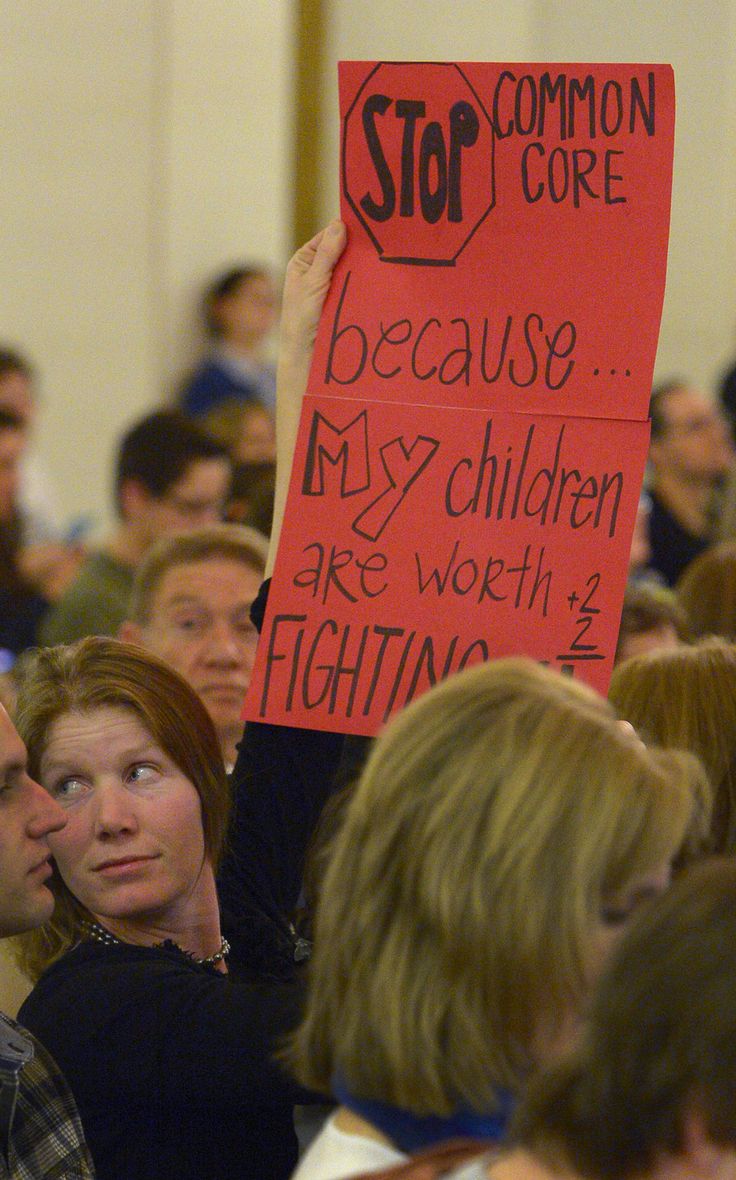









































 COMMON CORE

Here are several important news/action items for those concerned about stopping the Common Core “reforms” and restoring freedom in education:
1. Michelle Malkin has joined American Principals Project and others on a letter-signing campaign aimed at governors, insisting that they break free of Common Core. Read and sign here.
2. The Utah State Office of Education is permitting people to give public comment on the new common library book standards.
I urge you to comment; the survey takes very, very little time. Also, send a personal letter to the USOE on this issue, to these addresses for the board: librarycomments@schools.utah.gov and Board@schools.utah.gov
Here is one of the library standards: 1.2.4. Maintain a critical stance by questioning the validity and accuracy of all information.
This simple little sentence begins with “maintain a critical stance” –implying having good critical thinking skills, but then it veers into idiocy by “questioning the validity and accuracy of ALL information.”
Are children to doubt the existence of any truth? Yes, according to the state school board’s library standards.
Classical (very pre-common core) education taught children to confidently and logically pursue truth. But “progressive” education teaches children that there is no truth, no morality, no known anything. Thus all information is of equal importance and any library book is of equal worth: reading the rantings of Joe the communist pedophile may be as worthy a way to spend class time as studying what Washington, Einstein and Shakespeare wrote. What a terrible “standard”!
Of course there is truth; and there are facts. Doesn’t our existence on earth depend on the truth that the earth is a certain, precise, indisputable distance from the sun? If it were not so, we’d freeze or burn! That library standard has got to go.
Utah Standards for Library Media are posted; comment please. (The USOE Web site is hosting the public comment –before Aug 17, 2014. Also widen your audience by posting your opinion of the library standards to librarycomments@schools.utah.gov and Board@schools.utah.gov as well as to your local newspapers and radio stations.)
3. Jenni White of Oklahoma’s ROPE has this blog post: If you do nothing, nothing happens!
4. Governor Herbert has approved government preschool in Utah, and President Obama is pushing for federal preschool for all, but is anyone questioning the wisdom of such a move? What are its impacts on the business of private preschools? What are its impacts on little ones who would stay home with their families if not for the big government push to put them in rigorous preschools? Jonas Himmelstrand’s my favorite opponent of this push. This Swede has spoken to countless groups in many countries about the disintegration of families, mental health and academic success when government daycare becomes the norm. He speaks from experience. Himmelstrand’s voice needs to be more widely heard. Please read more here and here.
5. If you haven’t already seen them, see these news links, published by Oak Norton at Utahns Against Common Core today:
Pioneer Institute Study Finds That New Technology, Relaxation of Protections Threaten Student Privacy A must read press release: you can also download the full Pioneer Institute study.
Here’s a relevant clip: “These expansive data structures are intimately connected to the Common Core State Standards Initiative and national testing. Any information from the data initiatives mentioned above that is given to the two federally funded national assessment consortia aligned with the Common Core State Standards will be made available to the USED. The national standards will also create a unified “taxonomy” that facilitates creation of common instructional materials and data-collection technology. Because Common Core focuses not on academic knowledge but rather on “skills” that involve attitudes and dispositions, it paves the way for national assessments and digital platforms that measure such attributes.” http://pioneerinstitute.org/featured/study-new-technology-relaxation-of-protections-threaten-student-privacy/
Massachusetts Teachers Association Elects Anti-Common Core President We’ve already had the NY and Chicago teachers unions take anti-CC stances, but for a strong teachers association to join in is a great step. “The Massachusetts Teachers Association (MTA), a union that represents about 110,000 teachers in the Bay State, elected an anti-Common Core president on May 10 in a hotly contested and close election. Barbara Madeloni, a clinical psychologist turned teacher, beat a Brockton teacher by 681 to 584 votes. A proponent of local control, Madeloni opposes high stakes testing and nationalization of educational standards.” http://www.hslda.org/hs/state/ma/201405130.asp
Saber-Rattling on Common Core (Utah) This is why we want legislators who understand Common Core issues. “On Wednesday, education officials climbed Capitol Hill to inform lawmakers of the progress they’re making on implementing the Common Core education system into Utah’s K-12 schools. But the educators were met with an extremely hostile welcome, as Republican lawmakers expressed their animosity towards the Core changes, which have grown increasingly unpopular among conservatives nationwide.”
http://utahpoliticalcapitol.com/2014/05/22/saber-rattling-on-common-core For the audio go here: http://le.utah.gov/asp/interim/Commit.asp?year=2014&com=INTEDU
Conflict: Common Core Testing Company VP Evaluating NCLB Waivers Utah mom Autumn Cook dug this interesting tidbit out showing a Vice-President of AIR (the SAGE test company) was selected to review NCLB waivers. http://www.utahnsagainstcommoncore.com/conflict-common-core-testing-company-vp-evaluating-nclb-waivers/
Student-centered or subject-centered education?
This article by Lynn Stoddard in the Standard contains a great story about a mom who noticed what her struggling autistic child was good at, and now, as a 15-year old, the child is being considered for a Nobel prize. For that full story here’s a link (http://themotherlist.com/mother-tore-label-nurtured-sons-hidden-genius/) http://www.standard.net/Opinion/2014/05/08/Student-centered-or-subject-centered-education.html
Share this: