Update 3/8/16 – Friends in Ohio and Florida have confirmed that this exact bill (elimination of elected school boards) is being pushed there. Watch the “greedom-over-freedom” ed-tech lobbies, such as Jeb Bush’s Foundation for Excellence in Education, Global Silicon Valley investment group, Bill Gates, Marc Tucker’s National Center on Education and Economy, and Pearson, whose investments benefit from the streamlined elimination of voter input.
The bill in Utah has passed the Senate and is being considered in the House with a (pointless) amendment that would add to the appointed dictator-superintendent, an appointed-not-elected board. Several House members are opposing the bill right now. One rare senator who voted against the bill said in an email, “I couldn’t believe this may pass with no input – I like that the voters will determine if this goes to the ballot, but it’s a lot to explain to voters.” Yes, it is!
I’ve added contact emails for senators and representatives below.
SJR16, Senator Jim Dabakis’ bill to abolish the voice of voters in Utah education by abolishing the elected State School Board, passed the Utah Senate this week.
Dabakis’ claim is a ridiculous lie. The very short bill (SJR16) has only two elements, as it slashes at the Utah Constitution: 1) toeliminate the elected board, and 2) tohave no election and no representation at all. A solitary, governor-appointed superintendent would supervise all of Utah’s education system by him/herself.
This bill puts voters dead last, of course– because no vote will ever select the governor-appointed, solo-flying, unremovable superintendent.
An email from a Utah legislator who supports SJR16 argued: “Think of the current state board as a school bus with fifteen different steering wheels all driving in different directions….if one person is in charge, it’s harder for them to pass the buck.”
If he applied that reasoning to his own seat in the legislature, then there should be no legislature, but a king instead. And if the Senate gets the House to agree, and if the voters agree, then there will be an Education King of Utah.
It is up to the members of the House of Representatives to kill this awful bill that the Senate has approved. If they don’t, voters get one chance to end it. But will they? Will we all take the time to look at the history surrounding this long-planned effort?
This bill may have been sponsored by the notorious Democrat Jim Dabakis, but he didn’t come up with the idea of eliminating elected school boards. Blatant enemies of local control came up with the idea years ago and their ploy is ticking along even better than they’d planned. See the GSV’s graphic below. The “battle plan” of this investment company started with Common Core, and about ten years later, it planned to eliminate school boards. Utah’s leadership is listening to and acting on these plans —because of investment. Because dollars speak more loudly than children do.
Look at two movers and shakers from outside Utah, who are shaping Utah policy in this direction. One is a socialist and the other is a corporate hog. Both are instrumental in changing Utah’s formerly representative system: Meet Marc Tucker and Deborah Quazzo.
MARC TUCKER, THE SOCIALIST
To know Marc Tucker, simply peruse his report on Governing American Education, which says: “And the United States will have to largely abandon the beloved emblem of American education: local control... much of the new authority will have to come at the expense of local control.”
You can also study his infamous 1992 letter to Hillary Clinton, which was made part of the U.S. Congressional Record. The letter outlined Tucker’s vision of a communist-styled pipeline of education and workforce that would control individuals from early childhood through life.
It is a vision indistinguishable from Communism. It is a vision that Dabakis’ SJR16 consummates.
Tucker was invited recently by Utah legislators to speak in Utah at a statewide joint legislative/school board/USOE conference held at Southern Utah University. He’s also spoken at countless national venues, some of which are radical left-wing institutions: the Annenberg Institute, the Public Education and Business Coalition, the Aspen Institute, and state education conferences in various states.
Less that a year ago, Salt Lake City sponsored an education-tech conference co-hosted by GSV Advisors (an investment group) with Arizona State University. Bill Gates paid for it, of course. Former USDOE Secretary Arne Duncan was a featured speaker. Ms. Deborah Quazzo, founder and CEO of GSV Advisors, headed the conference, and was listed as “a prolific angel investor” who “leverages technology in the global $4.9 trillion education and talent technology sectors”.
She charged people $2,795 per person to attend this conference– just to walk in the door.
Above, you saw the graphic of Quazzo’s “Strategic Battle Plan” for GSV (and Utah politics). Keep in mind that Quazzo is an investor, not an educator. Her battle plan has nothing to do with what you or I as teachers and parents know is best for our children. It is her openly, repeatedly stated desire to eliminate local control by eliminating elected school boards.
[As an aside, here is some context: Forbes christened Salt Lake City the “tech mecca” of America, so now, ambitious, hungry eyes are on Utah’s ed-tech industry and school system and taxpayers’ votes. Those hungry eyes care deeply about whether Dabakis’ bill passes. From their point of view, voters and teachers and parents and children are a necessary annoyance, but they feel that our elected school boards are not: so, if Utah eliminates “messy” debate and gets rid of the old time-consuming elected representation business; if Utah streamlines decision-making for the entire state, we will have created an ed-tech dictatorship. It’s so very profitable to those (inside and outside Utah) who invest in the Common Core-aligned education system that Tucker and Quazzo promote. If it’s hard to wrap your brain around socialism now bedding with corporate America, or of socialism taking over the Utah legislature, just revisit how this “elimination of boards” policy –espoused by the GSV investment group that is repeatedly in our state preaching to legislators– perfectly matches the communist “human capital pipeline” agenda of Marc Tucker. Utah’s not utterly clueless, either; remember that Tucker and Quazzo were invited to this state to advise the once conservative legislators and businesses of Utah.]
How many mecca attendees last spring had read Quazzo’s creepy GSV document, entitled American Revolution 2.0, which echoes Tucker’s call for the removal of local control and local school boards? How many agree with it now– other than virtually the entire Utah Senate? The GSV calls for the promotion of Common Core and the elimination of elected school boards. What a strange coincidence that the Tucker-featured SUU conference also called for the same things.
In the GSV document’s “Strategic Battle Plan” Quazzo and company say: “We eliminate locally elected school boards, recognizing that the process by which they are elected doesn’t correspond with either strategic planning or longer term results.”
Strategic planning for whom? Longer term results for whom? WHAT ABOUT THE CHILDREN? And what about the taxpaying voters who are to foot the bill without a voice in it? What about the reasons we fought the American Revolution 1.0? We wanted representation. We wanted a voice in our own lives, not dicatorship by Mother England. Do we want a dictatorship led by Mother Quazzo or Mother Dickson or Father Gates?
This bill of Dabakis, the consummation of Quazzo’s and Tucker’s long-term scheming, must be stopped.
Obama has set up a shadow educational governance system.
It’s called Education44 –in honor of the Fed-Ed programs of Obama, 44th president of the United States.
Shadow governments are creepy.
Shadow governments are not elected, so they can’t be un-elected. They aren’t accountable. They aren’t subject to sunshine laws– no transparency. They have nothing to fear except the great American wake-up.
They get their power by pretense, by assuming power roles, rather than earning legitimate power through an actual election. Education44 has power because it is so connected to the big ed-tech money funneled in Common Core-aligned systems from the U.S. taxpayer.
You’ve heard of political correctness? How about educational correctness? If you are educationally correct, you are aligned with Education44 and the ed-tech industry as defined by Bill Gates/Microsoft/Pearson/Obama; you are in ed reform for money, but you pretend that you are in it for the kids.
The Education44 website promotes socialist ear candy in programs such as the “Promise Neighborhoods” that will provide “wraparound services through school communities” for “access to longer school days and year, affordable food and healthcare, and extracurricular activities”.
Education44 also promotes “guidance letters” that Obama, Secretary King and Secretary Duncan pushed on American schools. It promotes many, many other education “reforms” that are controlling and/or harmful to American autonomy and freedom, but for each program, it uses “ear candy” terminology so that each appears, on the surface, harmless.
I have learned to beware of vague “ear candy” terminology.
For example, Education44’s supposed priority (and apparent motto) is “protecting students“. Where in the U.S. Constitution did we ever delegate any role over children to the federal government? That’s the job of a family, not of a federal bureaucrat –and not of business owners (Bill Gates) in greedy partnership with government.
Education44 seems less about protecting students and more about dividing and controlling students.
Check it out: one of its programs “My Brother’s Keeper” focuses on male students “of color” only; too bad if you are a female child or are not seen as an “of color” child. Another of its “guidance letter” programs focuses on protecting only certain religious/ethnic groups –with no mention at all of “protecting” the rest of the students; protected are the “Syrian, Muslim, Middle Eastern, or Arab… Sikh, Jewish, or students of color”. Another program is called, simply, the Enforcement Unit. It sues private schools and colleges.
Its website promotes common core in the same code-phraseology for common core that the ed reformers always have: (College and Career Ready, or College and Career Standards, or College and Career Grants). It admonishes all to continue the [Common Core] goals via Obama’s Race to the Top:
“Adopting college-ready, globally competitive academic standards and tests
These partnerships can’t be called conspiracies. They are openly acknowledged. Yet they are conspiratorial in nature because they work their greedy, money-grubbing agenda under the radar of the average person. And the agenda is so sadly, always anti-local control, anti-individual autonomy, anti-classical education, anti-privacy… and none of it was ever subjected to a vote.
None of these ed “partners” are elected to do education reforms, any more than Education44 is. An elected school board has that job; in some states, legislators do.
But neither rich pants Bill Gates, nor the now-nobodies Obama, Duncan and King, nor ed-tech lobbyists near or far have any authority to be telling you what to teach your child.
They do it anyway. Because they can. Because so few stand up to them.
Neither the federal USDOE nor these shadow governments and wannabe business-education partnerships have any basis in the Constitution. Let’s give education back to WE THE PEOPLE, where the Constitution assigned it in the first place.
This week, the New Boston Post published this article by Dr. Sandra Stotsky, which is republished here with the author’s permission.
Dr. Sandra Stotsky
The efforts by the Gates Foundation to manipulate our major institutions lie at a very deep level in order to remain difficult to detect. Its efforts have been made much easier because our media don’t seem to care if the manipulation is done by a “generous philanthropist,” someone with an extraordinary amount of money and ostensibly the best of intentions for other people’s children. At least, this is how they seem to rationalize their tolerance of political manipulation by moneyed and self-described do-gooders—and their unwillingness to dig into the details.
As one example, we can surmise that Gates gave the Massachusetts Business Alliance for Education (MBAE) the funds it would need to pay a very pricey Boston law firm (Foley Hoag) for its 2015 Memorandum of Opposition to the citizen petition asking for a ballot question on Common Core and for the MBAE’s 2016 lawsuit against the Attorney General. We can assume the connection because Gates gave the MBAE large funds in recent years under the guise of “operating” costs. Until Judge Margot Botsford sings, we will not know her reason for using the flawed argument that had been worked out by Foley Hoag for the MBAE 2015 Memorandum of Opposition and that had already been rejected by the Attorney General’s Office (AGO) when it declared the citizen petition constitutional in September 2015. The flawed argument, to remind readers, was that the release of used test items is NOT related to the transparency of a test—an illogical statement that most Bay State teachers would recognize as reflecting more the thinking of the Red Queen or Duchess in Wonderland than that of a rational judge. Moreover, the flawed argument was supported unanimously by Judge Botsford’s colleagues on the Supreme Judicial Court (SJC). Not a murmur of dissent is on record.
Why Foley Hoag repeated the flawed argument it first offered in the 2015 MBAE Memo of Opposition in the 2016 MBAE lawsuit is something only the well-paid lawyers at Foley Hoag can explain. Why Judge Botsford and her colleagues on the SJC so readily used an already rejected and poorly reasoned argument for a “full court” opinion in July 2016 is what only she (and they) can explain. The end result of this fiasco is a corrupted judiciary and legal process. But how many reporters have spent time looking into this matter?
The Boston Globepublished a long article the very day Judge Botsford’s decision was released (an amazing feat in itself) that revealed no inquiry by the reporter, Eric Moskowitz, into some of the interesting details of the ultimately successful effort by the MBAE and Gates to prevent voters from having an opportunity to vote on Common Core’s standards. Recall that these were the standards that had been hastily adopted by the state board of education in July 2010 to prevent deliberation on them by parents, state legislators, teachers, local school committee members, and higher education teaching faculty in the Bay State in mathematics and English.
As another example, we know from 1099 filings that the Gates Foundation gave over $7 million in 2014 to Teach Plus, a Boston-area teacher training organization, to testify for tests based on Common Core standards at Governor Baker-requested public hearings in 2015. These hearings were led by the chair of the state board of education and attended by the governor’s secretary of education. Teach Plus members earned their Gates money testifying at these hearings. (See the spreadsheet for the amounts) For links to all the testimony at these hearings, see Appendix B here. Has any reporter remarked on what many see as an unethical practice?
As yet another example, it is widely rumored that the Gates Foundation also paid for the writing of the 1000-page rewrite of No Child Left Behind known as Every Student Succeeds Act (ESSA). It is public knowledge that Senators Lamar Alexander (TN-R) and Patty Murray ((WA-D) co-sponsored the bill, but the two senators have been remarkably quiet about ESSA’s authorship. No reporter has commented on the matter, or reported asking the senators who wrote the bill and who paid for the bill.
In addition, the accountability regulations for ESSA now available for public comment were not written by the USED-selected committees (who failed to come to consensus on any major issue), but by bureaucrats in the USED. Who gave the USED permission to write the accountability regulations it wanted, and who wrote them? No reporter has expressed any interest in finding out who these faceless bureaucrats are. Why?
Sandra Stotsky, former Senior Associate Commissioner of the Massachusetts Department of Education, is Professor of Education emerita at the University of Arkansas.
My husband often says, “Truth is truth, whether people believe it or not.”
Here’s the truth that even the Common Core’s lead architect, David Coleman, and its main funder, Bill Gates openly admitted in the videos below:
The Common Core was never state led. If it had been, it would have been constitutionally legitimate. It would have represented voters’ informed consent and desires. It would have a built-in a states’ amending process. It would have represented and standardized something vetted, not this untested theory, this not parentally authorized, not teacher-authorized, not voter-authorized, experiment on, and tracking of, children.
The Common Core is greed-led. It was not an educator but a businessman, David Coleman, who wrote his ideas on a napkin, and brought them to the second richest man on earth, Bill Gates. Gates saw the potential: using standardized data systems, educational standards and tests (and tax dollars) they’d forge what he called, in the video below, a “uniform base of customers” nationally. While Coleman pitched the idea to a partial club of governors and a partial club of state superintendents ( who bought it, and claimed it, and copyrighted it after hiring Coleman’s company, Achieve Inc., to produce it). Gates paid anyone who would take his millions, to promote it.
To this day, the private trade groups NGA and CCSSO claim that they are the “state” originators of the Common Core. That defies common sense and the structure of U.S. government. We have legislatures to represent voters; NGA and CCSSO are not legislative bodies.
I believe in capitalism and I cheer for entrepreneurs who make money legitimately; but Common Core is not legitimate business. It took over political processes. It represents the takeover of voters’ rights. It is collusion: between businessmen who have no authority to determine educational processes, and the federal government. Think that’s just some wacky theory?
Look at this link from the CCSSO’s website. It’s clear evidence of the collusion which went behind constitutional rights of states and which destroyed checks and balances, by setting education policy centrally. Only the feds, married to these nonlegislative and private organizations, call the shots here:
The Common Education Data Standards Initiative is a joint effort by CCSSO and the State Higher Education Executive Officers (SHEEO) in partnership with the United States Department of Education.
So the same superintendents’ club (CCSSO) that partnered with the partial governors’ club (NGA) to copyright a Common Core for math and English, also partnered with the feds to standardize a common data mining program with CEDS standards, nationally.
Video One: Bill Gates
Bill Gates telling legislators to “unleash” the forces of a “uniform customer base” by using Common Core
Video Two: David Coleman
Businessman David Coleman explaining that he personally persuaded governors to sign on to Common Core, a business idea he plotted on a napkin
Despite the fact that the #StopFedEd / Stop Common Core movement has become politically huge, and that many people know the truth about Common Core, many people still believe that it’s a harmless initiative, and that the Common Core was “state-led”.
Who could blame them for believing so? The promoted “talking points” said so. These were marketed by power-wielders: Bill Gates, the U.S. Dept. of Education, the paid-off National P.T.A., and the U.S. Chamber of Commerce –and were passed along by state boards of education and local boards of education to teachers and parents who trusted those lines. Few fact-checked. The lie got passed along and believed.
Common Core is not primarily an academic argument; it’s a takeover of local authority.
A good friend recently asked, “What’s so bad about the federal government controlling local education?”
If you know socialist/communist countries’ educational malpractices and propaganda machines; their lack of creativity, lack of joy, condemnation of faith, and lack of truth, you will not ask this question.
If you know that there is zero constitutional authority for the federal government to make decisions about education for American schools, you will not ask this question.
But if you don’t know or believe that, just think about your own desires for your children and grandchildren.
If you desire to have an ongoing voice of authority in your child’s education, his/her testing, and his/her data privacy, you cannot support federal education nor Common Core.
The Common Core allows nobody but its copyrighters to amend it. Its tests are held secret, even after the tests are over. The SLDS databases collect data on your child according to federal designs, and it is only a matter of time before this aggregated data will be legalized in disaggregated form. These are questions of personal power and personal conscience. Over time, it is ultimately a question of religious liberty, because the freedoms of conscience and of action are freedom of religion.
Who has God-given authority over what goes into your child’s open mind? Business sectors and federal government? –Or parents, with the consented-to assistance of teachers and perhaps a local school board?
If programs (such as Common Core and Common Educational Data Standards) do not allow for user amendability, for personal conscience to input change, then they are on day one, already corrupt. They are, or will be, tyrannical.
Remember the founders’ words: “consent by the governed“.
This is why the chairman of the National Governors’ Association (NGA), Utah Governor Gary Herbert, failed to secure the nomination in last week’s state GOP convention. This is why that same governor was so loudly booed at the Utah County GOP convention by most of the 1,500 delegates in the audience, every time he said that Utah had control of education standards locally. They knew the truth.
The governor/NGA chair either didn’t know it, or didn’t believe it.
Suggestion: Don’t call Common Core “state-led” anymore, because millions of Americans realize that –even though well-meaning people were duped and then promoted it in good faith– Common Core has always been a solely greed-led collusion between the business sector and the federal government.
WHAT COMMON CORE REALLY DOES TO EDUCATION
Let me share my recent experience with you.
While I teach 10th grade English, part time, at a non-common core, classical, traditional, private school called Freedom Project Academy (FPA) I also tutor, for free, neighbors and friends.
The comparison between my private, not-common core school, and the local public school, in English Language Arts, is stunning.
Background: FPA is an online school that recognizes no governmentally-set educational standards. It recognizes time-tested books as standards: the Bible, the classic works of literature, and the classic works of math, etc. It does not promote “informational text” articles, as Common Core does. FPA tenth graders read the following works of literature cover to cover, and wrote about them this year: The Old Man and the Sea; Romeo and Juliet; Murder on the Orient Express; The Adventures of Huckleberry Finn; The Scarlet Letter. Fantastic!
Meanwhile, local public school teenagers who have come for help with their essays let me know that they were assigned “mostly articles” and very few books. Their essay assignments were based on articles about “gender-based toys” and “green cars of the future” –clearly, these young people were being fed the progressive agenda under the banner of “English Language Arts”.
I told them that they are being robbed of real education, and that they should get some real books, especially classics, on their own, and read all that they can.
How can students who are being made to read “informational articles” ever gain the depth of perspective, the insight and humanity found in the rich characters and stories of Hawthorne and Shakespeare and Hemingway?
Common Core apologists are quick to point out that there’s no prohibition against Hawthorne, Shakespeare and Hemingway in Common Core. But Common Core businessmen have made curriculum that is sold and bought nationwide, which is “informational article” heavy, not classics-heavy. The businesses are thus driving what goes on in the classroom, as imagined by noneducator David Coleman, who openly mocks the teaching of traditional, narrative writing. This is not representative governing of education policy!
Talk to your local public high school students. Ask to see what they are being asked to read and write about. I would love to know if my town is an isolated case of losing classic literature.
Video Three: Here’s Coleman, mocking traditional narrative writing, in an effort to promote his notion of reading and writing mostly informational text in English classrooms.
Lastly– NATIONAL COMPREHENSIVE SEXUALITY STANDARDS – aka “Amorality for All”
The centralization/nationalization is not just about English and Math. It is clear in the push for national science standards (Next-Generation Science Standards) which Utah has tragically now accepted. It is clear in the common alignment of tests and data mining to the illegitimate Common Core and CEDS– whether tests are the Utah SAGE, other states’ PARCC, the College Board’s SAT and AP, or other tests.
Centralization of power away from localities is clear, and most dangerous, in the push for national sexality (amoral) standards, CSE, Comprehensive Sexuality Standards (which Utah considered and rejected for now). The video below explains why it is not true that Comprehensive Sexuality Standards are simply about “medically accurate information” but are instead teaching children amorality, which is so important to the progressives’ anti-family, anti-God agenda.
Don’t watch it with children in the room.
Video Four: The War on Children– The Comprehensive Sexuality National Standards:
We are not a communist country. Why are we acting like one, in centralizing so many matters of children’s education? There is nothing secretive about what’s going on; no conspiracy theory here, but conspiracy fact: progressives proclaim that government, not family, owns the children and defines for children what is true, good, moral, healthy, or allowed.
Video Five: Progressives’ announcement that government, not parents, own children:
We need the fire of Patrick Henry to wake America.
Many today seem to fear taking a stand for parental control, state control, local school board control. Do not fear the pretentious monster! It has no constitutional, no authoritative, legitimacy. Our rights, given by God and protected by the Constitution, are legitimate. Your authority over your own children is legitimate. Own it. Act like it. It is only when each person stands in his or her place, firmly, against encroachment, that a free country remains free.
Patrick Henry’s words apply today to the takeover of authority, which is Common Core and Common Data Mining, which is in the process of stealing our God-ordained duty to determine what our children will be taught:
“[W]e are not weak, if we make a proper use of the means which the God of nature hath placed in our power. Three millions of people, armed in the holy cause of liberty, and in such a country as that which we possess, are invincible by any force which our enemy can send against us.
…There is a just God who presides over the destinies of nations, and who will raise up friends to fight our battles for us. The battle, sir, is not to the strong alone; it is to the vigilant, the active, the brave. Besides, sir, we have no election [choice]. If we were base enough to desire it, it is now too late to retire from the contest. There is no retreat, but in submission and slavery.”
Even though I don’t like bumper stickers, I proudly slapped a U.S. Senator Mike Lee bumper sticker on my car because he’s that rare legislator who honors in actions as well as in talk, that priceless treasure, our freedom-friendly U.S. Constitution. And this week, I waited on the phone for a long time to ask him a question during his virtual town hall meeting this week.
I never got my chance, and that’s understandable because I heard the announcer say that 15,000 Utahns were attending, so… I’ll ask it now.
How weighty does the list of grievances need to be for Congress to convene a hearing on the Department of Education?
It seems like any one of the grievances that I’ll list next, would deserve action. Taken together, these assaults on Constitutional rights of individuals is almost unbelievable.
What are your thoughts on this list: as a legislator, as a parent, as a teacher (especially if you are a special ed teacher) as a student, as a taxpayer, as a citizen with Constitutionally protected rights? When should Congress hold the Department of Education accountable for:
ADMITTING IT FORCED STATE ALIGNMENT TO COMMON CORE – Department of Education official Joanne Weiss has just now not only confessed, but boasted, that the federal government deliberately “forced alignment” and “deployed tools” to push states into Race to the Top/Common Core, in this recent report. ( See the Pulse2016 article.) Important note: Weiss’ confession starkly contrasts with countless claims in the past three years from the Department, that Common Core was “state-led” and that any other view was “nonsense”. Duncan then said:
“… a new set of standards—rigorous, high-quality learning standards, developed and led by a group of governors and state education chiefs—are under attack as a federal takeover of the schools. And your role in sorting out truth from nonsense is really important.” – 2013 speech by Sec. Duncan.
4. DELETING PRIVACY LAWS – The Department of Education altered previously protective federal FERPA laws, altering policy that changed the definition of what IS personally identifiable information (PII). PII can now include biological and behavioral data (biometric data) about children or about any citizen who once was in a publically funded school. The Department also reduced to just a “best practice” –a.k.a. “optional”– the previously protective FERPA rule that parental consent had to be received prior to any sharing of student PII. The Department was sued by the Electronic Privacy Information Center for doing this. Read details at that site.
5. STANDARDIZING THE P-20 DATA MINE – The Department of Education partnered with a private, closed-door group called CCSSO (the co-creators, by the way, of Common Core) to co-produce common data standards, called CEDS, which further standardizes the data mining ability of the federal government over American citizens from early childhood through the workforce, in an initiative known as P-20 (or P-20W).
6. TEACHING AND IMPLEMENTING SOCIALISM, ALMOST AS A NATIONAL RELIGION – The Department of Education’s official blog, as well as Secretary Duncan’s speeches themselves, have unilaterally redefined education– as the teaching of socialism, aka social justice. Who passed a law that social justice would be the foundation for student learning? Who was authorized to take the entire population of U.S. school children down that path? In “Education is Social Justice” and other official articles and speeches, we learn that no longer will our education dollars teach our children to cherish Constitutional ideals like individual rights, property rights, separation of powers, or religious; instead schools will teach social justice, which is, unfortunately, not justice. It is theft. It allows the Department of Education (or others) to steal teachers, money, or data from one group to redistribute to another, without consent. Duncan can’t seem to give a single speech without spreading “social justice” and his Equity and Education Commission‘s publications reveal that the Department is promoting not just the teaching, but the implementation of socialism and forced redistribution, nationally. Shouldn’t there at least have been a vote?
7. SUBMITTING TO GATES – The Department of Education worked closely with, and accepted money from, the worlds’ second richest man and implemented nationwide policies based not on voter intent but on Gates’ intent. As Diane Ravitch wrote:“The idea that the richest man in America can purchase and — working closely with the U.S. Department of Education — impose new and untested academic standards on the nation’s public schools is a national scandal. A congressional investigation is warranted.”
In conclusion:
“When the story of the Common Core is finally told, it’s going to be ugly. It’s going to show how the sponsors of the Common Core made a mockery of the Constitution and the democratic process. It’s going to show how the Obama administration pressed a completely untested reform on the states, evading public debate at both the federal and state levels. It’s going to show how a deliberative process that ought to have taken years was compressed into a matter of months. It’s going to show how legitimate philanthropic funding for an experimental education reform morphed into a gross abuse of democracy. It’s going to show how the Obama Education Department intentionally obscured the full extent of its pressure on the states, even as it effectively federalized the nation’s education system. It’s going to show how Common Core is turning the choice of private — especially Catholic — education into no choice at all.”
That quote comes from Stanley Kurtz’s article for “The Ethics and Policy Center”entitled “Time for Congressional Hearings on Common Core”.
So maybe it’s good that I didn’t get to ask this question on the phone with my senator this week. I can mail it to him now. Maybe others will, too.
Dr. Gene V. Glass, the award-winning psychometrician who invented the term meta-analysis, made recent news when he announced that he is no longer comfortable in his field. In a Washington Post column, Dr. Glass summarized the failure of psychometrics (educational measurement using big data) to give accurate information: “Both talent and tasks were too complex to yield to this simple plan.”
This failure of psychometrics to win “the wars on poverty and ignorance” do not stop psychometric testing companies from lobbying politicians to alter American education for financial gain, he said. Glass writes: “test company lobbyists convince politicians that grading teachers and schools is as easy as grading cuts of meat. A huge publishing company from the United Kingdom has spent $8 million in the past decade lobbying Congress.”
Glass laments the false belief of politicians who are convinced by articulate, monied lobbyists to buy, and then act on, the idea “that testing must be the cornerstone of any education policy”.
The results? “Parents see the stress placed on their children and report them sick on test day. Educators, under pressure they see as illegitimate, break the rules imposed on them by governments. Many teachers put their best judgment and best lessons aside… And too many of the best teachers exit the profession.” A result Glass did not mention, but which is also notable, is that some politicians are beginning to be swayed by the idea of stealth testing.
The resignation from the field of psychometrics by Dr. Glass came to my attention because of Utah-based child psychologist Dr. Gary Thompson, who published the article with the following warning directed at Utahns who are complicit in the use of Utah’s nonconsensual student data mining web.
A Warning To Educational Data Worshipers:
We can’t paint a meta data picture of creations we still know so little of. The arrogance of the “career and college ready crowd” along these lines, is astounding to me both as a father, and as a doctoral level local clinical community scientist.
Apparently the scientist, who I studied in graduate school…and who pioneered the process of mass educational meta data analysis, feels the same way that I do.
Mankind (e.g., “Bill Gates, Secretary Duncan, AIR, USOE, or Superintendent Smith, etc) will never create a form of data analysis more accurate and informative than what can be garnered from the combination of a mother, a well trained local teacher and principal, and valid, personalized, private, assessment tools interpreted by a professional, with one, and only one motive in mind:
To lift the academic, emotional, and spiritual foundation of a child for the sake of the joy of enrichment.
Assessments, as well as the associated meta-data generated by our current Common Core-based educational system, will never be able to be used as a valid measure of teachers, schools, or as a tool to achieve the mythical political term of “career & college ready”….or to support the political desires of our current Governor and Utah’s Chamber of Commerce.
Parents are, and must always be the resident experts of their own children.
The testing/data pseudo-science spewing from the lips of the educational/political bureaucracy, can’t change this very law of nature and the universe.
Using stealth rather than SAGE tests, states can cater to federal and corporate funders seeking metadata on children while appeasing parental and teachers’ uproar against the time wasting and anxiety of high stakes testing. Stealth (hidden) assessments perma-test, but imperceptibly, with assignments and activities recording data beyond the control of teachers and without supervision by parents.
Is this what Utah really wants?
Utah mom Jakell Sullivan’s deep, documented research reveals why Utah’s SAGE/Common Core test (as well as other states’ tests) are on their way out. Parents who value their rights will want to read and share this article.
Thank you, Jakell.
SAGE Tests Are a Red Herring
by Jakell Sullivan
Utah’s Common Core Tests Entering the Next Federal Phase: Stealth, Embedded Assessment
What every parent should know RIGHT NOW about why we should Opt-Out of Common Core Tests AND aligned-online learning programs
While Opt-Out of Common Core Testing campaigns are underway all around the country (and ought to be broadly supported by parents in a free society), Common Core’s testing “pilot” is coming to a close. The Federal objective was to use the pilot period of their Race to the Top Assessments Program to gather data on children, schools and districts and to train states on new technology systems—and set them up (and, yes, it was a real set-up) for what’s to come.
Now, Utah is ready to embrace the Next Generation of Assessments. Utah’s legislature is set to pass a bill this session to create a task force to get Utah out of SAGE testing, and a resolution to move us toward the fruition of the federal end-game.
What’s the federal end-game? It’s to get all states—and most importantly, all children in PK-12—using stealth, embedded assessments. These assessments are seamlessly woven into the fabric of the learning environment and are invisible to the user. Gaming companies have been using stealth assessment for quite some time, but they are relatively new to the PK-12 arena, and are now being federally funded.
Parents might ask, “What’s wrong with getting rid of high-stakes tests and using stealth embedded assessments that won’t stress my children out?”
The problem is that the federal government has colluded with global organizations who now have the power to, not only track untold amounts of data (personal information) on your children, but to use that data to control what and how your children learn through “personalized” learning platforms. And, the Feds want to assess much more than “did Johnny know how to add 2+2.” They want to measure what they call 21st Century competencies created by major multinational information technology corporations. These competencies include things like: environmental literacy (ie; does your child have the skills to understand that humans are causing climate change and that we need to solve this “real world” problem through population control?) and global citizenship (ie; does your child have the skills necessary to embrace global citizenship?). If you think this is a stretch, you haven’t gone to the Gates Foundation website lately, or heard him saying this to Germany’s largest newspaper last month, “We need a world government.”
So, what is the Federal Government doing with Bill Gates?
On May 12, 2012, IMS Global Learning Consortium and the SIF Association (the two leading organizations that create industry standards for technology) answered the U.S. Department of Education’s call to support the federal Race to the Top Assessment Program. The two organizations issued a Press Release which announced that they had created the “First Version of the Assessment Interoperabiity Framework” to expand U.S. collaboration in interoperable assessments—globally.
IMS Global announced, “IMS is very pleased that the Bill and Melinda Gates Foundation is supporting acceleration of the open architecture for educational innovation that over 270 IMS member organizations around the world have made viable,” said Dr. Rob Abel, Chief Executive of IMS Global. “Achieving 1-click, data-rich connectivity of educational tools, content and apps with institutional systems is a game-changer that is now closer to reality via this grant and the anticipated ongoing collaboration with the [Gates] Foundation.”
When IMS Global says they are working with Gates to achieve “1-click, data-rich connectivity”, it means that they are about to use your child’s student ID like a social security number on steroids. As one friend who’s studied the data-gathering propensities of the federal government put it, “Imagine if anytime you used the internet you could be tracked by a number that not only was linked to your personal identity, but 100s of data points about you. And that most of that information was available to any website that agreed to use the same development standards.”
As mentioned above, 270 IMS member organizations around the world have already agreed to use the federal industry standards, and that number is quickly growing. What tech group, or nation, wants to be left out of the “new economy” being created by Bill Gates?
And, Utah wanted in on the action so much that they were part of the industry standard pilot! IMS Global announced, “To develop an industry standard for accessibility and interoperability of test items, [the] U.S. Department of Education helped fund the “Accessible Portable Item Profile” project. The Minnesota Department of Education led the effort, which included the states: New Hampshire, Vermont, Utah, Montana, Florida, South Carolina, and Maryland as participants and Michigan, Massachusetts, and North Carolina as observers.” APIP “allows for the transfer of assessment content between vendors.”
Question: Do parents have the fundamental right to know where their children’s curriculum and test questions are coming from? Do parents have the fundamental right to know that Utah is ready to help the federal government track our children into workforce tracks like socialized countries? Think the idea of workforce tracks being used in America is ludicrous?…see the Federal/Gates Learning Registries information below in the “more” section.
In May 2012, IMS Global and the SIF Association said that, as they had helped the federally funded SBAC and PARCC fulfill their federal interoperability requirements, they were helping to move states away from outmoded assessments and stood ready to “personalize instruction and leverage centralized professional development resources.”
From information I obtained, the Utah State Office of Education and other stakeholders were invited on a conference call with the Reform Support Network (a U.S. Department of Education network created to “help” states support all the reforms associated with Common Core standards) on Feb. 3, 2015 to aid Utah in the transition to stealth assessment. On the call, they were going to: “identify and eliminate assessments that are redundant or that do not contribute to teaching and learning” and to “identify the quality of assessments and move toward a better balance of question types.”
So, just three years after IMS and SIF’s said they were centralizing things, we see that our State Office of Education is coordinating with the Feds in the process of centralization. Learn more about the federal Assessment Interoperability Framework using Common Education Data Standards here.
What this means is that third parties, along with the federal government, can now control everything happening at the local school level as it pertains to learning—children’s learning and teachers’ learning. And, use that control to enforce almost any other federal reform or learning “intervention” required for children to be college and career ready.
Question: “Why do school districts, schools, teachers and parents, in a free society, willingly allow third parties to collect information about them and then tell them how to behave in order to meet federal mandates?” Doesn’t it appear that we are selling our children into a life of servitude and bondage all because we are unwilling to be self-reliant?
There is MUCH MORE to this article. For those that want to read it, see below. But, for now, suffice it to say, that the Feds have us right where they want us.
Utah parents DO NOT WANT SAGE, and we DO NOT WANT big-data-gathering-tech-companies, being funded by Bill Gates and the Feds, to replace (or morph) SAGE with real-time, adaptable assessments in learning technology. In order to preserve parental rights, parents should demand that our children’s tests be designed and controlled at the school and district level, so that tests are fully transparent to parents. After all, aren’t WE the consumers of educational services in this country? Aren’t we the sole stewards of our children? And, are we accountable to Government or to God in fulfillment of that stewardship?
STOP Utah’s legislature from creating a Task Force to further grow K-12 stealth assessments. (Contact your legislators and Task Force Sponsor Senator Howard Stephenson in DROVES and tell them “WE DO NOT WANT THIS FEDERALLY-MOTIVATED TASK FORCE IN UTAH!”
STOP Utah’s legislature from supporting a resolution to use K-12 stealth assessments. (Contact Utah’s House members and Resolution Sponsor Rep. Marie Poulson in DROVES and tell them “WE DO NOT WANT stealth assessments in Utah’s K-12 ed system without parental disclosure and opt-in requirements!”
HERE’S “MORE” INFORMATION AND RESOURCES, INCLUDING IMS GLOBAL GRAPHICS, FOR THOSE THAT WANT IT:
Stealth learning platforms and assessments (platforms and assessments that operate in real-time within the technology without a child knowing it) foster an education system where parents will have very little control over what our children learn and what they are tested on. Meta-data can be tracked through every key stroke, as well as facial expressions and behaviors through computer cameras, etc. And, the data collected from our children’s learning platforms will be used to control what and how their teachers teach, as well as what federal mandates will be placed on teachers and schools in order to make individual children “college and career ready.” (I used the word “make” because that’s exactly what the Feds are trying to do….force outcomes). The federal mandates will require “Response to Intervention” as well as redistribution of taxes and resources to aid centralization of our education system—and to profit the crony capitalists in bed with big government. (American Institutes for Research (AIR) controls Utah’s SAGE tests and is also in charge of the US Department of Education’s “Response to Intervention” program. So, whether SAGE exists or not, the data AIR collects through learning and assessment platforms will control what schools and teachers have to do to comply with federal mandates.
Here’s some background:
The US Department of Education, with funding funneled through the Education Testing Service, created the Gordon Commission to develop policy guidelines to help state legislatures change their education technology policies to align with Common Core Standards Metadata Requirements’—and to push states toward using stealth assessments.
(see Graphic #1 below)
Two key members of the Gordon Commission are President Obama’s former education policy advisor Linda Darling-Hammond, who was originally responsible for creating content specs for Common Core tests, and former governor Bob Wise. Bob Wise helped found Digital Learning Now with former Governor, and GOP Presidential candidate Jeb Bush. Digital Learning Now is profiting off of federal and state tech reform policies and Utah’s legislature is leading the charge in implementing all 10 of their digital learning policies.
The Gordon Commission published a report that said, “The Common Core Standards, and the rethinking of assessments that they are fostering, provide an opportunity to challenge [the] deeply held belief in local control.” Translation: “Parental rights mean nothing to us. We want to control what your children learn through stealth assessment and we are going to use your tax dollars to do it. Local boards will operate as subsidiaries of the Federal administration and eventually be regionalized so that we can further erode your local tax systems.”
The federal government funded the ConnectEd Initiative to replace textbooks within 5 years and simultaneously, the US Department of Education joined forces with IMS Global Learning Consortium and Bill Gates to fund open-coding specs for technology and learning companies. They used the Race to the Top Assessments program to get most tech and software companies to adopt open-free license coding specs that are interoperable across platforms—some nations have already adopted the specs.
IMS Global’s goal is to “Advance Learning Impact by Enabling the Open Foundation for Seamless, Agile and Information-Rich Educational Technology Integration.” Pearson wrote a Request for Information Response for the US Department of Education regarding which assessment programs the Feds should fund via Race to the Top Assessments (RTTA) to support this “seamless integration.” Their report states, “The RTTA program and state consortia adopting the Common Core State Standards (CCSS) have identified interoperability as essential in helping to maintain the feasibility and affordability of next-generation assessments.” It should be noted that Pearson plans to take over the United Nation’s PISA tests (tests that compare nations to each other) in 2018.
It should also be noted that the groups over Utah’s testing—American Institutes for Research and Bill Gates’ MeasuredProgress—have both adopted IMS Global’s interoperability specs, see member affiliate list here. (The USOE signed a contract with Bill Gates’ MeasuredProgress in 2009.)
IMS Global talks about a single student login like this:
“Achieving single sign-on and an overall seamless experience for students and teachers is a key foundational step for interoperable assessments across formative and summative environments….The open IMS platform of standards features the Learning Information Services (LIS) standard and Learning Tools Interoperability (LTI) standard, both of which work in tandem with these federated identity solutions to enable single sign-on and reporting relative to specific individuals as required LIS and LTI focus on the data and service exchanges among cooperating learning related systems, such as assessment systems, learning management platforms, student systems, and learning tools.”
Page 37 of IMS Global’s report to the U.S. Department of Education entitled, “IMS Response to Assessment Standards RFI”, shows that they need Common Core standards to facilitate meta-data collection.
IMS Global is piloting an educational GPS system that operates just like the GPS on our phones and in our cars. It’s called EPS (yes, it’s meant to sound like GPS), or Educational Positioning System. IMS Global describes it like this, “As with a GPS system, there must be a way to compare the current position (student progress) with a starting point (past academic accomplishments) and destination (future educational goal).”
They published an online call to tech companies and encouraged them to become part of regional data clusters to begin pooling the data they collect so that it can be further centralized. In the call, they explain that “this EPS concept was put forth by StudentAlignment.com. President Obama released an Executive Letter from the Whitehouse which is posted on StudentAlignment or “EPS” Website. The President’s letter is entitled, “Unlocking the Power of Education Data For All Americans” and can be found here. Here is a student review of the EPS System and how it can create a student’s Learning Registry. President Obama’s letter highlights progress being made with the Learning Registry.
What’s the Learning Registry?
IMS Global’s website states, “the IMS Instructional Innovation through Interoperability Leadership Council (I3LC) of school districts and states has recently published a position paper that attempts to put some of the myriad projects and investments made in the last few years in the U.S. by the Gates Foundation into perspective. These initiatives include the Learning Registry (initially funded by the U.S. government, later by Gates), LRMI (Learning Resource Metadata Initiative) and SLC (Shared Learning Collaborative), now InBloom. These projects all share the notion that learning objects or progress can be referenced back to a common set of educational standards, and are generally complimentary, and perhaps even dependent upon success of the Common Core.” [note to reader: Although inBloom is defunct, IMS Global touts what they’ve done right and what inBloom did wrong].
So, lucky Utah, our Governor still thinks Common Core Standards have nothing to do with federal reforms, meanwhile, President Obama and internationalists are clearly using them to create Learning Registries on our children so that they will know what our children are learning and thinking at every step of the way through their education and beyond. Sounds exactly like the system needed to get our children into socialist-style workforce tracks. Ask yourselves again, “Why do Bill Gates’ kids attend a private school that does not use Common Core standards or aligned-assessments?” It seems obvious that we are creating a class system: some families will be workers and their tax dollars will be used to fund the companies of the elites who receive non-standardized educations.
Here’s a graphic from IMS Global about the US government/Gates Learning Registries. LOOK AT ALL THE DATA POINTS THAT CAN BE TIED TOGETHER FROM BIRTH TO WORKFORCE. It creates quite a profile on children and their families.
As mentioned above, Utah is an IMS Global APIP (e-assessment interoperability standard) Leader state:
“APIP: States & Suppliers Collaborating to Revolutionize Assessment”
“APIP has been under evaluation by both SBAC and PARCC since December 2010. The recent SBAC architectural analysis has indicated a key role for APIP. PARCC is currently performing its architectural analysis. The U.S. Department of Education performed an extensive analysis of interoperability standards for assessment in early 2011 that highlighted APIP as a good fit for the needs of RTTA.”
“Q. What efforts have been under taken to build accessibility standards for assessment content? Recent technological advances and the growing importance of—and unique demands inherent in— assessment drove efforts to increase the accessibility of test content for all students, illustrated for example by the requirements for the U.S. Federal Department of Education’s (USED) Race to the Top Assessment Program. To develop an industry standard for accessibility and interoperability of test items, USED funded the Accessible Portable Item Protocol (APIP) project. The Minnesota Department of Education led the effort, which included the states: New Hampshire, Vermont, Utah, Montana, Florida, South Carolina, and Maryland as participants and Michigan, Massachusetts, and North Carolina as observers. National interoperability and accessibility experts provided technical support. In December 2010 the team released the first version of the APIP standard, intended to make assessment content portable between systems and accessible to a wide range of students.”
Page 11 and 12 of IMS Global’s Report to the US Department of Education reads:
“The conformance matrix shown at the above URL is also significant because it relates to the critical issue of supporting assessment interoperability throughout an “integrated system of instruction and assessment” which is required to support the balanced assessment requirements of the Common Core State Standards (CCSS) and achieve the potential of Race to the Top Assessments. In order to achieve use of interoperable assessments throughout formative, summative, and intervention strategies, interoperability must go beyond item and test interoperability. Diverse digital learning content and applications must provide interoperable results reporting that enables a diagnostic student record created from data that comes from a wide range of formative and summative tools. And, interventions must adapt based on the same interoperable data.
The range of interoperability requirements to support the Common Core and the Race to the Top Assessments projects are depicted in the following series of three figures.”
Here are the graphics from Page 11 and 12. It’s clear that there are a myriad of ways that embedded assessments can collect data on our children.
Conclusion:
Everything at the local school level will be controlled by third parties and international organizations using stealth assessments to centralize and synthesize data collection (I’ll leave the reader to surmise who).
These global organizations will:
Track your children’s metadata through learning and assessment programs
Build data profiles on your children from preK-career (and into the workforce)
Send real-time feedback to teachers to control what learning “interventions” your child will undergo (making sure those interventions will pad the pockets of those crony companies in bed with the federal government)
Make it impossible for parents or local schools to understand who’s controlling the data that parents, teachers and local schools must comply with, and what kind of data is being collected
Potentially, and most-likely, push our children towards a globalist mindset where families, parents and individual rights are undermined so that children will support collectivist strategies for solving “real world” problems, ie; global government
IMS Global Announces Inspiring Action to Transform Education:
“Digital Assessment Transformation: Get the latest on the rapid transition to digital assessment for both summative and formative purposes and theintegration of assessment systems and data with learning platforms. ”
Technical working group members of the “Learning Resource Metadata Initiative” (LRMI) include Microsoft, Gates Foundation, IMS Global, and of course, Creative Commons.
2015 Leadership Opportunities in IMS Global Learning Consortium:
Here are a few quotes:
” 1-click integration of educational apps. ”
“…syncing student information between SIS systems and learning systems,”
“…better support for assistive technology and serving as an actual rendering format (versus just an interoperability format – which is what QTI is) for the range of devices supported via the web. They are calling this aQTI. Some long time contributors, such as Educational Testing Service, along with some newer IMS Global member organizations, like Dutch Exam Board, Cito, TAO, NWEA and Smarter Balanced Assessment Consortium are leading the way on all of this.” (So, Stealth assessment was the plan all along)
“…get to the next generation educational content interoperability. In less than one year we went from an exploratory meeting (hosted by Pearson) to an impleme
in bed with the federal government)
Make it impossible for parents or local schools to understand who’s controlling the data that parents, teachers and local schools must comply with, and what kind of data is being collected
Potentially, and most-likely, push our children towards a globalist mindset where families, parents and individual rights are undermined so that children will support collectivist strategies for solving “real world” problems, ie; global government
IMS Global Announces Inspiring Action to Transform Education:
“Digital Assessment Transformation: Get the latest on the rapid transition to digital assessment for both summative and formative purposes and theintegration of assessment systems and data with learning platforms. ”
Technical working group members of the “Learning Resource Metadata Initiative” (LRMI) include Microsoft, Gates Foundation, IMS Global, and of course, Creative Commons.
2015 Leadership Opportunities in IMS Global Learning Consortium:
Here are a few quotes:
” 1-click integration of educational apps. ”
“…syncing student information between SIS systems and learning systems,”
“…better support for assistive technology and serving as an actual rendering format (versus just an interoperability format – which is what QTI is) for the range of devices supported via the web. They are calling this aQTI. Some long time contributors, such as Educational Testing Service, along with some newer IMS Global member organizations, like Dutch Exam Board, Cito, TAO, NWEA and Smarter Balanced Assessment Consortium are leading the way on all of this.” (So, Stealth assessment was the plan all along)
“…get to the next generation educational content interoperability. In less than one year we went from an exploratory meeting (hosted by Pearson) to an implementable draft specification”
“…defining and authorizing a more robust set of outcomes or achievements beyond grades”
Have you seen the new regulations that just came out of the White House?
Americans who see these must run screaming to legislators for protection against the Department of Education.
The new regulations declare that Secretary Arne Duncan will amend ESEA to “phase out the authority of States to define modified academic achievement standards and develop alternate assessments based on those modified academic achievement standards in order to satisfy ESEA accountability requirements. These amendments will permit, as a transitional measure, States that meet certain criteria to continue to administer alternate assessments…for a limited period of time.”
“Phasing out the authority of the states” has been precisely the point for every last one of Duncan’s promoted education reforms, from Common Core to Common Data Standards to State Longitudinal Database Systems to P-20 programs to Common Core Assessments to teacher and school evaluations.
Utahns Against Common Core have been pointing out this phase-out of local authority for over two years. Others have been saying it for decades.
But fat cats (Salt Lake Chamber of Commerce, School Improvement Network, Prosperity 2020, Education First, Pearson Inc., Microsoft) –each of whom wants to sell fat educational products to the fat, “uniform customer base of Common Core” (as Gates put it) will not listen, and will mock and scorn critics because they want to get fatter and fatter on the taxpayer’s dime.
Why does such a supposedly conservative state allow the educational authority of the state to be “phased out” –because of businesses’ greed and lack of care for our children? Where are our children’s educational defenders when we need them? Where is the action behind all the flag-waving speeches that we’ve heard, now, Governor Herbert, Education Advisor Pyfer, Senator Stephenson, Representative Powell?
Why doesn’t our Governor, our legislature, our state school board, lift a finger to fight for our Constitutional right to educational self governance?
I cannot understand the apathy and the complacency and the tolerance– even at the legislative level– of all reforms aligned to the Common Core.
Is it not tragically crazy that we, as a state, willingly allow liberties –guaranteed under the supreme law of the land– to slip so easily out of our lives? We allow ourselves to be lied to by our leaders, who cradle these education reform lies in positive, appealing language, and only for one reason: cash flow. Not for our children, at all.
When will Utah, when will America, wake up to this devastation of liberty and education?
I sat in the Early Life Child Psychology and Education center this week, watching Dr. Gary Thompson’s presentation about Common Core testing, thinking that Dr. Thompson is the fearless kid in the tale, “The Emperor’s New Clothes.”
Dr. Thompson stands armed with honesty, science and evidence, pointing out that the Emperor of SAGE/Common Core tests is stark raving naked. All around Salt Lake City, meanwhile, people play along with the wealthy emperor, pretending that nothing’s wrong with what the whole world seems to have been paid to agree are such smashing, new –dare we call them rigorous— clothes.
What does Dr. Thompson see as he analyzes the Common Core SAGE test in its birthday suit?
He points out foremost that there is such a thing as a code of ethics for the psychological testing of children.
“Wait, wait–” says the State Office of Education– “We’re not doing psychological testing on your kids.” But this does not placate Utahns who fact check for themselves. SAGE/Common Core tests –in addition to being tests of academic subjects– are psychological tests. We know this because:
1) Utah law demands it. HB15, passed in 2012, required Utah’s public and charter schools to administer computer adaptive tests aligned with Common Core. It specified “the use of behavior indicators in assessing student performance.” Behavior indicators are not math, science or language arts data points. They are psychological data points.
2) The SAGE tests are created by Utah’s test contractor, American Institutes for Research (AIR) which is primarily “one of the world’s largest behavioral and social science research organizations.” Its stated mission is “to conduct and apply the best behavioral and social science research and evaluation.”
3) The federal Department of Education –which shouldn’t, but does, call shots for the Utah State Office of Education– openly encourages psychological profiling of students via tests, calling it “data-driven decision making,” “a data quality campaign” and other positive-sounding terms. See any of its initiatives, reports and recommendations which do depend on/openly promote psychological profiling of children by testing.
Here’s how Dr. Thompson says that SAGE violates the code of ethics for psychological testing:
Standard 9.03 from the Ethical Principles of Psychologists states that “psychologists obtain informed consent for assessments. SAGE does not do this. The ethics for informed consent include telling the client (in SAGE’s case, the student and parents) what the nature, purpose and anticipated course of services will be; using clear language; allowing the client (student and parents) to ask questions; telling them about involvement of any third parties who may have access to the information gathered via the test; disclosing whether experimentation will be used; informing the client whether the test administrator is a trainee or fully qualified to administer psychological testing; obtaining consent in advance of recording or observing; potential risks; potential limitations; and more.
Each of these codes of conduct were broken by the USOE in implementing SAGE tests on Utah schools.
Standard 9.02 states that “Psychologists use assessment instruments whose validity and reliability have been established…when such validity or reliability has not been established, psychologists describe the strengths and limitations of test results and interpretation.”
There have been no independent validity and reliability studies done on SAGE tests, whatsoever, as Dr. Thompson pointed out. Another enormous principal of all scientific forms of testing– broken.
While it is clear that SAGE tests are psychological in nature, and that the tests do not adhere to the code of ethical conduct for psychological testing, there’s even more at stake.
Dr. Thompson pointed out that the future is very close to already here: Game-based assessment, also known as Stealth Assessments, are secret tests embedded in video games for schools that are further eclipsing parental rights and knowledge about what data is being collected while children are at school. Even teachers would not know what exactly is being collected or analyzed when stealth assessments are used in classroom settings.
In a scholarly journal entitled “District Administration” Dr. Thompson read, and shared, that now, in an attempt to lessen student stress, Gates-funded groups are telling us that video games are the education of the future. “District Administration” journal writes that because “complex thinking skills can’t be measured by traditional standardized tests, educators are turning to stealth assessments hidden in video games.” The article continues, “stealth assessments are seamless, so the distinction between learning and assessment is completely blurred. Kids are playing, they are learning, and they are being assessed all at the same time.” Further: “testing companies are working on ways to integrate formative assessments into daily instruction.” Children will be tested all of the time. How does a person opt out of that?
Dr. Thompson’s presentation also touched on many other issues of great importance. He spoke about the vulnerable populations that are forced to take Common Core SAGE tests (unless parents opt them out). These include children with any of a host of learning disabilities, children with depression and anxiety, children with autism and Asberger’s, children with historically poor test taking scores due to cultural bias in testing including African-American and Latino children, children with Post Traumatic Stress Disorder, children from high-stress poverty homes, children with psychotic disorders, ADHD, and dual exceptional (gifted and learning disordered) to name a few.
He shared from academic journals many ethical considerations associated with Common Core’s pushing of the very young into “rigorous” and age-inappropriate standards. He shared research he’s collected, too, about the use of children’s data for marketing purposes, (quoting from the academic journal article, “Children as Consumers.” This is relevant and troubling because the SAGE test creator, AIR, has open partnerships (and data sharing policies) with numerous corporations that have no restraint on accessing SAGE-collected student information.
Thompson further discussed harm to the brain of a child using Common Core testing practices on every type of child, and using Common Core styled math on every type of learner. He spoke of the brain’s disorganization response to Common Core-styled math pedagogy and to high-stakes tests like SAGE.
This brain-analyzing portion of the presentation must be explained in detail in a separate post. Briefly: the neurological (brain-affecting) Common Core issues raised by Dr. Thompson’s research are extremely important in light of the fact that both Bill Gates (Common Core funder) and our federal government are highly focused on studying and applying research about the neurology of children, right now. The federally approved Fattah Neuroscience Initiative, also known as the White House Neuroscience Initiative, was granted federal funds to invest in brain research and drug development, and not just to prevent Alzheimer’s. Its stated aims: “optimizing interactions between the environment and the brain across the lifespan,” “applying the brain’s information processing capabilities” and “enhancing communication among federal agencies”. Congressman Fattah wrote that he is “a major proponent of brain mapping… understand…the role of individual neurons in controlling our thoughts, movements…”. –Recall that Secretary Duncan mocked the idea that the federal government was involved in this, when it was accused of collecting student data using Common Educational Data Standards. He said, “Let’s not even get into the really wacky stuff: mind control, robots, and biometric brain mapping.” Yet that is exactly what the federal Fattah Neuroscience Initiative aims to do. Congressman Fattah has made it clear that brain mapping is the aim of the White House Neuroscience Initiative. Now, let’s use our brains. Who is the only huge, captive group of guinea pigs they have under their control upon whom they can do brain mapping research (call it education) for hours and hours every single day?
Dr. Thompson’s full presentation:
You’ll want to see the whole presentation and discuss it with your local and state representatives on the school boards in detail. Each of the issues touched on in Dr. Thompson’s presentation deserves a chapter or a book written on it.
It is the enforcer of Utah’s Common Core and the primary vehicle for massive student data collection right now. We need to get rid of it, or opt individual children –by the thousands and thousands– out of it, so that its data collectors cannot do what they aim to do, and so that Common Core experimental standards cannot take deep root in our schools, cannot dictate teacher salaries, cannot narrowly define and narrowly present what is “education” to our children.
Somebody will look out for students’ mental health, privacy, and happiness, even in this age of politically motivated high-stakes SAGE testing –and soon, in this age of stealth testing. Somebodywill look out for the parents’ rights to know about and to guide psychological treatment or analysis of children. Someonewill pound on the door of the USOE, the governor, and the legislators’ offices, demanding the end of SAGE tests in Utah schools, demanding answers to the questions that Dr. Thompson and other child psychologists, such as Joan Landes and Dr. Megan Koschnick (video below) have raised.
That someone is that person in your bathroom mirror or it’s nobody, because everybody’s so busy.
Legislators are busy. Teachers are busy. Board members are busy. Reporters are busy. Common Core technological implementers and teacher development conference producers are busy. Everyone is so busy being busy that the busy-ness that matters most of all— our children and our liberty-– have lost precious ground.
The Utah Attorney General (AG) recently issued a report about Common Core. I’m grateful that Common Core concerns are receiving much-needed attention, rather than being dismissed as unfounded. I thank the Attorney General for his time spent on this issue. But the report is egregiously errant.
I’m just a full-time mom, not a lawyer. Though I have many years of experience teaching in public schools, plus years spent researching ed reforms, I never aimed to rebut a state attorney general’s education report. But truth is truth and error should not be accepted as fact.
Please study this out for yourself. I’m here to point out and to back up with documentation, the errors and omissions of the A.G.’s Common Core report. It’s for you to draw your own conclusions. It’s for our children to live with what we adults see as truth.
Before I get to the errors and omissions, I will point with gratitude to three key issues that the report correctly clarified:
1) The report’s first paragraph correctly clarified the fact that the “Utah Core” for K-12 math and English is, in fact, the exact same thing as “Common Core.” Many have been confused about this fact and some in leadership allow that confusion to continue because they know Common Core has become a toxic term. But no one need be confused. The A.G. is correct: Utah does (unfortunately and voluntarily) adhere to centralized, standardized Common Core standards and tests.
2) The report also correctly stated that the US Dept. of Education ( by imposing waiver conditions and pushing states to adopt federally approved standards) “has infringed upon local and state authority over public education” and that Utah and other states “consented to this infringement through federal coercion...” (emphasis added).
3) The report correctly said that “Utah has the legal ability to repeal” Common Core. Most people already knew that Utah CAN withdraw from Common Core; our point has always been that we REQUEST that our state will indeed withdraw from Common Core.
The Attorney General’s report wrongly concludes three main things, which I will afterward explain in detail:
1) That adoption of Common Core followed the rule of law; that the parent-teacher lawsuit –brought against the state’s decision to adopt Common Core without proper vetting– holds no water and that the board’s adoption of Common Core was legal; that Common Core standards do not qualify as rules –so the UARA’s rulemaking process did not need to be followed;
2) That Utah has not ceded authority nor lost local control over its education system via the Common Core Initiative; and that there are no groups that now hold direct or indirect control over Utah’s education system;
3) That Common Core does not impact curriculum.
1. The report incorrectly states that the board’s adoption of Common Core followed the rule of law, using “a very public process” and that it was not illegal in any way. That question will soon be determined in a Utah court. The lawsuit to which the report referred –in which parents and teachers are suing the board over its method of adopting Common Core– is still a live, active lawsuit.
Connor Boyack of Libertas Institute (the institution supporting the lawsuit) was correctly quoted by the Deseret News, saying, “Specific behavior was required of the board that was not done.That is the basis of our lawsuit, andthat was not responded to by the attorney general. Our allegations still stand and we’re confident that a judge will determine that the board, in fact,did not comply with the law.”
The A.G. came to a different conclusion not only from that of Libertas Institute but also from U.S. Department of Education secretary Arne Duncan, who noted that Utah’s state school board and many other states very quickly, quietly adopted Common Core “without studying it, without writing a white paper on it,” without consulting with the teachers, administrators and others whose careers would forever be altered by it.
This clearly goes against our state’s law.
As a public school teacher whose credential has never lapsed out of date, I can attest that when Common Core came to Utah, neither I nor any teacher, to my knowledge, received so much as a letter or an email consulting with or discussing or debating or communicating the fact that a decision was in process, nor announcing any potential positive or negative consequences of the decision. Local school boards can and have attested that they were likewise left out of the decision. Millions of public school parents can testify that there was no “very public process”. Although parents often get letters, robocalls and emails about school pajama day, the fall carnival, community council elections and many other issues, it was only long after the state had agreed to Common Core (and its associated data, testing and evaluation reforms) that parents and teachers became aware of what it was and how it would change our lives forever. Teachers and the general public would have had to have been actively scouring the state office of education website weekly basis (–and why would they?) –to have come across any invitation for public discussion or feedback on this huge, transformative issue.
The report also falsely states that prior to adoption of Common Core, Utah was an active participant in the creation of Common Core standards. This claim is not backed up with evidence of any kind. Listening to the minutes of the state school board meetings surrounding adoption of Common Core reveals that the claim is far from true.
Last, there’s the reference to Utah’s UARA which defines rules and rulemaking. The A.G.’s report correctly states that a plausible case can be made that because Utah is now ruled by Common Core’s rules, the rulemaking process should have been followed, and was not. UARA defines a rule as a statement by an agency (in our case, the USOE/school board) which implicitly or explicitly requires some class of people or agencies (in our case, school system employees) to obey it; a statement that implements or interprets law (in this case both state and federal law, even though the federal government does not have constitutional authority to make education laws– since it has done so and it uses money to control states’ obedience to these unauthorized laws and policies, and now Common Core-implementing state laws are congruent with Common Core education reforms as well).
Common Core standards must be considered rules since the state school board and USOE mandate statewide adherence to its benchmarks and tests, and the legislature specifically mandates teacher and school evaluation using Common Core computer adaptive testing.
But the A.G.’s report oddly states that because Utah law does not define the meaning of the term “standard,” the standards aren’t really rules so the rulemaking process was correctly skipped over. That defies common sense, and research. Teachers and administrators rely on USOE/USSB statements on Common Core to interpret and implement education law and policy. Common Core is mandated by the legislature’s Common Core CAT testing laws, and adherence to Common Core was partial payment for receipt of federal waivers, monies and technologies; it was parceled with federal No Child Left Behind waivers, ARRA grant obligations, SBAC (Utah’s former) testing grants, and the federal SLDS grant, each of which helped bind Utah schools, teachers and students to Common Core and common data standards.
2. The report incorrectly states that Utah has NOT ceded authority over standards and curriculum. Utah ceded her authority by adopting Common Core, in several ways:
Way one: Utah has no vote or voice in the revisions to “its own” common core standards. Utah did not write Common Core. Neither did any other state. Common Core was never, despite its marketing claims, a state-led process. The creator-copyrighters of Common Core were two unelected, nonpublic groups— unaccountable-to-voters groups, cannot-be-influenced-by-voters groups; closed-door, private D.C. groups, that go by the misleadingly governmental-sounding titles of “National Governors’ Association” (NGA) and “Council of Chief State School Officers” (CCSSO). NGA and CCSSO are private clubs– they are nongovernmental, and not all governors nor all superintendents choose to belong to NGA/CCSSO; in fact, some U.S. governors and state superintendents avoid the NGA and CSSSO like the plague.
The power of the NGA and CCSSO over standards and education policy in many states is the prime example of education without representation.
Way two: Utah cannot vote for those who have authority to revise or change Common Core. And we know that Common Core IS going to change.
Utah’s Common Core standards are under copyright by NGA/CCSSO. Utah can’t influence who gets hired by NGA/CCSSO or what policies get created in those closed-door meetings. Utah can’t participate in any amendment meetings when Common Core “living work” standards get altered and revised, which the copyright holders have promised to do. The standards state: “The Standards are intended to be a living work. As new and better evidence emerges, the Standards will be revised accordingly.”
Way three: The CCSSO –significantly– has also created the Common Educational Data Standards (CEDS), in partnership with the federal department of education, to match up with the Common Core standards technologically as well as academically. Utah promised the federal government to adhere to CEDS tracking technologies in such documents as Utah schools’ 2009 ARRA federal grant application, which is fully explained and linked here. Because our federally paid-for State Longitudinal Database System is also (per federal grant requirement) interoperable with federal systems, and because our Common education standards and Common data standards match the CCSSO’s CEDS requirements, student privacy and state autonomy over data systems are also no longer in our control. Truly, control over student data privacy is threatened via the interdependence of Common Core standards and federal Common data standards.
Way four: Utah’s statewide SAGE/AIR Common Core tests enforce the Common Core being taught in Utah schools and the Common data standards (CEDS) being used in Utah schools. SAGE/AIR are Common Core-led, computer adaptive tests which are not only end-of-year but year-round formative tests, controlled and created by the American Institutes for Research (AIR) with token help from a handful of appointed Utah teachers. AIR is officially partnered with both the federal government and the SBAC (federally-funded testing consortium). This means that the micromanagement of tests and the sharing of student level data –to which the SBAC is subject by contract— also binds AIR-partnered Utah. Utah students must be tested on Common Core standards using SAGE/AIR tests, which are secretive in nature, written by psychometricians with a mission statement that focuses on applying behavioral and social science research, and which follow the Common Core copyrighters’ philosophies. Test cannot be seen (because of secrecy rules) by those governed and tested and evaluated by them.
All of these controls do fetter Utah citizens to federal dictates, and each rests on the Common Core standards.
3. The report incorrectly states that Common Core impacts only standards and not curriculum. Because the state Common Core tests (aka SAGE tests) are not only year-end but formative (year-round) tests, they impact curriculum very much– much more than any previous statewide testing did. Because state and federal reforms have now attached teacher evaluations and school evaluations directly to student scores on these Common Core tests, teachers must choose from an ever-narrowing spectrum of curriculum that teaches to the test more than ever before. The SBAC testing group, which is partnered with Utah’s AIR testing group, and Microsoft (Bill Gates’ company) which is partnered with Pearson (the world’s largest education sales products company) each offer Common Core test-matched curriculum, and Utah schools and technologies are purchasing them over other products, because the board mandated that Common Core would be Utah’s Core.
Lead Common Core funder Bill Gates revealed in a speech, “Identifying common standards is just the starting point. We’ll only know if this effort has succeeded when the curriculum and tests are aligned to these standards… When the tests are aligned to the common standards, the curriculum will line up as well. And it will unleash a powerful market of people providing services… For the first time there will be a large, uniform base of customers looking at using products…”
The A.G.’s report also omits key concerns, including:
I. Copyright and control of Common Core– The report ought to have clarified who truly controls and holds copyright over the Common Core standards and its related data standards, and who has authority to revise them. Neither voters, nor elected representatives, nor local teachers, nor Utah’s State school Board, but only the nonpublic D.C. group, NGA/CCSSO, controls them.) As has been stated, there is no amendment process for our state to revise the “living work” of Common Core, by which we are now governed, although these standards will be revised by its copyrighters.
II. The State Duty to Educate Locally – While the report is correct in saying that the federal government coerced states into adopting its definition of college and career ready standards with the hope of getting federal money, the report does not stand up and say that Utah is under a constitutional obligation to stand up for the right to educate via local dictates. The A.G.’s report does not recommend that Utah cease being controlled by and unreasonably swayed by federal money. It apparently accepts Utah’s seeming submissiveness to the federal (unconstitutional) posture of authority over education. If the A.G.’s office has not itself adopted the submissive mindset under the federal posture of (unauthorized) authority, then the report should have recommended that Utah fight for a reclaiming of state power over all aspects of education. If Utah’s A.G. believes in the constitutional separation of powers and in the importance of maintaining local control of the constitutionally state-held right and responsibility over state education — then the report should have focused on that point rather than sidelining it as an historical, water-under-the-bridge detail. Nor did the report recommend standing in solidarity with Oklahoma, a state which recently repealed Common Core and has faced federal power grabbing struggles as a result.
The report said, “Will we lose federal monies if we modify Common Core standards? No.”
That is a half-truth. Utah didn’t lose federal monies by adding cursive to Utah’s English standards in addition to Common Core, true. But if we make more than minimal additions (there’s a 15% cap on adding to Common Core) or if we aim to repeal the whole enchilada we end up with severe federal pushback as has been demonstrated in the case of Washington state and Oklahoma. We should, of course, still hold the line of state authority and ignore the pretended authority of Secretary Duncan.
III. The State Board’s Constitutional Duty to Not Cede Its Authority – The report correctly states that the school board has the authority to set standards, and that the board “is the appropriate constitutional body” to withdraw from Common Core, based on the Utah Constitution‘s words: “The general control and supervision of the public school system shall be vested in a state board of education consisting of the Superintendent of Public Instruction and such other persons as the legislature may provide.” True.
But nowhere in Utah’s Constitution does it say that the board, superintendent and other persons may give away or delegate that “general control and supervision of the public school system”.
Conclusion:
The Attorney General’s report receives an “F” in my gradebook. It simply veers so far from the truth that it cannot be taken as correct.
I don’t expect to hear from the Attorney General’s office, apologizing for the errors. I don’t expect the state school board members nor those education staffers at the Governor’s office who openly call me and other teachers and parents “crazy” to suddenly fact-check, turn around and be enlightened. I simply wrote this piece for other people like me– people who care about the truth, people who aren’t financially rewarded by and tied to the claim that Common Core is the One True Path, people who value this knowledge, to better protect and educate their children and to possibly have a chance at saving some of the local control that is our Constitutional inheritance.
Paul Ryan did not mention Common Core at last month’s Independence Day address at Hillsdale college. But the Wisconsin Congressman’s speech, called “Renewing the American Idea,” had everything to do with what this blog stands for. When Ryan spoke about discerning between” measures that conform to the American Idea and those that weaken or conflict with the American Idea” he warned, “The American Idea imposes a duty to oppose programs that subvert popular government and impose bureaucratic rule.”
That duty and distinction is why Common Core stands opposed in America today.
Ryan defined the American Idea as, “self-government under the rule of law” that declares “human beings are created equal with unalienable rights that come from God.” He noted that many political measures conflict with the American Idea and undermine self-government, being “composed of boards and commissions with uncertain responsibilities and unaccountable decision-making”. As I read that sentence, I was thinking of the CCSSO, the NGA, the NDCM, and the College Board. Ryan explained that “the way they operate creates relationships between government and money that encourage cronyism and breed political corruption… they are incompatible with the American Idea, and they must be rejected.”
Nodding in agreement, I thought of Gates’ countless millions given to the CCSSO, NGA, PTA, Education First, Jeb Bush, and even granted to the Department of Education directly, that helped ensure that Common Core’s rule became not only the business success of Microsoft’s and Pearson, but also became government policy.
Ryan said, “these programs and their administrative forms…cannot be reformed and restructured, but must be ended, or, if we choose, replaced by something completely different and consistent with popular consent and self-government… No reform is worth pursuing that does not turn against this rule and take us on a path of renewal.”
Ryan talked about the Affordable Care Act (Obamacare) but I was applying his words to the No Child Left Behind Waiver, as he wrote:
“Nobody understands it, and it makes everyone anxious… maybe you can get a delay or a waiver or an exemption. How do you get these things? Nobody knows. The administration makes decisions on the fly, so the law changes every day… bureaucrats are calling the shots and running the show… protect[ing] the big guys– the biggest, most powerful [education sales] institutions in the country. The result is predictable: Big [education sales companies] get bigger and small [education sales companies] get fewer… [it’s] the difference between fair play and playing favorites.”
I was thinking about the U.S. Chamber of Commerce and the Utah Chamber of Commerce, which has been drooling all over Common Core and pushing, pushing its promotion. Ryan wrote, “Big business is a willing accomplice because regulation keeps the competition out. Many times, large corporations don’t oppose new regulations; indeed, they help write them. The point is, crony capitalism isn’t a side effect– it’s a direct result of big government… big businessmen spend less and less time hustling in the marketplace and more and more time lining the halls of government.”
(At this point, I was thinking about truths recently articulated by Ze’ev Wurman in a Breitbart article about Gates and his crony capitalism: “…Bill Gates’ goal is ‘to leverage private money’ in a way that ‘redirects’ how tax dollars are spent inside public education… Gates is using his personal philanthropy to direct government policy, to channel taxpayers’ funds to pay for the national curriculum he personally wants… paying for Common Core, Common Core ‘validation studies,’ curricular units development, and through paying for Education First to promote textbooks and pedagogical approaches he supports. Yet consider that the computer technology and infrastructure needed to support just the annual testing by Common Core’s newfangled assessments is estimated at $50 per tested student every year. Since over half of students are tested annually, we are talking about public education spending an additional one and a half billion dollars annually on technology for testing – 30 million students times 50! …Microsoft will capture at least half of that market, and assuming just 40% gross margin, Bill Gates is expected to reel in every year in extra profit (not revenue) as much as all he spent on supporting Common Core throughout the years. I’m not arguing Bill Gates wants necessarily to harm education for his personal profit. But isn’t it nice when you can convince yourself that what’s good for Microsoft is good for America, even when studies show it’s not necessarily so?”)
Ryan then explained how the difference between the U.S. Founders’ vision and the Progressive vision is the difference between freedom and the end of it. He wrote that the founders “limited government… Progressives believed in a much larger and more active central government that reaches further and further into our lives…[O]ver the course of the 20th century, the Progressive view came to dominate the modern Democratic Party– and to cloud Republican thinking as well. This is the core problem we face today. The American Idea has not been rejected. Far from it: The Progressive counter-vision has never commanded a settled majority… [Americans] have never consented to have their lives micromanaged by bureaucrats.”
Ryan nailed the Progressive (and Common Core) agenda when he explained that in Progressive ideology, self-government gives way to “professional bureaucrats governing according to centralized plans.”
Centralized plans that are uninfluenced by those who are governed by them = Common Core.
Common Core: where those governed by the rules don’t get any voice in what those rules will be.
Common Core: where big corporations marry big government, using taxpayer dollars to pay for the wedding and the couple’s future living expenses –and make sure not to invite taxpayers to the wedding lest any stand up and oppose the union.
Common Core: where corporate+federally aligned tests drive local curriculum and standards.
Common Core: where student absorption of common standards is tracked by corporate+government longitudinal database systems –without parental knowledge or consent.
Common Core: where the unelected, such as David Coleman (a noneducator-businessman, now president of the College Board and leader of English standards) get to run Common Core’s promotion company, Achieve, Inc., as well as alter the A.P. and the ACT, thus conforming all student tests to unelected and unaccountable whims
Common Core: where the unelected CCSSO and NGA get to hold copyright over Common Core –and also set common data standards, which enables the robbing of student privacy and ends local autonomy in testing.
It’s hard to find a more perfect fit for Paul Ryan’s definition of “measures that undermine the American Idea” than Common Core. Yet, despite the monstrousness of the problem we face, I believe in the same hopeful note of Paul Ryan’s closing paragraph:
“Nothing in history is inevitable. If we are to get through our current trial, as we have done in the past, it will be by the use of our wits and through tremendous effort … Let us remain committed to the American Idea.”
I love to watch my favorite thinkers from the left and the right wing agree that “college- and career- ready standards” or Common Core– aka ObamaCore –along with its CEDS data-grabbing plot in cahoots with the CCSSO — is utterly unacceptable and has got to go.
Today I read Stanley Kurtz (conservative writer) who praised Diane Ravitch (liberal writer) for her public call for Congressional hearingson Common Core.
Both are must-read articles.
They explain why in recent cases of states dropping Common Core, leading events appear to be bipartisan efforts. Nobody likes to be micromanaged. And the Constitution protects us all.
Look at a few highlights of the Stop Common Core fight:
Last year, in February, liberal educator/historian Diane Ravitch announced that she could not support Common Core. In April, eight Republican senators wrote an open letter decrying Common Core. The same month, the national GOP met to discuss (and then passed) the anti-Common Core resolution. In August, Dr. Joseph Rella, a superintendent of Comsewogue District in New York, led 1,500 parents in a rally against Common Core. In October, Democratic Massachusetts Senator Ed Markey penned an open letter to Secretary Arne Duncan, also attacking federal-corporate education “reforms” in student data collection. The next month, 132 Catholic scholars wrote a letter to U.S. Bishops, voicing their concerns about Common Core. Following several governors who wrote executive orders” against Common Core, a group of Florida parents launched a parental national executive order against Common Core and student data mining. And the teachers! Look at heroic progressive Democrat teacher Paul Horton alongside conservative Republican teacher David Cox — two examples of thousands from both political camps, equally opposed to Common Core.
“The misguided notion of social justice that stands behind the Common Core excuses in the minds of its advocates… silly little things like the consent of the governed… Congress is obligated to investigate.”
Ravitch wrote: “The story about Bill Gates’ swift and silent takeover of American education is startling. His role and the role of the U.S. Department of Education in drafting and imposing the Common Core standards on almost every state should be investigated by Congress.
“The idea that the richest man in America can purchase and–working closely with the U.S. Department of Education–impose new and untested academic standards on the nation’s public schools is a national scandal. A Congressional investigation is warranted.
“The close involvement of Arne Duncan raises questions about whether the law was broken.
“Thanks to the story in the Washington Post and to diligent bloggers, we now know that one very rich man bought the enthusiastic support of interest groups on the left and right to campaign for the Common Core.
“Who knew that American education was for sale?
“Who knew that federalism could so easily be dismissed as a relic of history? Who knew that Gates and Duncan, working as partners, could dismantle and destroy state and local control of education?”
——————
Ravitch and Kurtz make me proud to be an American. This is what freedom of speech, freedom of political choice and the national tradition of lively debate can do.
A smiling school board member, tired of me and unwilling to fight the Common Core monster, advised me to do what she does: focus on the positive parts of Common Core. Be an optimist, she said.
“The positive parts? –You mean the lies?” I thought, because I’ve not seen positive parts unless you count the positive–sounding parts.
There are lots of those– the Common Core advertisements, the school board’s website promotions and newspaper quotes.
Because the smiling board member knew many of these unsavory facts that she wished not to know, her advice reminded me of the part in Dr. Jekyll and Mr. Hyde when Dr. Jekyll tells Utterton not to worry about Mr. Hyde. How illogical, dangerous and self-defeating. But to some, it seems that being an optimist requires putting ourselves at the mercy of bullies and pretending to agree to things that are clearly not so.
This conversation exposed the wide gap between the pretty surface language versus the ugly facts under the belly of Common Core.
In response to that conversation, I’m promoting George Orwell’s brilliant 1946 “catalogue of swindles and perversions” entitled Politics and the English Language.
Orwell’s great at explaining how to cut through verbal jungles of lies. (Please read his whole essay here; I’m just borrowing highlights.)
My favorite image from the essay tops Orwell’s explanation of how manipulators make a bad situation sound grand by using language to cloud truth: as a cuttlefish clouds his intentions by squirting a lot of ink.
“When there is a gap between one’s real and one’s declared aims, one turns… to long words and exhausted idioms, like a cuttlefish squirting out ink” … “the great enemy of clear language is insincerity,” he wrote.
Orwell’s essay does more than reveal how political language deceived listeners in 1946; it also foretells 2014 ed reform lingo. It could have been titled “Interesting Ways That People Cook Up Lies to Appear Not Only True, But Delicious.”
They can’t risk alerting Americans to the real direction in which ed reforms have taken our liberties. Speaking plainly would reveal everything, so they use language to conceal and cloud the sources of the power grab, banking on the fact that most people accept wordiness as if it were smartness and lawfulness.
As a cuttlefish squirts out ink to mask the direction in which he’s really swimming, so do Duncan, Obama, Gates, Coleman, Barber, Tucker, writers of grants, reports and publications try to cloud our minds to lull us, as school boards, governors, parents and taxpayers, to nod and hand over our keys– because we can’t see where the cuttlefish is going and the ink’s kind of pretty.
This is how they do it.
1. BORROWED WORDS OR PRIVATE DEFINITIONS
Those who are either lazy or liars continually borrow phrases and metaphors “tacked together like the sections of a prefabricated hen-house,” as Orwell called it, rather than to actually work to think of an original phrase, metaphor or image.
Keeping that henhouse in mind, watch for the repetitive phrases tacked together in education reformers’ speeches. The repeated handful of vague, positive terms include:
These terms have defined, mostly private second meanings. For one example, “world class education” does not mean the best in the world, as we might think –instead, it means noncompetitive, as in: the same as all the world –which is supremely ironic given the fact that the phrase “international competitiveness” is another prefabricated ed reform hen house phrase.
Orwell said that people use words of this kind “in a consciously dishonest way. That is, the person who uses them has his own private definition, but allows his hearer to think he means something quite different.” The trendy, pre-fab terms are re-echoed by the federal government, the NGA, CCSSO, Achieve Inc., the Chamber of Commerce, and top university leaders. Some high up officials do not even know that there are private definitions, and they parrot what they’ve heard from people who they may not even recognize as being liars; real, actual, ongoing, habitual, caught-in-the-act liars.
The prime example, of course, of an overused, overborrowed term with a private definition is President Obama’s “call for success in college and careers” also known as “college and career ready standards.” It sounds unobjectionable. But it’s not just a nice, vague term to Obama. It’s narrowly defined on the federal website as standards “common to a significant number of states.” That’s no definition at all except common, the same. Excellence doesn’t come into it. And the phrase is repeated seven times just in one short white house press release. It’s that important and weighty. Now I can’t hear the term “college and career ready” without groaning and rolling my eyes. The ed reformers stole its innocent meaning.
Another pet deceit among ed reformers is to misuse the word “back” by equating any attempt anyone makes (to restore freedoms previously held) to moving backward, or making unintelligent decisions. Bill Gates said that controversy around Common Core “comes from people who want to stop the standards, which would send us back to what we had before.” He did not define “what we had before” as freedom. He left that intentionally vague. But ponder it: would restoring text and test diversity really be a step backward? Would restoring student privacy by getting rid of common data standards (CEDS) and the common databases (SLDS) be a step backward or forward for lovers of freedom? Is all change positive change?
Of course, some changes are good and some are bad. But top ed reformers, including education sales giant Pearson, relentlessly push the idea that deletion of traditional education is good. Pearson CEA Sir Michael Barber said, “governments need to rethink their regulatory regimes for an era when university systems are global rather than national… standing still is not an option.”
Do you buy the idea that governments should give up their national constitutions and local systems and that holding fast to time-tested traditions in education is stupidly “standing still”? Me neither. But this gives us insight into the private definition of “globally competent”.
2. VERBAL FALSE LIMBS
Overuse of the quantity words, especially of overused and educratically vogue words, is usually deliberate snowing. Ed reformers cover up the sharp truths so people don’t recognize what they’re doing, nor fight back. But George Orwell pointed out that adding extra, unneeded words is as obvious and cumbersome –if you pay attention– as adding an extra limb to the body. Watch for phrases lacking usefulness but still commanding space and posing as credibile.
Remember: the motive is to conceal, not to reveal, truth. Orwell said that these excess words “fall upon the facts like soft snow, blurring the outlines and covering up all the details… ”
Indeed they try. But there are red flags that they themselves created, phrases that can signal to us that lies are afoot. One especially irksome phrase is “informed by” –such a trendy, snooty false limb. Its academic tone may intimidate some readers, but the phrase is often used as a spout near missing evidence. For example, the Common Core official website states that “Common Core is informed by the highest, most effective standards from states across the United States and countries around the world.” Not true!
Promoters used to claim, often and loudly, that Common Core was internationally benchmarked, but after critics pointed out that not a single country had math and English standards that matched Common Core, promoters changed to the term “informed by” which is so vague that it’s harder to prove it’s a lie.
Still, it’s a lie: top state standards-holders prior to Common Core were Massachusetts, Indiana and California, and they dropped their high standards and came down to common core. Common Core didn’t reach up at all. There’s nothing “internationally informed” about them. Just ask validation committee member Dr. James Milgram, who said that the reason he didn’t sign off on the standards was that “they did not match up to international expectations. They were at least two years behind practices in high achieving countries by seventh grade”.
A very wordy example of verbal false limbs running amok is seen in a federal Common Core grant called the “Cooperative Agreement.” It connects the federal government and the Common Core tester, Smarter Balanced Assessment Consortium (SBAC). The lengthy agreement applies to PARCC, too. And since SBAC partnered with Utah’s and Florida’s current testing group, A.I.R., this document still matters to me despite Utah’s dropping out of SBAC. Buried in its snowbanks of wordiness is a micromanaging federal bully. States must:
“Actively participate in any meetings and telephone conferences with ED staff… Be responsive to requests from ED for information about the status of the project… providing such information in writing… Comply with… ED staff … make student-level data that results from the assessment system available on an ongoing basis… [R]espective Project Directors [this means the testing arms] will collaborate to coordinate appropriate tasks and timelines to foster synchronized development of assessment systems…The Program Officer for the RTTA grantees [this means the Feds] will work with the Project Directors for both RTTA grantees [this means the testing arms] to coordinate and facilitate coordination across consortia.”
In other words, conform. But that sharp message is buried behind pleasant phrases earlier in the document, such as “the purpose of this agreement is to support the consortium recipient.” Support? The way that a jail supports those jailed inside it? This brings us to the next tool: pretentious diction.
3. PRETENTIOUS DICTION
Orwell said that pretentious diction tries to “dignify sordid processes” and to “give an air of scientific impartiality to biased judgments.”
Example: Read the pretentious, one-sided judgments underlying the highly controversial Obama-Duncan “Preschool For All Initiative”. For those who don’t know, this move puts four year old toddlers in federal preschools –based on supposedly settled scientific research that concludes that this will benefit little ones.
Yet, highly respected researchers oppose what Obama-Duncan tout; they say that it is best to keep young children free of institutionalization (not to mention keeping them free of data tracking and high stakes testing). Still, President Obama speaks about the federal Preschool For All, using “research” that serves his idea that government should rear children from the cradle.
Watch how he does it. He imposes the intimate, tiny yet very pretentious term “we” on listeners, and implies that “we” can simultaneously –and fairly– serve the child, the business interests, and the educational-political interests:
“Research shows that one of the best investments we can make in a child’s life is high-quality early education.”
Notice that the president omits any mention of governmental mandate. Elsewhere, we learn that Preschool For Allis to be mandatory. In an April 29, 2014 speech, Duncan called for mandatory preschool, saying, “The third major priority in the 2015 request is to continue the President’s commitment to expanding educational opportunity for millions of children through a $75 billion mandatoryPreschool for All program…”
A clue to detecting the lies that are hidden behind pretentious diction is to search for links to research that supports the claims being made. Usually, there are no references, no links; listeners are expected to be trusting and dumb enough to assume what is being said is truthful. On those rare occasions that links to evidence are provided, find out if the cited think tank/university/publisher is financially partnered with the politicorporate cuttlefish of Common Core. Invariably, they are.
We are left to realize that in Common Core ed reform, money now has a stronger voice than voters, teachers, parents, students or taxpayers in determining what will be policy. And that money is deeply committed to making more of itself. Case in point:
Gates’ company, Microsoft, wrote: “At Microsoft, we are deeply committed to working with governments… [blah blah blah] … learning for all.”
“Deeply committed” sounds good. It sounds noble. But why is Gates’ company so deeply committed to “learning for all”? Because they’re making money while altering political and educational policy. Making money is a good thing; I’m all for capitalism. The problem is that nobody elected Microsoft or Pearson; they have no authority other than the dollars they use as bait. We can’t un-elect them now or ever, and we’ve swallowed their baited hooks right and left in countless “partnerships” with our governments.
Deeply committed.
4. MEANINGLESS WORDS
Orwell pointed out that much of what passes for writing is “strictly meaningless, in the sense that they not only do not point to any discoverable object, but are hardly even expected to do so by the reader.” Orwell despised “long passages almost completely lacking in meaning.” He would not enjoy the 26-transcript-paged speech by David Coleman, current president of the College Board, because it is a black hole that says nothing except for the part when Coleman admitted he’s unqualified for his office. That part would be funny if the education of children were some kind of laughing matter.
Here’s more meaninglessness: Bill Gates said: “common standards could transform U.S. education.” It’s meaningless because nobody would argue it; it’s like saying rain could make your hair wet. Common standards could and ARE transforming education. But is it a disasterous or a delightful transformation? He left out that part so nobody could argue with him or criticize his sound byte. Except that I am criticizing it for its desperate spineless meaninglessness.
Sometimes Gates speaks so vaguely that he covers both ends of opposing concepts. He said that Common Core would “enable American students to better compete globally.” He didn’t explain how (considering the fact that the standards are only preparing students for nonselective colleges). But since it’s an established, defined fact that “world-class education” now means “noncompetitive education,” Gates’ statement passes neither the logic nor the meaningfulness test.
Why does the second richest man in the world, who probably has dozens of speech writers and image makers, deliberately choose to speak and write meaninglessly, vaguely? Because Common Core is a power grab and the truth would upset people. He can’t say so.
Neither can Arne Duncan or President Obama. So the cuttlefish use words that mean “we control; you submit” but that don’t sound that way. Look at the beige terms they use such as:
turning around schools
fostering rigor
supporting states
flexibility for states
federal accountability
sustainable reform
education pipeline
stakeholder
These terms support the top-down edu-politicorporate control system that boils down to “we are the boss of you.”
Orwell warned readers against such ready-made phrases, not only because they often veil corrupt power moves, but also because “every such phrase anaesthetizes a portion of one’s brain.”
Not to mention that they smell like lies from miles away.
Just like like the others on this Top Ten list, Marc Tucker comes across as a nice guy; he carries no pitchfork, wears no horns, debates politely.
Yet Marc Tucker has openly worked for decades to “strengthen the role of the state education agencies in education governance at the expense of “local control” and insists that “the United States will have to largely abandon the beloved emblem of American education: local control.” (See links below.) He wants to alter the actual quality of U.S. education, also. For example, he hopes to remove “the policy of requiring a passing score on an Algebra II exam for high school graduation” because he feels that overeducating the masses is a waste of collective tax money.
And these ideas are nothing new. In Tucker’s infamous 1992 letter to Hillary Clinton, now part of the Congressional Record, he outlined his vision of a communist-styled pipeline of education and workforce that would control individuals from early childhood through workforce. He and Hillary shared the vision: “to remold the entire American system for human resources development… This is interwoven with a new approach to governing… What is essential is that we create a seamless web… from cradle to grave and is the same system for everyone — young and old, poor and rich, worker and full-time student. It needs to be a system… guided by clear standards…regulated on the basis of outcomes…”
Can anyone distinguish between that Tucker quote and actual, literal Communism for me? I see no difference.
That was in 1992. It seemed conspiratorial at that time. But it’s openly pursued today by Tucker and by his associates on the Top Ten Scariest list).
Fast forward to 2007.
In a report entitled “Tough Choices for Tough Times” Tucker’s NCEE implied that America had the constitutional authority, and suggested that America should: develop national standards, tests and curriculum; create “personal competitiveness accounts,”should “create regional competitveness authorities,” should provide “universal early childhood education,” should tie teacher evaluation to teacher pay, and more. Remember, Common Core national standards weren’t adopted by the majority of states (or even offered via the Race to the Top grant) until 2009-2010. But Tucker had this going on long ago.
Fast forward to 2013.
The Center for American Progress published this report in which Tucker asserted, among other things, that “the United States will have to largely abandon the beloved emblem of American education: local control.”
Here’s a little taste of what his report proposed:
If Americans are going to decide which level of government we want to run our education systems, the only realistic choice is the state. No one wants a national education system run by the federal government, and the districts cannot play that role. [Why wouldn’t local school districts serve in that controlling role? –Too “we the people” for Mr. Tucker, perhaps?]
…Each state needs to consolidate in its state department of education the policymaking and implementation authority that now resides in a welter of state-level commissions, agencies, and other independent bodies. And the United States will have to largely abandon the beloved emblem of American education: local control. If the goal is to greatly increase the capacity and authority of the state education agencies, much of the new authority will have to come at the expense of local control.
….I propose to greatly strengthen the role of the state education agencies in education governance, at the expense of “local control…” The line of political accountability would run to mayors and governors through their appointees… governance of the schools, higher education, early child- hood education and youth services would all be closely coordinated through the governance system… I propose that a new National Governing Council on Education be established, composed of representatives of the states and of the federal government, to create the appropriate bodies…”
Did Tucker really think that “we, the people” would roll over and give in to his constitution-slaughtering dream to end local control and to permit governmental tyranny over education?
Don’t go refill your soda yet. There’s more.
In 2013, Marc Tucker also put out this document at the National Center on Education and the Economy, that says out loud that it’s not important under Common Core to have high educational standards in high school; that it’s silly to waste time educating all high school graduates as high as the level of Algebra II.
Tucker thus pushed for an emphasis on the lowest common denominator, while also marketing Common Core as a push for “rigorous” academics.
“Mastery of Algebra II is widely thought to be a prerequisite for success in college and careers. Our research shows that that is not so… Based on our data, one cannot make the case that high school graduates must be proficient in Algebra II to be ready for college and careers. The high school mathematics curriculum is now centered on the teaching of a sequence of courses leading to calculus that includes Geometry, Algebra II, Pre-Calculus and Calculus. However, fewer than five percent of American workers and an even smaller percentage of community college students will ever need to master the courses in this sequence in their college or in the workplace… they should not be required courses in our high schools. To require these courses in high school is to deny to many students the opportunity to graduate high school because they have not mastered a sequence of mathematics courses they will never need. In the face of these findings, the policy of requiring a passing score on an Algebra II exam for high school graduation simply cannot be justified.”
So, Tucker’s NCEE report goes on to say that traditional high school English classes, with their emphasis on classic literature and personal, narrative writing, is useless. The report says that Common Core will save students from the worthless classics with its emphasis on technical subjects and social studies via the dominance of informational text in the Common Core classroom:
“The Common Core State Standards in English Language Arts (CCSSE) address reading in history/social studies as well as science and technical subjects, and in so doing may increase the relevance of high school instruction.”
Did you catch that? Tucker and the NCEE just trashed English literature, calling it irrelevant. And, in calling classic literature and personal writing irrelevant, he underscores the socialist mentality: that only job prep matters, only the collective economy, not the mind and soul of the individual.
In 2014, Marc Tucker wrote an article entitled “On Writing” in which he suggested the country should “hold our teachers accountable for the quality of student writing” –saying that incentivizing teachers would increase college level literacy. (To Tucker, teachers and students seem to be lab rats. Hand out larger government chunks of cheese and the rats will do whatever you like.)
This post is long. But I cannot “byte” these pieces apart for easier consumption. They have to be seen as a whole.
Thanks for reading –and sharing. Unpaid parents and teachers like me (and there are many of us) —have to report, because the so-called “real” reporters are failing to give us real reports with actual evidence and fact-checkable links about what is going on in education.
Today I’m reporting that the Common Core developers (in corporate and governmental partnerships) and the United Nations’ global education developers (also in corporate and governmental partnerships) are working hand in hand to deliberately take away classical education. Yep. They call it “whole system revolution.”
Actual classic literature and classic math takes up too much time that the globalists desire to use to teach environmental “education.” (Why? It sounds so nutty.)
The reason is both sneaky and evil. The one-world-government believers (U.N., Sir Michael Barber, Bill Gates, and others) want big power and big money, and that comes when they get rid of pesky things like loyalty to a country, local control and local rights, –all easily done when they circumvent the voice of the people by creating public-private partnerships. –Which is exactly how Common Core’s developers have done what they’ve done. (Links and specifics on that, below)
This puts our most basic rights and liberties at risk. If we have no actual representation, no actual say in how education is run, what is to be taught, or whether our children will have to attend these nonrepresentative systems, what do we have?
Let me bring you to some sites to show what I mean.
Did you know that last year, the U.N. launched a “Global Education First Initiative”?
What is the “GLOBAL EDUCATION FIRST INITIATIVE“?
The Global Education First Initiative is the United Nations’ Secretary General’s new program, launched last year. (See http://www.globaleducationfirst.org/ )
It states that it plans to:
1. Put every child in school.
2. Improve the quality of learning.
3. Foster global citizenship.
This might sound nice to some. But think about it.
1. “Put every child in school”? Will this pit the government against some parents? (What if the student’s physical or other circumstances mean he or she should not be in school? What if the U.N.’s definition of school differs from yours or mine? What if the school is a danger to the student?) The word “every” can be tyrannical as easily as it can be compassionate.
2. “Improve the quality of learning” ? Whosedefinition is meant by “quality” of learning? Newsflash: the UN’s “global” and “sustainable” definition of education is not about classical education, nor is it about teaching time-tested truths.
It’s full of politics in “environmental stewardship” lessons, an environmental focus used as a facade to teach that individual freedoms and individual property rights should be destroyed for the global, collective, environmental “good”. (But again, whose definition of “good”? See globalist/Common Core Implementation Guru, Sir Michael Barber’s international speech where he explains that “ethical underpinnings” of global education are nothing other than an intensely environment-bent focus.) So when they say “quality of learning” they are not talking, for example, about helping more students learn calculus in high school, as you might assume. –In fact, the globalist NCEE has called Algebra II “too much” math for high schools.
They are talking about teaching students to be prepared to sacrifice country loyalty, religious loyalty, and God-given rights to life, liberty and the pursuit of property– anything for the global green collective. The U.N.’s education arm, UNESCO, has endless documents which preach the same doctrine: environmentalism IS the new global education.
This leads us to #3.
3. “Foster Global Citizenship”? As opposed to what— local citizenship, national citizenship? Yep. What global citizenship really means is global law and global punishment. They talk about the obliteration of local and individual liberty. They make the United Nations a governmental god.
Don’t believe this?
Check out Article 29 of the U.N.’s Declaration of Human Rights which states that “rights and freedoms may IN NO CASE be exercised contrary to the purposes and principles of the United Nations.”
But free agency is more important than the U.N.’s “sustainability” principle. Freedom is a God-given natural right that every person can claim and no person nor government has a right to steal, no matter how pretty their reasoning.
My rights should only end when I aim to destroy the freedoms of others; that’s why we have laws– to protect individual freedoms and rights. Article 29 of the U.N.’s Declaration of Human Rights is perversion.
Because the U.N. believes that it should destroy individual rights when they conflict with the U.N.’s designs, it flat out believes in tyranny. It believes that it knows better than anyone and that it has more authority than anyone.
One of my religious leaders, Elder James Faust, spoke about the United Nations’ “sustainability” phraseology, in a 1994 speech at Brigham Young University entitled, “Trying to Serve the Lord Without Offending the Devil.”
Elder James Faust said:
“Much controversy surrounded a recently concluded United Nations International Conference on Population and Development held in Cairo, Egypt. No doubt the conference accomplished much that was worthwhile. But at the very center of the debate was the socially acceptable phrase “sustainable growth.”
This concept is becoming increasingly popular. How cleverly Satan masked his evil designs with that phrase.
Few voices in the developed nations cry out in the wilderness against this coined phrase “sustainable growth.” In Forbes magazine of September this year, a thoughtful editorial asserts that people are an asset, not a liability. It forthrightly declares as preposterous the broadly accepted premise that curbing population growth is essential for economic development. The editorial then states convincingly that “free people don’t ‘exhaust resources.’ They create them” (Forbes, 12 September 1994, p. 25).
… Those who argue for sustainable growth lack vision and faith. The Lord said, “For the earth is full, and there is enough and to spare” (D&C 104:17).
That settles the issue for me. It should settle the issue for all of us. The Lord has spoken.”
Elder Faust, a man I recognize as an apostle of Christ, just said that the phrase “sustainable growth” is being used as a tool of Satan to try to curb population growth in the name of economic prosperity, and that those who argue for “sustainable growth” (U.N.) are lacking “vision and faith”.
I say Amen.
Just as I don’t believe in the assumptions of “sustainable growth” nor of the “Global Education First Initiative,” I do not believe in the U.N.’s “Academic Impact” program.
—————
WHAT IS “ACADEMIC IMPACT“?
The United Nations is not content simply to push their version of education on children. They also mean to push it on university students via the initiative called “Academic Impact.”
The United Nations has a stated opposition to individual liberty if it conflicts with U.N. dogma. The United Nations places itself above countries’ and individuals’ freedom.
Why would ANY university or college join the “Academic Impact” movement? Doing so means that the institution agrees with the U.N.’s Declarations, which –I am repeating this because it’s so important– openly states:
Article 29- “rights and freedoms may in no case be exercised contrary to the purposes and principles of the United Nations.”
Please tell your local colleges and universities and schools to RUN from the United Nations’ “purposes and principles”. Don’t JOIN with them, for heaven’s sake.
Now, what does all of this have to do with Common Core?
Everything!
You won’t see it in the text of the standards but you will find it in the network of individuals and corporations and governments that worked in harmony to develop, fund, market, implement and entrench Common Core’s power grab everywhere.
For evidence of this globalist-approval of Common Core, study globalist (and Pearson CEA) Sir Michael Barber who has been praising and pushing and profiting from Common Core and its alignment with globalist goals, all along.
Worldwide, Pearson’s CEA is pushing the idea of partnering governments and corporations (which circumvents voters).
“The hipbone’s connected to the thighbone, the thighbone’s connected to the kneebone, the kneebone’s connected to the shinbone…”
These groups that promote Common Core, whether globally or locally, are all partnered and connected with MONEY and not by any vote by the people’s voice:
Secretary of Education Arne Duncan and Pearson’s CEA Sir Michael Barber are as mutually fawning as can be. Secretary Duncan quotes Barber and praises his “Deliverology” methods (which are controversial in their ruthless aim to “deliver” without regard for people). See Secretary Duncan’s Vision of Education speech to UNESCO.
And Barber is equally cozy with Duncan. He retweets Duncan’s tweets on Twitter all the time. Think about that. Our U.S. Secretary of Education is holding hands with the head of the largest educational sales company on earth.
“The hipbone’s connected to the thighbone, the thighbone’s connected to the kneebone, the kneebone’s connected to the shinbone…”
And the CEA of the world’s largest educational sales company, (who is cozy with the U.S. Secretary of Education, who, like Duncan, loves and praises Common Core) happens to believe that education reform is a “global phenomenon,” and reform is no longer to be managed by individuals or sovereign countries; education reform has “no more frontiers, no more barriers.”
Pearson’s Sir Barber shows a chart during this summit speech, displayed at 12:06 minutes, which he calls his goal of ”whole system revolution,” pinpointed as the sum of the following addends: systemic innovation + sameness of standards + structure + human capital.
–Whole system revolution? Human capital? What awful word choices, even for a global-control-freak.
Sir Michael Barber admits that he’s after your privacy, too: “We want data about how people are doing. We want every child on the agenda.” (6:05)
Who will control or protect global student data? And what if my desire to maintain my rights to privacy, conflicts with the U.N.’s article 29 “purposes and principles?”
Tonight’s much-anticipated Common Core debate, featuring Alpine school board member Wendy Hart and mother Alyson Williams arguing against Common Core, versus two state school board members, Dave Thomas and Tami Pyfer arguing for Common Core, will be live-streamed by the Deseret News.
If you want to attend the event in person, here is the time and address.
(Note: a Logan newspaper mistakenly wrote the start time to be 7:00. It is actually 6:00.)
Where: Mount Logan Middle School at 875 N. 200 E. Logan, Utah.
When: January 6th, 2014, from 6:00 to 8:00 p.m.
Who: The public, legislators and press will be there. Moderator: radio personality Jason Williams of KVNU’s “For the People.”
The public is invited to submit questions for the debaters to: jasonthe@gmail.com or kvnuftp@gmail.com.
Utah radio personality Jason Williams of KVNU’s “For the People” has asked the public to submit questions for next week’s Common Core debate, which will take place at Mount Logan Middle School on January 6th, 2014, from 6:00 to 8:00 p.m. in Logan, Utah, at 875 N. 200 E.
Submit questions to: jasonthe@gmail.com or kvnuftp@gmail.com.
Legislators have already committed to attend the debate. I hope thousands of teachers, parents, grandparents, students and reporters show up.
The debaters will be Alpine School Board member Wendy Hart and mother Alyson Williams (against Common Core) versus state school board members Dave Thomas and Tami Pyfer (for Common Core). The event will be moderated by radio personality Jason Williams.
I sat down to write a few questions and ended up with 40. Some are borrowed from Professors Yong Zhao, Professor Christopher Tienken, Dr. Sandra Stotsky, Dr. Daniel Coupland and others. I hope Mr. Williams has time to ask them all.
2. How important is the defense of local autonomy and local control of schools, to you personally –and does Common Core affect local control in any way? Yes or no?
3. The Common Core itself calls itself a “living work” and it admits that the document will change. Does the Utah State School Board have authority over the copyrighted Common Core “document” to change the document itself? ( To clarify: this is not a question of adding 15% as the Common Core governance allows a state to add in-state, but we are asking about changing the national standards themselves.) Yes or No?
4. Can Utah voters remove from positions of power the people who hold copyright over Utah’s Common Core standards (Board of Directors of CCSSO/NGA) if we do not approve of the direction of Common Core? Yes or No?
5. Are those who hold copyright over Common Core subject to transparency (“sunshine” laws) –so that the Utah State School Board can supervise the decisions which affect and govern Utahns? Yes or No?
6. Where can I read for myself how the states-led (inter-state) amendment process will work when we want to change something in the Common Core standards, if a process exists?
7. Where can I see for myself the evidence that Common Core standards have been field tested prior to implementation, so they were proven to be of superior academic quality, if testing evidence exists?
8. Professor Christopher Tienken of Seton Hall University has called Common Core “educational malpractice.” Regardless of how you feel about Common Core, how would you recognize educational malpractice if you saw it; what would be its hallmarks?
10. Where can I see for myself the specific countries and specific standards to which the Common Core standards are “internationally benchmarked” if such benchmarking exists?
11. Where is the American process of representation of individuals in the Common Core education and assessments system, if it exists?
13. Where can I see for myself empirical, researched evidence that Common Core’s move away from traditional math toward constructivist math will benefit our children, if it exists?
16. Several official documents show that there is a 15% cap on a state adding to the Core; we also from Common Core architect Jason Zimba and validation committee member James Milgram that Common Core math does not prepare students for STEM math careers; then how are Utahns to prepare for STEM careers?
17. If local Utahns break through the common core academic ceiling and add more than the allowable 15% to their local standards, how will that 15% be taught using common core aligned math and English tests and texts?
18. Although we have been told that Common Core was state-led, no citizen in this state received an invitation to discuss this, before math and English standards were decided. To make sure this does not happen again, please explain the vetting process for Utah teachers and parents, before we add upcoming national science, national social studies, and national sex ed standards.
19. Which element played a larger role in Utah’s decision to adopt Common Core: the chance to win Race to the Top grant money, or a thorough review of the Common Core academically? Please give evidence for your answer.
20. Where can I read our state’s cost analysis for implementing Common Core standards, tests and professional development costs?
21. Does the Common Core essentially discriminate against talents and interests that are not consistent with their prescribed knowledge and skills?
22. What roles does the Utah State Longitudinal Database System (SLDS)play in reporting to the federal Edfacts Exchange and to the national E.I.M.A.C./CCSSO data collection machines?
23. How do you respond to the question asked by Christopher Tienken of Seton Hall University? He said:
“This is not data-driven decision making… Yet this nation will base the future of its entire public education system, and its children, upon this lack of evidence. Where is the evidence to support the rhetoric surrounding the Common Core standards?”
24. Do you see Common Core’s emphasis on testing as potentially harming American creativity and entrepreneurial fields in which U.S. graduate have historically led the world– or do you see this emphasis on standardization and testing as simply creating more individuals who are very good at taking tests– like students in some Asian countries– without any harm being done to creativity or love of learning?
25. The Constitution assigns education to the states, not to the federal government. Also, the federal General Educational Provisons Act (GEPA) states: “No provision of any applicable program shall be construed to authorize any department, agency, officer, or employee of the United States to exercise any direction, supervision, or control over the curriculum, program of instruction, administration, or personnel of any educational institution, school, or school system …“ In light of this, please explain why our state has partnered with those who agree to micromanagement by the federal department of education such as the CCSSO.
26. Which portions of local autonomy have been traded for federally-lauded Common Core standards and tests?
27. What types of legal protections does student data have in writing that can protect us from the federal government and vendors and researchers– in light of recent changes to FERPA privacy regulations, and in light of the federally funded and federally-reporting State Longitudinal Database System (SLDS) that is partnered with the CCSSO (and PESC) under Utah’s SLDS grant agreement?
28. Why has the Utah State School Board not stood up against federally-partnered and SBAC-partnered Common Core tests to defend local control?
29. For students in the United States to be globally competitive, they must offer something different, that is, something that cannot be obtained at a lower cost in developing countries. High test scores in a few subjects can be achieved in most developing countries, so how could Common Core increase global competitiveness for U.S. students?
30. How can any test predict global competiveness or economic growth?
31. What empirical evidence do you have that high Common Core test scores could result in higher levels of innovation, creativity, and entrepreneurship?
33. Are you aware, that when you disaggregate the data by percentages of poverty in a school, the U.S. scores at the top of all the international PISA tests? (see Riddle, 2009) In other words, why are we pushing Common Core when our previous system of local control and freedom worked better academically than other countries’ governmentally standardized systems?
34. Companies like Boeing and GE are allowed to give their technology, utility patents, and know-how to the Chinese in return for being able to sell their products in China (Prestowitz, 2012). Can U.S. emphasis on standardized test scores create global competitiveness, really, or is it more likely that we should change the policy of allowing U.S. multinationals to give away our technological advantages, to increase our global competitiveness?
35. Are you aware that 81% of U.S. engineers are qualified to work in multinational corporations – the highest percentage in the world (Kiwana, 2012) while only 10% of Chinese engineering graduates and 25% of Indian engineers are prepared to work in multinational corporations or corporations outside of China or India (Gereffi, et al., 2006; Kiwana, 2012)?
36. Are you aware that the U.S. produces the largest numbers of utility patents (innovation patents) per year and has produced over 100,000 a year for at least the last 45 years? No other country comes close (USPTO, 2012).
37. Are you aware that adults in the U.S. rank at the top of the world in creativity, innovation, and entrepreneurship –and that those adults were educated during a time of NO state or national standards (Tienken, 2013)?
39. How do you feel about the funding of the Common Core: one unelected businessman– Bill Gates— funded the Common Core initiative, paid the PTA and the pro-Common Core think tanks (Fordham Institute, Manhattan Institute, Foundation for Educational Excellence) that advocate for it, he partnered with Pearson, the largest educational text sales company in the world to market it, that he publically calls American schools his “uniform customer base”, and that he has said that his goal is for Common Core tests, curriculum and standards to align? See Gates’ public speech here.
40. How do you feel about Secretary Arne Duncan’s stated goals for national Common Core Educational Standards andCommon Data Standards? To summarize, a few of Duncan’s stated goals are:
(More thoughts on the ongoing Common Core debate:)
If you aren’t going to attend the debate, please use these questions or your own to create more strong pushback from the Common Core disaster.
This is America! We are the people with the power to make things right when we see that they are wrong. This is not a land of centralized power, dictatorship, socialism. This is a land of liberty, where the local people self-govern. We have to wake people up to see that freedom matters– and that Common Core surely takes it away from our children.
We can use the beautiful American processes of debate, of real representation, and of constitutional balances of powers that are supposed to defend freedom and local autonomy.
If everyone who cared deeply about the damages of Common Core were to weary the school boards and governors with questions —repeatedly, weekly, persistently, patiently, unceasingly— Common Core could not stand.
Common Core has no legs –except expensive marketing legs and lies– to stand on.
It has no academic pilot testing, no written amendment process for states to retain local control, no privacy protections for its tests’ data collection processes, no wisdom, no international benchmarking, no chance of improving “global competitiveness,” no heart, no state-led history, no commitment to local control; no hope to develop any real love of learning; no common sense.
What it does have is millions upon millions of dollars gambled on this takeover of American schools as a “uniform customer base” and many more millions spent on marketing its unsupportable talking points.
Parents (and teachers) can win back local control. We care more deeply about our children and about legitimate education than the proponents care about our children or Common Core.
“There was in a city a judge, which feared not God, neither regarded man:
And there was a widow in that city; and she came unto him, saying, Avenge me of mine adversary.
And he would not for a while: but afterward he said within himself, Though I fear not God, nor regard man;
Yet because this widow troubleth me, I will avenge her, lest by her continual coming she weary me.”
Weary them, weary them.
We can write or call newspapers and t.v. stations.
We can politely and persistently pester our governor: 801-538-1000 or 800-705-2464 (Utah’s Governor Herbert’s number).
We can politely and persistently pester the principal and others in the school districts and especially make sure to pester state and local school board members, who are supposed to REPRESENT US, not Arne Duncan, Bill Gates, or Sir Michael Barber.
Here is the Utah State School Board’s address: board@schools.utah.gov
Here is the state superintendent’s address: martell.menlove@schools.utah.gov
Here is the governor’s education counselor’s address: ckearl@utah.gov
If you want to get 2 minutes to testify about these things at the monthly state school board meeting, contact secretary Lorraine at: Lorrain.Austin@schools.utah.gov
“You [the guidance counselors] are often the first line of defense in honoring the validity of the Utah Core State Standards.”
How many school counselors do you think became counselors so that they could serve (without pay) as marketing agents for the Gates-Pearson-Duncan power machine? I wonder if any school counselors are asking the state school board or their local superintendents on WHAT grounds they should honor the Core’s supposed validity. –Or is even the asking now seen as being insubordinate?
School counselors are supposed to “honor” the validity of UNVALID standards.
Does anything about this seem right to you?
VALID?
Doesn’t the word “valid” imply passing a validity test?
Common Core is both academically and politically invalid.
Surely at least some of the school counselors know these things.
The document quotes Jeb Bush: “The Common Core State Standards are an example of states recognizing a problem, then working together, sharing what works and what doesn’t.”
JEB BUSH.
Yikes. Jeb Bush, of all people, is not about to tell the truth about Common Core. Jeb Bush is funded by the very “philanthropist” who funded the entire Common Core and all its marketing, the one and only Bill Gates. Jeb Bush as a neutral, trustworthy source? Not even close!
But his statement is a lie even if it wasn’t coming from a Gates-bought man. Because Common Core is not, and never has been, an example of states “working together”. States didn’t ever “share what works and what doesn’t” to create the Core. That never happened, no matter how many times proponents claim that it did.
Nor did any state (or anyone) ever test these experimental standards. Ever.
This document for school counselors fails to mention, too, that no state has been given any authority by the Common Core Initiative to “work together” in the future, either, to amend or ever ALTER these commonly-held, supposedly states-controlled standards.
So where’s the voice of the people in all of this?
School counselors are being pressured to believe and repeat actual falsehoods to students and parents.
INTERNATIONALLY BENCHMARKED?
Guidance counselors are told in the document that the standards are internationally benchmarked, which is another lie. As Dr. Stotsky has explained, “we are regularly told that Common Core’s standards are internationally benchmarked. Joel Klein, former head of the New York City schools, most recently repeated this myth in an interview with Paul Gigot, the Wall Street Journal editor… Not mentioned at all… is Klein’s current position in a company that does a lot of business with Common Core. An Exxon ad, repeated multiple times during a recently televised national tennis match, also suggested that Common Core’s standards were internationally benchmarked. We don’t know who influenced Exxon’s education director. Gigot never asked Klein what countries we were supposedly benchmarked to. Nor did the Exxon ad name a country to which these standards were supposedly benchmarked. Klein wouldn’t have been able to answer, nor could Exxon have named a country because Common Core’s standards are not internationally benchmarked.“
On what planet are the Common Core standards in fact internationally benchmarked?
STATE-LED? NO FEDERAL ROLE?
According to U.S. Secretary of Education Arne Duncan, “In March of 2009, President Obama called on the nation’s governors and state school chiefs to develop standards and assessments”.
So the President claims he thought up Common Core.
But school guidance counselors are reading that “The Federal Government played NO role in the development of the Common Core State Standards.”
There’s a federal cap of 15% on Common Core in the ESEA flexibility document, meaning that the federal government is telling states that they can’t add more than 15% to their standards if they’ve accepted Common Core.
There’s a federal review of Common Core tests.
Obama claimed he asked American governors to create common standards.
Duncan promised that he and Obama would enlarge the federal role in education. He announced in a speech to UNESCO, “Traditionally [Constitutionally] the federal government in the U.S. has had a limited role in education policy… The Obama administration has sought to fundamentally shift the federal role, so that the Department is doing much more“. Clearly, Duncan and Obama have unconstitutional aims in controlling states’ educational systems. They are not hiding their aims very well.
There is also the outrageous, officialDepartment of Education partnership with the unelected D.C. club (CCSSO) that wrote and copyrighted the Common Core Standards –as well writing the Common DATA standards. Then we have the federal carrot of money going directly from the federal Department of Education to individual DISTRICTS that accept Common Core. Next there are federal reviews of Common Core tests. And there is federal data collection by federally partnered EIMAC/CCSSO and the federal EDFACTS data exchange, of information gathered by Common Core tests. And don’t forget President Obama’s Blueprint for Reform, which includes STANDARDS as well as data collection and teacher controls and more.
This lie is repeated, as counselors are told in the document’s “helpful talking points” section, that Common Core was a state-led effort “spearheaded by governors and state school chiefs” –assuming counselors (and all of us) are too stupid to realize that governors and school chiefs have ZERO authority over creation of unconstitutional, national education standards and do not represent voters on a national stage.
So on what planet is it a true statement that there is no federal role in the Common Core?
NO HARM TO CLASSIC LITERATURE?
The next “myth” that the document addresses is “the standards do not limit reading to non-fiction but promote a balance between literature and non-fiction works”.
The fact is that Common Core standards will drive the Common Core aligned tests and thus will drive the teaching.
Common Core standards do reduce the amount of classic literature that a student may be exposed to, and that limitation level increases gradually so that by the time a student is in high school, only a small percentage of his/her reading may be literature; most of it must be informational text, the types of nonfiction reading assignments that used to be given in history, science, journalism, or health classes. Now it’s invaded the sacred territory of the English classroom, to the marginalization of stories, and in my view, also to the detriment of the love of reading.
The English professor who served on the Common Core validation committee and refused to sign off on the validity of the standards, Dr. Sandra Stotsky, explained in a white paper:
“Common Core’s “college-readiness” standards for ELA and reading are simply empty skill sets… As empty skill sets, Common Core’s college-readiness standards for ELA and reading cannot strengthen the high school curriculum, and they cannot reduce post-secondary remedial coursework in a legitimate way. Instead, they weaken the base of literary and cultural knowledge needed for authentic college coursework… Common Core expects English teachers to spend over 50 percent of their reading instructional time on nonfiction and informational texts such as seminal U. S. political documents, court decisions, and scientific and technical manuals. This is not what English teachers are trained to do in any college English department or teacher-preparation program… Common Core makes it impossible for English teachers to construct a coherent literature curriculum in grades 6-12, since most of the reading curriculum in those grades must address nonfiction and informational topics. Information about what? Will test developers select informational texts from science, history/social studies, and mathematics that English teachers have never been expected to teach?”
On what planet is there no harm to classic literature (to student learning of it) under Common Core?
STUDENT DATA PRIVACY?
Next, the school counselors’ document says that it is a myth that “implementation of the standards requires the collection and retention of personally-identifiable student data“.
First, a few questions: Can I, (barring homeschool) opt my child out of the Common Core aligned curriculum in any public/charter school in Utah? Of course not; it’s the new (although WRONG) normal.
(If Common Core and student data tracking are completely unrelated, as the document claims, then why are both mandated by the state school board and why do new core tests link the two?)
Common sense shows us that Common Core and common data systems are intertwined. But here’s more than common sense: links to proof.
If you go to the website of the CCSSO, that private D.C. club to which some superintendents belong, that same club that created and copyrighted Common Core, you will read this:
“The Common Education Data Standards Initiative is a joint effort by CCSSO and the State Higher Education Executive Officers (SHEEO) inpartnership with the United States Department of Education.” So the Department of Education has partnered officially with the CCSSO/Common Core makers to also create a Common Data Standards Initiative.
When Utah accepted a $9.6 million grant to build a federally-stipulated student longitudinal database in Utah, it also agreed to the PESC model, a CCSSO creation funded by the Gates Foundation. The PESC Model, in its own definition, “includes early childhood, elementary and secondary, post-secondary, and workforce elements, known as “P20,” and establishes comparability between sectors and between states.”
PESC states that it “will do for State Longitudinal Data Systems what the Common Core is doing for Curriculum Frameworks and the two assessment consortia. The core purpose of an SLDS is to fulfill federal reporting…”
Did you read that? The core purpose of SLDS is to FULFILL FEDERAL REPORTING. Creepier and creepier. Why even call it a “State” database? Why not just call it a federal database housed inside our state?
I find this alarming. Here is the evidence:
The agreement is stated on page 4 of section 1 (page 20 on the PDF) of Utah’s 2009 ARRA SLDS Data Grant: “The UDA (Utah Data Alliance) will adhere to standards such as the School Interoperability Framework (SIF), the Postsecondary Electronic Standards Council (PESC) and other XML schemas.”
We see clearly that Utah agreed to PESC common data standards in exchange for federal money. And the PESC “will do for State Longitudinal Data Systems what the Common Core is doing for Curriculum” and the purpose of the $9.6 million SLDS was “to fulfill federal reporting.”
But wait, there’s more.
The Common Core federal grant for Common Core testing, also known as the “Cooperative Agreement,” says that states receiving this grant money must “Comply with, and where applicable coordinate with the ED staff to fulfill, the program requirements… including, but not limited to working with the Department to develop a strategy to make student-level data that results from the assessment system available on an ongoing basis for research, including for prospective linking, validity, and program improvement studies; subject to applicable privacy laws.” (And recall that the Department of Education shredded the previously protective privacy laws.)
Equally bad is the lack of safety for student data in the hands of the vendors of Common Core-aligned educational products. A New York Times article this week says that “when school districts are transferring student information to cloud service providers, by and large key privacy protections are absent from those arrangements,’ said Joel R. Reidenberg, a law professor at Fordham who led the study. ‘We’re worried about the implications for students over time, how their personal information may be used or misused.’”
The NYT article also states that “privacy specialists, industry executives and district officials say that federal education privacy rules and local district policies are not keeping up with advances like learning apps that can record a child’s every keystroke or algorithms that classify academic performance. Without explicit prohibitions on the nonacademic use of the information, specialists warn that unflattering data could hypothetically be shared with colleges or employers, to the detriment of the student” and that “under the Family Educational Rights and Privacy Act, schools that receive federal funding must generally obtain written permission from parents before sharing students’ educational records. An exception allows school districts to share student information with companies, like those providing student information systems, without parental consent.”
So, on what planet does Common Core have nothing to do with federal student data collection or vendor data collecting?
A TRAGIC EXPERIMENT ON OUR FUTURE
Tragically, the entire underlying assumption that the Common Core standards are in fact an improvement, rather than a detraction from education, is totally questionable.
Though we wouldn’t allow a doctor to operate on our children without first vetting his surgical theories, yet state school board members and our governor are allowing children to be subjected to experimental standards that rest on zero research data– and there is no empirical data for unpiloted experimental standards. (For more on that, read Seton Hall University Professor Christopher Tieken’s article and video on “Dataless Decisionmaking” and the educational malpractice of Common Core.)
At what point does a parent raise her voice?
At what point does a teacher just say no?
At what point does a guidance counselor stand up for truth?
If I were a school guidance counselor, I would find a job at a private school, independent of Common Core.
If I couldn’t find another job, I would tell my students and inquiring parents that Common Core is a controversial topic and that they should research it for themselves.
I would tell my principal and school board that I did not become a guidance counselor to promote unproven theories of businessmen, noneducators, federal agencies and racketeers.
Folks, there can be no question that the federal government is using Common Core to take away our freedoms.
So why do many people still believe that “there’s no federal control of Common Core”? Because trusted education leaders are not being forthright with –or are not in possession of– the truth. Here in Utah, for example, the Utah State Office of Education, has a “fact-versus-fiction” pamphlet which still says that the standards “are not federally controlled.”
The fact is that states that adopted Common Core standards are being co-parented by two groups in partnership, neither of which takes seriously the constitutional rights of the states to govern education locally: these partners are 1) The federal government and 2) Private trade clubs financed by Bill Gates– NGA and CCSSO.
So first, here’s evidence of terrible federal controls: (click to fact check, please)
And here’s evidence of unelected,corporate controls of Common Core:
1) Common Core copyrights (and “living work” alteration rights) are held solely by two unelected, private clubs, the superintendents’ club (aka CCSSO) and a governors’ club (aka NGA).
2) These two clubs’ Common Core creation was influenced and funded not by voters/taxpayers, by the politically extreme Bill Gates, who has spent over $5 Billion on his personal, awful version of education reform– and that dollar amount is his own admission.
3) No amendment process exists for states to co-amend the “living work” standards. The “living work” statement means that OUR standards will be changed without representation from US as the states; it will be controlled by the private trade groups CCSSO/NGA.
4) Bill Gates and Pearson are partnered. (Biggest ed sales company partnered with 2nd richest man on earth, all in the effort to force Common Core on everyone.)
5) The speech of corporate sponsor Bill Gates when he explains that “We’ll only know [Common Core] this works when the curriculum and the tests are aligned to these standards.” This explains why he is giving away so much money so that companies can be united in the gold rush of creating Common Core curriculum.
6. Virtually every textbook sales company now loudly advertises being “common core aligned” which creates a national monopoly on textbook-thought. This, despite the fact that the standards are unpiloted, experimental (in the words of Dr. Christopher Tienken, Common Core is education malpractice.)
7. The U.S. Chamber of Commerce and many huge corporations (ExxonMobil) are loudly selling Common Core as a way of creating wealth, despite the standards’ untested nature.
The federal partnering with the private groups like CCSSO/NGA, means that mandates and thought-monopolies of Common Core are truly beyond even legislative control. –Because they are privately controlled, they’re beyond voters’ influence.
This is why nothing short of an outright rejection of all things Common Core can restore us to educational freedom.
Why should you care? Why should you fight this, even if you don’t have children in school? Because of the Constitution.
The Constitution sets us apart as the only country on earth that has ever truly had the “freedom experiment” work. This makes us a miraculous exception. Why would we ever shred the Constitution by accepting initiatives that disfigure our representative system?
The G.E.P.A. law states that “No provision of any applicable program shall be construed to authorize any department, agency, officer, or employee of the United States to exercise any direction, supervision, or control over the curriculum, program of instruction, administration, or personnel of any educational institution, school, or school system, or over the selection of library resources, textbooks, or other printed or published instructional materials by any educational institution or school system…”
So the federal government is prohibited from creating tests or instructional materials– but the private groups NGA and CCSSO, funded by Gates, are not! This is why the federal Department of Education officially partnered with these unelected, private corporate interests –groups which are not accountable to G.E.P.A. laws, to teachers, principals, taxpayers, voters or children. (This may also explain why Arne Duncan goes to such great lengths to distinguish between standards and curriculum. Everybody knows that standards dictate curriculum like a frame dictates the height and width of a house. But GEPA law doesn’t use the word “standards.”)
We are in unrepresented dire straits: In no way do voters or teachers (or states themselves) control what is now set in the Common Core standards.
This is true in spite of the so often-repeated “the standards are state-led” marketing line. Don’t believe the marketing lines! So much money is money being spent on marketing Common Core because of Bill Gates. Gates sees this whole Common Core movement as a way to establish his (and Pearson’s) “uniform customer base.”
Please don’t let people keep getting away with saying that the Common Core is free from federal controls, or that “we can add anything we want to it” and “there are no strings attached.” It simply isn’t true.
Some Utah leaders are working hard to fortify privacy rights, I know. But many powerful organizations, departments and corporations are working hard to ignore, dismiss, or stop any efforts to defend student privacy– all with great intentions but absolutely without authority.
The result is a data collecting and sharing network that represents loss of parental authority and loss of individual privacy.
But few Utahns know that their child is being tracked and very few know that they can’t opt out of that tracking.
Fewer still know that there’s a Utah Data Alliance (UDA) that links K-12 data, collected by schools, with higher ed., with the State workforce and other agencies.
Utah’s UDA has agreed to use the Postsecondary Electronic Standards Council (PESC) State Core Model –which means all of our data will be interoperable and sharable across state lines. The PESC’s State Core Model aligns different states’ SLDS data systems so that they all match.
I am not saying that Utah agencies are sharing private data yet; I am saying that there’s nothing strong preventing them from doing so and that school systems are moving in the direction of more and more data commonality and disaggregation of student data. (see point 4 at that link.)
Countless entities have lined up with a “Data Quality Campaign” to make sure all their data points and technologies match, so that student information can be pooled.
Federal FERPA laws, previously protective of student data, have now been grossly loosened, and federal agencies including the NCES and the Department of Education, as well as White House events such as “Datapalooza” and White House Chiefs such as Joanne Weiss, are encouraging us to pool data, while (weakly) noting that student privacy is, of course, important. Yet proper protections are missing.
The Department of Education does a two-faced dance, asking for “robust data” and altering FERPA on the one hand, and insisting that they don’t even collect student data when speaking to the press. The U.S. Department of Education’s intentions are, however, revealed in the student-level data-sharing mandate in its cooperative testing agreements and in the contrast between what Secretary Arne Duncan says and does.
The PESC model was developed by the unelected, private trade group, CCSSO, as part of the Common Education Data Standards (CEDS) funded by the Gates Foundation. (CCSSO is the same private group that developed and copyrighted Common Core standards). The PESC Model, in its own definition, “includes early childhood, elementary and secondary, post-secondary, and workforce elements, known as “P20,” and establishes comparability between sectors and between states.”
PESC states that it “will do for State Longitudinal Data Systems what the Common Core is doing for Curriculum Frameworks and the two assessment consortia. The core purpose of an SLDS is to fulfill federal reporting…”
I find this alarming. You might find it hard to believe that Utah is lined up with it.
So here is the evidence:
The agreement is stated on page 4 of section 1 (page 20 on the PDF) of Utah’s 2009 ARRA Data Grant: “The UDA will adhere to standards such as the School Interoperability Framework (SIF), the Postsecondary Electronic Standards Council (PESC) and other XML schemas.”
Here is the PESC State Core Model abstract.
“1.0 Abstract
The State Core Model is a common technical reference model for states implementing state longitudinal data systems (SLDS). It was developed by CCSSO as part of the Common Education Data Standards (CEDS) adoption work with funding from the Gates Foundation…The State Core Model will do for State Longitudinal Data Systems what the Common Core is doing for Curriculum Frameworks and the two assessment consortia. The core purpose of an SLDS is to fulfill federal reporting (EDEN/EDFacts)…
The Model [can replace] 625 distinct Federal reporting types with record-level data collections.
… The Model is designed to address unique, complex P20 SLDS relationships, business rules, and entity factoring… It addresses student-teacher link, common assessment data model, and comes pre-loaded with Common Core learning standards.
The State Core Model consists of three principle artifacts… All three artifacts can be downloaded and used without charge or attribution from [the EIMAC group site].”
And, what is EIMAC? In case you hadn’t heard of EIMAC: it’s the branch of the CCSSO that “advocates on behalf of states to reduce data collection burden and improve the overall quality of the data collected at the national level.” Yes, they said that out loud. They collect data at the national level without authority nor any representation.
But, but– (we say) –Aren’t we protected by GEPA law and by the Constitution from any sort of “accountability” to federal agencies in educational matters or privacy matters including “unreasonable searches”?
EDEN – EDFacts 79 file types
CRDC – Civil Rights Data Collection 2 parts
SFSF – State Fiscal Stabilization Fund 33 indicators, 3 descriptors
MSRI – Migrant Student Records Exchange Initiative
CSPR – Consolidated State Performance Reports 191 Indicators
OSEP – Office of Special Education Programs 34 indicators
IPEDS – Integrated Postsecondary Education Data System
CCD – Common Core Data (fiscal) Financial data collected in survey format
SDFSCA – Safe and Drug Free Schools and Communities Act Data are collected in CSPR
M-V – McKinney-Vento Collected through CSPR.
Perkins – Perkins Act
RTTT – Race to the Top N/A
TIF – Teacher Incentive Fund 6 Sections
N or D Annual Report of Neglected and Delinquent (N or D) Children Collected through CSPR”
—————–
To clarify: the document that signed us up for PESC is the Utah application for the ARRA grant for a SLDS database. (This document resulted in Utah receiving $9.6 million from the federal government, none of which was used for actual education, but only to build the student database (SLDS).)
That SLDS grant application talks about authorizing de-identification of data for research and it says that individuals will be authorized to access personal student information in the various Utah agencies that belong to UDA.
Who are these individuals? How many of them are there? Why does the UDA trust them with information that parents weren’t even told was being gathered on our children?
NON-COGNITIVE AND PSYCHOLOGICAL DATA, TOO.
Starting at page 87, we read how non-cognitive behaviors that have nothing to do with academics, will be collected and studied by school systems.
These include “social comfort and integration, academic conscientiousness, resiliency, etc.” to be evaluated through the psychometric census known as the “Student Strengths Inventory. (SSI)”
The SSI inventory –your child’s psychological information– will be integrated into the system (SLDS) and there are plans to do this for earlier grades, but for now it’s for 11th and 12th graders. Demographic information is captured while administering the test and SSI data will be given to whomever it is assumed needs to see it. (This is not a parental decision but a state decision.)
INTEGRATING STUDENT PSYCHOMETRIC CENSUS DATA INTO THE SLDS SYSTEM:
The SLDS grant also promises to integrate our psychological data into the SLDS (that database which the feds paid for/pushed on us.)
“Utah’s Comprehensive Counseling and Guidance programs have substantial Student Education Occupation Plan, (SEOP) data, but they are not well integrated with other student data. With the introduction of UtahFutures and the Student Strengths Inventory (SSI) and its focus on noncognitive data, combining such data with other longitudinal student level data to the USOE Data
Warehouse the UDA. Both the USOE (K-12) and the Postsecondary Outcomes and Data Needs
sub-sections will address these needs.”
(My, what big data collection teeth you have, Grandmother! —The better to integrate you with, my dear.)
Next, on page 87 of the same grant, Utah’s application for the ARRA money, it says:
“… psychosocial or noncognitive factors… include, but are not limited to educational commitment, academic engagement and conscientiousness, social comfort and social integration, academic self-efficacy, resiliency… Until recently, institutions had to rely on standardized cognitive measures to identify student needs.
… We propose to census test all current student in grades 11 and 12 and then test students in grade 11 in subsequent years using the Student Strengths Inventory (SSI) – a measure of noncognitive attitudes and behaviors.”
So the Student Strengths Inventory (SSI) is a “psychometric census” to be taken by every 11th and 12th grade student in Utah. That’s how they’re gathering the psychological data.
Massachusetts Democratic Senator Edward Markey has taken action. He articulated his concerns on this subject in a letter to Secretary Arne Duncan. Other legislators around the nation are writing bills to take protective action for student privacy.
This would mean ending the “partnerships” by Utah with: the CCSSO, the Data Quality Campaign, the PESC State Model, the SLDS interoperability framework, the National Data Collection Model, the CEDS program of EIMAC; it would mean creating proper protections inside the Utah Data Alliance, and most of all, it would mean establishing permission from parents prior to any student SLDS surveillance.
Not only is teen Patrick Richardson’s powerpoint presentation excellent, but as a kid –free of the parental panic that is quite paralyzing to many adults– he finds humor in the horror story of the takeover of U.S. education!
For example, at minute 16:48 Patrick says:
“How will student data be collected? This is another funny topic when you start asking people who are supposed to know the answers, because they swear up and down that they aren’t collecting this data, they never will, they never have. They tell you no. Bottom line is, they’re sort of being bypassed too.”
Then he goes on to show exactly how it’s happening.
I LOVE THIS BOY!
Patrick Richardson is the 2013 version of the boy in “The Emperor’s New Clothes” who dares say out loud, that the darn emperor is stark naked. And he’s right.
At the Arkansas Against Common Core site, you will find this video, and an introduction to the remarkable Patrick Richardson. The site explains:
“Grace Lewis, founder and organizer of Arkansas Against Common Core, did not know the power she would unleash when she asked a technologically savvy local youth to help her create a website for Arkansas Against Common Core. Patrick Richardson, a then 15 year old youth with high personal standards and a vast interest in technology, answered that request when he presented Mrs. Lewis with an organized, well researched, fact based website… shocked and elated, Mrs. Lewis asked Richardson if he would also like to speak at the upcoming House and Senate Joint Education Committee Interim Study on Common Core. He was up to the challenge and showed up at the hearing with a presentation that completely amazed everyone including the Joint Education Committee and the State Department of Education. No one was prepared for Patrick’s well researched power point presentation on the money trail behind Common Core. He left many with dropped jaws and stunned faces.”
In January 1986 I was a high school student in Orlando, watching out the window as the Challenger Space Shuttle launched about fifty miles away. Christa MacAuliffe, the first teacher in space, was being launched with a seven member crew.
Then we all saw the explosion in the sky.
The plumes represented total failure and the deaths of seven people. Christa MacAuliffe perished along with every one of the seven members of the Challenger crew– a horrible, history-scarring launch. But.
What wasn’t widely known until years later was that the Challenger disaster had been avoidable.
NASA chose to ignore legitimate concerns –under financial and cultural pressures. That decision to ignore proved disasterous to the entire country.
Today, launch-executives of Common Core (including School Boards/PTA/NGA/CCSSO/Bill Gates’-funded thinktanks) are choosing to ignore concerns because of financial pressure. This will prove disasterous to the children and teachers now being launched into Common Core.
The morning of the Challenger’s launch, Florida temperatures were very cold.
NASA remembered that the builder of the shuttle, Morton-Thiokol, had been concerned about low temperature launches and made a call to the Utah headquarters.
“A manager came by my room and asked me if I was concerned about an 18 degree launch,” recalled Morton Thiokol engineer Bob Ebeling. “I said ‘What?’ – because we’re only qualified to 40 degrees. I said, ‘What business does anyone even have thinking about 18 degrees, we’re in no man’s land.'”
The O-rings had never been tested below freezing.
The Senior Representative for Morton Thiokol, at the Kennedy Space Center, Alan McDonald, refused to sign off that the project was ready and safe; he said temperatures were too cold to safely use the booster motors Morton Thiokol had built.
It wasn’t just the temperatures on that day that were a problem. It wasn’t just the fact that they hadn’t tested the O-rings at these temperatures. Problems had been percolating all along. Months earlier, in October 1985, engineer Bob Ebeling had sent out a memo with the subject heading, “HELP!”
The purpose of Ebeling’s memo was to draw attention to dangerous structural errors in engineering. Roger Boijoly, yet another Morton Thiokol Engineer, validated Ebeling and McDonald, saying that the management’s style, the atmosphere at Morton Thiokol, dis-allowed dissent. (Doesn’t this description remind you of the atmosphere of the State Office of Education which treats dissenting voices on Common Core as “misinformed” and insubordinate?)
Boijoly testified that “Many opportunities were available to structure the work force for corrective action, but the Morton Thiokol management style would not let anything compete or interfere with the production and shipping of boosters. The result was a program which gave the appearance of being controlled while actually collapsing from within due to excessive technical and manufacturing problems as time increased.”
Why were these whistleblowers ignored? This question lingers. Many university courses use the Challenger disaster as a case study in the dangers of groupthink and the importance of listening to dissenting voices –even when listening means risking great financial and cultural pressures.
(See samples of university case studies of the Challenger ethics/groupthink disaster here and here.)
Today, the Florida Department of Education uses this image on its website, calling it “Countdown to Common Core.” It is eerie but it’s real.
Eerie logo or not, most states in the US are launching these un-vetted, un-tested, un-piloted, un-constitutionally governed Common Core standards. And whistleblowers who testify that this launch must be stopped, are being marginalized and scorned, rather than being heard.
—————————————————————————–
Here are five parallels between the launch of Common Core and the launch of the 1986 Challenger.
1. In both cases, teachers were placed in harm’s way yet they nobly and confidently took on the high-risk role.
2. In both cases, there was a lack of pilot testing and a lack of proper study of the structure of the thing that was to be launched.
See Professor Christopher Tienken’s condemnation of the launching of Common Core without pilot testing in his research paper, here. See the side-by-side studies of pre and post Common Core academic standards, commissioned by Senator William Ligon of Georgia, here. See Pioneer Institute’s white paper on the rapid, unvetted implementation of Common Core across the nation, here.
3. In both cases, leading experts risked reputation and careers to be whistleblowers, to stop the doomed launches.</strong>
5. <strong>In both cases, there was no escape hatch provided for those who chose to be onboard.
In the case of the Challenger shuttle, evidence suggests that some if not all of the people on board were alive during part or all of the descent of the cabin after it detached from the rest of the shuttle. It took over 2 minutes for the cabin to crash into the Atlantic. Might lives have been saved if there had been an escape system?
Launch escape systems had been considered several times during shuttle development, but NASA’s conclusion was that the shuttle’s expected high reliability would PRECLUDE THE NEED for one.
In the case of the Common Core launch, again, high expectations for reliability have apparently precluded the need for an escape hatch. While states may technically drop out of the Common Core initiative at any time, it becomes about as realistic to do so as it was for Hansel and Gretel being able to find their trail of crumbs in the woods that might have led them to freedom; with each passing day, that likelihood diminishes.
States are investing hundreds of millions upon hundreds of millions nationwide to create technological infrastructures, teacher trainings, textbook repurchasings, and public advocacy programs to implement Common Core. They are not likely to pull out.
States staying in do try to make these standards feel locally owned, by changing the name from “Common Core” to “Utah Core” or “California Core,” or by adding some of the federally permitted 15% to the Common Core.
But the nationally aligned tests will never take any 15% into account. (How could they? Differing would mean states’ standards were no longer “common.” And then comparisons from state to state would not be useful to the data hungry corporations and governmental “stakeholders” who crave that student testing data)
And if states were to try to get together and actually significantly alter and improve the commonly held standards, GOOD LUCK.
Anybody see see an actual, functioning escape hatch for Common Core?
What happens if we decide, down the line, that we don’t like how things are going? How can we regain that control, that copyright, that states-owned amendability of state standards, and that privacy (pre-S.L.D.S?)
I don’t see proper testing or vetting in the history of these standards. Do you?
I don’t see proponents caring at all for the well-being of the children and teachers being launched without their consent on this thing. Proponents are driven by money and by indebtedness to funders and by the desire for greater power over our children and over all people.
It is time to stop the Common Core launch.
And if we can’t stop this launch– if our leaders choose to ignore all reason and ignore the voices of those who not only have elected them, but who are the first authorities over the children– then it is time to take action and pull our children off the machine.
“All these groups want accountability from our children but I demand accountability from them“ – Debbie Higginbotham, Florida mother
——————————————————————————————————–
FLORIDA’S FIGHT FOR EDUCATION: FREEDOM FROM “THE MACHINE”
By Debbie Higginbotham
In every state across this great nation, parents, grandparents, and great Americans are speaking out loudly against Common Core and the Race to The Top Agreement (RTTT). And they should!
Each state has their grassroots groups and coalitions marching to their state capitols demanding answers on why their children have been sold to the Federal Government.
When I started this personal crusade to save my children’s educational freedoms about a year ago, I had no idea what I was going to encounter. I am just a mom who is enjoying raising six beautiful children with no political aspirations nor experience in debating these political cronies.
Every state has their mountains to climb when fighting CC and ridding their state of these horrible standards and mandates all enclosed with the RTTT. Here in Florida most of our battles are the same, but we are fighting a white elephant in the room as well. That white elephant is Jeb Bush and his foundations and other groups he has “founded” that are promoting “higher standards”.
Many refer to Jeb Bush and his cronies as “The Machine”.
When originally talking with school board members and legislators– and being told that Common Core was here to stay and there was nothing I could do about it, I knew something was not right with this whole thing.
Some legislators were giving me the smile and wink –and I thought I was making progress.
It was pleasing to know, at the time, that my elected officials were taking my complaints to heart because this was going to affect their children as well.
I quickly started doing more research and that old saying of “follow the money trail” came to light so true and it wasn’t just looking into Bill Gates anymore, but looking into Jeb Bush and his involvement with Gates and his continuing efforts to alter Florida’s education system for his own political gain and a bid for the White House.
Those winks and nods were just that, empty promises.
The more I was learning, it soon disgusted me. How can a man with no elected accountability from voters have such an influence on my children’s education?
Everywhere I turned I was hitting the same roadblocks and that was “The Machine”. It wasn’t only Jeb Bush but I came to find out through more digging that Jeb Bush has pretty much bought and paid for almost all of the Republican legislators in office right now, including Governor Rick Scott. Even Lobbyists have a loyalty to him.
Jim Horne is the prominent one.
Back in August, Rick Scott called for an education summit to make it look like he was making an effort of hearing all sides of the education issues. He never showed up at the summit he’d called for, but then decided to further his political career and make decisions about Florida’s children over a bottle of an alcoholic beverage and dinner
on a Thursday evening with “The Machine” and its allies, Chair of the State Board of Education Gary Chartrand, and Republican Rep John Thrasher.
He also stated he would hold three district hearings to give parents and experts opportunities to voice their concerns on specific standards within Common Core. Great move on the Governor’s part, but the response from all of us was that this is just smoke and mirrors. Scott was only trying to pacify us, the parents, while still keeping “The Machine” happy.
REALLY! That just goes to prove it is all smoke and mirrors.
Everywhere we turn this white elephant shows up uninvited! There are little worker bees “The Machine” spreads throughout the state to try and shut us down. They make it their life each day to seek out moms like me and try to prove that we are misinformed about Common Core and how Florida needs higher standards and accountability from our children and teachers.
ACCOUNTABILITY!?Who is holding “The Machine” accountable?
Who is holding the NGA and CCSSO accountable? Let’s not forget ACHIEVE!
All these groups want accountability from our children but I demand accountability from them and what they believe to be best for my children. They have nothing better to do than come after moms and dads like me and call us misinformed! Only my husband and I, the true authorities, know what is best for our children.
“The Machine” has even promoted radio ads to be played boasting the standards on how they will give our children higher learning. The group “Conservatives For Higher Standards” was also involved with making and promoting the ad. We know those two have close ties to each other. The ad also touts making getting into college a fair playing field, no rote memorization, helping kids learn more, and states can opt in or our of the standards along with the lie that there are no DC mandates.
We are working on a counter ad to make sure our voices are right with theirs, and we are not backing down.
Debbie Higginbotham is a mighty but tiny, very adorable, very-pregnant-with-her-seventh-child, mother and fredom fighter, who currently homeschools all but her oldest child.
Dr. Christopher Tienken spoke at a conference on Common Core held in New York this month. His hard-hitting speech, posted below, includes the powerful, shattering truth that there’s no evidence to support the claims of Common Core proponents. The emperor is wearing no clothes.
This week’s Politico article entitled “The Common Core Money War” made me snort. While the authors admitted that the Gates Foundation has spent almost 200 million pushing Common Core on the masses, they asserted that opponents of Common Core (that would be people like me) are “backed by an array of organizations with multimillion dollar budgets.”
Not very funny. Not very true.
I am an example of the opposition to Common Core. I may be just one mom/teacher/voice against Common Core. But I can testify that I have never received a penny for any of my work against Common Core, and neither have my friends in this battle.
We spend countless hours researching government documents and attending boring school board meetings, write hundreds and hundreds of blog articles based on hours of research; plead with legislators and our governor; speak to groups and to the media. Our “stop common core” work is very tightly sandwiched time, budgeted between teaching school, changing diapers, doing laundry, being wives and mothers and church people.
We don’t sleep a lot and our houses aren’t all that tidy. We do this because it MUST BE DONE.
We are protecting our children and our Constitution. This is the only reason we work so hard.
We lose money in this fight; we pay for all our photocopies and the gas in our cars to drive to give speeches all over Utah. Notice: the reason there are no donate buttons on this blog, and the reason I haven’t paid WordPress the $100 they charge to get rid of their ads at the bottom of my page, the reason I don’t choose to accept ads or to make money off this blog is simple: I think I would lose credibility if this became a paid job for me. I think I would watch my words too carefully, be too careful of who I might offend, be afraid to speak out of my heart, be afraid to quote religious leaders or business leaders. WordPress is the only entity making money off my anti-common core fight.
There may be salaried folk at FreedomWorks or some of the think tanks that are against Common Core, but none of them are paid off by the conflict-of-interest, Microsoft-owning, Pearson-partnering Leviathan of all Grantmaking, Bill Gates.
And almost all of the Common Core proponents are paid by Gates. Follow the money trail: National PTA: paid by Gates to advocate. Harvard: paid by Gates to advocate. Jeb Bush: Paid by Gates to advocate. National Governors’ Association and Council of Chief State School Officers: Paid by Gates to develop and advocate for the Common Core.
But Politico is right about one thing: there is definitely a Common Core Money War going on. Lots of people ARE GETTING SO RICH because of the Common Core gold rush.
Just today in the Salt Lake City paper, Deseret News, I saw this little doozy: Companies are announcing plans to bring over a thousand new jobs to Utah. Guess what almost all of them are? Common Core jobs. Jobs that are Common Core dependent.
The article states: “The School Improvement Network provides tools and resources to educators to help them improve their teaching ability and meet the needs of all students. Over the 10-year life of the agreement, the company will pay out more than $5.9 million in new state wages… School Improvement Network will pay more than $15 million in new state taxes and invest more than $10 million in capital expansion at the Utah-based offices….’Utah is increasingly known as the emerging Wall Street of the West,’ Gov. Gary Herbert said. “The opening of the new office by Indus Valley Partners demonstrates the capabilities of Utah’s educated and hardworking workforce'”
Governor Herbert is more concerned with Utah making money by using Common Core technologies and Common Core sales products than he is concerned with making sure we haven’t been sold snake oil. But we have.
The Governor’s never done a cost analysis on Common Core although he promised us in a face to face meeting that he would.
He’s never looked into the fact that Common Core is an unpiloted experiment on children that throws out time-tested classical education and local control of education in favor of a collective notion of federally supervised and funded tests and standards.
I don’t care how much money Common Core implementation could make for our state. So could legalizing gambling, prostitution and drugs. It’s so wrong.
In July (2013) a report was issued (at the request of Georgia Senator William Ligon) that compares Georgia’s pre-Common Core standards to Georgia’s now-adopted Common Core standards.
Oh, boy.
You can read the full reports at the Senator’s web page, here and you can see the web page of Dr. Mary Kay Bacallao, the Georgia math professor who provided the report, here. You can also read the report of Dr. Sandra Stotsky who provided the English Language Arts segment for Senator Ligon’s report, here.
There are a few vital highlights that I want to share.
——————————————————————————————————————
From Dr. Bacallao’s math report:</strong>
“What is missing in the new Common Core Math Standards? A few examples:
– Mean, median, mode, and range — gone in elementary grades.
– The concept of pi, including area and circumference of circles – gone in elementary grades.
– The Fundamental Theorem of Arithmetic (prime factorization) – gone completely.
– Using fractions, decimals, and percents interchangeably — gone completely.
– Measurement -density – no measurement instruction after 5th grade.
– Division of a fraction by a fraction – gone in elementary grades.
– Algebra — inadequate readiness in the elementary grades and pushed back one year (from middle school – 8th grade – to high school – 9th grade). This means the majority of Georgia students will not reach calculus in high school, as expected by selective universities.
– Geometry — simple skills such as calculating the area of triangles, parallelograms and polygons are no longer taught in elementary grades.”
“1. Georgia should re-adopt its previous standards with some revisions spelled out below because they are far superior to Common Core’s. They emphasize reading far more than does Common Core, they stress the kind of reading (literary study) that fosters critical thinking, and they serve as far better guides to the kind of reading that secondary students in Georgia should be assigned in the school curriculum whether they choose to go to an institution of higher education, go into an occupational trade, or go into the military.
2. Georgia should base its state assessments in reading and literature on its previous standards, not on Common Core’s inferior English language arts standards. It would be a waste of the taxpayers’ money to base state assessments on a set of standards that needs to be completely revised, if not abandoned.
3. Georgia’s legislators should ask literary and humanities scholars at their own fine universities to work with a group of experienced and well-trained high school English teachers to design a readiness test in reading and literature for admission to Georgia’s own colleges and universities. They should also ask engineering, science and mathematics faculty at the University of Georgia and the Georgia Institute of Technology to design a readiness test in mathematics and science for admission to Georgia’s own higher education institutions, as well as the syllabi for the advanced mathematics and science coursework this faculty wants to see Georgia high school students take. Georgia can do much better than Common Core’s standards or tests for these purposes. Georgia does not need federal education policy-makers (or test developers) to decide what admission requirements to Georgia’s colleges and universities should be in reading, literature, mathematics, or science.
4. Before Georgia uses its previous ELA standards to guide classroom curriculum and state testing, the legislature should require them to be reviewed and vetted by experienced Georgia high school teachers and literary scholars at its own colleges and universities.
a. Some standards belong at the graduate level.
b. Some standards are repetitious, superfluous, or non-accessable.
c. The Reading Across the Curriculum (RC) standards should be removed. They are inappropriate for English teachers and English classes.
d. All of the standards for “multicultural” literature should be folded as appropriate into grade 8 or the high school courses for American, British and world literature. High quality literary works by “multicultural” authors are part of one of these bodies of literature and should not be isolated.”
————————————————————————————————————————
Post Script:
The fact is, the Common Core standards are an unpiloted experiment. School boards and governors signed on to them via federal coercion, to get a shot at the Race to the Top grant money. It was never about academic superiority. (That part about “international competitiveness” and “rigor” has always been an unverifiable claim / lie.)
So as brilliant and helpful as the above explanations are in educating Americans about the tragic weaknesses of Common Core, I still feel that ultimately, long term, the discussion –about whether Common Core Standards are worse or better in any given state– barely even matters. It’s always been about control of the American people and their schools; it’s never really been about raising educational standards.
Georgia (and every other state that adopted Common Core) should reject Common Core, yes. –But not primarily for the reason that previous standards were better. The standards should be rejected because they rob states of their Constitutionally guaranteed right to determine educational standards locally.
Nationally controlled education systems have been a well-known hallmark of tyrannies throughout modern history. The only thing standing between Americans and modern day kinglike tyranny is our separation of powers and our clearly defined state sovereignties outlined in the U.S. Constitution. And Common Core disrespects that– in pursuit of collectivity; of monopoly on thought, curriculum and education sales products.
Common Core pushes the nationalization of education not only federally (the Dept. of Ed used grants as a lure and NCLB waivers as a threat) but also corporate-wise (Common Core uses the biggest ed sales company on earth –Pearson– that is officially partnered with the 2nd richest man in the world –Gates–to create one size fits all curriculum and a uniform customer base.) This public-private partnershipping circumvents the American voter. We are left on the sidelines.
Just yesterday I was speaking with a friend about her kindergarten teacher/friend who says that she loves the Common Core standards, because teachers used to introduce new letters to kindergarteners too slowly and now they do many more letters fast.
(Here, I took a deep breath. I’d heard this so many times before: one can always find teachers who like Common Core, just as you can find teachers who hate Common Core. But the argument misses the more important issue: of future control of standards.)
I said, “Ask the teacher what she’d think if Common Core’s writers next year announced that they will be introducing all 26 letters of the alphabet on the first day of kindergarten. Think about it. If Common Core has the power to raise a standard in an area, it also has the power to lower it– or to raise it so high that it hurts children. The point is, why should the Council of Chief State School Officers and the National Governors’ Association hold the right to sit there in D.C. and tell us in our state how fast to introduce kindergarterners to the letters of the alphabet?”
Common Core is education without represenation. Whether the standards are academically better or worse is NOT the issue. Whether school boards, teachers and parents remain free to chart the course for their own students is the issue.
Those who hold the power over Common Core Standards (the private, unaccountable organizations that hold the copyright on these standards: NGA and CCSSO) can and will change them. They could take Dr. Bacallao’s and Dr. Stotsky’s recommendations and turn out new and improved Common Core standards. Or they could take the advice of the National Center on Education and the Economy (NCEE) and actually lower national education standards further and further. Not kidding. The NCEE actually says this out loud: “Mastery of Algebra II is widely thought to be a prerequisite for success in college and careers. Our research shows that that is not so… Based on our data, one cannot make the case that high school graduates must be proficient in Algebra II to be ready for college and careers… the policy of requiring a passing score on an Algebra II exam for high school graduation simply cannot be justified.”
So arguing about the academic value of the Common Core standards seems to me a little bit pointless. Good or bad, they still put us in a position of helplessness by their governance structure and testing structure and data collection schemes.
Good or bad, the Common Core standards still leave us out of decisionmaking regarding national or local standards for learning and testing. They leave us powerless and unrepresented. As American education has morphed into the opposite of freedom and self-determination under the Common Core agenda, we’ve also become powerless to alter the data-mining (without parental consent) that is such a huge part of the Common Core. Interoperable databases are aligning all states’ standards, tests, teacher accountability systems and technological capacities (interoperabilities) —under federal supervision.
Isn’t it ironic that the Common Core debate is barely even about education –it’s about political and corporate power.
We The People, are losing our constitutional rights and freedoms.
Fight back. The stakes could not be higher. We are talking about the liberty of our children. Don’t let Common Core win.
I already knew that Bill Gates spends billions implementing his personal version of education reforms –without any approval from American voters, without any authority other than his cash.
I already knew that Gates had singlehandedly paid for the development, creation and marketing of Common Core, which the Post noted, “demonstrates (sadly so) that when one has enough money, one can purchase fundamentally democratic institutions.” (The only part of Common Core that the federal government funds is common testing and interoperable longitudinal database set-up.)
I already knew that those promoting CCSS are deliberately misleading the public to believe that Common Core is ‘state-led’ when it is in fact “Gates-led.”
I already knew that with the help of Gates’ funding and connections, “strong state-federal partnerships” were colluding to accomplish the actually illegal goal of creating national education standards.
But I didn’t know, before reading the article, the extent to which Gates was involved in Common Core’s twin sister, the personal student data collection racket.
The article pointed out:
Gates gave $47.1 million to CCSSO …with the largest amount focused on data “access” and “data driven decisions“:
… Gates funded CCSSO an additional $31.9 million, with the largest grants earmarked for CSSS implementation and assessment, and data acquisition and control:
… [Gates’ stated] Purpose: to support the Council of Chief State School Officers (CCSSO) in helping States’ to build their data inoperability capability
… Purpose: to partner with federal, state, public, and private interests to develop common, open, longitudinal data standards Amount: $3,185,750 …” (The list, when you read the whole article, is much longer.)
Also, I did not previously know that the company that Common Core lead creator David Coleman (a noneducator) started in 2007, Student Achievement Partners, has no work other than CCSS. They live and breathe to push Common Core on all of us.
David Coleman first created the SAP company. Then he led the creation of the Common Core standards, on which his company depends to survive. Then, when Coleman moved over to the radically influential position of College Board president, he aligned college entrance exams to his creation, Common Core. He benefits from the whole deal at the expense of legitimate education and local control, as does Bill Gates, who has now partnered with the word’s largest education sales company, Pearson, to create more money-making curriculum for all of us who are trapped under the Common Core.
I am not against people making tons of money. That’s not the issue; American capitalism and entrepreneurship are wonderful inventions.
What I oppose are these unrepresentative, public-private partnerships (often called P3’s). All Americans ought to oppose the circumvention of the American voter by any “philanthropy” that creates new governance structures over previously representative educational systems.
Who is Gates’ constituency? Who elected him? Nobody. And nobody can vote him out –except by not cowering to his grantmaking wand.
As the author of yesterday’s Huffington Post article put it:
“So much Gates cash, and so many hands willing to accept it. Bill Gates likes Common Core. So, he is purchasing it. In doing so, Gates demonstrates (sadly so) that when one has enough money, one can purchase fundamentally democratic institutions… Can Bill Gates buy a foundational democratic institution? Will America allow it? The fate of CCSS will provide crucial answers to those looming questions.”
For example, there’s a taxpayer-funded Utah propaganda campaign that the Utah State School Board is to employ this year to “correct the misinformation” that the board members won’t actually, directly address, at all. (See page 232-236 of the 518-page document) There’s the fact that the USOE refers to critics of Common Core as “The Common Core Crazies” in teacher development trainings. This has been verified to me directly by multiple teachers who’ve attended Utah teacher conferences this spring and summer.
This fear of standing in light should signal to honest seekers of truth that there’s something very wrong: intellectual honesty (defined by empirical evidence and pilot testing of new programs) and freedom of speech and thought (defined by two-sided conversations) are concepts that the proponents of Common Core dismiss in favor of hand-me-down,Gates-funded “talking points.” It’s: One Size Fits All. (“If the shoe doesn’t fit, you still have to wear it.”)
These attacks, aimed at critics of Common Core, is actually great news: It’s evidence that we are making a dent in this power-grabbing beast.
Please remember three simple facts to spread the truth and to cut through Gates’ marketing noise:
It’s a shaky academic experiment; it slashes local control; it’s the glue in the unconstitutional surveillance program.
1) Common Core is an academic experiment on our children that will affect not just K-12 but also universities.
Nothing they say changes its experimental nature. There’s no empirical testing that’s ever been done, no pilot study, no proof that these standards are academically an improvement. It’s just marketing– the repetitive use of the misused words “rigorous” and “internationally benchmarked” which, just as any grocery item that’s labeled “new and improved” — isn’t remotely new or improved. But who fact-checks? And yes, we should be rattled; these are radical changes: less literature; untested, way-different math. The time-tested, classical instruction’s flown out the standardized-common-testing window with the massive increase of testing. The ACT/SAT/GED/AP are all aligning to the experiment. And don’t forget about the massive increase of nonacademic student data-mining linked to the Common testing. It’s not small potatoes, folks.
2.) Common Core circumvents local authority and hands power to those who are furthest from the children/teachers.
The copyright by NGA/CCSSO is one proof. The 15% rule of the feds, that disallows soaring, is another proof. The micromanagement of the feds over the testing is another. The lack of any coming together to create a state-led amendment process is another proof. The monopoly on thought (via all texts being aligned, all ACT/SAT/GED/AP tests aligned) is another. There is no local control when the standards and tests are created from “on high.” There is no legitimacy when the standards and tests are experimental in nature and lack empirical validity. So even if the standards WERE excellent, states/districts have no control over those entities (NGA-CCSSO) who can alter them without our consent, sooner or later. When you lose control, you lose control. It doesn’t come back.
If you remember these three points– and know where the links are to document them, you can stand up to the bullies, or to those who are uneducated about what Common Core is really all about.
All the opinion editorials in the world are not going to make the day night, or night day. Truth is truth whether people choose to believe it or not.
I’ve spoken with one of the highest-ranking education leaders in Utah about Common Core. His primary reason for wanting Utah to remain tied to Common Core was to make Utah’s children ready for the altered college testing; ACT and SAT are now aligning to Common Core. I pointed out to this man that lemming-like adherence to Common Core, regardless of the fact that these standards are LOWERING high school graduation requirements for most states, and are ending local control of education, might be unwise. But he wanted to be a lemming. (Not his exact words.) If ACT/SAT was aligning, Utah would align. Hmmm.
Do you think it’s never going to become household knowledge that these standards are unpiloted, untested, and that they dumb down high school graduates? Do you really think that the ACT, SAT, and other tests will maintain their former levels of respect and authority once people realize that they’ve lowered themselves into the academic murk of Common Core math and its diminishment of classical English standards that used to lead out with classic literature?
Already, the truth is seeping into the general consciousness. The ACT and SAT are going to lose credibility with thousands if not millions, of Americans.
Proponents of Common Core are running scared. We are onto their racket. So, evidence that damns Common Core and its appendages is disappearing, lately. Did you notice that the video where the current College Board President David Coleman, (lead architect on Common Core English standards) curses and demeans student narrative writing– is gone? The video where MSNBC spokesperson Melissa Harris-Perry promotes collectivism/socialism, saying that “we have to break away from the notion that children belong to their parents–” is gone! Even our local Utah State Office of Education broke the link to the portion of their “Utah Core Standards” that said that Utah only modified our local standards after getting permission from the unelected D.C. group called CCSSO. Gone!
But proponents can’t cover up everything. The evidence trail is so wide and so damning. Dozens and dozens of links to documents, videos and government reports are still online and openly available. Please read them. Share them.
What I really think about the whole now-college-consuming monopoly of Common Core, via David Coleman making sure that every formerly respected college-related test in America now aligns with his Frankenstein (Common Core): it’s just a puffed up bully tactic, an intimidation technique. Without long-term muscle.
When I see articles describing how the ACT/SAT/GED/AP/textbooks/K-12 testing are ALL ALIGNING to this new monopoly on thought: Common Core? I think it’s no scarier than any other schoolyard bully intimidation game.
Why? Because we can choose not to fall for it, no matter how many big name companies and institutions Bill Gates’ dollar bills have persuaded to “endorse” Common Core alignment.
We can choose to opt out of the now experimentally-aligned tests, and we can still get our kids into good colleges. We can stand strong and have higher expectations for colleges and schools, and work to make sure alternatives materialize.
Liberty– and legitimate, time-tested education: That’s where I’m placing my bets.
Because what do the proponents of Common Core really have? Nothing real, just marketing and money. They don’t own our children’s futures.
Tomorrow night at 7:00 p.m. there will be a Common Core informational meeting at a home in Syracuse, Utah. If you live nearby, please feel free to stop by and bring a friend. Dalane England and I will be speaking about the Common Core. Address: 2532 South 1300 West, Syracuse, Utah, 84075.
We plan to answer the following questions:
What is Common Core, and why are so many people fighting day and night to repeal it?
Does it harm my child?
Did all citizens and legislators get a chance to vet Common Core prior to its adoption by the state school board?
How does it kill local control of education, of privacy and of local values?
Why is it constitutionally threatening? / How are voters shut out of the decision making processes of Common Core?
Why don’t teachers or principals dare speak out against it?
Why must Utah’s state school board ask permission from unelected D.C. groups to modify ed standards in Utah, under Common Core?
How does unwanted student (and teacher) data mining and tracking rely on Common Core tests and standards?
Why has the Department of Education been sued for its Common-Core-test related changes to the Family Educational Rights Privacy Act?
What are intended and unintended consequences of having students take the Common Core tests?
How does Common Core affect homeschoolers and charter schoolers?
How is parental consent of student information sidestepped by the Common Core agenda?
Who paid for Common Core’s development, tests, and trainings and who will pay for Utah’s future Common Core costs?
Who gets wildly rich when Common Core aligned curriculum are virtually the only salable education products in America?
Why are both the Utah Chamber of Commerce and Utah’s Governor involved in promoting Common Core as part of Prosperity 2020?
What does the anti-common core legislation look like in those states that are withdrawing from Common Core –and can we do this in Utah?
Is there any evidence that Common Core can raise academic success or economic success in Utah? / Was there ever a pilot study or a field test of the standards? / Which lead creator of Common Core admitted that these standards only prepare students for a nonselective 2-year college?
Why did the main creator of Common Core get promoted to be president of the College Board and how will it dumb down college standards?
Which source documents from the Department of Education mandate teacher redistribution, sharing of student level data, not adding more than 15% to the standards in any state, and asking permission of D.C. groups to make amendments to these common standards?
How do we reclaim our now-lost educational power?
For anyone who can stand to plow through it, here’s another letter I wrote in response to Mr. Thomas’s response to my response to his response to my questions posted in the Deseret News op-ed last month.
____________________________________________________________
Dear Mr. Dave Thomas,
Please remember that I am not your enemy. I am a fellow Utahn, a mother, and a teacher. I hope for great schools and happy kids and teachers. I hope for the maintenance of local control of education. That is the goal here. Just to clarify.
On Evidence: You said: I actually gave more than Fordham’s opinion (although I might add that the Fordham study is the most extensive that has been done). I included the source material that backs up the Common Core standards in math and English language arts. You claim that the standards are not research based, but every time you are given the research your response is simply to ignore them. Common Core uses the “best practices” in both the United States as well as internationally. My research shows the Common Core standards not to be experimental, but an increase in quality and rigor over Utah’s prior standards. Math and ELA experts at our Utah colleges and universities agree with me.
I say: Even your fellow board member, Dixie Allen, admits that there is no evidence to support claims that Common Core will improve education; so she bases her approval of Common Core on trust –that those who wrote the standards had the best interests of students at heart. This is like buying a car, trusting that it won’t break down, trusting that its claims to improve gas mileage are correct— but never having test-driven it –or never even reading about someone who had actually test driven it. Since Common Core has never been piloted, it cannot be more than an experiment. You say that professors agree with you, but I, too, quote names of professors at BYU, UVU, Stanford University, Seton Hall University, University of New Hampshire, University of Colorado, etc., who do not agree that Common Core will “increase quality and rigor” in math.
On the Reduction of literature: You said:
Your response is to simply brush off the actual language of the standards and assert that “its common knowledge” that informational texts will be the main type of reading in English classes. Actually, that’s not common knowledge, because it is inconsistent with the actual standards. Both informational texts and classic literature will be taught in English classes. As I noted, the 70-30% ratio that is being touted as being exclusive to English classes is actually across the entire curriculum. Hence math, science and social studies teachers will not be teaching literature, but will be teaching the vast majority of the informational texts. Again, there is nothing in the Common Core ELA which states that the main teaching in English classes will be informational texts at the expense of literature. If you have some precise standards which state this, then I would like to see them because I can’t find them. As for textbooks, there are plenty of textbooks that have come out asserting that they are common core aligned. Most are not. Teachers and school districts will need to be vigilant in selecting textbooks and other instructional materials that truly align to the Utah core standards.
I say: Common Core increases informational text and reduces classic literature. For proof, in addition to actually reading the standards themselves, in addition to looking at Common Core curriculum sales companies’ interpretations of the standards, in addition to reading debate on the subject in the New York Times and Washington Post, in addition to listening to testimonies of Professor Stotsky and others, you can simply watch ELA chief architect David Coleman’s video speeches to teachers. Remember that he is not only the ELA architect, but now President of the College Board, aligning his radical ideas to the SAT. Watch his contempt for narrative writing and his preference for informational text. Watch his sterile view of reading. Is this what you, or most teachers, or most Utahns, believe in and hope for, for our children? I have never seen a believable or clear explanation of how that 70%/30% split would be accomplished across all subjects. Are there trainings for math, science, and P.E. teachers on how to teach English Language Arts in the Common Core Academies of Utah?
On Math Problems: You said:
Actually, the majority of math professionals are trending in the direction of an integrated model, as the National Math Panel suggests….
Dr. Milgram certainly dissented from the Validation Committee, but he was not the only mathematician on the Committee – there were a total of 5. In fact, there were 18 math professors on the Math Work Group and another 9 on the Feedback Group. I point to Dr. Wu because he was another one of the authors of the California Math Standards. The reality is that the vast majority of math educators support the Common Core math standards, including our most prominent Utah math professors. I find it interesting that you find it offensive that experts from outside Utah were involved in creating the Common Core State Standards, but you rely upon Dr. Milgram and other outside experts. Notwithstanding, I also rely upon our inside Utah experts who overwhelmingly approve of the Common Core Math Standards. Why don’t they have as much influence on you as Dr. Milgram?
I have found it interesting that Dr. Milgram does not seem to endorse any math standards that he, himself, has not personally written. He didn’t like our 2007 Utah math standards either….
As for the majority of Utahns never being able to weigh in? There were a total of three 30 day comment periods before the Utah Board adopted the standards.
I am not a math expert, although I have taught elementary school level math. Yet, this much I know: there is no universally endorsed math belief. There are math wars raging. So it is not true that “most” math professionals are believing in or trending toward any single math style. This math war issue needs to be vetted by the Utah public and by Utah teachers, not by a tiny group of mostly non-educators who make up our school board.
As for the majority of Utahns being able to weigh in on the math or English? My teaching credential has never lapsed, yet I never even received a letter or an email of any kind, letting me know that my entire future career would be drastically different because Common Core had come to town. It is absurd to think that Utah teachers or other citizens would surf onto the USOE website frequently enough to have been aware of Common Core’s adoption or of the public comment period.
To the claim that there were 5 “mathematicians” on the Validation Committee: Not everyone who has the word “mathematics” in his title is a math expert. As Dr. Milgram explains: “each of the others mentioned as ‘mathematicians’ on the validation committee actually has his or her advanced degree (if any) in mathematics education, not mathematics. I suppose that there is a general confusion about this distinction since both subjects have the word mathematics in their description. But there is actually a vast difference. The mathematical knowledge of virtually all U.S. citizens who call themselves mathematics educators stops with ratios and rates, not even algebra or calculus. Most of them are assumed to have had calculus in college, but typically it didn’t stick, and when I or my colleagues talk with such people we have to be very careful, as their knowledge of the actual subject is spotty.”
So Dr. Milgram was, in fact, the only mathematician, by this definition, on the Validation Committee, and the only one who really understood what preparation is required for higher-level university mathematics.
But as math-standards-drafter Jason Zimba has admitted, Common Core is not designed to prepare students for such courses – only for math at nonselective community colleges.
Even Common Core proponents admit that the math standards were not drafted by “70 math experts” but rather by three men: Jason Zimba, Phil Daro, and William McCallum (only McCallum had any previous experience writing standards). The other members of the two groups established as the “development team” (especially the large Feedback Group) frequently saw their contributions ignored, without comment. Because the drafters worked in secret, without open-meetings scrutiny or public comment, it’s impossible to know any of the thought processes that went into creating the standards. The only thing we know for certain is Zimba’s admission (see above) about the low level of the Standards, and McCallum’s comment that the math standards would not be “too high,” especially compared with the high-achieving Asian countries.
With respect to Utah, there is no 15% cap. Such was certainly discussed by the NGA and CCSSO, but the 15% cap rule did not make it into the actual public license. The public license allows free use of the standards without any 15% cap. I have read the Utah NCLB Flexibility Waiver, and there is no 15% cap in that either. I admit that I have not researched the Race to the Top requirements because Utah did not receive a grant and is not bound by such. The Utah State Board of Education has never asked for permission from anyone to modify our Utah core standards and as long as I am on the Board never will.
There is a 15% cap. You are right that the copyrighters didn’t place it; but the federal government and its associates did. The same language is repeated in many places, including in the Race to the Top grant application, Race to the Top for Assessments, in the documents of SBAC, PARCC, and Achieve, Inc., and it was also previously in the ESEA, but has been removed. For example, see http://www.achieve.org/files/FINAL-CCSSImplementationGuide.pdf
You said that the board never asked permission to alter Utah’s standards, yet on the Utah Core Standards document online, to which the link is currently broken, it said “Modified by Permission.”
On Data Collection: You say:
While admitting that the Common Core State Standards do not require data collection, you assert that the “Common Core agenda” does. I am not aware of such an agenda. Certainly the President has such an agenda, but the President is not part of the Common Core Initiative, although I admit that he wants to be. He certainly would like to use the Consortiums to collect data, but we are not members of SBAC.
You assume that AIR will violate our agreement and Utah law, and share Utah private student data with SBAC. We have received written assurances from AIR that they will not be sharing such data. Hence, you assume wrongdoing where there is no evidence of such.
Your answer, however, did not address my concerns – which are with NAEP. The National Education Data Model is not being used by Utah and will not be used by Utah. NAEP, however, is a different story. I have tremendous concerns over NAEP.
I say: It doesn’t matter whether the corporate groups (Bill Gates/Pearson/Achieve/AIR) or the federal groups (Obama/Duncan/Linda Darling-Hammond) first pushed national, Common Core standards and the data collection agenda, which moves hand in hand with the common tests and standards. Both groups are shamelessly power-grabbing. The two groups are equally unwelcome to monopolize Utah education standards and tests.
It matters who here in Utah will put a stop to it.
The corporate – public collusion creates a loss of local voices and local control in multiple ways. Those at the top benefit financially and control-wise, when they can persuade all of us to believe in their collectivist ideology.
You may not have read the report by the President’s Equity and Excellence Commission entitled “For Each And Every Child.” In it, we learn that redistribution of resources is the whole point of the “education reform” agenda, Common Core or whatever you want to call it. Redistribution– of money and of teachers and principals. A total loss of local control. This top-down redistribution can not be accomplished if those governmental bodies and corporate bodies at the top do not have access to personally identifiable information about teachers, as well as of students.
We cannot separate data collection issues from Common Core reforms. They work hand in hand.
To protect Utah citizens from groups gaining improper access to student data, we need more than assurances. (I am not interested in evidence of wrongdoing; we need impenetrable knowledge that such improper access is impossible) I mean that we need to end Utah’s use of the federally promoted and funded and nationally interoperable State Longitudinal Database System (SLDS). We should at the very least make parents aware that personally identifiable information on their student is being collected, and make an opt-out form available widely.
On Testing: You said:
Unlike SBAC, we control our own CAT. AIR is our contractor who works for us, not for SBAC. So I see a big difference between SBAC and AIR. The tests given and the questions asked are approved by the State Board, not AIR. We have a 15 member parent committee who also reviews all of the questions. With respect to “behavorial indicators,” AIR is not free to ask any questions about Utah students. Behavioral indicators has been interpreted by the State Board to mean only graduation data, grades, school discipline and attendance – nothing more. AIR has no ability to collect the data which you fear them collecting. While AIR does behavioral research, that is not what they are tasked with in our contractual arrangement. AIR is one of the premiere computer adaptive testing providers – that is what we contracted with them to do.
I say: AIR is partnered with SBAC and is philosophically aligned (and contractually connected) with George Soros, the Clintons, Microsoft/Gates, and the U.S. Department of Education, to name a few.
What evidence do we have that Utah, not AIR and its partners, has full control over the AIR common core-aligned test? How can we ever go beyond the 15% Common Core alignment rule for common core aligned tests? What are the actual writers’ names and qualifications for AIR tests for Utah? What qualifies the State Board to approve questions while Utah teachers and principals cannot? Why can’t all parents– not just fifteen– see the questions? Have you read what Utah psychologist Dr. Gary Thompson has advised us on this subject?
On Constitutionality: You said:
The State Board completely controls the standards and testing as it pertains to the Utah core standards. Of this I have first-hand knowledge.
I say: The State Board has zero say in what will be written on the NGA/CCSSO produced Common Core standards, nor can they affect its future changes which will be handed down, top-down, to all the states who adopted Common Core. The State Board has no evidence that is can write AIR/SAGE tests to any standard that it desires, beyond the 15% rule for Common Core aligned tests.
On Spiral of Silence: You say:
Once again, I see no evidence of such. Provide to me a name and contact information of a teacher whose job was threatened by speaking out against the Utah Core standards.
I say: No, I will not provide to you the names of the Utah teachers and other staff who I have personally spoken with, who feel that their jobs are threatened if they who dare speak out about Common Core. I have already provided you with the names of those who have retired who are speaking out. And I can promise you that there are many who currently teach, who wish they dared.
On Not Being State-Led: You say:
This assumes that the Common Core Initiative is a federal led effort. There is no evidence of such. Simply because President Obama wants to claim credit for something he didn’t do, does not make it so. I believe he also got a Noble Peace Prize for not doing anything either. These trade organizations are state led – the elected governors and state superintendents control them. 48 state boards of education joined them in the Initiative. The federal government was expressly excluded and no federal funds were used. The states often act through their trade associations as a collective group. The National Governors Association does that on a regular basis. It was in my capacity as a member of the National Association of State Boards of Education and member of the Utah State Board that I confronted the US Department of Education. You assume that the elected governors, state superintendents and state school boards do not control their own associations. I can tell you that in my experience that is not the case.
I say: Is the NGA or CCSSO accountable to the public? No. Do they have open door meetings or financial transparency? No. Were they elected to determine my local school district’s policies in educational matters? No. Do they have a right to assume governance and influence over my child or over me as a teacher, when I have not elected them nor can I un-elect them? No. These groups are not representative of the states. Not even all superintendents belong to CCSSO. Not even all governors belong to NGA. It’s all outside the framework of our founding.
State-led implies that Congressmen and Representatives led and vetted it, in the American way, which is by voter representation. This was never the case. It is not honorable to continue to call this “state-led” because it implies something that it never was– a movement with actual representation.
On Cost: You say:
Tell me who those teachers are so I can confirm this. I find this hard to believe because none of our textbooks have ever been aligned to our core standards. We have intentionally put forth a 5 year implementation of the Utah core standards so that textbooks are bought on the same current cycle. Line items on the costs of teacher development and textbooks are available through the Office of the Legislative Fiscal Analyst as well as from the Utah State Office of Education. Those budgets do not show any measureable increase in the amount spent on either teacher development or textbooks. In fact, you find that over time, the teacher development monies have significantly decreased.
I say: No, I will not provide to you the names of the Utah teachers and other staff who I have personally spoken with.
Governor Herbert agreed in a face to face meeting that a cost analysis should have been done, and was not. He agreed to have one done. He has not. All we have is your word for it. Nothing is on paper. This is not fiscally responsible, especially considering that the largest chunk of Utah tax monies go toward education, and in this case, toward implementation and marketing of Common Core in Utah.
On NAEP: You say:
…the horse you’re riding, the 2001 Massachusetts standards, are the dressed up federal NAEP standards. Dr. Stotsky sits on the NAEP Steering Committee for the Reading Framework. Dr. Driscoll, the Commissioner of Education of Mass, has stated that they aligned their standards and curriculum to NAEP. You will find that I am not a believer in NAEP.
I say: Honestly, I have not studied NAEP very much. So I asked friends in Massachusetts. They told me this, which I will not right now take time to verify, but you and I should both study it further, obviously.
“NAEP only has assessment standards–for its tests. It has no curriculum standards. Stotsky helped to develop curriculum standards in MA. They were approved by the teachers in the state. Stotsky is not on any NAEP committee. To get $250,000 in Race to the Top money, MA adopted Common Core. Gates funded evaluations that were intended to show Common Core standards were better than MA own standards.”
In closing, Mr. Thomas, I am sure you and I would both have a better summer if we actually met face to face rather than spending so much time writing unbearably long emails back and forth.
Testifiers included several high school students, as well as parents and other citizens before the local school board.
At 22:35 a graduating high school senior speaks about how “we forget about the high achieving students” in the misguided effort to comply to government policies and financial carrots and not allowing enough AP and honors classes. He says, “Time and time again we look at the middle, we do look at the bottom… that also affects the higher achieving students.” He is so right.
Most eloquent and impressively source-based is the seven minute testimony of Anne Marie Banfield. (ending at minute 20:00 and picking up again at 26:25 – 30 when another testifier gave her three minutes to Anne Marie.)
At minute 31:10 a woman spoke (directly to the high school students who were in attendance as testifiers ) saying that in the past a principle might have said to a child who was getting detention, “that’s going to go on your permanent record” as a threat, but now because of the SLDS systems, absolutely everything that a student does, good or bad, is going to be used as part of everyone’s permanent record. “It’s none of their business!” she said.
Then the listeners gave their loudest applause.
The fact that these testimonies were given at a local, not state, school board meeting is evidence to me that it’s individual localities that make a difference, not top-down, far-flung policies from D.C. groups with official sounding names like CCSSO and NGA.
It’s the individual voice that matters.
We the People are individuals, not a coagulated, collective mind as defined by the self-proclaimed know-it-bests: Duncan, Barber or Gates.
Local school boards can make a difference.
Here are the words of a wise member of another local UT school board member, who will remain anonymous here:
“One of the main reasons, in my opinion, Common Core and all of its predecessors have had any traction at all is because we, as a society, have mostly given up on the idea of local control of education. We’ve bought into having “experts” tell us what and how our children will be taught. I’m not opposed to experts, but parents need to be the biggest experts. Local control is exactly what will fix this problem. However, most people don’t know what local control would look like. We drop our kids off at the door, volunteer for PTA, and sometimes go into the classroom. Some fellow school board members in another district were actually in shock when I mentioned that one of the problems with Common Core was that parents were left out of the process.
“Do you really think parents should be involved with standards and curriculum?” “Yes, I really do.”
Back to the point. In our city, a few years back, we put together a rotating group of people to attend city council meetings and report back. It wasn’t much, but it made a huge difference. It only took a commitment of attending 2 meetings/year. And, of course, the more people you can get to attend, you can either have a greater impact or reduce the number of meetings each person needs to attend.
If you had 20 or 30 people in each school district, depending on the number of meetings they hold, you could certainly set something up like that.
Thebeauty of it is 1) the content of the meetings will change when “outside people” are present. I can personally attest to this. If the press isn’t there and if “regular people” aren’t there, it has a different feel. 2) there is an organized group of people to show up for any and all public hearings (like budgets) or if there is an issue of concern. You don’t need to worry about how to get in touch with people, you just email the group and they show up. 3) You end up with a “head’s up” on all new issues. In our district, there is public comment allowed in every board meeting. And having members of the public voice comments and concerns actually has a greater impact than just the individual board members. If you are a board member in the minority, then your voice is often dismissed because of that minority status. Having people in the public show up to voice a similar concern give weight to the board member’s concerns. I tell people that the elected officials are just the tip of the spear. The people need to be behind that spear providing the force.
People keep asking, “What do we use in place of Common Core if we are successful?” The actual answer is: Local Control.
If we don’t backfill with more involved, and locally concerned parents and taxpayers, then there will be another creation, just like Common Core or maybe worse, that will take it’s place. Power abhors a vacuum. So, we need to step up and get back to the system that used to work, once upon a time.
And even if your local district isn’t going in the right direction, it’s a lot easier to replace the local school board than the CCSSO.
My two cents.”
-from a school board member of a local school board in Utah.
—————————————–
Thank you to the school board member who shared those “two cents.”
Guest post by California English teacher Cherie Zaslawsky
The much touted Common Core Standards (CCS) Initiative that is being pushed as a silver bullet to improve our schools is not simply the latest fad in education: CCS is actually an unprecedented program that would radically alter our entire K-12 educational system, affecting content (i.e. curriculum), delivery (largely via computer), testing (also via computer), teacher evaluations (connected to test scores), as well as creating an intrusive database of sensitive information from student “assessments.” This program, for all the protestations to the contrary, represents the nationalization of education in America, extinguishing any semblance of local control. Furthermore, it was essentially developed at the behest of billionaire Bill Gates, who also funded it to the tune of some $150 million, and who clearly thinks he knows what’s best for everybody else’s children. (His own are safely ensconced in private schools).
California adopted the Common Core Standards (CCS) Initiative on August 2, 2010, only two months after the standards were released. Nor has this multi-billion dollar program ever been piloted anywhere! It’s a nationwide experiment—with our children as the subjects. Nor was CCS ever internationally benchmarked. In California, as in most states, there was no time to devote to studying the intricacies of the program, vetting it, or introducing it to the public. Instead, Race to the Top money was dangled in front of state legislatures, and 45 states sprang for it, but 16 of these states at last count are already seeking to withdraw from the program.
Parents need to understand the implications of the Common Core Standards. These standards, which amount to a national curriculum via bundled tests, texts and teacher evaluations, would severely degrade our local schools. How? By lowering the standards of high-performing schools to make them “equal” with low-performing schools, in a misguided attempt to reach what its proponents call “equity” or “fairness” by mandating the lowest common denominator for all schools. True, this would close the muchballyhooed “achievement gap”—but only by dumbing down the education of the best and brightest to better match that of the unmotivated and/or less academically gifted.
The idea that all students should perform identically sounds eerily like something out of Mao’s China. What happened to our relishing of individual talents and uniqueness? Would we lower the standards for the best athletes to put them on a par with mediocre athletes to close the “performance gap” in, say, high school football?
How do a few of the experts view this program? Dr. James Milgrim of Stanford University, the only mathematician on the Common Core validation team, refused to sign off on the math standards because he discovered that by the end of 8th grade, CCS will leave our students two years behind in math compared to those in high-performing countries. And according to Dr. Sandra Stotsky, the respected expert who developed the Massachusetts standards, widely regarded as the best in the nation, “Common Core’s ‘college readiness’ standards for ELA are chiefly empty skill sets and cannot lead to even a meaningful high school diploma. Only a literature-rich curriculum can. College readiness has always depended on the complexity of the literary texts teachers teach and a coherent literature curriculum.”
As English teacher Christel Swasey notes: “We become compassionate humans by receiving and passing on classic stories. Souls are enlarged by exposure to the characters, the imagery, the rich vocabulary, the poetic language and the endless forms of the battle between good and evil, that live in classic literature.” Instead, students will swim in the murky waters of relativism where all things are equal and no moral compass exists. We should not be surprised if they are also encouraged to view history along the lines of multiculturalism, “social equity,” and the Communitarian glorification of the collectivist “global village.”
Consider how drastically literature is being marginalized (30%) in favor of “informational” texts (70%) in the 12th grade, with a maximum of only 50% literature ever, throughout middle and high school English classes. The switch to a steady diet of “informational” texts virtually ensures that students won’t be learning to think critically or to write probing, analytical essays, let alone to develop the love of reading and appreciation for the literary masterpieces of Western culture. Put in practical terms, it means that instead of reading Hamlet, Great Expectations and Pride and Prejudice, your child will be reading computer manuals and tracts on “climate change,” “environmental justice,” and the virtues of recycling.
And the price of mediocrity? In California, implementation cost is estimated at $2.1 billion, with $1.4 billion as upfront costs—mainly for computers (every child needs one—along with special apps—could that be one reason Bill Gates poured a cool $150 million into this program? Perhaps giving new meaning to the word “philanthropist”…) along with training teachers to navigate the complicated new programs. Even though it’s been proven—as if we needed proof—that children learn better from real live teachers than from staring at LCD screens.
In addition, tests and “assessments” will be taken on computers—resulting in the harvesting of personal data that amounts to a dossier on every child, including choice tidbits about Mommy and Daddy. And what is to stop the powers-that-be from using these assessments and test results to “re-educate” “politically incorrect” students who show too much independence?
Clearly Common Core is a disaster in the making. So what can we do? The simplest solution is to insist that our school boards turn down the carrot of federal funding and reject Common Core in order to preserve the integrity of our local schools through local control and to continue to allow our teachers to use their creativity in the classroom. The price of compliance with Common Core, however tempting monetarily speaking, is just too high— the mortgaging of our children’s future.
——-
Thanks to Cherie Zaslawsky for permission to publish her essay here.
The multinational software giant, Microsoft, once bundled its Explorer search engine with Windows, and refused, for a time, to have Windows run WordPerfect, a competitor to Microsoft Word. As head of Microsoft, Bill Gates wanted everyone to use the same program. As funder of the Common Core, I believe he wants to do the same with our children.
The Common Core is one of the most effective educational reform movements in United States history. Gates is a financial backer of this movement. Looking at this connection enables us to see why the United States should be wary of letting any one person or group acquire too much control over education policy.
Launched in 2009 and now adopted by 45 states, the Common Core articulates a single set of educational standards in language arts and mathematics. Although the Common Core claims not to tell teachers what or how to teach, school districts must prove to state legislatures or the federal government (via the Race to the Top program) that they are complying with the Common Core. The simplest and most cost-effective way for a school district to do that is to purchase an approved reading or math program.
The Common Core transfers bread-and-butter curriculum decisions from the local to the state and national level.
On the Common Core website, Gates applauds this development, stating that the initiative brings the nation closer to “supporting effective teaching in every classroom.” Here, I believe, one sees a link between Gates’s business and advocacy sides.
The Common Core may raise standards in some school districts, but one ought to read the literature with a critical eye. The Common Core has not been field-tested anywhere. The Common Core does not address many root causes of underperforming schools, such as hungry students or dangerous neighborhoods. And the Common Core has an opportunity cost, namely, that it forces thriving school districts to adopt programs that may be a worse fit for the student body.
We can learn a lesson from the recent history of the computing industry. Apple and Microsoft have pressed each other to make better applications, phones, notepads, and cameras. Though Gates may have wanted to vanquish Apple, Steve Jobs prompted him to improve his products, which in turn benefited every computer user. Competition brings out the best in people and institutions. The Common Core standardizes curricula and thereby hinders competition among educational philosophies.
Surely, one could say, certain standards are self-evidently good. A Common Core principle of first grade math is that students should “attend to precision” and “look for and make use of structure.” Just as a computer program requires each number, space, and function to be in its right spot to operate, so too the standards emphasize thinking in an orderly fashion and showing each step of the work.
In a new book, Letters to a Young Scientist, the Harvard biologist E.O. Wilson argues that the demand for precision can hurt the scientific imagination. Wilson celebrates the fanciful nature of innovation by reflecting on how Darwin formulated the idea of descent with modification while sailing on the H.M.S. Beagle and Newton discovered that white light is a mix of colored lights while playing with a prism. Though teachers sometimes need to write orderly equations on a blackboard, real progress comes “amid a litter of doodled paper.” Doodling is a prelude to a eureka moment, the fuel of scientific research.
Would it be wise to nationalize an educational policy that frowns on doodling?
One could argue about the details of the Common Core standards: how to strike the right balance, say, between fiction and non-fiction, humanities and sciences, doodling and straight lines, and so forth. And yet this approach concedes that America ought to have the same approach in every classroom.
America needs many kinds of excellent programs and schools: International Baccalaureate programs, science and technology schools, Montessori schools, religious schools, vocational schools, bilingual schools, outdoor schools, and good public schools. Even within programs and schools, teachers should be encouraged to teach their passions and areas of expertise. Teachers inspire life-long learning by bringing a class to a nature center, replicating an experiment from Popular Science, taking a field trip to the state or national capital, or assigning a favorite novel. A human being is not a computer, and a good education is not formatted in a linear code.
As a result of the Common Core, teachers in our school district must now open boxes filled with reading materials, workbooks, and tests from a “learning company.” How depressing and unnecessary. As Apple and Google have shown, great work can be done when talented employees are granted power and encouraged to innovate.
In regards to education policy, I’d prefer Bill Gates to have a loud voice in his school district, but a quieter one in mine.
Prof. Nicholas Tampio teaches Critical Theory at Fordham University.
Postscript from Professor Nicholas Tampio on why he began to study the Common Core:
Last spring, my son’s kindergarten education went from outstanding to mediocre in a blink. The teacher is a wonderful woman who lives and breathes her craft. For years, she developed innovative curricula and inspired children to love school. The year before my son started kindergarten, the high school valedictorian spoke at length about how this teacher sparked his curiosity in physics and space. He is at Stanford now.
In February, the teacher had to use a program designed to satisfy the Common Core criteria. She was required to open big boxes and follow a script. My son’s curriculum went from fresh to canned and, as could be anticipated, the classroom mood suffered. My son’s problem at the start of kindergarten was that he was too excited to learn (he would answer every question she asked, etc.). That “problem” disappeared.
I met with administrators and they were nice and helpful. But their hands are tied. The state signed up for the Common Core. The state wants proof that our school district is complying and the way to do that is to use a program.
My motivation, then, is simple: I want my kids to have a great education. When the rubber hit the road, the Common Core damaged our school district. I am confident that Americans, when presented with good arguments and evidence, will realize that the Common Core is a misguided initiative. The sooner the better.
Why is a Pearson and Gates combination a nightmare for America, for anyone who cares about competitive free enterprise, constitutional rights regarding education, and local control?
First, a few facts:
1. Pearson, led by Sir Michael Barber, is the biggest education product sales company on earth.
2. Bill Gates is the second richest man on earth, a man who has almost single-handedly funded and marketed the entire Common Core movement.
Gates previously partnered with UNESCO to bring a master curriculum worldwide in his “Education For All” program. Gates openly values extreme socialism and says that it’s much better than American constitutional government. Listen to Gates at minute 6:20 on this clip. Gates says, “We’ll only know this works when the curriculum and the tests are aligned to these standards.”
Pearson’s CEA is Sir Michael Barber, a man whose company colludes with governments worldwide in public-private-partnerships (soft fascism) and believes that children’s data should be gathered on a global scale. Barber pushes his version of “sustainable educational revolution,” worldwide, explaining that sustainable education reforms mean “it can never go back to how it was.” See his speeches on YouTube and his Twitter feeds.
These two mega forces for globalizing and standardizing education have now come together.
In a New York Times article on the partnership, Susan Neuman, a former Education Department official in the George W. Bush administration who is now a professor at the University of Michigan, was quoted:
“This is something that’s been missing in all the policy statements on the common core: a sequential curriculum,” Dr. Neuman said. But she worries that Pearson has few rivals.
“Pearson already dominates, and this could take it to the extreme,” she said. “This could be problematic for many of our kids. We could get a one size fits all.”
Indeed.
So when my state school board says that Common Core is just a set of minimum standards, not a curriculum, I will point them to this: the biggest monopolizer of textbooks, technologies and teacher training–Pearson– has now partnered with one of the wealthiest foundations on earth to create a one size fits all curriculum.
Where will private schools and others go to buy books, who don’t want Common Core-aligned curriculum? How will others stay in business with such huge competition?
This is the fifth in a countdown series of introductions, a list of the top ten scariest people leading education in America. For numbers 6, 7, 8, 9 and 10, click here.
The biggest philanthropist on earth comes across as the epitome of sincere, nerdy nice-guy. And he probably is very nice and very sincere. But does sincerity trump truth?
The truth is, Bill Gates’ herculean attempt to fund and market Common Core to Americans, and to circumvent the voting public on educational issues, is dangerously, dangerously misguided.
Thus, not everybody is happy in philanthropy land. The biggest philanthropist in the world got behind the unproven experiment of Common Core and –using money rather than the voice of the American voter– he pushed it into schools, circumventing any vetting by legislative, educator or parent groups.
Gates’ astronomical wealth has persuaded millions that Common Core is the solution to education problems, the argument from everywhere, approved (by him) and beyond debate. But let me repeat the fact: regardless of whether the standards are horrible or glorious, the truth remains that whenever unelected philanthropists are permitted to direct public policy, the voting public gets cut out of the process. It’s happening all over the U.S., but not just in the U.S. The Gates-directing-world-education effect is happening everywhere.
Since Gates has no constituency he can’t be un-elected; so it’s not the the wisdom of experienced educators, but simply one man’s money that is directing implementation of the controversial Common Core. His money has bought, besides technology, work groups, and a seat at the policy making table, extreme marketing success.
No wonder, then, even educators don’t seem to know the full truth about Common Core. They’re reading Education Week and the Harvard Education Letter. Translation: they are reading Gates’ dollar bills. (By the way: want to make some money selling out your fellow teachers? Gates is searching for a grant recipient who will receive $250,000 to accelerate networking of teachers toward acceptance of Common Core. )
Wherever you see advocates for Common Core, you see Gates’ influence. He gave a million dollars to the national PTA to advocate to parents about Common Core. He gave Common Core developer NGA/CCSSO roughly $25 million to promote it. (CCSSO: 2009–$9,961,842, 2009– $3,185,750, 2010–$743,331, 2011–$9,388,911 ; NGA Center: 2008–$2,259,780.) He gave $15 million to Harvard for “education policy” research. He gave $9 million to universities promoting “breakthrough learning models” and global education. Gates paid inBloom 100 million dollars to collect and analyze schools’ data as part of a public-private collaborative that is building “shared technology services.” InBloom, formerly known as the Shared Learning Collaborative, includes districts, states, and the unelected Council of Chief State School Officers (CCSSO). The list goes on and on and on.
It’s hard to know exactly how much money Gates has put toward the promotion of Common Core because of the chameleon-like wording of educational granting areas. For example, he gave $3 million Stanford University and $3 million to Brown University for “college and career readiness.” (The average person wouldn’t know that college and career readiness is a code phrase defined as common core by the Department of Education.) Sometimes he’s promoting “support activities around educational issues related to school reform” for the CCSSO (common core developer) and other times he’s “helping states build data interoperability” –which not everyone would recognize as Common assessments’ bed-making.
According to Gates himself, he’s spent five billion dollars to promote his vision of education since 2000.
And not just in America– he wants global education standards.
Gates’ company, Microsoft, signed a cooperative agreement with the United Nations’ education branch, UNESCO. In it, Gates said, “Microsoft supports the objectives of UNESCO as stipulated in UNESCO’s constitution and intends to contribute to UNESCO’s programme priorities.” UNESCO’s “Education For All” key document is called “The Dakar Framework for Action: Education For All: Meeting Our Collective Commitments.” Read the full text here: http://unesdoc.unesco.org/images/0012/001211/121147e.pdf
So Gates partners with the U.N.’s educational and other goals via UNESCO’s “Education for All” which seeks to teach the same standards to all children (and adults) on a global scale. Why is this a problem? It supercedes local control over what is taught to students, and dismisses the validity of the U.S. Constitution, all in the name of inclusivity and education and tolerance for all nations.
At this link, you can learn about how Education For All works: “Prior to the reform of the global EFA coordination architecture in 2011-2012, the Education for All High-Level Group brought together high-level representatives from national governments, development agencies, UN agencies, civil society and the private sector. Its role was to generate political momentum and mobilize financial, technical and political support towards the achievement of the EFA goals and the education-related Millennium Development Goals (MDGs). From 2001-2011 the High-Level Group met annually.”
The six goals of “Education For All” are claimed to be internationally agreed-upon. On the linked Education and Awareness page of the U.N. website, we learn:
Did you get that? Education is indispensable for the U.N. to get its agenda pushed onto every citizen worldwide. They just admitted it out loud. They want a strong hand in determining what is taught worldwide.
So then we click on Chapter 36. In 36.2 it says we should “reorient” worldwide education toward sustainable development. (No discussion, no vote, no input needed on this reorientation plan, apparently.) 36.3 says: “Both formal and non-formal education are indispensable to changing people’s attitudes…. It is also critical for achieving environmental and ethical awareness, values and attitudes, skills and behaviour consistent with sustainable development… To be effective, environment and development education should deal with the dynamics of both the physical/biological and socio-economic environment and human (which may include spiritual) development, should be integrated in all disciplines, and should employ formal and non-formal methods”
The take-away? What does Bill Gates agree to in his Microsoft – UNESCO partnership?
Environmental education will be incorporated in formal education.
Any value or attitude held by anyone globally that stands independent to that of the United Nations’ definition of “sustainable education” must change. Current attitudes are unacceptable.
Education will be belief-and-spirituality based as defined by the global collective.
Environmental education will be integrated into every subject, not just science.
The stated objectives (36.4) include endorsing “Education for All,” and “giving special emphasis to the further training of decision makers at all levels.”
Hence the need for people like Gates to influence the training of decision makers. When asked what matters most to him, Gates said: education. His version of education. The Huffington Post reported:
“I’d pick education, if I was thinking broadly about America,” Gates responded. “It’s our tool of equality.” Is it coincidence that equality and redistribution are also concepts that Linda Darling-Hammond, Chaka Fattah and Arne Duncan are promoting in the federal Equity and Excellence Commission?
How committed is Bill Gates to the United Nations having a say in American education?
In his annual letter, Gates emphasized the importance of following the United Nations’ Millennial Goals and measuring teachers more closely. One of those UN Millennial goals is to achieve universal education. Also, Gates helped create Strong American Schools (a successor to the STAND UP campaign launched in 2006, which was an outgrowth of UNESCO’s Millennium Campaign Goals for Universal Education). It called for U.S. national education standards. (link 1) (link 2)
Also, Gates’ Foundation funded the International Benchmarking Advisory Group report for Common Core Standards on behalf of the National Governors Association, Council of Chief State School Officers, and ACHIEVE, Inc. titled, “Benchmarking for Success: Ensuring U.S. Students Receive a World-Class Education.” This report showed the United Nations is a member of the International Benchmarking Advisory Group for Common Core Standards. (link)
It appears that Bill Gates is more than a common core philanthopist; he is a promoter of global sameness of education as defined by UNESCO and the U.N.
Does every state have a federally funded, interoperable State Longitudinal Database System that tracks people throughout their lives? Yes.
Every state has accepted 100% federally funded data collection (SLDS). The Data Quality Campaign states: “every governor and chief state school officer has agreed to build statewide longitudinal data systems that can follow individual students from early childhood through K-12 and postsecondary ed and into the workforce as a condition for receiving State Fiscal Stabilization Funds as part of the American Recovery and Reinvestment Act (ARRA). A condition of getting the funding (ARRA money) was that the system would be interoperable.
Is the SLDS accessible by the federal government? Yes.
The SLDS grant explains that the SIF (state interoperability framework) must provide interoperability from LEA to LEA, from LEA to Postsecondary, from LEA to USOE, and from USOE to the EdFacts Data Exchange. The EdFacts Data Initiative is a “centralized portal through which states submit data to the Department of Education.”
The P-20 workforce council exists inside states to track citizens starting in preschool, and to “forge organizational and technical bondsand to build the data system needed to make informed decisions” for stakeholders both in and outside Utah. — http://www.prweb.com/releases/2012/2/prweb9201404.htm
Is personally identifiable student information gathered, or only aggregate group data? Personal, identifiable, individual data is collected.
Many of us in Utah were present last summer when UT technology director John Brandt stood up in the senate education committee and testified that there are roughly twelve people in the state of Utah who have access to the personally identifiable information of students which is available in the Utah Data Alliances inter-agency network of student data. So it is not true that we are talking about only aggregate data, which leaders often insist. The Utah School Board confirmed to me in writing, also, that it is not allowed for any student to opt out of the P-20/ SLDS/ UDA tracking system, (which we know is K-workforce (soon to include preschool) citizen surveillance.)
Is the collected private student data accessible to agencies beyond than state education agency? Yes:
There are state data alliances that connect agencies. The Data Quality Campaign states: “states must ensure that as they build and enhance state K–12 longitudinal data systems, they also continue building linkages to exchange and use information across early childhood, postsecondary and the workforce (P–20/workforce) and with other critical agencies, such as health, social services and criminal justice systems.”
What data will be collected? According to the new FERPA regulations, pretty much anything. Social security numbers, psychometric and biometric information (see pg. 4 and 6) are not off the table. According to the National Data Collection model, over 400 points. Jenni White mentioned another federal model that asks for thousands of data points.
Data linking changes being made in regulations and policies make former privacy protection policies meaningless. The Electronic Privacy Information Center (EPIC) suedthe Dept. of Education, under the Administrative Procedure Act, arguing that the Dept. of Ed’s regulations that changed the Family Educational Rights and Privacy Act in Dec. 2011 exceeded the Department of Education’s authority and are contrary to law. http://epic.org/apa/ferpa/default.html
The Federal Register outlines, on page 51, that it is not now a necessity for a school to get student or parental consent any longer before sharing personally identifiable information; that has been reduced to the level of optional.
The Federal Register of December 2011 outlines the Dept. of Education’s new, Congressionally un-approved regulations, that decrease parental involvement and increase the number of agencies that have access to private student data: http://www.gpo.gov/fdsys/pkg/FR-2011-12-02/pdf/2011-30683.pdf (See page 52-57)
Although the Federal Register describes countless agencies, programs and “authorities” that may access personally identifiable student information, it uses permissive rather than mandatory language. The obligatory language comes up in the case of the Cooperative Agreement between the Department of Education and the states’ testing consortium http://www2.ed.gov/programs/racetothetop-assessment/sbac-cooperative-agreement.pdf
Effectively, there is no privacy regulation governing schools anymore, on the federal level. Khalia Barnes, a lawyer at EPIC disclosed that these privacy intrusions affect not only children, but anyone who ever attended any college or university (that archives records, unless it is a privately funded university.)
Why did the Dept. of Ed need to alter FERPA regulations?
To match their data collection goals (stated in the Dept. of Ed cooperative agreement with testing consortia) which contracts with testing consortia to mandate triangulation of tests and collected data. This federal supervision is illegal under G.E.P.A. law and the 10th Amendment). http://www2.ed.gov/programs/racetothetop-assessment/sbac-cooperative-agreement.pdf
Who can access collected data?
The National Data Collection Model (the federal request for what states ought to be collecting) represents 400 data points schools should collect and “it is a comprehensive, non-proprietary inventory… that can be used by schools, LEAs, states, vendors, and researchers”. Vendors are already using this.
How can we get free of this system?
Jenni White of ROPE (Restore Oklahoma Public Education) states that the only way to get free of this federal data collection invasion is to put political pressure on our governors to give that ARRA money back. As long as we keep it, we are in data collection chains by the federal government; also, our increasing buy-in to common core exacerbates the educational tech scam on the corporate side. Dept. of Education infringements upon state law and freedom are explained in the white paper by Jenni White entitled “Analysis of Recent Education Reforms and the Resulting Impact on Student Privacy” – http://www.scribd.com/doc/94149078/An-Analysis-of-Recent-Education-Reforms-and-the-Resulting-Impact-on-Student-Privacy
What else is at stake?
Sheila Kaplan has provided expert testimony about the student data collection, but has also said that an educational data monopoly is an issue, too. She explains that a group exists, including Bing, Yahoo, Microsoft, etc., that assigns high or low attention to content and directs internet traffic. So if code uses hashtags and common core aligned taxonomies, your education data will get traffic. If not, it won’t. If you are searching for any educational data it won’t come up unless it’s using that coded taxonomy. This wrecks net neutrality and is, in her educated opinion, an anti-trust issue of the internet. She mentioned the CEDS, (common element data system) that is ending net neutrality. She also finds appalling the Learning Registry, funded by the Department of Defense and the Department of Education, which is a place for teachers to advertise for common core aligned products– all using stimulus money.
Why did the Dept. of Ed redefine FERPA’s meaning of the term “educational agency” to include virtually any agency and redefine “authorized representative” to mean virtually anyone, even a “school volunteer?
When FERPA is weak, linking of data allowseasy access to data, both technologically and in terms of legal policy. It also trumps other laws, such as HIPPA. For example, as both Gary Thompson and Jenni White have pointed out, the new, weak FERPA law takes precedence over HIPPA (patient privacy) when medical or psychological services are provided in schools or when educational services are provided in jails.
In that document, states are obligated to share data with the federal government “on an ongoing basis,” to give status reports, phone conferences and other information, and must synchronize tests “across consortia”. This triangulation nationalizes the testing system and puts the federal government in the middle of the data collecting program.
For understanding of the motivation of the federal government, read some of US Dept. of Education Arne Duncan’s or Obama’s speeches that show the passion with which the federal agency seeks access to data to control teachers and educational decisions. http://www2.ed.gov/news/speeches/2009/06/06082009.pdf
Are teachers also to be studied like guinea pigs, along with students? Yes.
The Common Core of Data (CCD) is another federal program of data collection that studies TEACHERS as well as students. It calls itself “a program of the U.S. Department of Education’s National Center for Education Statistics that annually collects fiscal and non-fiscal data about all public schools, public school districts and state education agencies in the United States. The data are supplied by state education agency officials and include information that describes schools and school districts, including name, address, and phone number; descriptive information about students and staff, including demographics; and fiscal data, including revenues and current expenditures.” http://nces.ed.gov/ccd/
How does Common Core relate to the federal and corporate data collection movement?
Chief of Staff Joanne Weiss at the Dept. of Education has been publicly quoted saying that “data-mashing” is a good idea. Secretary of Education Arne Duncan gives speeches calling for “more robust data.” And at the recent White House Datapalooza, the CEO of eScholar stated that without Common Core tests being “the glue” for open data, this data movement would be impossible.
There’s an 8th grade teacher by the name of Paul Bogush in Connecticut, who writes a blog called BLOGUSH. He says:
“I don’t think anyone would teach using a unit on tolerance given to them by the enemies of civil rights. No teacher would put up with that.
But yet, teachers (including myself) will start off this year fully supporting the Common Core in the classroom.
I feel as though every day when I come home I need to take a shower, because I have spent my day in bed with the enemy.”
Strong words.
Bogush has researched the corporate web of common core promoters, has studied the standards themselves, has felt the pressure of having to teach lessons that feel, he says, more like advertisements than education, and recently, he’s made a video that expresses his feelings about Common Core.
The video’s funny. It’s smart. And it’s sad.
The funny part is when he shows the absurdity of micromanagement on the sports field. A coach lifts a player up under the armpits to make sure she’s jumping high enough. A coach runs right behind a soccer dribbler, almost making it impossible for the player to play. You get the idea.
Then he says: If micromanagement doesn’t work in the field, why would it work in the classroom?
He points out that Common Core standards tell a teacher what, when, and how to teach –and it comes from people who are not teachers, and who don’t know HIS kids. This, he notes, also comes with 13 years of continuous testing of the little ones. Sad music plays as the video ends. Worth watching.
There is some very informative information in this weeks Ed Week – Thought you might gain some valuable insight – if you have time to check it out.
Dixie
——–
Dear Dixie,
Thanks again for including me in your loop.
Were you aware that Ed Week, like so many organizations that promote Common Core, is a Gates’ product?
I can’t take Ed Week seriously because it is published by Gates’ funding and its articles support his unelected-dictatorial influence over American education policy.
Christel
——–
Christel – that saddens me because most of their articles are written by educators and of all the participants involved in education – I trust teachers, students and parents most.
I also believe it is important to keep an open mind.
Best Wishes,
Dixie
——–
Dixie,
Openmindedness is great, but sincerity does not trump truth. Teachers and parents have written articles on both sides of the Common Core debate. I hope you listen to all of us, not just those published by Gates. There are some teachers and parents whose side of this story has been published elsewhere, because Gates will never publish the side that hurts his well-intentioned but unrepresentative agenda.
Christel
——–
Yes Christel, I do — however, in Utah where we are the lowest funded state in the nation by a long shot for per student expenditure, it would be so costly to throw out the Core curriculum that we have adopted and try to put in place another curriculum — especially the way we have developed curriculum over the past many years I have been in education (over 30 years).
The way we have created core standards over time is to bring teachers and other educators together from all over the state and decide which standards work in specific curricular areas and grade level expectations. By adopting the Common Core we upgraded all the curriculum by grade level for both Language Arts and Mathematics. Up until that time our State ranked about a C in Language Arts curriculum and a B for our Mathematics curriculum. So the issue of rewriting the curriculum is just not economically possible for this state — the best we can do is take standards that we know work and change those that we don’t believe will work.
When a state like Utah funds education at such a low level, there are many parts of the educational process that we must borrow from others who have the funding to develop them. In some cases that has been other states, that allowed us to use some of their identified quality education practices — so you may be right that those with lots of money have influenced this core — however, I know from experience that our State Office and many experts in the fields of educational mathematics and language arts were really the ones who wrote the standards — not the Bill Gates of the world.
Please, in conjunction with your fellow educators who have concerns – share those concerns with us or the State Office of Education and allow us to work on improving what we can with the little funding we do have now and over time. But don’t ask us to throw out the Core, because we cannot afford to do that, either in time or money.
Thanks for your passion.
Dixie
——–
Dear Dixie,
Thanks for continuing to talk with me.
As you know, Utah districts are funded primarily by local taxpayers, then some by the state, and then a small fraction of funding comes from the federal government. So, the fact that the people who pay the most have the least say, and the people who pay the least have the most say, is absurd. I’m sure you agree.
We can’t afford NOT to toss out the core. Although we have invested tens of millions (at least) in the tests and standards and PD so far, this is a drop in the bucket. California and Mississippi and other states are publishing news articles about the painfulness of having to implement all Common Core’s platforms without having the financial support from those who invited us to join Common Core. It’s a huge burden that will only become heavier with time.
The cost of creating our own Utah standards need not be exorbitant. In fact, I can almost promise you that it could be FREE. Many of the top curriculum and standards writers in our nation are on the stop common core side of this debate. ELA standards have been posted and published for free, for use by us or any state, for example, here: http://www.uaedreform.org/wp-content/uploads/2000/01/Stotsky-Optional_ELA_standards.pdf
Math standards, I am sure would also be available for free if we were to ask, from such giants in the math and curriculum fields as James Milgram, Ze’ev Wurman, Christopher Tienken, William Mathis, Jim Stergios, David Wright, and others who are true friends to education and to Utah.
The CCSSO/NGA have published that they solely developed the standards, so I don’t know how any Utahns can claim to have done it.
The CCSSO meetings are closed-door without transparency for some reason, so there is no way that we will ever be able to find out who really did what. Nor can we influence what they’re doing with social studies and science right now. Nor can we amend the many problems we see, and/or that teachers and parents will be seeing over the next few years. By then it may be way too expensive to pull out.
That’s why I feel the time is now. Thanks for listening.
The Twin Cities’ Venture Academy is already raising expectations—not to mention a boatload of cash—despite the fact that the school hasn’t opened yet.
‘Tis the season for miracles and today I give you a miraculous one indeed. Imagine a school so excellent, so innovative that it has succeeded in raising expectations and boosting achievement before its doors have even opened. Where is this miracle occurring? Reader: it’s time to squeeze into your ski pants and slip the insulator over your wine box. We’re headed to Minneapolis, or as I like to call it, the Land of 10,000 Rephorm Miracles.
2 Cool 4 School
Today the Rephorm Express is making but a single stop: the Twin Cities’ Venture Academy. Alas we can’t go inside to see the excellence as the school won’t officially open its doors until August 2013, but breathe in the frosty air, reader, and the scent is unmistakable: audaciousness. Now hater, I know what you’re thinking: how can a school be handed a gold star before it admits a single student? Meet my edu-visionary friend Bill Gates, who just named named Venture one of 20 winners of the Next Generation Learning Challenges award, which identifies breakthrough school models, because next generation learning knows no boundaries.™
Also, we know that Venture is different because of its totally cool job titles. Whereas old school union-stifled public schools are filled with space occupiers with titles like “LIFO lifer” and “clock watcher,” Venture Academy has a Chief Learning Officer AND a Chief Entrepreneurship Officer. And the stuff they do at the school is way cooler and more innovative than the achievement gap widening that happens at a failing public school—or at least it will be when Venture actually opens. They don’t “teach,” reader, they “transfer” and “coach.” And forget about old school educating—Venture is about Growing Good People™ and Try-Measure-Learn-Iterate-ing™. And how cool is this? During all-school assemblies, students will be encouraged to celebrate “marvelous mistakes” by sharing weekly failures and what they’ve learned.
Wanted: MacGyvers
Did I mention that Venture Academy is hiring? Old, union-stifled teachers need not apply though. Venture is only interested in what Chief Learning Officer Kerry Muse describes on his blog, Blend My Learning, as the “MacGyvers” of education: mission-driven, able to think on his feet and solve complex problems in resourceful and creative ways, and as a scientist he also has in-depth content knowledge. If you’re baffled by this particular pop culture reference allow me to translate: using his Swiss Army Knife and knowledge of a few common scientific principles, the innovative educator at Venture Academy “MacGyvered” a solution to what had long seemed like an intractable problem: poverty, which, by the way, is not an excuse.
The Next Big Thing
But will tricked out job titles and a mad entrepreneurial ethic really be enough to ensure that Venture Academy is able to prepare poor minority students for college? Absolutely, reader. You see Venture embodies the Next Big Thing: blended learning, which will FINALLY reverse our schools’ long slide into suckage by filling them with cool new hand-held devices. And we already know that this approach is guaranteed to succeed because the people peddling the hand-held devices keep telling us this. The only thing holding Operation Big Blender back is that it costs so much to employ living, breathing, teachers that there isn’t enough dough left over to purchase the miracle blenders. Note to LIFO lifers: this is a different kind of blender then the one you fire up at 3:07 PM and, on very special occasions, in the teachers’ lounge.
Miracle.com
That’s why Venture Academy is guaranteed to be a success—it’s the model of the very School of the Future™, one where edu-stuff, helpfully provided by an endless and evolving parade of edu-vendors, is the real star of the show. Best of all, before it even opens its doors, Venture Academy has already joined the ranks of Minneapolis’ growing roster of miracle schools: institutions that teach the EXACT SAME STUDENTS as the city’s union-stifled public schools but with EXTRAORDINARY, OUTSTANDING and AUDACIOUS results. Venture Academy will soon be working miracles with these exact same students—as long as they meet a few simple requirements.
Are you a MacGyver of education? Send comments to tips@edushyster.com.
– – – – – – – – –
Thank you, Eduschuyster, for keeping us informed about educorporate goings-on in Minnesota.
At a recent conference of “Agency Based Education,” Alisa Ellis spoke about the goals of the U.S. Department of Education as they align with the United Nations’ “Universal Education” goals. This informative video explains how the nice-sounding plans of the United Nations actually harm us. They take away parental rights over children and take away teachers’ and school boards’ rights about what will be taught in local schools.
There is no more troubling fact about U.S. education than this: The reading scores of 17-year-olds have shown no significant improvement since 1980.
The new Common Core State Standards in 46 states and the District are designed to solve that problem. Among other things, students are being asked to read more nonfiction, considered by many experts to be the key to success in college or the workplace.
The Common Core standards are one of our hottest trends. Virginia declined to participate but was ignored in the rush of good feeling about the new reform. Now, the period of happy news conferences is over, and teachers have to make big changes. That never goes well. Expect battles, particularly in this educationally hypersensitive region.
Teaching more nonfiction will be a key issue. Many English teachers don’t think it will do any good. Even if it were a good idea, they say, those who have to make the change have not had enough training to succeed — an old story in school reform.
The clash of views is well described by two prominent scholars for the Pioneer Institute, a Boston-based public policy group, in a new paper. Sandra Stotsky of the University of Arkansas and Mark Bauerlein of Emory University say the reformers who wrote the Common Core standards have no data to support their argument that kids have been hurt by reading too much fiction. They say analyzing great literature would give students all the critical thinking skills they need. The problem, they say, is not the lack of nonfiction but the dumbed-down fiction that has been assigned in recent decades.
“Problems in college readiness stem from an incoherent, less-challenging literature curriculum from the 1960s onward,” Bauerlein and Stotsky say. “Until that time, a literature-heavy English curriculum was understood as precisely the kind of pre-college training students needed.”
The standards were inspired, in part, by a movement to improve children’s reading abilities by replacing standard elementary school pabulum with a rich diet of history, geography, science and the arts. University of Virginia scholar E.D. Hirsch Jr. has written several books on this. He established the Core Knowledge Foundation in Charlottesville to support schools that want their third-graders studying ancient Rome and their fourth-graders listening to Handel.
Robert Pondiscio, a former fifth-grade teacher who is vice president of the foundation, quotes a key part of the Common Core standards making this case:
“By reading texts in history/social studies, science, and other disciplines, students build a foundation of knowledge in these fields that will also give them the background to be better readers in all content areas. Students can only gain this foundation when the curriculum is intentionally and coherently structured to develop rich content knowledge within and across grades.”
The Common Core guidelines recommend fourth-graders get an equal amount of fiction and nonfiction. Eighth-grade reading should be about 55 percent nonfiction, going to a recommended 70 percent by 12th grade.
Bauerlein and Stotsky say that could hurt college readiness. The new standards and associated tests, they say, will make “English teachers responsible for informational reading instruction, something they have not been trained for, and will not be trained for unless the entire undergraduate English major as well as preparatory programs in English education in education schools are changed.”
Pondiscio says he admires Bauerlein and Stotsky and doesn’t see why English classes have to carry the nonfiction weight. Social studies and science courses can do that. The real battle, he says, will be in the elementary schools, where lesson plans have failed to provide the vocabulary, background knowledge and context that make good readers.
Those who want the new standards say learning to read is more than just acquiring a skill, like bike riding. It is absorbing an entire world. That is what the fight in your local district will be about.
Its summary states: “In order to realize the world’s commitment to ensuring education for all by 2015, important innovations and reforms will be needed in the governance and financing of global education. In 2008, Presidential Candidate Barack Obama committed to making sure that every child has the chance to learn by creating a Global Fund for Education. Secretary of State Hillary Clinton has recently called for a new architecture of global cooperation… A new Global Fund for Education… must be capable of mobilizing the approximately $7 billion annually still needed to achieve education for all, while holding all stakeholders accountablefor achieving results with these resources. None of these objectives will be achieved without a major rethinking of the global education architecture and an evolution of current mechanisms for financing education… Achieving these two Millennium Development Goals, and the broader Education for All Goals… will require more capable international institutions.”
I have to ask three questions as I read this:
Since when do nations collectively finance global education?
Since when has the whole world agreed onwhat should be taught to the whole world?
Since when is the United States of America reduced to “accountable stakeholder” status over its own educational and financial decisionmaking?
So Obama created a global education fund, using U.S. taxpayer money. I don’t remember voting on this.
And Hilary Clinton is misusing the word “inclusiveness” to now mean “no more independent sovereignty for anyone.” Meanwhile, there’s a United Nations/UNESCO program called “Education For All” that involves the same ideas and the very same key people as “Common Core”. And there’s also an “Education, Public Awareness and Training” chapter in the U.N.’s Agenda 21 goals.
Both the U.N.’s educational goals (via UNESCO and “Education for All” ) and “Common Core” do sound very appealing on the surface. Each seeks to educate by teaching the exact same standards to all children (and adults) on a national or a global scale. But both supercede local control over what is taught to students, and both dismiss the validity and importance of the U.S. Constitution implicitly.
Both UNESCO’s educational goals and Common Core are, coincidentally, heavily funded by activist and philanthropist Bill Gates, one of the wealthiest billionaires on earth. http://www.eagleforum.org/links/UNESCO-MS.pdf ( Link to Gates’ Microsoft/Unesco partnership)
Gates gave the Common Core developer/copyright holders, NGA/CCSSO, about $25 million dollars to promote his special interest, Common Core. (See CCSSO: 2009–$9,961,842, 2009— $3,185,750, 2010–$743,331, 2011–$9,388,911 ; NGA Center: 2008–$2,259,780 at http://www.keepeducationlocal.com .
Gates partnered with UNESCO/U.N. to fund “Education For All” as well. See http://bettereducationforall.org/
The “Education For All” developer is UNESCO, a branch of the United Nations. Education For All’s key document is called “The Dakar Framework for Action: Education For All: Meeting Our Collective Commitments.” Read the full text here: http://unesdoc.unesco.org/images/0012/001211/121147e.pdf
At this link, you can learn about how Education For All works:
In a nutshell: “Prior to the reform of the global EFA coordination architecture in 2011-2012, the Education for All High-Level Group brought together high-level representatives from national governments, development agencies, UN agencies, civil society and the private sector. Its role was to generate political momentum and mobilize financial, technical and political support towards the achievement of the EFA goals and the education-related Millennium Development Goals (MDGs). From 2001-2011 the High-Level Group met annually.”
The six goals of “Education For All” are claimed to be internationally agreed-upon. But since much of what happens with the United Nations threatens the sovereignty of the United States and all sovereign nations, I do not recognize that these goals, or anything else for that matter, are “internationally agreed-upon.” Do you?
For everyone on earth to totally agree, we’d have to submit to a one-world government with a one-world constitution that would override any individual country’s constitution. There are some great thoughts on this subject here: http://www.keepeducationlocal.com/
So Agenda 21 is a comprehensive plan of action to be taken by everyone. We all apparently have been signed up to agree, whether we agree or not. I’m already getting the communist creeps.
But most of us haven’t even heard of Agenda 21 nor do we know anything about “sustainable development”.
On the linked Education and Awareness page of that same U.N. website, we learn:
“Education, Public Awareness and Training is the focus of Chapter 36 of Agenda 21. This is a cross-sectoral theme both relevant to the implementation of the whole of Agenda 21 and indispensable for achieving sustainable development.” http://www.un.org/esa/dsd/susdevtopics/sdt_educawar.shtml
Did you get that? Education is indispensable for the U.N. to get its agenda pushed onto every citizen worldwide. They just admitted it out loud. They want a strong hand in determining what is taught worldwide.
So then we click on Chapter 36. The “indispensable” implementation tool they are describing are your children’s American public schools. Yes, really:
36.2 says they plan to “reorient” worldwide education toward sustainable development. (No discussion, no vote, no input needed on this reorientation plan, apparently.)
36.3 says: “While basic education provides the underpinning for any environmental and development education, the latter needs to be incorporated as an essential part of learning. Both formal and non-formal education are indispensable to changing people’s attitudes so that they have the capacity to assess and address their sustainable development concerns. It is also critical for achieving environmental and ethical awareness, values and attitudes, skills and behaviour consistent with sustainable development and for effective public participation in decision-making. To be effective, environment and development education should deal with the dynamics of both the physical/biological and socio-economic environment and human (which may include spiritual) development, should be integrated in all disciplines, and should employ formal and non-formal methods
The take-away?
Environmental education will be incorporated in formal education globally.
Any value or attitude held by anyone globally that stands independent to that of the United Nations’ definition of “sustainable education” must change. Current attitudes are unacceptable.
Environmental education will be belief-and-spirituality based.
Environmental education will be integrated into all disciplines, not just science.
The stated objectives (36.4) include endorsing “Education for All,” achieving “environmental and development awareness in all sectors of society on a world-wide scale as soon as possible”; and to achieve the accessibility of environmental and development education, linked to social education, from primary school age through adulthood to all groups of people; and to promote integration of environment concepts, including demography, in all educational programmes, and “giving special emphasis to the further training of decision makers at all levels.”
Does that not sound like quite an agenda?
But it gets worse.
Under “Activities,” we find:
“Governments should strive to update or prepare strategies aimed at integrating environment and development as a cross-cutting issue into education at all levels within the next three years. This should be done in cooperation with all sectors of society…. A thorough review of curricula should be undertaken to ensure a multidisciplinary approach, with environment and development issues and their socio-cultural and demographic aspects and linkages.”
So, if a country like the USA, for example, has a Constitution and G.E.P.A. laws that states that its federal government has absolutely no legal right to supervise or direct state school systems, then what? How can it be done?
I’ll tell you how! Just get a U.S. President to circumvent Congress and the states’ right to educate. Just use nongovernmental groups like the NGA/CCSSO to write and copyright new national educational standards. Just pay groups to do what you are not legally authorized to do. Just create “Race to the Top” grants. Just promote a socialist education system but call it a state-led Common Core. Then get zillionaire philanthropist Bill Gates to promote and pay for most of it.
And that is what has happened.
Enough info for today? Oh, no. Not even close.
They go on to say how countries should pay for all the reorientation and values/attitudes changing for all people. And there’s even a media-to-museum rebranding blitz outline:
In 36.10:
“Countries… should promote a cooperative relationship with the media, popular theatre groups, and entertainment and advertising industries by initiating discussions to mobilize their experience in shaping public behaviour and consumption patterns and making wide use of their methods. Such cooperation would also increase the active public participation in the debate on the environment. UNICEF should make child-oriented material available to media as an educational tool, ensuring close cooperation between the out-of-school public information sector and the school curriculum, for the primary level. UNESCO, UNEP and universities should enrich pre-service curricula for journalists on environment and development topics;
(f) Countries, in cooperation with the scientific community, should establish ways of employing modern communication technologies for effective public outreach. National and local educational authorities and relevant United Nations agencies should expand, as appropriate, the use of audio-visual methods, especially in rural areas in mobile units, by producing television and radio programmes for developing countries, involving local participation, employing interactive multimedia methods and integrating advanced methods with folk media;
(g) Countries should promote… environmentally sound leisure and tourism activities… making suitable use of museums, heritage sites, zoos, botanical gardens, national parks…”
So, it should be pretty clear that there is a huge re-education program happening to all countries, the aim of which is to change people’s attitudes toward believing in “sustainable development” and environmental education. If it’s picking up litter, some other innocuous program, fine; spend trillions without taking a vote to make sure we all think alike. Stupid but harmless. On the other hand, what if, what IF, it’s something we DON’T all agree upon? There are hundreds of countries. Even if it were just up to China* vs. the U.S. to define “sustainable behavior” how would we ever agree? Paper or plastic? Paper wastes trees; plastic creates landfills. These “green-defining” issues are endless.
But the problem, in a nutshell, is simply: Whose version of “sustainable” do you want to re-educate everyone to believe –assuming that you can accept massive-scale propagandizing for the promotion of one single belief system, under which people didn’t get a representative vote)
*Sustainable thinking includes limiting by abortion the number of babies allowed to be born, in order to have control over population growth. The Chinese “One Child Policy” was introduced by the Chinese Government in 1979 with the intention of keeping the population within sustainable limits even in the face of natural disasters and poor harvests, and improving the quality of life for the Chinese population as a whole. Under the policy, parents who have more than one child may have their wages reduced and be denied some social services.” (BBC)


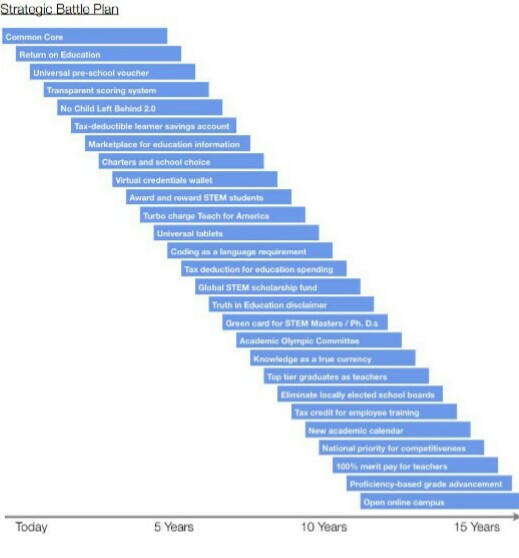













 COMMON CORE